
Type & Discipline
The dark night of the soul is a construct, not a school of psychotherapy or a clinical modality LLM. Its native discipline is Christian mystical theology and pastoral care: it originates in the sixteenth-century poem and treatise of the Spanish Carmelite mystic John of the Cross, where it names a period of spiritual desolation and the felt absence of God experienced as a purgative, transformative passage of faith 4. The term has migrated far beyond its theological home into ordinary speech, where it loosely denotes any stretch of despair, but its disciplined meaning is narrower and more specific: a darkness that is understood within the contemplative tradition as purposeful, formative, and oriented toward deeper union with God rather than as a breakdown to be reversed 5.
For the clinician, the load-bearing value of this construct is not as a treatment but as an interpretive and differential lens LLM. The psychiatrist Gerald May brought the concept into explicit dialogue with psychiatry, arguing that some experiences of spiritual darkness are distinct from clinical depression and should not be reflexively pathologized 1. This places the dark night in the same territory as other spiritually integrated frameworks: it is a way of understanding a client’s suffering that a clinician may hold alongside, not instead of, standard assessment LLM. Used well, it sharpens differential thinking and meaning-making; used carelessly, it can become a rationale for under-treating a treatable disorder, which is why its disciplinary origins and limits matter LLM.
Creators & Lineage
The construct’s originator is John of the Cross (San Juan de la Cruz, 1542–1591), a Carmelite friar, mystic, and poet whose poem Noche Oscura and its accompanying prose commentaries gave the dark night its foundational articulation 4. He wrote not as a clinician describing pathology but as a spiritual director mapping the stages by which the soul is stripped of its attachments and consolations on the way to union with God 4. In his framing the darkness is the work of grace, not its absence — a counterintuitive premise that remains central to every later use of the term 5.
John of the Cross is inseparable from Teresa of Ávila, the companion mystic and reformer of the Carmelite order with whom his work is consistently read 1. May analyzes the two together, treating their writings as a single contemplative stream on the transformation of the self through love and loss 1. The broader lineage is the Christian contemplative and apophatic tradition — the “way of unknowing” — within which desolation is understood as a normal, even necessary, phase of spiritual maturation rather than a sign that something has gone wrong 5.
The pivotal modern figure for clinicians is Gerald G. May, MD (1940–2005), a psychiatrist associated with the Shalem Institute for Spiritual Formation 1. In his book The Dark Night of the Soul: A Psychiatrist Explores the Connection Between Darkness and Spiritual Growth, May reads John of the Cross and Teresa of Ávila through a contemporary clinical and psychological lens, and it is his work that most directly frames the dark-night-versus-depression distinction that a practicing therapist is most likely to encounter 1. A parallel academic bridge comes from Durà-Vilà and Dein, whose paper on the dark night examines the construct’s spiritual-distress dimension and its psychiatric implications, including the differential from depression 2. A wider depth-psychological reading also exists, linking John of the Cross’s map to therapeutic ideas of transformation through descent, which is how the construct most often enters secular therapy rooms 4.
Core Principles
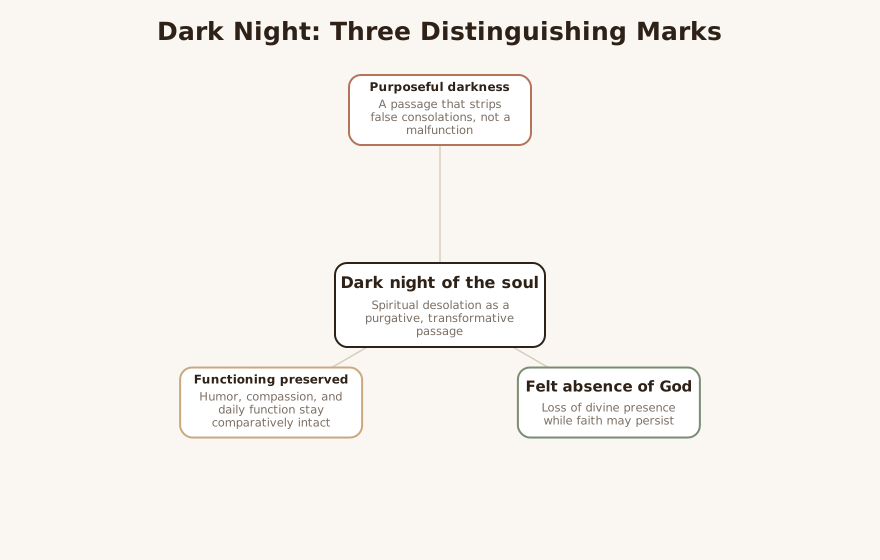
The first principle is that the darkness is purposeful. Within the tradition, the dark night is not a malfunction to be corrected but a purgative passage that strips away false consolations and reorders the soul toward God 5. This teleology — suffering as transformation rather than mere affliction — is the conceptual heart of the construct and the feature that distinguishes it from a symptom 4.
The second principle is the felt absence of God. The defining experience is a loss of the sense of divine presence and of the emotional rewards of prayer that the person previously relied upon, even as faith itself may persist underneath the dryness 4. The desolation is specifically spiritual in content: it concerns one’s relationship to the sacred and to ultimate meaning, not merely mood 2.
The third principle, and the one most clinically consequential, is relative preservation of functioning. A recurring observation in the clinical-pastoral literature is that in a genuine dark night the person’s humor, compassion, capacity for relationship, and basic daily functioning tend to remain comparatively intact, even amid real anguish — a pattern that contrasts with the pervasive impairment, anhedonia, and self-negation characteristic of major depression 1. This is not a clean dividing line but a clinically useful gradient LLM. The fourth principle is meaning: the person in a dark night, however distressed, can often locate the experience within a larger spiritual narrative of growth, whereas the depressed person more typically experiences their state as empty, futile, and devoid of meaning 3. For the clinician, the synthesis is that the dark night is defined less by the intensity of suffering than by its texture, its spiritual content, and its relationship to functioning and meaning LLM.
Interventions & Techniques
The dark night supplies no protocol of its own; what it offers the clinician is a set of interpretive and assessment moves rather than a manualized technique LLM. The first and most important is differential framing: holding the dark night as one hypothesis alongside major depression and other mood and adjustment conditions, and assessing across both, rather than forcing the client’s experience into a single category 3. The clinician gathers the standard depression history — onset, neurovegetative signs, anhedonia, hopelessness, suicidality — while also asking about the spiritual texture of the experience, the presence or absence of meaning, and whether humor, warmth, and functioning persist 1.
A second move is careful, non-pathologizing language. Naming a client’s experience as a possible dark night can normalize it within their own worldview and relieve the secondary shame of believing that their loss of felt faith means they have failed spiritually 5. This reframing is drawn directly from the tradition’s insistence that dryness in prayer is an expected phase, not a verdict 5. A third move is meaning-oriented exploration, in which the clinician helps the client sit with the desolation and articulate what, if anything, is being asked of them — work that aligns the construct with depth-psychological and existential approaches to transformation through descent 4.
LLM-generated illustrative example (not a guideline): A long-time contemplative tells her therapist that prayer has gone “dead,” that she feels nothing where she used to feel God, and that she fears she has lost her faith. On assessment she sleeps and eats normally, still laughs with her grandchildren, volunteers weekly, and reports no suicidality — but she is ashamed and frightened by the spiritual silence. Within spiritually integrated psychotherapy, the clinician names the experience as a possible dark night, normalizing the dryness as a recognized phase rather than a failure, while continuing to monitor for depression. The reframing relieves the secondary self-condemnation layered on top of the desolation LLM.
Crucially, these moves are conducted within an established psychotherapy and a standard risk and mood assessment, not as a replacement for them LLM. The construct tells the clinician how to think about and frame a certain kind of suffering; it does not tell them to withhold evidence-based care when a treatable disorder is present 1.
Evidence Base
Honesty about maturity is essential here. As a theological and contemplative construct, the dark night of the soul is well established and well documented, with a five-century lineage and a coherent modern clinical-pastoral interpretation through Gerald May’s work 1. As a clinical entity, however, it is not an empirically validated diagnostic category, and the differentiation from major depression — though clinically discussed and intuitively compelling — rests on conceptual analysis and case-based reasoning rather than randomized controlled trials 2.
What exists in the literature is a serious but limited evidence base LLM. May’s book is the foundational modern clinical text and supplies the central distinction, but it is a work of synthesis and clinical reflection rather than an empirical study 1. The Durà-Vilà and Dein paper provides an academic examination of the construct’s psychiatric implications and its differential from depression, functioning as a useful scholarly bridge between contemplative theology and clinical psychiatry 2. Accessible explainers reinforce the same contrast — notably the observation that functional impairment tends to distinguish depression from a dark night — but these are educational rather than research sources 3.
Several cautions follow LLM. The dark-night-versus-depression distinction is best treated as a clinically meaningful gradient, not a validated screening instrument, and it should never be used to rule out a mood disorder 1. There are no established cutoffs, no validated measures specific to the construct, and considerable overlap between the two presentations, so a person can be in a dark night and clinically depressed at the same time 2. The defensible stance is to regard the dark night as an established and clinically useful interpretive framework for spiritual distress, while keeping standard, evidence-based assessment and treatment of depression firmly in place LLM.
Populations & Indications
The construct is most clearly indicated for religious and Christian clients, and especially for contemplatives, clergy, and others with an active prayer life for whom a loss of felt divine presence is both intelligible and distressing 4. For these clients the framework is congruent with their worldview, and naming a dark night honors rather than overrides how they understand their own suffering 5. May’s reading of John of the Cross and Teresa of Ávila was written precisely for people formed in this tradition 1.
Beyond this core group, the construct is relevant to clients in spiritual or existential crisis whose central struggle concerns meaning, faith, or their relationship to the sacred 2. It is also pertinent to clients presenting with low mood of uncertain origin, where the differential question — is this depression, a spiritual desolation, or both — is exactly the clinical work 3. People navigating a faith crisis or the painful loss of religious certainty may find the dark night a more accurate and less shaming frame for an experience that secular categories can flatten LLM. The construct may also speak to clients in extended grief or in major life transitions who describe a comparable stripping-away of old securities, provided the clinician does not stretch a theological term past the point where it illuminates LLM.
Problems-for-Work
The construct speaks most directly to suffering with a spiritual or existential dimension, and to the differential question of how that suffering relates to a mood disorder LLM. For spiritual distress and the felt absence of God, the work uses the dark-night frame to normalize dryness as a recognized phase and to relieve the secondary shame of believing one has lost one’s faith, while the clinician helps the client stay with the desolation rather than flee it 5. For the depression-versus-desolation differential, the work is structured assessment across both domains — neurovegetative and risk signs on one side, spiritual content, meaning, and preserved functioning on the other — so that neither a treatable disorder is missed nor a meaningful spiritual passage is needlessly pathologized 1.
LLM-generated illustrative example (not a guideline): A client in an existential and meaning crisis after the collapse of a career he had treated as a vocation says he feels hollow and “spiritually bankrupt,” but denies anhedonia in other domains and still finds his children meaningful. The clinician uses the dark-night frame within an existential-meaning approach to explore what the loss is stripping away and what it might be opening, while continuing to track mood and risk. Holding the desolation as potentially formative, rather than purely as damage, gives the client a way to stay in the experience long enough to find its shape LLM.
For faith crisis and deconversion distress, the construct offers a vocabulary that takes the spiritual stakes seriously without prejudging the outcome 2. For depressive symptoms, the practical work is to ensure that a dark-night interpretation never displaces evidence-based treatment when the clinical picture warrants it 3. For spiritual bypass and misframed suffering — where a client uses spiritual language to avoid addressing a genuine disorder — the construct paradoxically helps, because its own tradition distinguishes the dark night from despair and does not treat all darkness as holy 5.
Contraindications, Cautions & Cultural Humility
The gravest caution is clinical, not theological: the dark night must never become a reason to under-treat depression or to overlook suicide risk 1. Because a genuine dark night can coexist with major depression, and because the two presentations overlap, a clinician who is captivated by the spiritual interpretation can miss a treatable, even life-threatening, disorder 2. Standard mood assessment and risk screening therefore take priority, and the dark-night frame is layered on top of, never in place of, that assessment LLM. If suicidality, severe neurovegetative symptoms, or marked functional collapse are present, the working assumption shifts toward depression and toward evidence-based care 1.
A second caution concerns fit and consent. The dark night is an explicitly Christian, theistic construct, and it should not be imposed on clients who do not share that framework or who would experience it as the clinician’s religion intruding into the therapy LLM. Even with religious clients, the client’s own understanding of their experience must lead; the clinician offers the frame tentatively and drops it if it does not resonate LLM. Cultural and spiritual humility also means recognizing that not every tradition reads desolation as purgative or formative, and that comparable experiences in other faiths or worldviews have their own native vocabularies that should not be overwritten by a Carmelite one LLM. Finally, the clinician must respect scope: framing a client’s suffering as a possible dark night is a clinical and pastoral conversation within therapy, not an act of spiritual direction or theological authority that the therapist does not hold 5.
Treatment-Plan Suggestions & SMART Objectives
| Goal | SMART objective (example) | Mechanism |
|---|---|---|
| Clarify the depression-versus-desolation differential | Within 2 sessions, complete a structured assessment covering neurovegetative and risk signs alongside spiritual content, meaning, and functioning, and document the working formulation | Differential framing across both domains 1 |
| Reduce secondary shame about “lost” faith | Within 4 sessions, client will articulate that dryness in prayer is a recognized phase rather than spiritual failure, and rate the shift in self-condemnation | Non-pathologizing reframing from the tradition 5 |
| Stay with spiritual desolation rather than flee it | Over 8 weeks, client will keep a brief weekly reflection on the felt absence and its possible meaning, and discuss it in session | Meaning-oriented exploration of the darkness 4 |
| Maintain safety while honoring spiritual meaning | At every session, screen mood and suicide risk and escalate to evidence-based care if indicators worsen, regardless of spiritual framing | Risk monitoring layered over interpretation 1 |
| Distinguish formative darkness from spiritual bypass | Within 6 sessions, client will identify whether spiritual language is helping them face or avoid a concrete problem, and name the avoided concern | Tradition’s distinction between dark night and despair 5 |
| Locate the experience in a coherent narrative | Over 10 sessions, client will draft a short account of what the passage is stripping away and what it may be opening | Transformation-through-descent meaning-making 4 |
| Integrate spiritual distress with standard care | Across treatment, client will pursue evidence-based depression treatment where warranted while using the dark-night frame for meaning, tracking both | Spiritual framework alongside clinical treatment 2 |
Common Misconceptions
The most consequential misconception is that any prolonged despair is a “dark night of the soul”; in its disciplined meaning the term denotes a specifically spiritual desolation understood within the contemplative tradition as purgative and formative, not a generic synonym for misery 5. A second misconception is that a dark night and clinical depression are mutually exclusive; in fact they can coexist, and the construct is a gradient for thinking, not a screen that rules a mood disorder in or out 2. A third, common among devout clients, is that losing the felt sense of God’s presence means one has lost faith or failed spiritually; the tradition holds the opposite, treating dryness as an expected phase of deepening rather than a verdict 4. A fourth is that the dark night is something to be cured or escaped as quickly as possible; in John of the Cross’s framing the darkness does its work precisely by being endured and traversed, not bypassed 5. A fifth, relevant for clinicians, is treating the dark-night-versus-depression distinction as a validated diagnostic test; it is a conceptual and case-based distinction, useful but not empirically standardized, and it never substitutes for proper assessment 1.
Training & Certification
There is no clinical license or psychotherapy certification in the dark night of the soul; it is a theological construct and an interpretive lens, not a credentialed intervention LLM. The foundational text for clinicians is Gerald May’s The Dark Night of the Soul, which supplies the modern clinical-contemplative reading and the differential framing most useful in practice 1. The Durà-Vilà and Dein paper offers a scholarly examination of the construct’s psychiatric implications and is a reasonable next step for clinicians who want the academic treatment 2. Primary engagement with John of the Cross and Teresa of Ávila grounds the clinician in the source tradition and guards against using the term loosely 4.
For practicing therapists, the relevant competence is twofold LLM. First is genuine familiarity with the construct’s contemplative origins, so that it is used accurately and not flattened into a vague metaphor for sadness 5. Second, and more important clinically, is solid training in the differential assessment of mood disorders together with competence in spiritually integrated psychotherapy and the ethics of working with clients’ religious lives — so that the clinician can hold a spiritual interpretation without ever compromising standard, evidence-based care 1. A therapist who engages this construct seriously should also cultivate the humility to recognize where their role ends, since framing suffering theologically is a clinical-pastoral conversation, not the spiritual authority of a director 5.
Key Terms
Dark night of the soul — John of the Cross’s term for a period of spiritual desolation and the felt absence of God, understood within the contemplative tradition as a purgative, transformative passage of faith 4. Purgation — the tradition’s understanding of the darkness as a stripping-away of false attachments and consolations that reorders the soul toward God 5. Felt absence of God — the defining experience of losing the sense of divine presence and the emotional rewards of prayer, even as underlying faith may persist 4. Differential framing — the clinical move of holding the dark night as one hypothesis alongside major depression and assessing across both domains 3. Preserved functioning — the clinically observed tendency for humor, compassion, and basic functioning to remain comparatively intact in a dark night, in contrast to the pervasive impairment of depression 1. Spiritual distress — suffering whose content concerns one’s relationship to the sacred and to ultimate meaning, the domain in which the construct operates 2. Apophatic tradition — the contemplative “way of unknowing” within which the dark night is read as a normal phase of spiritual maturation 5.
Resources & Further Reading
▶ Watch — a video introduction to this concept:
- The Dark Night of the Soul: A Psychiatrist Explores the Connection Between Darkness and Spiritual Growth — Gerald G. May
- The Dark Night of the Soul: Spiritual Distress and its Psychiatric Implications (Durà-Vilà & Dein)
- Is It Depression or a Dark Night of the Soul? (Psych Central)
- The Dark Night as Therapeutic Journey: St. John of the Cross and Depth Psychology
- The Dark Night of the Soul by Gerald G. May — review (Spirituality & Practice)
Reflective / Supervision Questions
- Have I completed a full mood and suicide-risk assessment before allowing a dark-night interpretation to shape my formulation, so that I am not under-treating a treatable disorder LLM?
- Am I holding the dark night and depression as a gradient that can coexist, rather than as mutually exclusive categories LLM?
- Is this framework already meaningful to my client, or am I introducing a Christian, theistic construct from my own worldview into a therapy where it does not belong LLM?
- Am I representing the dark night accurately — as a purgative, formative passage in its tradition — rather than as a loose synonym for any despair LLM?
- When my client fears they have “lost their faith,” am I helping them see dryness as a recognized phase rather than reinforcing a sense of spiritual failure 5?
- Where might a client be using spiritual language to avoid a concrete clinical problem, and am I able to name that without dismissing the genuine spiritual dimension of their suffering LLM?
- Am I honest with my client and myself that the dark-night-versus-depression distinction is conceptual and case-based, not a validated diagnostic test LLM?