
Type & Discipline
Spiritual assessment tools are structured clinical techniques, not a school of psychotherapy or a standalone treatment LLM. A spiritual assessment evaluates a patient’s spiritual beliefs, needs, and hopes within the clinical context so that care can address the whole person and account for how spirituality shapes health-care decisions 5. Their native disciplines are medicine, chaplaincy, and counseling, and they were designed to make spirituality a routine, askable part of a clinical history rather than a topic left to chance 3. For a therapist, the load-bearing point is that these are eliciting and screening frameworks: they open and organize a conversation, they do not by themselves resolve anything LLM.
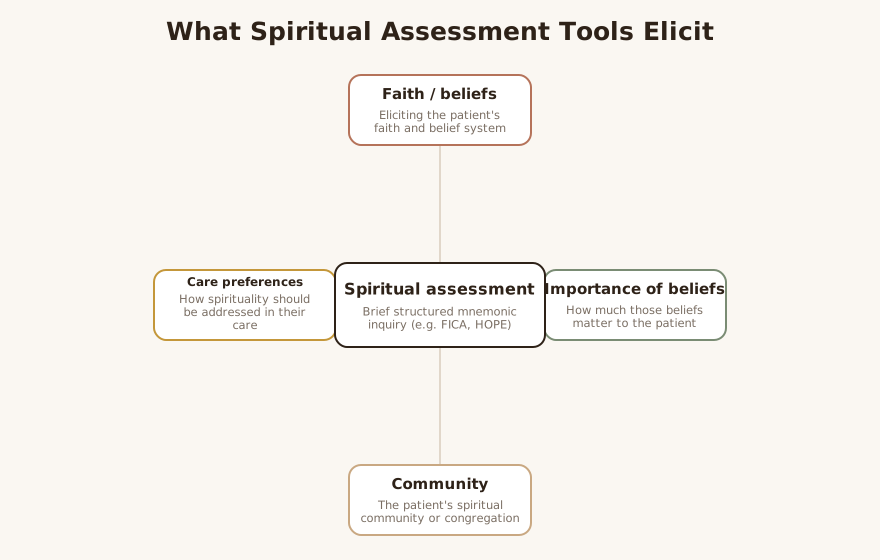
Structurally, the best-known instruments are brief mnemonic frameworks — FICA, HOPE, and the Open Invite prompt among them — that a clinician can carry in working memory and weave into an intake much as one would take a social history 3. Each maps the same broad territory: whether the person holds a faith or meaning system, how important it is to them, whether they belong to a supporting community, and what, if anything, they want the clinician to do about it in their care 4. Because the tools are short and semi-structured rather than scored questionnaires, they are better understood as conversation scaffolds than as psychometric scales, a distinction that matters when judging their evidence LLM.
Creators & Lineage
The figure most associated with modern spiritual assessment is Christina Puchalski, a physician who developed the FICA Spiritual History Tool in 1996 and argued that taking a spiritual history allows clinicians to understand patients more fully 4. Puchalski’s case, advanced with Romer, was that spirituality is a clinically relevant dimension of how people cope with illness, find meaning, and make decisions, and that eliciting it should be a normal part of patient care rather than an optional extra 1. FICA has since become the reference point for the field and is the instrument against which others are often compared 5.
The other widely adopted framework, HOPE, was developed by the family physician Gowri Anandarajah in the 1990s and first published in American Family Physician in 2001 6. HOPE was intended in part to lower the threshold for clinicians uncomfortable with religious language by opening on sources of hope, meaning, and connection before moving to organized religion and personal practice 6. Both tools sit within a broader movement, sometimes called the biopsychosocial-spiritual model, that sought to add an explicit spiritual axis to the biopsychosocial frame and to integrate spirituality into ordinary clinical workflow LLM.
The lineage matters for therapists because these instruments were born in medicine and chaplaincy, particularly palliative and hospice care, where existential and spiritual concerns are unavoidable 5. They share intellectual kinship with pastoral counseling and with spiritually integrated psychotherapy, which take the further step of working with spiritual material therapeutically rather than only documenting it LLM. A clinician using a FICA or HOPE history is borrowing a screening technique from medicine and chaplaincy and folding it into a psychotherapeutic frame LLM.
Core Principles
The first principle is that spirituality is a legitimate and clinically relevant domain of assessment, on a par with a social history, because beliefs and meaning systems shape coping, decision-making, and the experience of illness 1. Eliciting this information is framed as part of comprehensive, whole-person care, not as an intrusion into private life 5. The aim is understanding the patient more fully, so that care can be aligned with what matters to them 1.
The second principle is patient-led, non-coercive inquiry. The clinician’s job is to open a door and follow the patient’s lead, never to impose, evaluate, or correct the patient’s beliefs 5. Willingness to discuss spirituality varies widely by context — far higher among seriously or terminally ill patients than in routine visits — and a meaningful minority never want the conversation at all, so refusal must be respected 5. The tools are explicitly not vehicles for the clinician’s own faith 3.
The third principle is structured brevity. Each tool is a short mnemonic that gives the clinician a reliable map without turning the encounter into an interrogation, so the conversation feels like a history rather than a checklist 3. The fourth principle is that assessment is meant to lead somewhere: the final domain of FICA — Address or Action in care — and the Effects domain of HOPE both push the clinician to decide what, if anything, the elicited information changes, whether that is a referral to chaplaincy, accommodation of a practice, or simply documentation for the team 4. Assessment that goes nowhere defeats the tool’s purpose LLM.
Interventions & Techniques
FICA is the most established framework and assesses four domains 4. Faith, belief, or meaning asks whether the patient identifies with any belief system or source of meaning at all 4. Importance and influence explores how central that is in their life and how it bears on health-care decisions 4. Community asks whether they belong to a religious or spiritual community and rely on it for support 4. Address or Action in care asks how the clinician should incorporate what they have learned into the plan of care 4.
HOPE covers parallel ground with a softer entry point 6. H elicits sources of hope, meaning, comfort, strength, peace, love, and connection 6. O asks about organized religion and its role for the person 6. P explores personal spirituality and practices apart from organized religion 6. E examines the effects on medical care and end-of-life decisions 6. A lighter-weight prompt, the Open Invite mnemonic, simply reminds the clinician to open the door to a spiritual conversation and then invite the patient to discuss spiritual needs, useful when a full history is not warranted 3.
LLM-generated illustrative example (not a guideline): A therapist meeting a newly diagnosed oncology client opens with the Hope domain — “When things are hard, where do you find strength or comfort?” — rather than a question about religion. The client, who is not religious, describes drawing strength from her garden and her sister, and the clinician records this as a meaning resource to mobilize in later sessions, never raising organized religion at all LLM.
In practice the technique is to integrate one of these histories into intake or an early session, follow the patient’s answers conversationally rather than reading items verbatim, and treat the closing domain as a decision point LLM. A clinician should paraphrase to match the client’s language, dropping “God” or “religion” for a secular client and keeping it for a religiously identified one LLM. Importantly, taking the spiritual history is often itself a relational intervention: the act of asking signals that the clinician is prepared to walk alongside the patient and can strengthen the alliance even before any content is acted upon 4.
Evidence Base
The honest framing is that these are well-established, widely adopted assessment instruments — not outcome-proven treatments LLM. Of roughly two dozen spiritual assessment instruments reviewed in the primary-care literature, FICA was the one that had been formally validated, which is why it functions as the field’s reference tool 5. That validation, however, should be read precisely: the key study was a pilot in 76 patients with solid tumors at a comprehensive cancer center, testing feasibility rather than clinical outcomes 2. It found that most patients rated faith or belief as very important (mean 8.4 on a 0–10 scale) and that FICA’s qualitative and quantitative ratings correlated closely with the spirituality items of a validated quality-of-life measure, supporting the tool’s feasibility and content validity 2.
HOPE has a broader but similarly assessment-focused evidence base 6. A 2024 scoping review spanning more than two decades identified 1,047 sources, of which 571 explicitly cited HOPE across 51 countries and 21 languages, and concluded that the model had demonstrated acceptability, feasibility, and content validity, with particular strength in acceptability across secular, religious, and multicultural populations 6. Among the formal studies, a subset validated HOPE as a clinical, educational, and research tool 6.
What this evidence establishes — and what it does not — should be stated plainly LLM. It establishes that FICA and HOPE are feasible, acceptable, and face- and content-valid ways to elicit spiritual information in real settings, including with diverse populations 6. It does not establish that performing a spiritual assessment improves symptoms, quality of life, or any health outcome; the studies are about the instruments’ usability and validity, not about downstream clinical benefit LLM. “Established,” here, means a mature, validated assessment method in routine use, not an evidence-based intervention for any disorder, and a clinician should present it that way LLM.
Populations & Indications
Spiritual assessment is most welcomed, and most clearly indicated, when illness raises existential stakes 5. Palliative and hospice patients and the seriously or terminally ill are the paradigm population; willingness to discuss spirituality rises from roughly a third of patients in routine visits to a majority among dying patients 5. People with chronic illness and those recently diagnosed with a serious condition are likewise strong candidates, as are older adults and medical inpatients, for whom these histories were largely designed 5.
Beyond medicine, the tools are indicated for religiously or spiritually identified clients, for whom spirituality is a central coping resource that a clinician should understand to provide congruent care 1. HOPE’s evidence of acceptability across secular and multicultural groups means it is also appropriate for clients who do not identify as religious but who hold meaning systems worth eliciting 6. Bereaved individuals are another apt population, since grief commonly raises questions of meaning, continuity, and the sacred that a structured history can surface LLM. In each case the indication is the same: a person whose beliefs, meaning, or community plausibly bear on their distress or their care decisions LLM.
Problems-for-Work
These tools speak most directly to suffering with a spiritual or existential dimension LLM. For spiritual distress and the formal religious or spiritual problem (V62.89), a FICA or HOPE history is the natural first step, surfacing whether a person’s relationship with their faith or meaning system has become a source of pain, and then locating the resources or ruptures to work with 5. For existential distress and demoralization, the Hope domain’s focus on sources of strength and connection helps map what still holds meaning for a person who feels their world has emptied out 6.
LLM-generated illustrative example (not a guideline): A hospice client expresses that he is “being punished” and has stopped praying. A FICA history reveals deep prior faith now ruptured by anger at God; the clinician documents this as spiritual distress, names it without correcting his theology, and — using FICA’s Address domain — coordinates a chaplaincy referral while continuing the meaning-focused work in therapy LLM.
For grief, bereavement, and end-of-life distress, the history opens a structured space to explore continuing bonds, ritual, and the sacred without the clinician having to improvise the entry LLM. For moral injury, the Importance and Community domains can reveal whether a violated moral or spiritual framework, and an estranged community, are driving the person’s shame and isolation LLM. For adjustment disorder, coping with serious illness, and meaning-making difficulties, the assessment identifies the belief and community resources a person can mobilize as they adapt 1. In every case the tool’s job is to find the material; the therapeutic work happens within an established psychotherapy LLM.
Contraindications, Cautions & Cultural Humility
The first caution is consent and fit: a meaningful minority of patients do not want spirituality discussed, and refusal must be honored without pressure 5. The clinician opens the door and lets the patient decide whether to walk through it 3. The second, and most serious, caution is against imposing the clinician’s own beliefs: providers must avoid evangelizing, must not attempt to convert patients to their own faith tradition, and should recognize that prayer or any practice is the patient’s choice and never a clinical goal the clinician sets 3.
Cultural humility runs throughout LLM. Clinicians should avoid assumptions about whether a patient adheres to the practices of their stated tradition, since identification and observance often diverge, and should let the patient define what their spirituality means rather than mapping it onto the clinician’s own categories 3. The non-judgmental, patient-led stance is not optional politeness but a condition of the tool working at all 5. A further caution is scope: these are assessment frameworks, and surfacing acute spiritual distress, crisis of faith, or material tied to trauma may exceed what a brief history can hold, warranting chaplaincy referral or focused therapeutic work rather than a checked box LLM. Finally, the tools are not a substitute for treating a diagnosable disorder, and a clinician should not let a completed spiritual history stand in for indicated, evidence-based care LLM.
Treatment-Plan Suggestions & SMART Objectives
| Goal | SMART objective (example) | Mechanism |
|---|---|---|
| Establish a baseline spiritual history | Within the first 2 sessions, complete a FICA history and document faith, importance, community, and care preferences | Structured four-domain elicitation 4 |
| Identify and name spiritual distress | Within 3 sessions, client will articulate the specific belief or relationship that has become a source of pain, recorded from the history | Surfacing distress via structured inquiry 5 |
| Map meaning resources for a secular client | Within 2 sessions, use the HOPE “H” domain to list 3 non-religious sources of strength the client can draw on | Hope/meaning-focused entry point 6 |
| Mobilize community support | Over 4 weeks, client will identify one spiritual or meaning-based community and take one step to re-engage it | FICA Community domain 4 |
| Align care with the client’s preferences | By session 4, clinician will document and act on the client’s stated care preferences, including any chaplaincy referral | FICA Address/Action domain 4 |
| Strengthen the therapeutic alliance | Within 2 sessions, client will report feeling that their beliefs were heard and respected, rated on a brief check-in | Asking as relational intervention 4 |
| Explore meaning in serious illness | Over 6 weeks, client coping with diagnosis will keep a weekly note on what gives life meaning and review it in session | Meaning-making elicitation 1 |
| Respect non-engagement | At intake, clinician will offer and, if declined, document the client’s choice not to discuss spirituality without re-raising it | Consent and refusal honored 5 |
Common Misconceptions
The first misconception is that a spiritual assessment is only for religious patients; the frameworks, and HOPE especially, are built to elicit meaning, hope, and connection from secular and multicultural clients as readily as from religious ones 6. A second is that these tools are validated treatments; they are assessment instruments with evidence of feasibility, acceptability, and validity, not interventions shown to improve outcomes 2. A third is that taking a spiritual history means endorsing, recommending, or sharing a belief — it means the opposite, a non-judgmental, patient-led inquiry in which the clinician’s own faith stays out 3. A fourth is that the assessment is a scored scale; FICA, HOPE, and Open Invite are mnemonic conversation scaffolds, not psychometric questionnaires, which is precisely why they are quick to use 3. A fifth, common among clinicians new to the practice, is that asking will offend; in fact most seriously ill patients welcome the conversation, and the act of asking can itself strengthen the relationship 5. A sixth is that the assessment ends with elicitation; both FICA and HOPE require the clinician to decide what the information changes in the plan of care 4.
Training & Certification
There is no license or formal credential in “spiritual assessment”; FICA and HOPE are teachable clinical techniques rather than certifications LLM. The recognized home for FICA training is the George Washington Institute for Spirituality and Health (GWish), founded by Christina Puchalski, which disseminates the clinical FICA tool and educates clinicians in its use 4. HOPE is taught primarily through the medical-education literature in which it was published and through the many curricula that have since adopted it across primary care, palliative care, and chaplaincy training 6.
For practicing therapists, the relevant competence is twofold LLM. The first is procedural familiarity with one or two frameworks — enough to take a fluent, conversational history without reading items aloud — which clinicians can build from the GWish materials and the medical literature 4. The second, and more important, is the broader competence of spiritually integrated psychotherapy and the ethics of working with clients’ religious and spiritual lives, so that the clinician knows how to act on what a history surfaces, when to refer to chaplaincy, and how to hold the non-imposing, patient-led stance the tools require 3. A therapist who can run a FICA history but cannot work with the distress it uncovers has only half the skill LLM.
Key Terms
Spiritual assessment — evaluation of a patient’s spiritual beliefs, needs, and hopes in the clinical context, to support whole-person care 5. FICA — Puchalski’s four-domain spiritual history tool: Faith/belief/meaning, Importance/influence, Community, and Address/Action in care 4. HOPE — Anandarajah’s framework: sources of Hope and meaning, Organized religion, Personal spirituality and practices, and Effects on care and end-of-life issues 6. Open Invite — a minimal prompt to Open the door to a spiritual conversation and Invite the patient to discuss spiritual needs 3. Spiritual distress — suffering arising from a disrupted or painful relationship with one’s faith, meaning, or the sacred, which assessment aims to identify 5. Address/Action domain — the closing step of FICA, where the clinician decides how to incorporate the spiritual history into care 4. Biopsychosocial-spiritual model — the framework that adds an explicit spiritual axis to biopsychosocial care LLM. Spiritually integrated psychotherapy — therapy that works with spiritual material therapeutically, the natural home for acting on a spiritual assessment LLM.
Resources & Further Reading
▶ Watch — a video introduction to this concept:
- Taking a Spiritual History Allows Clinicians to Understand Patients More Fully (Puchalski & Romer, 2000)
- Evaluation of the FICA Tool for Spiritual Assessment (Borneman, Ferrell & Puchalski, 2010)
- The Spiritual Assessment (American Family Physician, 2012)
- Clinical FICA Tool — GWish, GW School of Medicine
- Spiritual Assessment — StatPearls (NIH/NCBI Bookshelf)
- Evaluation of the HOPE spiritual assessment model: a scoping review (2024)
- The FICA Spiritual History Tool — Palliative Care Network of Wisconsin Fast Fact
Reflective / Supervision Questions
- Did I open the door to a spiritual history and let the client decide whether to walk through it, or did I assume their willingness either way 5?
- When I asked, did I keep my own beliefs out of the room, following the client’s language and meaning rather than mapping it onto my own categories 3?
- Have I treated this as the assessment it is, honest that the evidence supports its feasibility and validity but not that asking improves outcomes 2?
- Did I act on what the history surfaced — referral, accommodation, or therapeutic work — or did I let a completed FICA stand in for care 4?
- For a secular client, did I use a meaning-and-hope entry point rather than defaulting to questions about religion 6?
- When acute spiritual distress emerged, did I recognize when it exceeded a brief history and warranted chaplaincy or focused therapeutic work LLM?