
Type & Discipline
Centering Prayer is a contemplative technique rather than a school of psychotherapy or a standalone clinical modality LLM. Its native discipline is Christian contemplative practice: it is taught by its originating organization as “a receptive method of Christian silent prayer which deepens our relationship with God, the Indwelling Presence” 2. The method does not aim at relaxation, problem-solving, or insight in the therapeutic sense; its stated purpose is to cultivate consent to God’s presence and action within the practitioner, and any psychological benefit is understood as secondary to that relational and spiritual intention 2. For the clinician this distinction is essential: Centering Prayer is a spiritual discipline a client may already practice or wish to integrate, not a clinical treatment in its own right, and it is most responsibly engaged within spiritually integrated psychotherapy rather than prescribed as a clinical intervention LLM.
Structurally, Centering Prayer resembles other silent contemplative practices in that it is done seated, with eyes closed, for a recommended minimum of twenty minutes twice each day 2. What sets it apart is its theology of intention. The “sacred word” used in the practice is not a mantra to be repeated continuously and is not an object of concentration; it is a symbol of the practitioner’s consent, reintroduced only when the mind becomes engaged with thoughts 6. This places Centering Prayer in the apophatic, or “way of unknowing,” stream of Christian contemplation, in which the practitioner moves beyond images, concepts, and discursive reflection toward a wordless openness 4. Understanding this non-concentrative structure is what allows a clinician to discuss the practice accurately with a client rather than collapsing it into generic mindfulness LLM.
Creators & Lineage
Centering Prayer was developed in the 1970s by three Trappist (Cistercian) monks at St. Joseph’s Abbey in Spencer, Massachusetts: William Meninger, M. Basil Pennington, and Thomas Keating 4. Keating served as abbot of the community during the 1960s and 1970s and is the figure most associated with the method’s later articulation and dissemination 4. The two key figures for a clinician to know are Keating and Pennington: Pennington gave the practice one of its early step-by-step formulations, while Keating became its principal theologian and teacher 4.
The method did not arise in a vacuum. It was explicitly framed as an effort to “respond to the growing interest in Eastern meditation while remaining authentically Christian,” offering Western practitioners a contemplative discipline rooted in their own tradition 5. Its sources are drawn from across the Christian contemplative and mystical heritage: the anonymous fourteenth-century English text The Cloud of Unknowing, the Desert Fathers of early Christian monasticism, the Lectio Divina tradition of Benedictine monasticism, and the writings of Carmelite mystics such as Teresa of Avila and John of the Cross 4. The practice’s very name was inspired by Thomas Merton’s description of prayer “centered entirely on the presence of God” 4. In this sense Centering Prayer is best understood not as a new invention but as a modern, teachable repackaging of an old apophatic stream of Christian prayer LLM.
Keating’s influence extended well beyond the method itself. After his abbacy he devoted himself to teaching Centering Prayer full time and founded Contemplative Outreach, the organization that codified the guidelines and grew to encompass thousands of practice groups worldwide 5. His book Open Mind, Open Heart presented the contemplative dimension of Christian spirituality to a modern audience and remains a common entry point 5. Keating also developed an explicitly psychological theology around the practice, framing regular contemplative prayer as a “divine therapy” that, through openness to God beyond thoughts and emotions, initiates a healing of the unconscious 5.
Core Principles
The first principle is consent rather than concentration 2. The practitioner is not trying to empty the mind, achieve a particular state, or focus attention on the sacred word; the word functions only as “the symbol of your intention to consent to God’s presence and action within,” reaffirming an underlying intention rather than producing an experience 6. This is the conceptual heart of the practice and the place where it most diverges from techniques that train sustained, single-pointed attention LLM.
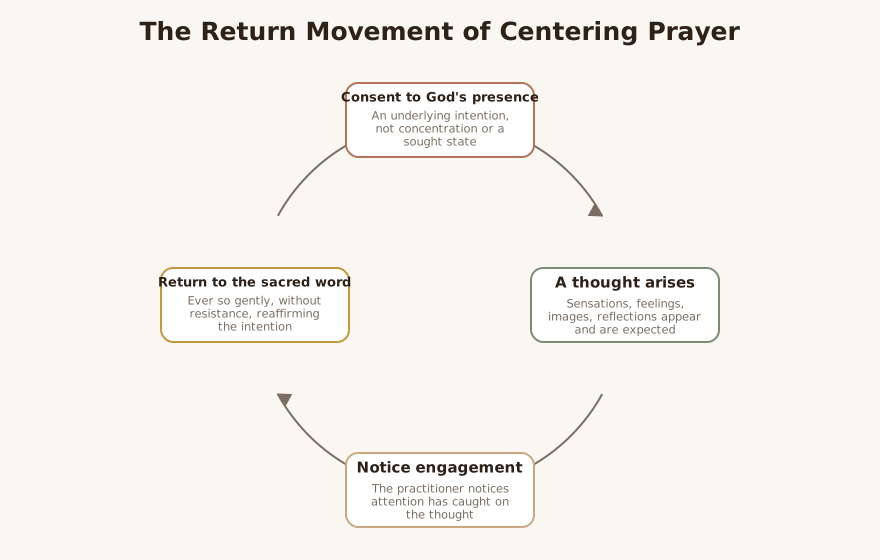
The second principle concerns how thoughts are handled. Centering Prayer treats thoughts — including, in the practice’s own definition, “body sensations, feelings, images, and reflections” — as an expected and unproblematic part of the prayer 6. When the practitioner notices engagement with a thought, the instruction is to “return ever-so-gently to the sacred word,” without resistance, judgment, or effort to suppress what arose 6. The aim is not a thought-free mind but a non-grasping relationship to whatever appears, which is why the symbols “do not establish you in interior silence; they simply reaffirm your original intention” 6.
The third principle is receptivity. The originating tradition describes the method as a “receptive” form of prayer that deepens relationship with what it names the Indwelling Presence 2. The posture is one of letting be and letting go rather than doing or attaining 2. The fourth principle, drawn from Keating’s psychology, is that this receptive consent has a transformative dimension: sustained practice is understood to open the whole person to a process that heals the unconscious, what Keating called the divine therapy 5. For the clinician, the load-bearing point is that the practice’s logic is relational and theological, not performance-based, and a client who approaches it as a technique to be mastered has misunderstood it LLM.
Interventions & Techniques
The core “technique” is a single, simple, repeatable protocol expressed in four guidelines 2. First, the practitioner chooses a sacred word as the symbol of the intention to consent to God’s presence and action within — a short word such as a name for God or a quality, selected once and kept 2. Second, sitting comfortably with eyes closed, they settle briefly and silently introduce the sacred word as the symbol of consent 2. Third, when they notice they have become engaged with their thoughts, they return ever-so-gently to the sacred word 2. Fourth, at the end of the prayer period they remain in silence with eyes closed for a couple of minutes before resuming activity 2.
The recommended dose is a minimum of twenty minutes twice each day, undertaken with the intention of deepening one’s relationship with God 2. The sacred word is reintroduced only as needed, not chanted or held continuously, and it is explicitly not the focus of concentration; its sole job is to reaffirm intention when the mind has wandered into engagement with thoughts 6. Because thoughts of every kind are anticipated and welcomed as ordinary, the practice involves no struggle against distraction; the only “action” is the gentle, repeated return 6.
LLM-generated illustrative example (not a guideline): A churchgoing client with chronic work stress already attends a weekly Centering Prayer group but says she “keeps failing because her mind won’t stop.” The clinician, working within a spiritually integrated frame, helps her see that the practice does not ask for a quiet mind: noticing she has drifted and returning gently to her sacred word is the practice succeeding, not failing. Reframing “wandering” as the ordinary substance of the prayer relieves the secondary self-criticism she had layered on top of her stress LLM.
For a clinician, the practical “intervention” is rarely to teach Centering Prayer cold, but to support a client who practices it: clarifying its non-concentrative logic, helping them hold realistic expectations, and exploring how the practice intersects with their presenting concerns within an established psychotherapy LLM. The technique itself maps cleanly onto the structure of other silent practices, which makes it familiar territory for clinicians trained in mindfulness, while its consent-based framing keeps it distinct LLM.
Evidence Base
Honest framing matters here. As a Christian spiritual practice, Centering Prayer is a well-established, widely taught discipline with a defined method, an institutional home in Contemplative Outreach, and decades of use across thousands of groups worldwide 5. As a clinical intervention, however, its dedicated empirical literature is thin and preliminary LLM. What exists is suggestive rather than definitive: studies indicate potential benefits, including help for women receiving chemotherapy and reductions in stress, alongside fostering “a more collaborative relationship with God” 4. These are encouraging signals, but they fall well short of the randomized controlled trial base that defines first-line psychotherapies LLM.
Several limitations should be stated plainly LLM. The available studies are few, often small, and frequently conducted in specific populations such as oncology patients, so they do not establish Centering Prayer as a validated treatment for any psychiatric disorder 4. The practice’s own aims are spiritual rather than symptom-focused, so symptom change is, by design, a secondary outcome 2. There is also conceptual overlap with the larger evidence base for mindfulness-based interventions, but that overlap cannot simply be borrowed: Centering Prayer’s consent-and-return structure differs from the attention-training emphasis of many secular programs, so generalizing from mindfulness trials would overstate what is known LLM. The defensible stance is to regard Centering Prayer as an established spiritual practice that may confer wellbeing benefits and can be meaningfully integrated into care for religious clients, while not presenting it as an evidence-based treatment for a specific condition LLM.
Populations & Indications
Centering Prayer is, first and most appropriately, indicated for clients for whom it is already meaningful or congruent: religious and Christian clients, and clergy and contemplatives whose lives are organized around prayer 2. For these clients, the practice’s explicitly theistic framing is a strength rather than a barrier, and integrating it respects rather than overrides their worldview LLM. Keating’s own development of the method as an authentically Christian alternative to Eastern meditation makes it a natural fit for clients who want a contemplative discipline without leaving their faith tradition 5.
Beyond this core group, the practice is plausibly relevant to people in spiritual or existential distress, where the central struggle concerns meaning, relationship with God, or one’s place in a larger order LLM. People with anxiety and those living with chronic stress may find the structured, twice-daily rhythm and the non-grasping stance toward thoughts steadying, consistent with the preliminary stress-reduction signal in the literature 4. People in grief and those with depressive symptoms may be served by a practice that offers a contained, regular space for silence and for relationship with the sacred, provided the practice is not asked to do the work of grief processing or disorder-specific treatment LLM. Clergy and contemplatives at risk of burnout are a particularly apt population, since the practice offers a sustainable form of spiritual self-care within their existing framework LLM.
Problems-for-Work
The construct speaks most directly to suffering that has a spiritual or existential dimension, and to distress amplified by a struggling relationship with one’s own mind LLM. For stress and anxiety, the work uses the practice’s non-resistant stance toward thoughts and its regular rhythm to reduce reactivity, and the clinician helps the client carry the “gentle return” attitude from the prayer period into stressful moments of the day 6. For rumination, the practice models a relationship in which thoughts are noticed and released rather than seized and elaborated, offering an experiential counterweight to the client’s habitual gripping of repetitive thought 6.
LLM-generated illustrative example (not a guideline): A client in spiritual distress after a faith crisis says she “can’t pray anymore” because words feel hollow. Within spiritually integrated psychotherapy, the clinician explores Centering Prayer precisely because it asks for no words and no feelings — only the silent intention to consent. The client experiments with sitting in silence with a single sacred word, and reports that a prayer requiring nothing of her but presence feels possible again when discursive prayer did not LLM.
For existential and spiritual distress and for spiritual struggle, the practice provides a relational container for sitting with the unresolved, which the clinician frames and processes within therapy rather than expecting the prayer to resolve LLM. For grief and depressive symptoms, a clinician may support an existing practice as one source of meaning and steadiness while keeping evidence-based treatment central LLM. For burnout in clergy and contemplatives, the work is sustaining a contemplative rhythm that replenishes rather than depletes, using the twice-daily structure as a protective routine 2.
Contraindications, Cautions & Cultural Humility
The most important caution is one of fit and consent: Centering Prayer is an explicitly Christian, theistic practice, and it should never be imposed on clients who do not share its framework or who would experience it as an intrusion of the clinician’s religion into the therapy LLM. Spiritually integrated work requires that the client’s beliefs lead, not the clinician’s LLM. Even with religious clients, the practice can carry real intra-faith controversy: a 1989 Vatican document raised concerns about modern prayer methods influenced by Eastern religions and the New Age movement, and some Christian critics argue that Centering Prayer is “devoid of content” compared with practices that engage the heart and mind with Sacred Scripture 4. A client may belong to a community that views the practice with suspicion, and the clinician must hold that tension with humility rather than dismissing it 4.
Clinically, silent contemplative practices are not uniformly safe for everyone LLM. Extended silent sitting can surface distressing material, and clients with trauma histories, dissociation, acute psychosis, severe depression, or active suicidality may be destabilized by long unstructured silence; for these clients, stabilization and evidence-based care take priority, and any contemplative practice should be introduced cautiously, if at all, with grounding and titration LLM. Keating’s own framing of the practice as a “divine therapy” that opens the unconscious is a signal that emotionally loaded material can arise, which argues for screening and pacing 5. The practice is also not a substitute for treatment of a diagnosable disorder LLM. Finally, cultural and theological humility means representing the practice accurately — including its contested status within Christianity — and never positioning oneself as a spiritual authority one does not hold 4.
Treatment-Plan Suggestions & SMART Objectives
| Goal | SMART objective (example) | Mechanism |
|---|---|---|
| Reduce stress reactivity through a regular contemplative rhythm | Over 6 weeks, client will practice Centering Prayer for 20 minutes twice daily on 5 of 7 days and rate daily stress before and after | Receptive silent prayer with non-resistant return 2 |
| Loosen rumination’s grip | Within 8 sessions, client will notice 4 instances weekly of an engaged thought during practice and return ever-so-gently to the sacred word without self-judgment | Noticing-and-releasing rather than seizing thoughts 6 |
| Reframe “failed” prayer to relieve secondary self-criticism | Within 4 sessions, client will articulate that returning to the sacred word is the practice succeeding, not failing, and log the shift in distress | Correcting the concentration misconception 6 |
| Sustain meaning and connection amid spiritual distress | Over 8 weeks, client will keep a brief weekly reflection on their sense of God’s presence during silent prayer and discuss it in session | Consent to the Indwelling Presence 2 |
| Support a protective routine against burnout | For 4 weeks, client (clergy/contemplative) will protect two daily 20-minute prayer periods and review their effect on depletion | Twice-daily contemplative self-care structure 2 |
| Integrate practice with grief without bypassing it | Within 10 sessions, client will use silent prayer as one source of steadiness while completing grief-focused work in session, tracking both | Contained space for the sacred alongside active treatment 4 |
| Build a non-grasping stance toward inner experience | Over 6 weeks, client will carry the “gentle return” attitude into 3 stressful daily moments weekly and record the outcome | Generalizing the consent-and-return stance 6 |
Common Misconceptions
The most consequential misconception is that the sacred word is a mantra or an object of concentration; in the method’s own teaching it is neither, serving only as a symbol of intention that is reintroduced when the mind becomes engaged with thoughts, not chanted continuously or focused upon 6. A second is that the goal is to empty the mind or achieve a thought-free state; the practice instead anticipates thoughts of every kind — sensations, feelings, images, reflections — as ordinary, asking only for a gentle return rather than their elimination 6. A third, common among new practitioners, is that “my mind keeps wandering” means the prayer is failing; in fact noticing and returning is the practice itself, and the symbols “do not establish you in interior silence; they simply reaffirm your original intention” 6. A fourth is conflating Centering Prayer with secular mindfulness; while structurally similar, it is an explicitly theistic practice of consent to God’s presence, not an attention-training exercise, and was developed precisely as a Christian alternative to Eastern meditation 5. A fifth, relevant for clinicians, is treating it as an evidence-based clinical treatment; its empirical literature is preliminary and its aims are spiritual rather than symptom-focused 4.
Training & Certification
There is no clinical license or psychotherapy certification in Centering Prayer; it is a spiritual practice, not a healthcare credential LLM. The recognized institutional home for training is Contemplative Outreach, the organization Thomas Keating founded, which codifies the guidelines, supports practice groups worldwide, and offers introductory workshops, retreats, and facilitator or commissioned-presenter pathways for those who wish to teach the practice within that tradition 5. Keating’s Open Mind, Open Heart is a standard text and a common starting point for understanding both the method and its underlying theology 5.
For practicing therapists, the relevant competence is twofold and distinct from learning to teach the prayer LLM. First is personal familiarity with the practice — ideally through Contemplative Outreach resources or a teacher — so that one can discuss it accurately and avoid the concentration and empty-mind misconceptions LLM. Second, and more important clinically, is training in spiritually integrated psychotherapy and in the ethics of working with clients’ religious lives, so that the clinician supports a client’s practice within their own framework rather than prescribing, evangelizing, or overstepping scope LLM. A therapist who wants to engage this practice seriously should ground themselves in its contested status within Christianity as well, so they represent it honestly rather than as a decontextualized wellness tool 4.
Key Terms
Centering Prayer — a receptive method of Christian silent prayer that deepens relationship with God, the Indwelling Presence, through consent to God’s presence and action within 2. Sacred word — a short word chosen as the symbol of one’s intention to consent, reintroduced gently when engaged with thoughts; not a mantra or object of concentration 6. Consent — the core stance of the practice, a willing openness to God’s presence and action rather than an effort to attain a state 2. Thoughts — in this practice, anything that arises during prayer, including body sensations, feelings, images, and reflections, all treated as ordinary 6. Gentle return — the only “action” in the method: noticing engagement with a thought and returning ever-so-gently to the sacred word without resistance 6. Apophatic prayer — the “way of unknowing,” a contemplative stream moving beyond images and concepts toward wordless openness, of which Centering Prayer is a modern expression 4. The Cloud of Unknowing — the fourteenth-century English text that is a primary historical source for the practice 4. Divine therapy — Keating’s term for the healing of the unconscious that he understood sustained contemplative prayer to initiate 5. Contemplative Outreach — the organization Keating founded that codifies and disseminates the method 5.
Resources & Further Reading
▶ Watch — a video introduction to this concept:
- Centering Prayer Method — Contemplative Outreach, Ltd.
- The Method of Centering Prayer — The Prayer of Consent (Thomas Keating, PDF)
- The Four Basic Guidelines — Contemplative Outreach of NYC
- Centering prayer — Wikipedia
- Thomas Keating and Centering Prayer: A Journey of Contemplation
- Centering Prayer — Center for Action and Contemplation
Reflective / Supervision Questions
- Is this practice already meaningful to my client, or am I introducing it from my own framework, and how do I keep the client’s beliefs leading the work LLM?
- Have I represented Centering Prayer accurately, including its non-concentrative logic and its contested status within Christianity, rather than collapsing it into generic mindfulness LLM?
- Am I screening for trauma, dissociation, psychosis, and acute risk before supporting extended silent practice that could surface destabilizing material LLM?
- Am I honest with my client and myself that the clinical evidence is preliminary, so that I support the practice without overselling it as a treatment for their disorder LLM?
- When my client says their “mind won’t stop,” am I helping them see the gentle return as the practice succeeding, rather than reinforcing a sense of failure LLM?
- Where do the spiritual aims of this practice and the clinical aims of the therapy diverge, and am I keeping disorder-specific, evidence-based care central where it is needed LLM?