
Kinesthetic empathy names something most clinicians have felt but few have language for: the moment when you register a client’s state not as an inference but as a sensation in your own body — a tightening in your chest as they describe a loss, a held breath that mirrors their stillness, a restlessness in your legs as their agitation rises. In dance/movement therapy (DMT) this is not background noise to be controlled but a primary instrument of assessment and intervention. LLM This article situates the construct for practicing therapists across modalities: what it is, where it comes from, what mechanism plausibly drives it, and how to use it deliberately and safely.
Type & Discipline
Kinesthetic empathy is best understood as a perceptual–relational construct rather than a manualized technique or a standalone therapy. LLM Its disciplinary home is dance/movement therapy and the broader field of embodied cognition, where it functions as the felt-sense substrate for the better-known clinical techniques of mirroring, attunement, and witnessing. 6 It also lives at the intersection of aesthetics, phenomenology, neuroscience, and performance studies, and a major interdisciplinary survey explicitly treats it as a phenomenon that crosses the boundary between the arts and the sciences. 4 For a clinician, the practical point is that kinesthetic empathy is the capacity — the trained perceptual ability — that techniques operationalize, not a discrete procedure you “do.” LLM
Creators & Lineage
The construct has a deep philosophical taproot. The German term Einfühlung — literally “feeling-into,” later translated into English as “empathy” — was developed across the second half of the nineteenth and early twentieth centuries, and Theodor Lipps is the figure most associated with formalizing it as a psychological concept. 5 Lipps theorized empathy as a process of inner imitation: when we perceive another’s expressive form or movement, we internally and involuntarily reproduce it, and that reproduction is the felt basis of understanding another’s experience. 5 This idea — that perception of another’s movement triggers a covert motor simulation in the observer — is the conceptual ancestor of contemporary kinesthetic empathy. LLM
The movement-analytic lineage runs through Rudolph Laban, whose vocabulary for describing the dynamic qualities of movement (its weight, flow, space, and time) gave DMT a systematic way to read and name what the body of the other is doing. LLM The somatic and aesthetic lineage continues through figures such as Sondra Fraleigh, whose phenomenological work on dance and lived experience deepened the field’s account of embodied perception, and Daria Halprin, who advanced expressive-arts and movement-based approaches that treat the body as a site of meaning-making. LLM In the contemporary literature, the edited volume by Dee Reynolds and Matthew Reason consolidated kinesthetic empathy as a research object across creative and cultural practices, defining it as the ability to experience empathy merely by observing the movements of another human being. 4
Core Principles
Several principles organize clinical use of the construct.
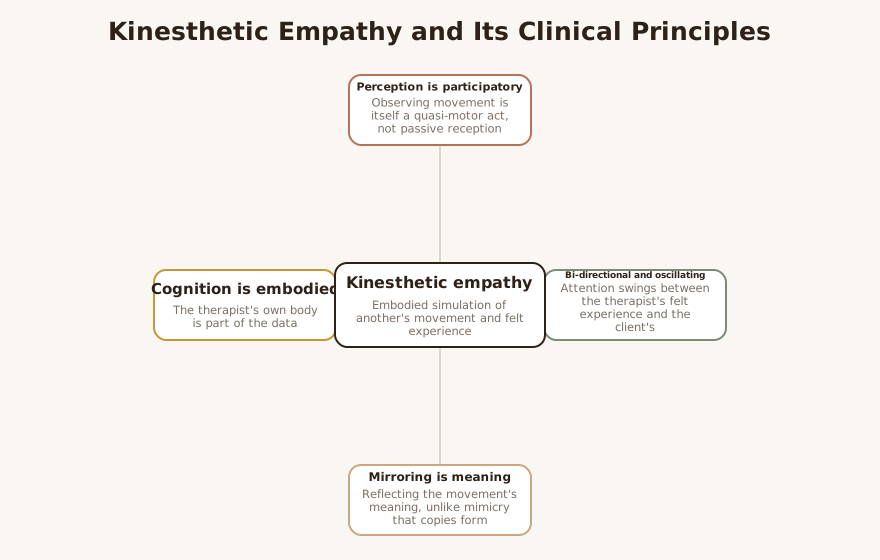
Perception is participatory. Watching another person move is not passive reception of information; the observer’s own sensorimotor system is engaged, such that observing movement is itself a quasi-motor act. 4 This is the throughline from Lipps’s inner imitation to modern embodied-cognition accounts. 5LLM
Empathy is bi-directional and oscillating. In session, kinesthetic empathy operates as an oscillating attention between internal and external stimuli — the therapist maintains contact with their own felt experience while attuning to the client’s, with resonance occurring between two minds and bodies simultaneously. 6 It is not a one-way scan of the client; the therapist’s body is part of the data. 6
Mirroring is meaning, not mimicry. A foundational distinction is that mirroring reflects back the meaning of a client’s movement through the therapist’s muscular activity and verbal narration, whereas mimicry merely copies form without meaning. 6 Clinically, this is the difference between attuned reflection and empty imitation. LLM
Cognition can be embodied and extended. Recent work frames kinesthetic empathic witnessing through embodied and extended cognition — the idea that the felt understanding of another’s movement is distributed across body, perception, and environment rather than locked inside the observer’s head. 2 In inclusive and adaptive settings, audiences and witnesses can resonate with movers whose bodies differ markedly from their own, which matters for clients with atypical motor presentations. 2
Movement carries metaphor. Movement is not only expressive but symbolic: how a client moves can function as a metaphor for how they relate, defend, reach, or withdraw, and DMP treats this movement metaphor as clinically interpretable material. 3
Interventions & Techniques
Kinesthetic empathy is enacted through a recognizable family of techniques. LLM
Mirroring. The therapist reflects a client’s movement qualities — tempo, weight, shape, effort — back to them, allowing the therapist to kinesthetically and visually experience the client’s embodied experience and to build a therapeutic movement relationship and pathway to kinesthetic awareness. 6 Done well, mirroring conveys “I am with you” at a pre-verbal level. LLM
Attunement. A subtler relative of mirroring, attunement matches the affective contour or vitality of the client’s movement without literal copying — for example, matching the intensity of a gesture in a different modality. LLM
Witnessing and Authentic Movement. In witnessing, the therapist gives empathetic attention to the client’s expressive movement without necessarily moving alongside them; in the Authentic Movement form specifically, the mover follows internal body impulses with eyes closed while a witness holds empathetic presence, which creates a context for building trust, rapport, and healthy therapeutic attachment. 6
Grounding and breath. Breathing serves as a foundational practice to ground individuals and build the embodied awareness that kinesthetic attunement depends on. 6
Safety, inquiry, and closure. Structured practices — establishing safety, inquiring into the felt experience for insight, and closing the movement exploration — scaffold the work so that embodied material is processed rather than left raw. 6
Movement metaphor work. The therapist names and explores the symbolic content of how the client moves, using the movement metaphor as a bridge to verbal insight. 3
LLM-generated illustrative example (not a guideline): A client describing a conflict at work begins, without noticing, to press both palms downward against their thighs while speaking faster. The therapist lets their own hands and breath register that downward, compressing quality, then gently reflects it back in their own posture and names it: “Something in you seems to be pushing down hard to hold this together.” The client pauses, exhales, and says, “I haven’t let go of anything in months.” LLM
Evidence Base
Honesty about maturity matters here. Kinesthetic empathy is an established construct — well-theorized, widely taught, and historically grounded from Lipps’s Einfühlung through contemporary embodied-cognition accounts. 54 Its mechanism is plausible and converges with embodied-simulation and extended-cognition frameworks. 2 LLM However, “established” describes the construct’s standing in theory and practice, not a body of high-powered randomized trials isolating kinesthetic empathy as an active ingredient; the supporting literature is heavily interdisciplinary, phenomenological, and practice-based rather than confirmatory-experimental. 14 Practice-based research has worked to embody and operationalize the construct through interdisciplinary methods, which is appropriate for a phenomenon defined by felt experience but means the evidence is qualitative and theory-rich rather than effect-size-driven. 1 The defensible clinical claim is that kinesthetic empathy names a real and trainable perceptual capacity central to DMT, not that it is an independently RCT-validated intervention. LLM
Populations & Indications
Kinesthetic empathy is broadly indicated wherever affect lives more in the body than in words. LLM It is particularly relevant for clients with limited verbal access to emotion — including alexithymic presentations — where movement-based attunement offers a route to material that talk alone does not reach. LLM It is well-suited to children and adolescents, for whom embodied and play-based engagement is developmentally apt. LLM In inclusive and adaptive dance contexts, witnesses can resonate empathically with movers whose bodies and motor patterns differ substantially from their own, which supports its application with clients who have atypical movement presentations, including autistic clients. 24 Trauma survivors, whose distress is often stored and expressed somatically, are another core population — with important cautions noted below. LLM
Problems-for-Work
- Affect dysregulation. The therapist uses mirroring and attunement to meet the client’s arousal at its current level and then gradually modulate tempo and effort, scaffolding co-regulation through movement. 6LLM
- Interpersonal disconnection / attachment rupture. Witnessing and Authentic Movement create a relational context that builds trust, rapport, and healthy therapeutic attachment for clients who experience closeness as unsafe. 6
- Difficulty verbalizing emotion (alexithymia). Movement-metaphor work surfaces and names felt states that the client cannot yet put into words. 3LLM
- Impaired interoceptive awareness. Grounding, breath, and structured inquiry build the embodied self-awareness that lets a client notice and report internal sensation. 6LLM
- Empathic failures in the alliance. The clinician’s own oscillating internal–external attention becomes a real-time check on attunement, catching ruptures the verbal channel misses. 6LLM
LLM-generated illustrative example (not a guideline): With an adolescent who shuts down whenever feelings are named directly, a therapist offers a slow, weighted gesture and invites the client to “do something back.” Over several exchanges, the pair builds a small wordless movement dialogue; only afterward does the client say the back-and-forth felt “like the first time anyone kept up with me.” The movement metaphor became the entry point to talking about loneliness. LLM
Contraindications, Cautions & Cultural Humility
Embodied resonance is powerful precisely because it bypasses verbal defenses, which is also its main risk. LLM With trauma, movement and somatic attention can precipitate flooding, dissociation, or re-traumatization if pacing and titration are neglected; the field’s emphasis on establishing safety and on inquiry-and-closure structures exists for this reason. 6LLM Therapists must distinguish their own kinesthetic resonance from countertransference and somatic over-identification — the oscillating internal–external attention is the safeguard, but it requires training and reflective supervision to use reliably. 6LLM
Cultural humility is essential because movement vocabulary, touch, gaze, proximity, and the meaning of specific gestures are culturally and individually variable; what reads as attuned mirroring to one client may read as mockery or intrusion to another. LLM Mirroring must remain meaning-bearing reflection rather than form-copying mimicry, and the therapist should hold interpretations of movement metaphor as hypotheses to be checked with the client, not decoded unilaterally. 63LLM Bodily difference also matters: inclusive-cognition accounts remind us that empathic resonance does not require sameness of body, but the therapist should not assume their felt experience maps cleanly onto a client whose embodiment differs from their own. 2LLM
Treatment-Plan Suggestions & SMART Objectives
| Goal | SMART objective (example) | Mechanism |
|---|---|---|
| Improve affect co-regulation | Within 8 sessions, client will tolerate and down-regulate elevated arousal in 3 of 5 movement sequences using therapist-paced mirroring. | Co-regulation via attuned mirroring of tempo/effort 6 |
| Build interoceptive awareness | Over 6 weeks, client will name one bodily sensation linked to an emotion in ≥4 of 6 sessions. | Grounding, breath, and structured inquiry 6 |
| Increase emotional vocabulary | Within 10 sessions, client will translate a movement metaphor into a verbal feeling-statement in ≥3 sessions. | Movement-metaphor surfacing and naming 3 |
| Strengthen therapeutic attachment | Over 12 weeks, client will initiate one movement exchange per session in ≥6 sessions. | Witnessing builds trust, rapport, attachment 6 |
| Reduce experiential avoidance | Within 8 sessions, client will remain present with a charged movement quality for 60 seconds without disengaging in ≥3 trials. | Titrated embodied exposure with closure 6 |
| Repair empathic ruptures faster | Across treatment, clinician–client will name and re-attune after a felt misattunement within the same session ≥80% of the time. | Oscillating internal–external attention 6 |
| Expand expressive range | Over 10 sessions, client will explore 2 novel movement qualities (e.g., light/sustained) per session in ≥5 sessions. | Laban-informed movement exploration LLM |
Common Misconceptions
“It’s just mimicry.” No — mirroring reflects meaning through the therapist’s muscular activity and narration, while mimicry copies form without meaning; conflating them produces hollow, even mocking, reflection. 6LLM
“It’s only for dancers or DMT specialists.” The capacity is a general perceptual-relational one rooted in ordinary perception of movement, and the underlying phenomenon appears across many disciplines and everyday social interaction. 4LLM Non-DMT clinicians already use it implicitly; the construct simply names and trains it. LLM
“You have to move to use it.” Witnessing demonstrates that empathetic kinesthetic attention can be given without moving alongside the client. 6
“It requires bodily similarity.” Inclusive-cognition research shows empathic resonance occurs across markedly different bodies. 2
“It’s mystical / non-cognitive.” It is increasingly framed within embodied and extended cognition — a perceptual process, not a paranormal one. 2LLM
Training & Certification
Reliable use of kinesthetic empathy is developed through dance/movement therapy training, which in the United States is anchored by graduate-level education and the credentialing pathway of the dance/movement therapy profession (the R-DMT and BC-DMT designations administered through the field’s professional body). LLM Core competencies include movement observation systems such as Laban Movement Analysis, supervised experiential practice in mirroring and Authentic Movement, and ongoing reflective supervision to discriminate attuned resonance from countertransference. 6LLM Clinicians from other disciplines can meaningfully cultivate the capacity through experiential workshops and embodiment-focused supervision, but should not represent themselves as dance/movement therapists without the corresponding credential. LLM
Key Terms
- Einfühlung — “feeling-into”; the aesthetic-psychological precursor concept, formalized in the Lipps tradition, later translated as “empathy.” 5
- Inner imitation — Lipps’s mechanism: covert reproduction of another’s perceived expressive movement as the basis of empathic understanding. 5
- Mirroring — meaning-bearing reflection of a client’s movement qualities through the therapist’s body and words. 6
- Attunement — matching the affective/vitality contour of movement without literal copying. LLM
- Witnessing — empathetic attention to a mover without moving alongside them. 6
- Authentic Movement — a form in which a mover follows inner impulses while a witness holds empathetic presence. 6
- Movement metaphor — the symbolic, interpretable meaning carried by how a client moves. 3
- Embodied / extended cognition — the framework treating felt understanding of movement as distributed across body, perception, and environment. 2
Resources & Further Reading
▶ Watch — a video introduction to this concept:
- Embodying kinaesthetic empathy through interdisciplinary practice-based research (The Arts in Psychotherapy)
- Kinesthetic empathic witnessing in relation to embodied and extended cognition in inclusive dance audiences (Cogent Arts & Humanities, 2023)
- Kinesthetic empathy and movement metaphor in dance movement psychotherapy
- Kinesthetic Empathy in Creative and Cultural Practices (Reynolds & Reason, eds., 2012)
- Theodor Lipps and the Concept of Empathy: 1851–1914 (American Journal of Psychiatry)
- When the Body Feels: Kinesthetic Empathy in Dance/Movement Therapy (Dance for Mental Health)
Reflective / Supervision Questions
- When I sense something in my own body during a session, how do I currently decide whether it is the client’s state resonating in me, my own countertransference, or both? LLM
- Can I recall a recent session where my reflection of a client tipped from meaning-bearing mirroring toward mimicry — and what would I do differently? 6LLM
- How do I titrate embodied or somatic attention with trauma clients to keep the work within the window of tolerance? LLM
- Where might my assumptions about what a gesture “means” reflect my own cultural movement vocabulary rather than the client’s? 3LLM
- With clients whose bodies differ from mine, how do I check that my felt resonance is accurate rather than projected? 2LLM
- What in my training would let me use kinesthetic empathy more deliberately, and where do I need supervision before doing so? LLM