
Type & Discipline
Curanderismo is a syncretic folk-healing system, not a psychotherapy — a point that should shape everything a clinician does with it. It sits within ethnomedicine and Latino folk healing, blending Indigenous healing traditions, Spanish folk medicine, and elements of Catholicism into a single framework for addressing physical, spiritual, and emotional suffering 3. Healers are called curanderos (male) and curanderas (female), and within the tradition they are understood to function much as shamans do, possessing powers believed to cure many kinds of maladies 3. The system is practiced throughout Mexico, the U.S. Southwest, major U.S. cities, and Latin America, and remains especially vital where access to biomedical care is limited 3.
For a psychotherapist, the relevant frame is not “how do I practice this” but “how do I recognize it, respect it, and work alongside it.” LLM Your clients may hold curanderismo beliefs, consult curanderos in parallel with you, or present distress through its idioms — and your competence is measured by how you respond. LLM
Creators & Lineage
Curanderismo has no single founder; it is a centuries-old folk synthesis. Its lineage braids Indigenous Mesoamerican healing, Spanish and Catholic folk medicine, and herbal knowledge, with broader Latino traditions also reflecting African and European elements 35. This places it in the wider family of ethnomedicine and folk healing, alongside shamanism, and overlapping at the edges with Afro-Caribbean traditions such as Espiritismo and Santería. LLM
The tradition has produced renowned regional healers. The most famous curandero in Texas, Don Pedrito Jaramillo, used simple remedies and emphasized faith in God’s healing power, attracting both Hispanic and Anglo patients who sometimes traveled hundreds of miles to see him 4. Practitioners typically describe their ability as a don de Dios — a gift from God — and acquire it through apprenticeship or spiritual calling rather than formal schooling 4. Curanderismo is thus best understood not as a discipline with a curriculum but as a living cultural inheritance transmitted person to person. LLM
Core Principles
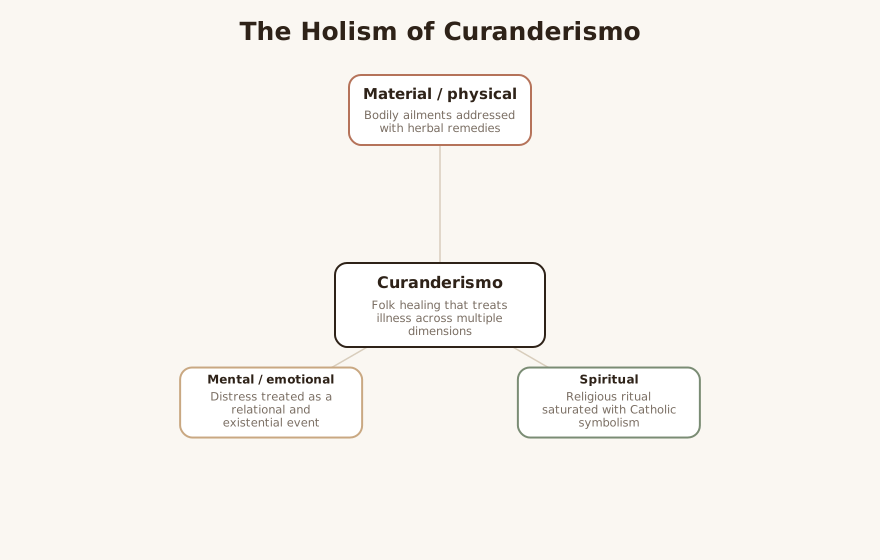
The organizing principle of curanderismo is holism: illness is understood across material, spiritual, and mental dimensions rather than reduced to biology alone 4. A curandero may work on any or all of these levels in a single encounter, moving fluidly between herbal remedy, religious ritual, and diagnostic techniques such as divination or pulse-reading 4. Treatment is saturated with Catholic symbolism — crucifixes, rosaries, and holy pictures appear throughout the healing space 4.
A second principle is that suffering is meaningful and socially embedded. The tradition supplies practical explanations for misfortune and personal failure, and its rituals — including group ceremony and what observers have described as psychodrama — function as social and behavioral mechanisms for releasing unbearable pressure 3. For the therapist, this is the conceptual bridge: curanderismo treats distress as a relational and existential event, not merely an intrapsychic one, which is congenial to many evidence-based frames. LLM
Interventions & Techniques
Within the tradition itself, the curandero is one of several specialized healers. Common roles include the yerbero (herbalist), the partera (midwife), and the sobador (masseur who treats musculoskeletal complaints through massage) 45. Techniques span the three levels of healing and may combine herbal teas and remedies, prayer and religious ritual, spiritual cleansings, and physical manipulation 45. Educational programs that survey the tradition describe practices such as limpias (spiritual cleansings), treatments for empacho (intestinal blockage), medicinal tea preparation, manteadas (shawl alignments), and “laugh therapy,” framed within an integrative approach to health 67.
These descriptions are useful for the clinician as recognition material, not as a procedure manual. LLM Knowing that a client’s limpia or herbal regimen is a coherent, culturally normative response to distress — rather than evidence of disorganized thinking — protects you from a serious assessment error. LLM
LLM-generated illustrative example (not a guideline): A client mentions that before her first session she visited a curandera for a limpia “to clear the heaviness.” Rather than challenging or ignoring this, the therapist responds with curiosity: “What did the limpia help with, and what’s still feeling heavy that you’d like us to work on?” — validating the practice while opening therapeutic space LLM.
Evidence Base
Honesty here requires splitting two questions. As a cultural healing tradition, curanderismo is well-established and ethnographically documented over centuries 34. As a clinical intervention with measured mental-health outcomes, the evidence base is essentially absent — there are no controlled efficacy trials in the literature reviewed here, and none should be implied. LLM
What we do have is utilization data, and it is instructive. A large national study (HHANES, 1982–84) found that only about 4.2% of Mexican Americans aged 18–74 in the Southwest reported consulting a curandero, herbalist, or folk practitioner in the prior year 2. The strongest independent predictor of use was dissatisfaction with recently received modern medical care (adjusted odds ratio 2.01); lower income, interview language, and poorer self-perceived health were also predictors 2. The clinical takeaway is twofold: folk-healing use is less common than stereotype suggests, and it rises when patients feel failed by biomedicine 2. A respectful, responsive therapeutic relationship is therefore not only ethical but may itself reduce reliance on parallel folk care driven by mistrust. LLM
Populations & Indications
Curanderismo is most salient among Latino and Hispanic populations, particularly those with strong ties to Mexico and the U.S. Southwest 3. It is especially relevant for immigrants and refugees, Indigenous and mestizo communities, and rural and agricultural populations — including farmworker communities where folk medicine remains common and access to biomedical care is constrained 5. Older adults and religiously or spiritually oriented clients are also more likely to hold and act on these beliefs. LLM
The clinical “indication” is not that you prescribe curanderismo, but that you assess for it. LLM When working with these populations, asking about traditional remedy use — openly and without judgment — is a recommended practice that surfaces both protective beliefs and potential safety issues 5.
Problems-for-Work
Curanderismo addresses a set of folk illnesses that map, imperfectly, onto distress a therapist will recognize. Susto (fright, sometimes glossed as soul loss) describes emotional distress following a frightening or traumatic event 5; clinically it may overlap with acute stress, PTSD, or somatic presentations. LLM Nervios (“nerves”) names stress-related symptoms and is a common idiom for anxiety and chronic distress 5. Mal de ojo (the evil eye) attributes affliction to envious attention 54, and empacho describes digestive blockage 5.
For the therapist, the productive work is translation, not correction. LLM A client reporting susto after a robbery is offering a culturally framed trauma narrative; a client with nervios is often describing generalized anxiety, depression with somatic features, or acculturative stress. LLM
LLM-generated illustrative example (not a guideline): An older farmworker presents with insomnia, racing heart, and “nervios” since his son’s deportation. The therapist treats nervios as the client’s word for his anxiety and grief, builds the formulation around acculturative stress and ambiguous loss, and uses the client’s own idiom in psychoeducation rather than replacing it LLM.
Contraindications, Cautions & Cultural Humility
Curanderismo is not a substitute for indicated medical or psychiatric care, and the genuine risks lie at that intersection. The most serious is delayed biomedical treatment — when reliance on folk healing postpones care for a treatable medical or psychiatric condition. LLM A second is safety of remedies: some herbal preparations carry herb–drug interaction potential, and clinicians should ask about, rather than assume the safety of, any ingested remedy LLM5.
The governing stance is cultural humility. Providers are advised to respect clients’ healing traditions without judgment, recognize the power imbalance inherent in the clinical relationship, ask open-ended questions about traditional remedy use, and integrate safe folk practices with evidence-based care rather than dismissing clients’ health beliefs 5. Dismissiveness is not merely impolite; given that dissatisfaction with biomedicine predicts folk-healer use, it can rupture the alliance and push clients away from care entirely 2. The goal is collaborative care that honors traditional knowledge alongside clinical expertise 5.
Treatment-Plan Suggestions & SMART Objectives
| Goal | SMART objective (example) | Mechanism |
|---|---|---|
| Reduce anxiety expressed as nervios | Within 8 weeks, client reduces self-rated nervios intensity from 8/10 to 4/10 on a weekly log | Culturally adapted CBT; psychoeducation using client’s idiom 5 |
| Process trauma framed as susto | Within 12 weeks, client narrates the fright event in session without dissociation across 3 consecutive sessions | Trauma-focused processing within a supportive, culturally responsive frame LLM |
| Strengthen the therapeutic alliance | By session 4, client reports feeling “understood” about cultural beliefs (4/5 on alliance check-in) | Cultural humility; open inquiry into folk-healing use 5 |
| Coordinate parallel folk and clinical care | Within 4 weeks, client and therapist agree on a written plan integrating any safe folk practices with treatment | Collaborative care model honoring traditional knowledge 5 |
| Address acculturative stress / cultural bereavement | Over 10 weeks, client identifies and reframes 3 acculturation stressors using a coping plan | Supportive psychotherapy; idioms-of-distress framework LLM |
| Improve safe use of remedies | Within 2 weeks, client discloses all herbal/folk remedies for review and continues only those deemed safe | Open-ended remedy inquiry; medical coordination 5 |
| Reduce somatic symptom burden | Within 8 weeks, client links 2 somatic complaints to emotional triggers in session | Mind–body psychoeducation within holistic framing 4 |
Common Misconceptions
“Most Latino clients use curanderos.” The data say otherwise — utilization in a large national sample was roughly 4.2%, far lower than stereotype assumes 2. “Belief in mal de ojo or susto signals psychosis or low intelligence.” These are normative cultural idioms of distress, not symptoms of a thought disorder, and treating them as pathology is an assessment error. LLM “Curanderismo and biomedicine are mutually exclusive.” Many clients use both, and contemporary integrative efforts deliberately combine traditional healing with modern healthcare into a holistic approach 35. “Folk-healer use means the client distrusts you specifically.” More often it tracks general dissatisfaction with the medical system and structural access barriers 23.
Training & Certification
There is no professional certification in curanderismo for therapists, and you should not seek to “become a curandero” as a clinical credential. LLM Within the tradition itself, the ability is regarded as a gift from God acquired through apprenticeship or spiritual calling, not academic training 4. Academically oriented programs do exist for clinicians and the public: the University of New Mexico offers continuing-education courses (with CEUs) taught by healers and practitioners from the Southwest, Mexico, and the community, covering history, traditions, rituals, herbs, and remedies — framed as personal enrichment and professional development, explicitly not a license to practice 6. A companion online course surveys traditional healing using plants 7. For therapists, the appropriate “training” is cultural competence and humility, not initiation. LLM
Key Terms
Curandero/curandera — folk healer regarded as working across material, spiritual, and mental levels 4. Limpia — spiritual cleansing ritual 6. Susto — fright/soul-loss illness following a traumatic event 5. Nervios — “nerves,” an idiom for stress-related distress 5. Mal de ojo — the evil eye; affliction from envious attention 54. Empacho — digestive blockage 5. Yerbero — herbalist 4. Partera — midwife 4. Sobador — healer treating musculoskeletal complaints by massage 5. Don de Dios — the “gift from God” by which curanderos understand their calling 4.
Resources & Further Reading
▶ Watch — a video introduction to this concept:
- Trotter RT, Chavira JA. Curanderismo: Mexican American Folk Healing (seminal text)
- Utilization of curanderos by Mexican Americans: prevalence and predictors, HHANES 1982–84 (PMC)
- Curanderismo — EBSCO Research Starters
- Understanding Curanderismo — Texas State Historical Association Handbook
- Folk Medicine and Traditional Healing — National Center for Farmworker Health fact sheet
- UNM Curanderismo / Traditional Medicine without Borders
- Curanderismo: Traditional Healing Using Plants — Coursera (UNM)
Reflective / Supervision Questions
- When a client describes a folk illness such as susto or nervios, do I translate it into my formulation, or do I unconsciously correct or pathologize it? LLM
- How would I respond if a client told me they were seeing a curandero in parallel with our work — collaboratively, neutrally, or defensively? LLM
- Given that dissatisfaction with biomedical care predicts folk-healer use, what in my own practice might signal to a client that they are not understood? 2LLM
- Where is the line between respecting a client’s healing tradition and ensuring they are not delaying needed medical or psychiatric care, and how do I hold both? LLM
- Am I assessing for traditional remedy use openly and without judgment, or am I avoiding the topic because it feels outside my training? 5LLM