
Type & Discipline
Cultural bereavement is a construct within cultural psychiatry, situated in the family of acculturation and migration concepts LLM. It names the grief of refugees and forced migrants for the loss of their homeland, social structures, language, and cultural identity — losses that are continuous and largely irreversible rather than tied to a single death LLM. The term was advanced by Maurice Eisenbruch, whose published work spans the mental health of refugee children, cultural bereavement among Cambodian refugees, and a structured cultural bereavement interview for clinical research 5. It is best understood not as a discrete disorder but as an interpretive lens that reframes distress in displaced people as an intelligible response to catastrophic loss of the cultural world LLM.
For practicing clinicians, the practical value of the construct is diagnostic humility: it asks whether a refugee’s “symptoms” are signs of pathology or expressions of a normative, culturally patterned grief that Western nosology lacks a category for LLM. Eisenbruch framed this explicitly as an argument toward a more culturally sensitive diagnostic system, positioning the traditional healer alongside the psychiatrist as a legitimate taxonomist of suffering 1.
Creators & Lineage
The construct is most closely associated with Maurice Eisenbruch, a cultural psychiatrist whose research program developed it across several decades 5. An early thread appears in his 1988 work on the mental health of refugee children and their cultural development, which located refugee distress within disrupted cultural transmission rather than within individual psychopathology alone 4. He elaborated the construct most influentially in studies of Cambodian refugees, arguing in a 1992 paper that a culturally sensitive diagnostic approach must take seriously the traditional healer’s own taxonomy of bereavement and spirit-related affliction 1.
More recently, Eisenbruch operationalized the concept through the Cultural Bereavement Interview, a structured clinical-research instrument intended to assess these experiences systematically in refugee populations rather than leaving them to ad hoc clinical impression 2. The construct’s lineage therefore runs from a critique of culture-blind nosology, through ethnographic engagement with Cambodian healing traditions, to a measurement tool LLM. It sits intellectually adjacent to work on acculturative stress, ambiguous loss, and prolonged grief, and is frequently contrasted with the trauma-centric framing of posttraumatic stress disorder LLM.
The concept has since been taken up by researchers outside the Cambodian context. A 2022 study of Ethiopian refugees in South Korea, for example, used cultural bereavement as an explanatory frame for mental distress in a population displaced into a culturally and linguistically distant host society 3. This uptake illustrates the construct’s portability beyond its origin population LLM.
Core Principles
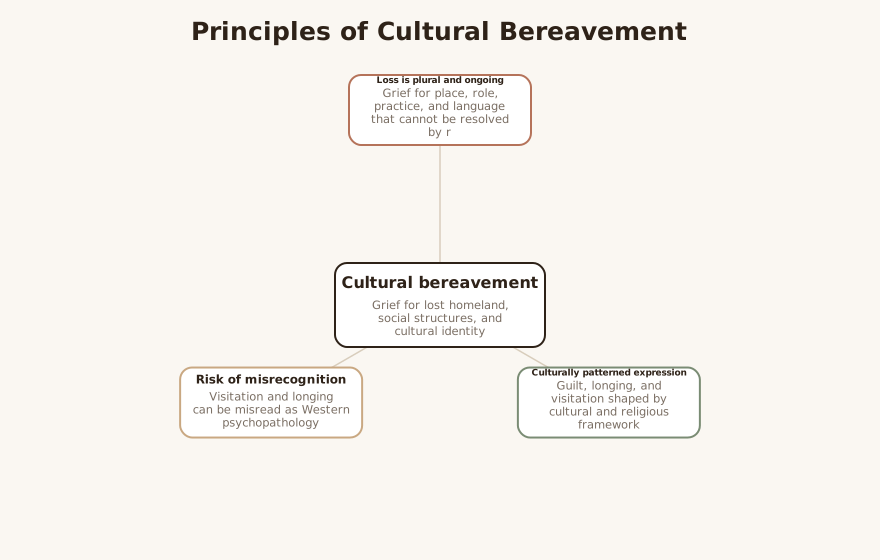
The first principle is that loss in displacement is plural and ongoing LLM. The refugee grieves not only people who died or were left behind but the loss of place, social role, religious practice, language, and the everyday cultural scaffolding that made identity coherent LLM. Because these losses persist and cannot be “resolved” by return, the grief does not follow the trajectory a clinician might expect from ordinary bereavement LLM.
The second principle is cultural patterning of grief expression LLM. The affective and somatic forms grief takes — including guilt toward the dead, intense longing for the homeland, and experiences of being visited by the spirits of deceased relatives — are shaped by the person’s cultural and religious framework rather than being free-floating symptoms LLM. In Eisenbruch’s account of Cambodian refugees, such experiences are intelligible within local cosmology and are read by traditional healers as meaningful rather than as madness 1.
The third principle is the risk of misrecognition LLM. When a clinician encounters visitation experiences, survivor guilt, intrusive longing, and altered sleep, the default Western reading is PTSD, major depression, or even psychosis LLM. The construct’s central clinical claim is that these phenomena may instead be culturally normative grief, and that pathologizing them risks both misdiagnosis and the erasure of the person’s own meaning system 1. Research applying the construct to Ethiopian refugees similarly treated cultural bereavement as distinct from, though potentially co-occurring with, conventional distress categories 3.
Interventions & Techniques
Cultural bereavement is primarily a diagnostic and formulation construct, so the “interventions” it implies are mostly assessment, framing, and respectful engagement rather than a proprietary therapy protocol LLM. The most concrete tool tied to the construct is the Cultural Bereavement Interview, a structured approach designed to elicit and characterize these experiences in refugees for clinical and research purposes 2. In practice, a clinician can adopt its spirit by asking directly and non-pathologizingly about what was lost in the homeland, about contact or communication with the dead, and about guilt toward those left behind LLM.
A second technique is cultural formulation: situating the presentation within the patient’s own explanatory model before mapping it onto any diagnostic label LLM. This aligns with the construct’s call for clinicians to function less as gatekeepers of a fixed nosology and more as collaborators with the patient’s meaning system, including, where relevant, traditional healers 1.
A third is normalization and witnessing LLM. Naming the experience as grief for a lost cultural world — rather than as a deficit — can reduce shame and open space for mourning that the host culture does not otherwise sanction LLM.
LLM-generated illustrative example (not a guideline): A clinician seeing a recently resettled refugee who reports nightly “visits” from a deceased parent and pervasive guilt at having survived might, instead of immediately scoring this for psychosis or PTSD, ask: “In your tradition, what does it mean when the dead come to you? What were you not able to do for them?” The answers reframe the presentation as cultural bereavement and guide care toward mourning rituals and meaning, not antipsychotics LLM.
Evidence Base
The honest appraisal is that cultural bereavement is an established construct in the sense that it is recognized, cited, and used across cultural-psychiatry literature — but “established” here refers to its conceptual standing, not to a mature body of treatment-outcome evidence LLM. There is no substantial corpus of randomized controlled trials demonstrating that a “cultural bereavement treatment” outperforms standard care, because cultural bereavement is descriptive and diagnostic rather than a manualized intervention LLM.
The supporting evidence is largely conceptual, ethnographic, and observational LLM. Eisenbruch’s foundational contributions — the work on refugee children’s cultural development, the Cambodian-refugee analysis, and the later structured interview — build the construct’s validity through cross-cultural clinical observation and instrument development rather than through controlled outcome trials 412. Empirical extensions such as the 2022 Ethiopian-refugee study provide cross-population support that the construct travels and maps onto measurable distress, but these are observational designs 3.
For clinicians, the takeaway is calibrated confidence: the construct is well grounded as a way of seeing refugee grief and as a corrective to culture-blind diagnosis, but it should not be presented to teams or patients as an evidence-based therapy with proven efficacy LLM. Its strongest claim is descriptive and ethical, not interventional LLM.
Populations & Indications
The construct was developed with and is most clearly indicated for refugees and forced migrants LLM. Its origin population is Cambodian and other Southeast Asian refugees, among whom Eisenbruch first articulated the interplay of bereavement, spirit visitation, and traditional healing 1. It has since been applied to other groups, including Ethiopian refugees resettled in South Korea, demonstrating relevance well beyond its origin context 3.
It is particularly indicated for refugee children and unaccompanied minors, whose cultural development and identity formation are disrupted by displacement in ways the construct was partly built to capture 4. It is also apt for asylum seekers living in prolonged uncertainty, for whom loss of the homeland is compounded by an inability to either return or fully settle LLM. More broadly, any clinical encounter where a person’s distress is entangled with the loss of a cultural world — including some long-settled immigrants confronting acculturation and intergenerational identity loss — may warrant consideration of cultural bereavement as a frame LLM.
Problems-for-Work
Grief for loss of homeland and cultural identity. A client may present not with a discrete loss but with a diffuse, persistent mourning for a place, language, and way of life LLM. The construct legitimizes this as bereavement and directs the work toward acknowledging and mourning the cultural world rather than “fixing” a mood disorder 3.
Survivor and separation guilt. Refugees frequently carry guilt for having survived, escaped, or left family behind LLM. Naming this within cultural bereavement reframes it as part of a culturally patterned grief rather than as a cognitive distortion to be disputed away 1.
Misdiagnosis as PTSD, depression, or psychosis. The clearest clinical application is corrective: pausing before labeling visitation experiences or pervasive longing as psychotic or as PTSD re-experiencing, and asking whether they are normative grief 1. The Ethiopian-refugee work treats cultural bereavement as conceptually separable from standard distress categories, supporting this differentiation 3.
Intrusive longing and visitation by spirits of the dead. When a client describes contact with deceased relatives, the work is to explore meaning within their cosmology rather than to extinguish the experience LLM. Eisenbruch’s engagement with traditional healers models this stance 1.
Acculturative stress and identity disruption. For displaced children and adults navigating a new cultural system, the construct frames identity disruption as a developmental and grief process, informing supportive work around cultural continuity 4.
Contraindications, Cautions & Cultural Humility
The construct is a lens, not a license to under-treat LLM. The principal caution is not using cultural bereavement to dismiss treatable, dangerous conditions LLM. Survivor guilt can coexist with major depression and active suicidality; visitation experiences usually reflect culturally patterned grief but, in rare cases, can accompany a genuine psychotic process; and many refugees do meet criteria for PTSD that warrants evidence-based trauma treatment LLM. The frame must complement, not replace, careful risk assessment LLM.
A second caution is avoiding cultural essentialism LLM. Cultural bereavement does not mean every refugee experiences grief identically, nor that a clinician can read a patient’s meaning from their nationality LLM. The construct’s own method — exemplified by the structured interview — is to ask the individual rather than assume 2.
Cultural humility is therefore central: the clinician approaches as a learner of the patient’s meaning system, holds diagnostic labels loosely, and, where appropriate and acceptable to the patient, collaborates with traditional or religious healers whom Eisenbruch positioned as legitimate interpreters of this suffering 1. The clinician should also remain alert to their own host-culture bias, which tends to convert culturally sanctioned grief into individual pathology LLM.
LLM-generated illustrative example (not a guideline): A clinician using the cultural-bereavement frame still screens directly for suicide when a client expresses survivor guilt; the frame contextualizes the guilt, it does not waive the safety assessment LLM.
Treatment-Plan Suggestions & SMART Objectives
| Goal | SMART objective (example) | Mechanism |
|---|---|---|
| Legitimize cultural grief | Client will name three specific homeland/cultural losses they are mourning within 4 sessions | Externalizing and validating grief reduces shame and pathology framing LLM |
| Differentiate grief from disorder | Clinician and client will distinguish culturally normative visitation/longing from depressive or psychotic symptoms via structured inquiry by session 3 | Accurate formulation prevents misdiagnosis 1 |
| Address survivor/separation guilt | Client will articulate the meaning of their guilt within their own framework and identify one mourning practice by week 6 | Meaning-centered processing reframes guilt as grief LLM |
| Engage cultural meaning system | Client will identify whether a traditional/religious healer or ritual is acceptable and desired within 5 sessions | Collaboration with the patient’s cosmology supports mourning 1 |
| Support identity continuity | Client will list two cultural practices to maintain in the host country within 4 sessions | Cultural continuity buffers identity disruption 4 |
| Screen co-occurring conditions | Clinician will complete depression, PTSD, and suicide-risk screening by session 2 | Prevents under-treatment of treatable conditions LLM |
| Structured assessment of bereavement | Clinician will administer a cultural-bereavement-informed interview to characterize losses by session 3 | Systematic elicitation improves formulation 2 |
| Reduce isolation | Client will connect with one same-culture community resource within 8 weeks | Restored social structure addresses lost cultural scaffolding LLM |
Common Misconceptions
“It’s just PTSD by another name.” Cultural bereavement overlaps with but is not reducible to PTSD; its core is ongoing grief for a lost cultural world, not fear-conditioned re-experiencing of a discrete trauma LLM. Research applying the construct treats it as separable from conventional distress categories 3.
“Spirit visitations mean psychosis.” Within the construct, communication with the dead is frequently a culturally patterned feature of grief rather than a psychotic symptom, and Eisenbruch’s work with traditional healers treats such experiences as meaningful 1.
“It’s a recognized DSM disorder.” It is a cultural-psychiatry construct and formulation lens, not a discrete diagnostic category; Eisenbruch in fact advanced it as a critique of culture-blind diagnosis 1.
“It only applies to one ethnic group.” Though developed with Cambodian refugees, the construct has been applied to other populations, including Ethiopian refugees in South Korea 3.
“There’s a proven treatment for it.” There is no manualized, RCT-validated cultural-bereavement therapy; the construct guides formulation and stance, and treatment-outcome evidence remains limited LLM.
Training & Certification
There is no formal certification in cultural bereavement, because it is a construct rather than a credentialed treatment model LLM. Clinicians build competence through the cultural-psychiatry literature — Eisenbruch’s foundational papers on refugee children, Cambodian cultural bereavement, and the Cultural Bereavement Interview are the primary primary-source grounding 412.
Relevant capability is best developed through broader training in cultural formulation, refugee and trauma mental health, and grief work, combined with supervised experience working across language and culture, ideally with interpreter-mediated care LLM. Familiarity with the structured Cultural Bereavement Interview offers a concrete entry point for clinicians who want a systematic assessment method 2. Engagement with community elders, traditional healers, and cultural brokers — consistent with the construct’s own stance — is itself a form of ongoing training in the meaning systems of the populations served 1.
Key Terms
- Cultural bereavement — Eisenbruch’s construct for the ongoing grief of displaced people for the loss of homeland, social structures, and cultural identity 5.
- Survivor / separation guilt — guilt for having survived or for leaving others behind, here understood as part of culturally patterned grief 1.
- Visitation by spirits of the dead — experiences of contact with deceased relatives, often meaningful within the patient’s cosmology rather than psychotic 1.
- Cultural Bereavement Interview — a structured clinical-research instrument for assessing these experiences in refugees 2.
- Traditional healer as taxonomist — Eisenbruch’s framing of the indigenous healer as a legitimate classifier of suffering alongside the psychiatrist 1.
- Acculturative stress — distress arising from adapting to a new cultural system, conceptually adjacent to cultural bereavement LLM.
Resources & Further Reading
▶ Watch — a video introduction to this concept:
- Eisenbruch (1992) — Toward a culturally sensitive DSM: cultural bereavement in Cambodian refugees and the traditional healer as taxonomist (PubMed)
- Eisenbruch (2018) — The Cultural Bereavement Interview: A New Clinical Research Approach for Refugees (Psychiatric Clinics of North America)
- Cultural Bereavement and Mental Distress: Ethiopian Refugees in South Korea (Healthcare/MDPI, 2022)
- Eisenbruch (1988) — The Mental Health of Refugee Children and Their Cultural Development (International Migration Review)
- Maurice Eisenbruch — Bereavement, PTSD, trauma, depression (author’s site)
- Cultural Bereavement — term overview
Reflective / Supervision Questions
- When I encounter a refugee client’s report of visitation by the dead or pervasive longing, what is my default diagnostic reflex — and is it the patient’s meaning or my nosology that I am centering? LLM
- How do I hold the tension between honoring culturally normative grief and rigorously screening for treatable depression, PTSD, and suicidality? LLM
- What do I actually know about this specific client’s cultural and religious framework for death, the dead, and obligation to those left behind — and how did I learn it? 2
- In what circumstances would collaboration with a traditional or religious healer strengthen this client’s care, and what are my own barriers to seeking it? 1
- Where might host-culture bias be leading me to convert a sanctioned, communal grief into an individual disorder? LLM