
Type & Discipline
Culturally Adapted CBT (CA-CBT) is a manualized, somatically focused form of cognitive-behavioral therapy developed for traumatized refugees and ethnic-minority patients, situated at the intersection of clinical psychology and transcultural psychiatry.1 It belongs to the broader project of cultural adaptation of evidence-based treatments — taking an established protocol such as CBT for PTSD and panic, and systematically modifying its content, idioms, and delivery so that it fits the explanatory models, symptom presentations, and values of a specific cultural group.1 What distinguishes CA-CBT from generic CBT is not the abandonment of cognitive-behavioral mechanisms but their re-targeting: the treatment places unusual emphasis on the body, treating culturally salient somatic symptoms and catastrophic cognitions about them as the primary engine of distress to be addressed.13 In this sense CA-CBT is best understood as a populations-specific, somatic-and-emotion-regulation-focused extension of standard CBT rather than a wholly separate school of therapy.1LLM
Creators & Lineage
CA-CBT was developed principally by Devon E. Hinton, a psychiatrist and anthropologist whose work bridges clinical psychiatry and cultural anthropology and who has long studied trauma, panic, and culturally specific syndromes among Southeast Asian and other refugee populations.7 Hinton’s profile at the Mass General Research Institute reflects this dual identity, with research spanning anxiety, post-traumatic stress, and the cross-cultural study of mental illness.7 The treatment’s intellectual lineage runs directly from the mainstream cognitive-behavioral tradition: the foundational 2012 Transcultural Psychiatry paper situates CA-CBT as an adaptation undertaken with co-authors drawn from the heart of the panic and CBT research world, including Stefan Hofmann, David Barlow, and Michael Otto.1 Barlow and Otto’s work on panic disorder and interoceptive exposure is a clear ancestor of CA-CBT’s emphasis on bodily sensations and catastrophic misinterpretation of arousal.1LLM
The clinical lineage was forged in work with Cambodian (Khmer) refugees who survived the Khmer Rouge genocide, among whom Hinton documented and treated PTSD comorbid with culturally specific panic presentations such as neck-focused panic attacks.3 From this origin the model was extended to Vietnamese and Latino patients, and more recently adapted and piloted with Afghan and Farsi-speaking refugee groups, each adaptation re-tuning the somatic idioms and metaphors to the new population.456 CA-CBT thus sits within the same family as other cultural-adaptation efforts and shares conceptual territory with transcultural and culturally responsive frameworks, but it is unusually well-specified and manualized for its target groups.LLM
Core Principles
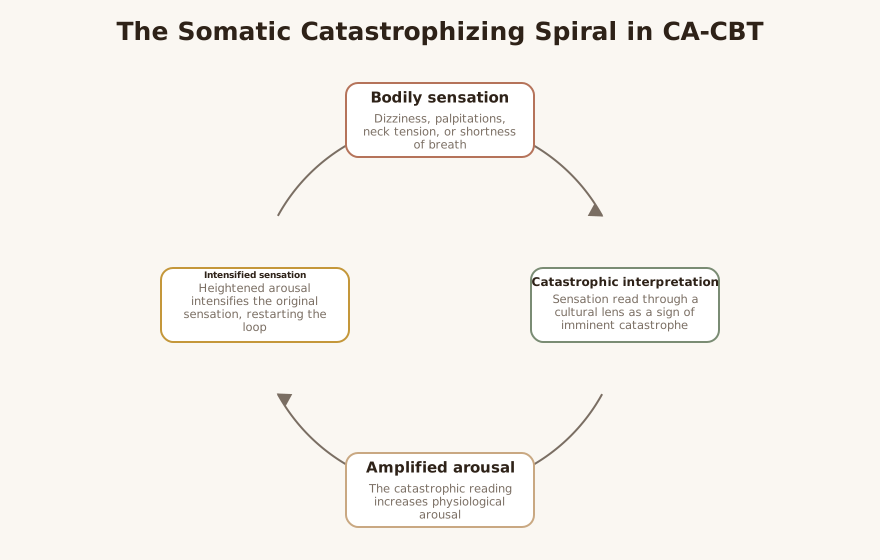
The organizing principle of CA-CBT is that, for many traumatized refugees, distress is experienced and expressed somatically, and that catastrophic cognitions about bodily sensations are a central maintaining mechanism that standard, cognition-and-narrative-focused CBT can miss.13 A bodily sensation — dizziness, palpitations, neck tension, shortness of breath — is interpreted through a cultural lens as a sign of imminent catastrophe, which amplifies arousal, which intensifies the sensation, producing a self-reinforcing spiral.1 A paradigmatic example is the khyal attack (a “wind” or “wind-overload” attack in Cambodian ethnophysiology), in which the patient fears that a wind-like substance and blood will surge upward in the body, causing syncope, rupture of vessels, or death; CA-CBT treats the catastrophic interpretation of these sensations as a primary clinical target.1LLM
Several further principles follow.1 First, CA-CBT insists on respecting and working within the patient’s explanatory model rather than overriding it, framing interventions in idioms the patient already holds.1 Second, it foregrounds emotion regulation and arousal reduction as core skills, on the premise that traumatized refugees often arrive with limited tolerance for strong affect and bodily arousal.1 Third, it builds psychological flexibility — the capacity to shift attention, generate positive states, and tolerate distress — using techniques that are presented as culturally congruent (for example, drawing on imagery, stretching, and meditative practices familiar to the population).1 Fourth, it is explicitly trauma-informed, sequencing skills before any approach to trauma material so that the patient has regulation capacity in place.1LLM
Interventions & Techniques
CA-CBT delivers change through a structured set of techniques that braid together cognitive restructuring, interoceptive and emotion-focused exposure, mindfulness, and culturally adapted bodywork.13 On the cognitive side, the work centers on identifying and modifying catastrophic cognitions about somatic symptoms — for example, correcting the belief that a racing heart or rising “wind” signals impending death — which directly parallels the cognitive component of panic-focused CBT but is conducted in the patient’s own ethnophysiological terms.13 On the experiential side, the treatment uses interoceptive exposure, deliberately inducing feared bodily sensations in a graded, tolerable way so the patient gathers disconfirming evidence that the sensations are not dangerous.13
CA-CBT is also notable for its integration of mindfulness, relaxation, stretching, and visualization delivered as culturally resonant practices, and for skills that generate positive emotional states and broaden attention away from threat-focused somatic monitoring.1 Techniques are taught as transportable coping tools the patient can deploy when a somatic symptom or trauma reminder arises, pairing a bodily skill (such as paced breathing or stretching) with a cognitive reframe.1LLM More recent variants extend the core protocol: a transdiagnostic version has been piloted to address mixed anxiety, depression, and PTSD presentations rather than a single disorder, and a CA-CBT+ version adds a problem-management component to address the concrete psychosocial stressors (housing, legal status, resettlement) that compound refugees’ distress.56
LLM-generated illustrative example (not a guideline): A Cambodian client who fears that standing up too fast will trigger a fatal “wind” surge practices, with the clinician, a graded interoceptive exposure — slow positional changes paired with paced breathing — while restructuring the catastrophic prediction (“the dizziness means a vessel will burst”) into a tested alternative (“the dizziness is a benign arousal sensation that passes”). LLM
Evidence Base
The overall maturity of CA-CBT is best described as established for the populations in which it was originally developed and tested, and emerging in newer groups.14 For Cambodian, Vietnamese, and Latino refugee populations, the approach has accumulated randomized-controlled support, including trials in which somatic-focused CBT reduced PTSD and comorbid panic — such as neck-focused panic attacks among Cambodian refugees — relative to comparison conditions.31 A systematic review of culturally adapted CBT for traumatized refugees and asylum seekers examined both its effectiveness and its acceptability, the latter being a clinically important outcome given how often this population disengages from generic care.4
Honesty about the limits is warranted alongside this support.LLM Much of the newer extension work rests on pilot and small-sample studies rather than large definitive trials: the CA-CBT+ study with Afghan refugees was an explicitly randomized pilot, and the transdiagnostic adaptation for Farsi-speaking refugees was likewise a pilot study, so their findings should be read as promising and feasibility-establishing rather than confirmatory.56 The evidence is therefore uneven across populations — robust for the originating Southeast Asian and Latino groups, preliminary for Afghan and Farsi-speaking groups — and clinicians should not assume that an adaptation validated in one cultural group transfers intact to another without its own tailoring and, ideally, its own evidence.4LLM The systematic review’s attention to acceptability also signals that effectiveness data, while encouraging, sits within a literature still consolidating its methods.4LLM
Populations & Indications
CA-CBT was designed for traumatized refugees and ethnic-minority patients whose distress is heavily somatized and who may be underserved or poorly engaged by standard CBT.1 Its best-evidenced indications are PTSD with comorbid panic and prominent somatic symptoms, particularly culturally specific panic presentations such as khyal attacks and neck-focused panic.13 The originally studied populations are Cambodian (Khmer) survivors of the Khmer Rouge, Vietnamese refugees, and Latino patients, with more recent adaptation to Afghan and Farsi-speaking refugees.3456
The treatment is especially indicated when a clinician observes the signature pattern: a patient who frames their suffering primarily in bodily terms, who holds a culturally grounded catastrophic interpretation of arousal sensations, and for whom a purely narrative or thought-record-based CBT has felt foreign or has stalled.1LLM The transdiagnostic and problem-management variants widen the indication to refugees presenting with mixed anxiety-depression-PTSD pictures and with significant ongoing resettlement stressors, rather than a single clean diagnosis.56
Problems-for-Work
CA-CBT maps its techniques onto specific maintaining mechanisms, which makes problem selection concrete.1 Representative targets and how the methods are applied:
- Posttraumatic stress disorder (PTSD) — sequencing emotion-regulation and somatic skills before approaching trauma reminders, then reducing avoidance and re-processing trauma-linked arousal.13
- Somatic-focused panic attacks (e.g., neck-focused panic, khyal attacks) — interoceptive exposure to feared sensations plus restructuring of the catastrophic cultural interpretation of those sensations.13
- Catastrophic cognitions about bodily sensations — identifying the feared bodily meaning (a vessel bursting, “wind” surging, fainting, death) and testing it against repeated benign experience.1LLM
- Comorbid depression and anxiety — building positive-emotion-generating and attention-broadening skills, addressed directly in the transdiagnostic adaptation.6LLM
- Anger and irritability — using arousal-reduction and flexibility skills to interrupt the escalation from somatic arousal to dysregulated affect.1LLM
- Resettlement and psychosocial stressors — the CA-CBT+ problem-management module addresses concrete stressors (legal, housing, social) that sustain distress.5
LLM-generated illustrative example (not a guideline): A Farsi-speaking client with mixed PTSD and depression who reports chest tightness and a sense of “pressure rising” learns a paced-breathing-plus-stretching routine, pairs it with a culturally framed reframe of the sensation as safe, and uses positive-imagery practice to widen attention away from constant threat-monitoring of the body. LLM
Contraindications, Cautions & Cultural Humility
CA-CBT is broadly appropriate for its target populations, but several cautions apply.LLM Its interoceptive-exposure component deliberately induces feared bodily sensations, which demands clinical judgment: in patients with relevant medical comorbidity, acute instability, or where arousal induction could be unsafe, exposures must be screened, paced, and adapted.1LLM Like all trauma work, the approach should sequence stabilization and regulation skills before approaching trauma material, and is not a substitute for medication, medical care, or higher levels of care when severity or risk indicate them.1LLM
The deepest caution is one of cultural humility about the adaptation itself.4 CA-CBT’s power comes from fitting a specific cultural group’s explanatory model and idioms; applying a Cambodian-derived khyal framework to a patient from a different culture, or assuming that “the refugee experience” is uniform, betrays the method’s own logic.1LLM The systematic review’s focus on acceptability is a reminder that fit and engagement — not just symptom change — are clinical outcomes for this population, and that an adaptation must be co-developed with cultural knowledge rather than imposed.4 Clinicians should also resist treating a culturally grounded somatic explanation as a “distortion” to be eliminated; the aim is to reduce the catastrophic and disabling interpretation of sensations while respecting the patient’s ethnophysiology, not to replace their worldview with a biomedical one.1LLM
Treatment-Plan Suggestions & SMART Objectives
Goals center on building somatic and emotion-regulation skills, reducing catastrophic interpretation of bodily sensations, and re-engaging life despite trauma reminders and resettlement stress.1LLM
| Goal | SMART objective (example) | Mechanism |
|---|---|---|
| Build somatic-arousal regulation skills | Within 3 weeks, client practices a paced-breathing or stretching routine ≥5 days/week, logged | Emotion / arousal regulation |
| Reduce catastrophic interpretation of a target sensation | Over 6 weeks, client reduces believability of one catastrophic somatic belief from 90/100 to ≤40/100, rated weekly | Cognitive restructuring of somatic catastrophizing |
| Tolerate feared bodily sensations | Over 8 weeks, client completes one graded interoceptive-exposure step per week, tracking distress pre/post | Interoceptive exposure / disconfirmation |
| Reduce trauma-related avoidance | Over 8 weeks, client approaches one avoided reminder per week using a learned regulation skill | Graded exposure with skills support |
| Increase positive-emotion and attention-broadening capacity | Over 4 weeks, client uses a positive-imagery or mindfulness practice ≥4×/week and rates mood | Positive-affect generation / attention broadening |
| Address a concrete resettlement stressor | Within 5 weeks, client completes one problem-management step on a prioritized stressor (e.g., a legal or housing task) | Problem management (CA-CBT+) |
| Develop a culturally framed coping plan | By the final phase, client produces a written plan pairing somatic cues with skills and reframes | Maintenance / generalization |
These objectives are illustrative; tailor each to the individual client, their cultural context, and a validated outcome measure. LLM
Common Misconceptions
- “CA-CBT is just CBT translated into another language.” Translation is the floor, not the method; CA-CBT re-targets mechanisms onto culturally salient somatic symptoms and explanatory models, not merely the words.1LLM
- “It works for refugees in general.” The evidence is population-specific — strong for the originating Cambodian, Vietnamese, and Latino groups and preliminary for others — and an adaptation must be re-tuned for each new cultural group.456LLM
- “The somatic focus is a soft add-on.” Catastrophic cognitions about bodily sensations are treated as a primary maintaining mechanism, and the somatic and interoceptive work is central, not ancillary.13LLM
- “Cultural adaptation means abandoning the patient’s beliefs as distortions.” The model works within the explanatory framework, reducing the catastrophic interpretation of sensations while respecting the patient’s ethnophysiology.1LLM
- “The newer adaptations are as well-proven as the original.” Several recent extensions (Afghan, Farsi-speaking) rest on randomized pilots and should be read as promising rather than definitive.56LLM
Training & Certification
There is no single mandatory license unique to CA-CBT; it is practiced by licensed clinicians — psychologists, psychiatrists, counselors, and social workers — who already hold core CBT competence and then build cultural and somatic-focused expertise.LLM Competence in CA-CBT presupposes grounding in standard cognitive-behavioral methods (cognitive restructuring, interoceptive exposure, panic-focused CBT) and is extended through the published manuals and protocol papers, supervision, and consultation with clinicians and cultural brokers familiar with the target population.1LLM The foundational 2012 Transcultural Psychiatry paper functions as a primary training reference, laying out the rationale and concrete adaptation examples, and Hinton’s broader body of work provides the conceptual basis clinicians draw on.17 Because fidelity depends on cultural fit, meaningful training also includes developing the cultural knowledge — ideally in partnership with community members and interpreters — needed to adapt the protocol responsibly.4LLM
Key Terms
- Cultural adaptation of EBTs — the systematic modification of an evidence-based treatment’s content, idioms, and delivery to fit a specific cultural group’s explanatory models and presentation.1
- Somatic-focused therapy — a treatment emphasis that targets bodily symptoms and the catastrophic interpretation of those symptoms as the primary clinical driver.3
- Catastrophic cognitions about somatic symptoms — culturally grounded beliefs that a bodily sensation signals imminent catastrophe (e.g., death, rupture), which amplify arousal in a self-reinforcing spiral.1
- Khyal attack — a Cambodian “wind”/”wind-overload” panic presentation in which the patient fears a wind-like substance and blood surging upward, causing syncope or death; a paradigm target of CA-CBT.1
- Neck-focused panic — a culturally specific panic presentation among Cambodian refugees in which feared neck sensations drive catastrophic interpretation.3
- Interoceptive exposure — graded, deliberate induction of feared bodily sensations to disconfirm their catastrophic meaning.1
- Transdiagnostic CA-CBT — an adaptation addressing mixed anxiety, depression, and PTSD presentations rather than a single disorder.6
- CA-CBT+ — a variant adding a problem-management component for concrete psychosocial and resettlement stressors.5
Resources & Further Reading
▶ Watch — a video introduction to this concept:
- Hinton et al. (2012). Adapting CBT for traumatized refugees and ethnic minority patients: examples from CA-CBT — Transcultural Psychiatry
- Hinton et al. (2012) — PubMed record (PMID 22508639)
- Somatic-focused therapy for traumatized refugees: PTSD and comorbid neck-focused panic among Cambodian refugees — PubMed (PMID 22122139)
- The effectiveness and acceptability of culturally adapted CBT for traumatised refugees and asylum seekers: a systematic review — Mental Health Science (Wiley)
- Culturally Adapted CBT Plus Problem Management (CA-CBT+) with Afghan Refugees: A Randomized Controlled Pilot Study — Journal of Traumatic Stress
- Transdiagnostic culturally adapted CBT with Farsi-speaking refugees: a pilot study — PMC
- Devon Hinton, M.D., Ph.D. — Mass General Research Institute profile
Related wiki articles: Cognitive Behavioral Therapy. Explore in the graph: Mindfulness-Based Interventions · Cultural Safety (Kawa Whakaruruhau) · or filter by PTSD.
Reflective / Supervision Questions
- Am I treating this patient’s somatic explanatory model as something to respect and work within, or as a “distortion” to be corrected out of existence?
- Before importing a CA-CBT protocol developed for one cultural group, what specific cultural knowledge and partnership do I need to adapt it responsibly for the patient in front of me?
- For this client, is distress primarily narrative or primarily somatic — and am I matching the treatment’s emphasis to that, rather than defaulting to thought records?
- When I introduce interoceptive exposure, have I adequately screened for medical and safety contraindications and paced the induction to this patient’s tolerance?
- How much of my confidence in CA-CBT for this particular population rests on definitive trials versus small pilots, and am I being honest with the client about that?
- Am I attending to acceptability and engagement as outcomes in their own right, not just symptom change scores?