
Type & Discipline
Cultural safety — Kawa Whakaruruhau in te reo Māori — is a practice framework rather than a discrete treatment modality LLM. It originated in nursing education in Aotearoa New Zealand and has since been adopted across medicine, psychology, and the allied health professions 1. Unlike an intervention with a defined protocol, it is a stance toward the entire clinical encounter: it asks the practitioner to interrogate their own culture, power, and bias and their effect on care 1. The defining feature, which distinguishes it from every “competency” model, is that the recipient of care — not the clinician — is the sole judge of whether care was safe 6.
The framework deliberately reframes responsibility LLM. Where cultural competency locates the problem in the clinician’s lack of knowledge about “other” cultures, cultural safety locates it in unequal power relationships, unexamined privilege, bias, and institutional racism 1. It therefore lives as much at the level of organisations and systems as it does in the individual consulting room 1.
Creators & Lineage
The framework was developed by Dr Irihapeti Ramsden (Ngāi Tahu / Rangitāne, 1946–2003), a Māori nurse, educationalist, philosopher, and writer whose work remains the most-cited published in Nursing Praxis 2. Ramsden articulated Kawa Whakaruruhau across foundational papers in 1990, 1993, and a ten-year retrospective in 2000 2. Her central concern was “the way in which people measure and define their humanity,” and her reframing was strikingly economical: she shifted the old nursing ideal of caring for people “irrespective” of difference to caring respective of difference — that is, honouring rather than erasing cultural reality 2.
Ramsden grounded the framework in Te Tiriti o Waitangi, New Zealand’s founding document, arguing that equitable, negotiated, partnership-based care aligned with the guarantee of tino rangatiratanga (self-determination) made to Māori as tangata whenua (people of the land) 2. Cultural safety has been a required nursing competency in Aotearoa since the early 1990s 2. Within psychology, the New Zealand Psychologists Board built directly on Ramsden’s work and the Nursing Council definition, embedding cultural safety, the Treaty, and Māori wellbeing in its standards from 2005 4.
For the practising therapist, the conceptual relatives are worth naming LLM. Cultural safety sits alongside cultural psychiatry’s attention to culturally patterned distress, liberation psychology’s analysis of oppression, multicultural counseling’s competency traditions, and Critical Race Theory’s account of structural racism — but it is distinctive in handing the verdict on “safety” to the patient LLM.
Core Principles
First, cultural safety requires healthcare professionals and their organisations to examine themselves and the potential impact of their own culture on clinical interactions, rather than mastering catalogues of other cultures 1. The unit of analysis is the clinician, not the patient 4.
Second, safety is defined by the recipient 6. The New Zealand Psychologists Board states plainly that “consumers of psychological training and services are the ultimate judges of cultural safety” 4. This is the principle clinicians most often invert in practice LLM.
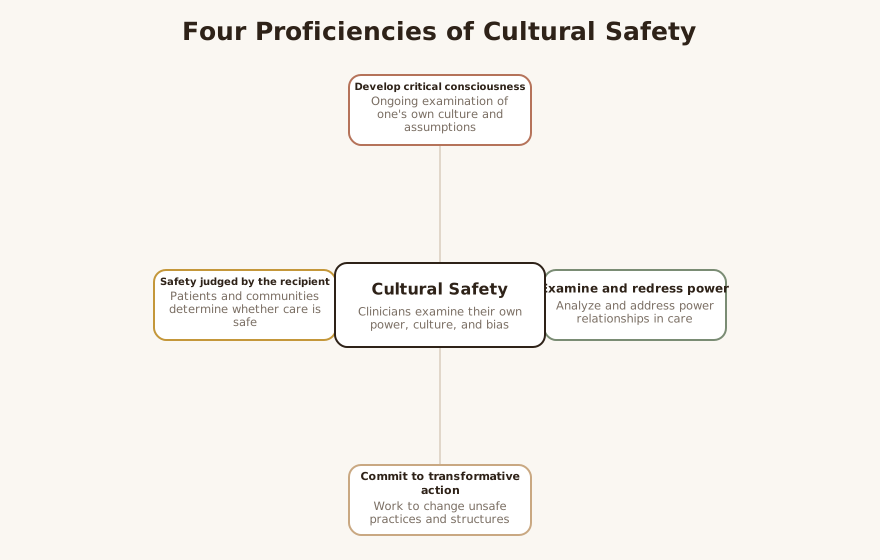
Third, the framework centres power and critical consciousness rather than knowledge acquisition 1. The clinician undertakes “a careful process of institutional and personal analysis of power relationships” and works alongside the patient from that awareness 4. The 2024 medical training framework crystallises this as four proficiencies: ongoing development of critical consciousness, examination and redress of power relationships, commitment to transformative action, and acceptance that safety is determined by patients and communities 5.
Fourth, cultural safety is broad in scope 4. While it emerged from a Māori / Treaty context, its definition extends beyond ethnicity to age, gender, sexual orientation, occupation, socio-economic status, migrant experience, religious belief, and disability 4. “Unsafe cultural practice” is any action that diminishes, demeans, or disempowers the cultural identity and wellbeing of a person, family, or group 4.
Fifth, the endpoint is health equity, with measurable progress as the test of success 1. Inequities are understood to arise from unequal power, maldistributed social determinants, marginalisation, bias, and institutional racism — not from patients’ cultural difference 1.
Interventions & Techniques
Because cultural safety is a stance rather than a manualised therapy, its “techniques” are practitioner behaviours embedded across every encounter LLM. The foundational practice is structured self-reflection: clinicians reflect on their own cultural identity and recognise the impact their personal culture has on professional practice 4. This is not a one-off exercise but the “ongoing development of critical consciousness” 5.
A second technique is recognising the cultural origins and limitations of one’s own theoretical models 4. The framework asks practitioners to acknowledge “the existence of cultural bias and boundedness implicit within aspects of Western psychological theory, training and practice” 4. A clinician using a Western evidence-based protocol is invited to hold it as culturally situated rather than universal LLM.
A third is the explicit redistribution of power in the encounter 4. Cultural safety gives consumers “the power to comment on practices,” to express “degrees of perceived risk or safety,” and to participate in changing any service they experience as negative 4. Practically, this means soliciting and acting on the patient’s own appraisal of whether the space feels safe LLM.
The 2025 refinement adds a verification step: evidence of cultural safety should come through external feedback from those served, not self-reflection alone 6. At the systems level, the 2024 framework holds that institutions must first build a culturally safe organisational environment — including employing appropriate educators without placing undue cultural load on Māori practitioners — before curriculum changes can land 5.
LLM-generated illustrative example (not a guideline): A therapist opens an intake by saying, “I work mostly from a CBT frame, which comes out of a particular Western tradition — tell me if any of it doesn’t fit how you understand what you’re going through, and I’ll adjust.” Late in the session she asks, “Did anything I said today land wrong, or make this feel less safe?” She treats the answer as data about her practice, not about the patient. LLM
Evidence Base
Honesty requires distinguishing two senses of “established” LLM. Cultural safety is established in the institutional sense: it has been a mandated nursing competency in New Zealand since the early 1990s, is embedded in regulator guidelines for psychology, and is built into a formal medical training framework 245. As a standard of practice, it is firmly entrenched 1.
It is not established in the sense of demonstrated outcome change LLM. Because cultural safety is a relational stance rather than a discrete intervention, it has essentially no randomised-controlled-trial base, and it is not the kind of thing a trial readily measures LLM. The candid appraisal from within the field is sobering: despite being a required competency for three decades, cultural safety “appears to have had little impact on the experiences of, and outcomes for, Māori in healthcare services,” and racism within the health sector and nursing remains evident 2. The Waitangi Tribunal’s Hauora inquiry (WAI 2575) found that health services were not meeting their Te Tiriti obligations to actively protect Māori health 2.
The literature is candid that the rationale is conceptual and equity-driven rather than trial-proven 1. Curtis and colleagues argue the case for cultural safety on the grounds that competency models have failed to shift inequities, not on the basis of head-to-head outcome data 1. The reasonable summary for clinicians: a well-reasoned, widely endorsed, ethically compelling framework whose real-world effectiveness depends heavily on systemic implementation and remains under-evidenced at the outcome level LLM.
Populations & Indications
Cultural safety was developed for and remains most pointed in the care of Indigenous peoples — Māori in its country of origin — for whom colonisation produced loss of language, cultural practices, and authority over health 4. It is directly indicated for colonized populations, racial and ethnic minorities, immigrants, and marginalized communities, where power asymmetries and histories of mistreatment shape the encounter 1.
The framework’s own scope is broader than ethnicity, extending to any axis of difference along which a patient may feel disempowered — generation, gender, sexual orientation, socio-economic status, religion, migrant experience, and disability 4. In that sense it is indicated whenever there is a meaningful power or cultural differential between clinician and patient, which is most encounters LLM. The 2025 work is explicit that these concepts are “not restricted to Indigenous health,” though Indigenous health carries additional commitments around rights and specific inequities 6.
Problems-for-Work
The framework maps onto several presenting problems that are themselves products of power and history LLM.
- Mistrust of providers and help-seeking barriers. When patients have learned that services demean their identity, withdrawal is rational; cultural safety addresses this by making the clinician demonstrate, and the patient verify, that the space is safe 4. A patient who “feels unsafe may not be able to take full advantage of a service” and may later require more intrusive intervention 4.
- Discrimination-related distress and minority stress. By naming the clinician’s power and the cultural limits of Western models, the framework reduces the risk that therapy re-enacts the very dynamics driving the distress 4.
- Intergenerational and historical trauma. Locating health status in colonisation and structural racism, rather than patient deficit, reframes the work away from blame 41.
- Internalized oppression and demoralization. Practices that “diminish, demean or disempower” are reclassified as clinical errors, which protects against reinforcing internalized messages 4.
LLM-generated illustrative example (not a guideline): A first-generation immigrant client repeatedly cancels and seems guarded. Rather than coding this as “poor engagement,” the clinician asks what would make sessions feel more respectful of how the client’s family understands distress, and adjusts scheduling, language, and framing accordingly — treating attendance as a signal about safety rather than a patient failing. LLM
Contraindications, Cautions & Cultural Humility
There are no contraindications to being a self-reflective, power-aware clinician LLM. The cautions concern misapplication LLM. The framework warns against the “checklist approach” — confining learning to the rituals and customs of a group — because it negates diversity and individual consideration and assumes cultures are simplistic 4. Cultural safety is explicitly the antidote to that error, not a license to substitute one stereotype set for another 4.
A second caution: self-reflection alone is insufficient and can become self-congratulatory; the patient’s appraisal is the test, and external feedback the verification 64.
For US-based clinicians, the central caution is one of transfer LLM. Every authoritative source for this framework is rooted in New Zealand’s specific bicultural, Te Tiriti–based legal and regulatory context, including statutory obligations on practitioners 45. The relational principles — that the recipient judges safety, that clinicians must examine their own power and bias, that institutions bear responsibility — generalise well LLM. The Treaty-partnership apparatus, the legal duties, and the tangata whenua relationship do not transfer to a US setting and should not be implied to LLM. American clinicians borrowing this framework are, in effect, blending it with cultural humility; that synthesis is defensible but should be named honestly rather than presented as importing New Zealand’s regulatory regime LLM.
Treatment-Plan Suggestions & SMART Objectives
The following objectives translate the stance into documentable, clinician-side practice LLM.
| Goal | SMART objective (example) | Mechanism |
|---|---|---|
| Build a safe therapeutic relationship | By session 3, clinician will elicit and document the client’s appraisal of whether the space feels culturally safe, using the client’s words | Recipient-defined safety 6 |
| Reduce power asymmetry in the encounter | Within 2 sessions, clinician will name the cultural origins and limits of the chosen treatment model and invite the client to flag poor fit | Critical consciousness; bias of Western models acknowledged 4 |
| Improve engagement / reduce cancellations | Over 6 weeks, collaboratively adapt scheduling, language, and framing to the client’s stated preferences and re-measure attendance | Empowering the service user 4 |
| Address discrimination-related distress | By session 4, validate and contextualise experiences of bias as structural rather than personal-deficit, per client report | Reframing inequity to power/history, not patient deficit 1 |
| Strengthen clinician reflective practice | Clinician will complete a structured self-reflection on cultural identity and power before each new intake for 8 weeks | Practitioner self-examination 4 |
| Verify safety externally | Quarterly, clinician will gather feedback from clients or community on perceived safety and adjust practice accordingly | External assessment over self-report alone 6 |
| Lower help-seeking barriers | Within 30 days, identify and remove one concrete access barrier the client names (forms, hours, intake wording) | Patient/community-determined service change 4 |
Common Misconceptions
The most common error is treating cultural safety as advanced cultural competency — more facts about more groups 1. It is the opposite: a shift away from knowing others toward examining oneself and the power one holds 1. A related misconception is that the clinician decides whether they have been culturally safe; by definition, only the recipient can 46.
A third misconception is that cultural safety and cultural competency are interchangeable 6. The 2025 refinement keeps them distinct: competency addresses cultural knowledge and appropriate adaptation, while safety addresses power imbalances — both useful, but not the same 6. A fourth is that the framework concerns only ethnicity; its own definition spans every axis of difference and power 4. Finally, some assume that because it is “established,” it is proven to improve outcomes — the field’s own honest record shows entrenched standing alongside disappointing equity gains 2.
Training & Certification
There is no single global certification in cultural safety LLM. In Aotearoa New Zealand it is woven into professional registration: it has been a required nursing competency since the early 1990s, is embedded in the New Zealand Psychologists Board’s standards and Code of Ethics, and is expressed for psychologists as learning outcomes around analysing Te Tiriti and applying its principles to practice 24. The Health Practitioners Competency Assurance Act (2003) requires the relevant boards to set standards of cultural competence and conduct 4.
The 2024 medical framework is instructive for any training program: it embeds cultural safety within three domains — Hauora Māori knowledge, cultural competence skills, and cultural safety reflection — and insists that institutions build a culturally safe environment and avoid loading the work onto Māori staff 5. For clinicians outside New Zealand, training is best understood as ongoing supervised reflective practice rather than a credential to be completed LLM.
Key Terms
- Kawa Whakaruruhau — the te reo Māori term for cultural safety, denoting protective protocol or custom 2.
- Tangata whenua — people of the land; Māori as Indigenous people of Aotearoa 2.
- Tino rangatiratanga — self-determination; the authority guaranteed to Māori under Te Tiriti 2.
- Te Tiriti o Waitangi / Treaty of Waitangi — New Zealand’s founding document and the basis for partnership obligations 4.
- Critical consciousness — ongoing reflective awareness of one’s own power, privilege, and bias 5.
- Cultural competency — knowledge of, and appropriate adaptation to, cultural difference; distinct from safety 6.
- Unsafe cultural practice — any action that diminishes, demeans, or disempowers a person’s cultural identity and wellbeing 4.
- Hauora Māori — Māori health and wellbeing, regarded as a treasured taonga 2.
Resources & Further Reading
- Why cultural safety rather than cultural competency is required to achieve health equity (Curtis et al., 2019)
- Dr Irihapeti Ramsden’s powerful petition for cultural safety (Nursing Praxis)
- Kawa Whakaruruhau: Cultural Safety in Nursing Education Aotearoa (Ramsden, 1993)
- Guidelines for Cultural Safety (NZ Psychologists Board)
- Cultural safety and the medical profession in Aotearoa New Zealand (NZ Medical Journal, 2024)
- Refining the definitions of cultural safety, cultural competency and Indigenous health (Int J Equity Health, 2025)
- Aboriginal Cultural Safety: An overview (YouTube)
Reflective / Supervision Questions
- Whose definition of “safe” am I working from in my current cases — mine, or the patient’s? 4
- Where does my primary treatment model come from, and what does it take for granted that my patient may not share? 4
- What power do I hold in this relationship — clinical, institutional, cultural — and have I named it honestly? 1
- How would I actually know if a patient experienced our work as unsafe, and what feedback channel exists beyond my own impression? 6
- When a patient disengages, do I reach first for “poor fit / poor motivation,” or for “what about this space felt unsafe?” 4
- If I am borrowing a framework rooted in another nation’s history and law, am I being honest about what does and does not transfer? LLM