
Type & Discipline
Li (Chinese 禮; often romanized lǐ) is a foundational concept of Confucian philosophy, not a treatment protocol or a clinical technique 1. It is variously translated as “ritual,” “ritual propriety,” “rites,” “ceremony,” “etiquette,” “rules of proper conduct,” or “good manners,” because no single English word captures its full range 23. At its broadest, li names the entire system of learned norms — from formal ceremony down to the small courtesies of everyday interaction — by which people conduct themselves appropriately within their relationships and social roles 25.
For practicing therapists, the relevant framing is that li is a moral-philosophical and cultural lens, not a stand-alone modality LLM. Its clinical value lies in how its functional core — that considerate, role-attuned, ritualized conduct both shapes and expresses inner character — maps onto work clinicians already do: relational-skills training, family-systems and role analysis, interpersonal therapy, and culturally responsive practice with collectivist clients LLM. Treating li as a frame rather than a therapy keeps the work honest, defensible, and culturally grounded LLM.
Creators & Lineage
The concept is most associated with Confucius (Kongzi, traditionally 551–479 BCE), the Chinese teacher whose recorded sayings in the Analects (Lunyu) became the seed of the Confucian tradition 14. Confucius did not invent li; the term predates him and originally referred to religious sacrifice and the ceremonial rites of the Zhou ruling house 23. His contribution was to broaden and ethicize it — extending ritual from court ceremony into a comprehensive ethic of everyday conduct and inner cultivation, and insisting that outward forms are empty without the right inner disposition 34.
Li is one member of a cluster of interdependent Confucian virtues and cannot be understood in isolation 4. It is bound most tightly to ren (benevolence, humaneness, co-humanity) — the inner virtue of caring rightly for others — and to yi (rightness or appropriateness) 14. In the classic formulation, ren is the inner reality and li is its outward, embodied expression: the rites give ren a form, and practicing the rites cultivates ren in turn 34. Confucius treated this as a developmental, lifelong project of self-cultivation, famously describing himself as only at seventy able to follow his heart’s desire without overstepping what is right — the point at which propriety has become second nature rather than external constraint 14.
The tradition was elaborated by later Confucians and codified in ritual texts, and it shaped the family, educational, and political life of China, Korea, Japan, and Vietnam for two millennia 25. For clinicians, the most useful adjacent lineages are virtue ethics (with which li shares a character-formation logic), social-role theory (the idea that conduct is organized by role and relationship), and family-systems therapy (which similarly reads behavior through relational structure rather than the individual alone) LLM.
Core Principles
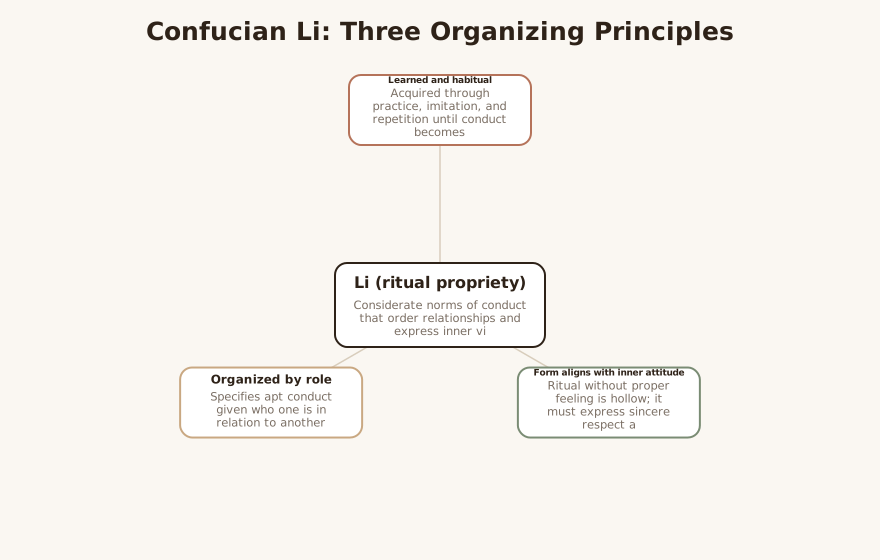
Several interlocking principles organize li for clinical use LLM.
First, ritual propriety is learned, embodied, and habitual. Li is not innate; it is acquired through practice, imitation, and repetition until appropriate conduct becomes natural 34. Confucius held that one is “established” by the rites — that disciplined practice of considerate forms shapes character over time 14. This is a behavioral, skills-acquisition logic: do the form well and repeatedly, and the disposition follows LLM.
Second, outward form and inner attitude must align. Confucius was emphatic that ritual performed without the proper inner feeling is hollow; he asked what ritual could mean to a person who lacked ren 34. Li is therefore not mere etiquette or social performance — it is the sincere, felt expression of respect and care, and going through the motions without the feeling is a failure of li, not a fulfillment of it 36.
Third, conduct is organized by relationship and role. Li specifies how one should act given who one is in relation to another — the conduct apt between parent and child, elder and younger, ruler and subject, friend and friend 25. Propriety is thus inherently relational and contextual: the same person owes different forms of conduct in different relationships 5. Scholarship frames li centrally as a structured way of showing respect — both to persons and to the order of relationships 6.
Fourth, propriety serves harmony, but harmony is not mere conformity. A well-known line in the tradition holds that “in the practice of li, harmony is to be prized” — propriety aims at smooth, considerate, conflict-reducing relations 45. Yet Confucius also taught that the exemplary person harmonizes without simply going along with everyone; li is not blind compliance, and rightness (yi) can require flexible or even corrective action rather than rote rule-following 14.
Interventions & Techniques
Li itself prescribes no clinical technique; the usable interventions come from the secular modalities that share its functional core LLM. The following are the most clinically translatable.
Relational-skills and “considerate conduct” practice. Helping clients identify and rehearse the small, concrete courtesies and respectful behaviors apt to a given relationship operationalizes li as a learnable skill rather than an abstraction 3LLM. The therapeutic move parallels the Confucian claim that character is built through repeated, embodied practice of appropriate forms 4.
Aligning behavior with felt value (form-and-sincerity work). Because li requires that outward conduct match inner attitude, a useful intervention surfaces the difference between performing relationship roles mechanically and acting from genuine care, then works to close that gap 36LLM. This is congruent with values-clarification and acceptance-and-commitment work, where committed action is meant to express, not merely simulate, what the person cares about LLM.
Role and relationship mapping. Because li is organized by role, charting a client’s significant relationships and the reciprocal conduct each implies — what is owed, expected, and offered in each — is a natural application, closely allied to family-systems and interpersonal-inventory methods 25LLM.
Respect-centered reframing of conflict. Framing interpersonal repair as the restoration of mutual respect and considerate conduct, rather than as winning or capitulating, draws directly on the scholarly reading of li as a structured expression of respect 6LLM.
LLM-generated illustrative example (not a guideline): An adult client is locked in escalating conflict with an aging parent and reports that “nothing I do is right.” Rather than adjudicating who is correct, the clinician explores what considerate conduct the client genuinely wants to offer in this relationship and what feels sincere versus merely dutiful. They rehearse one small, respectful ritual — a weekly call begun with a warm, specific greeting rather than a grievance. The aim is not to enforce deference but to let outward form and inner care realign, lowering the heat. LLM
Evidence Base
Honesty about maturity is essential. As a philosophical and cultural concept, li is firmly established: it is a central, well-attested doctrine documented across the Analects, the classical ritual texts, and two millennia of scholarship, and it is treated as foundational in standard academic references 134. “Established” here means a stable, thoroughly documented body of thought — not a validated clinical intervention LLM.
There is no body of randomized controlled trials testing “li therapy,” because li is not a discrete treatment LLM. The defensible clinical evidence belongs to the modalities that carry its functional core — social-skills training, family-systems therapy, interpersonal psychotherapy, and culturally adapted, values-based approaches — and clinicians should anchor evidentiary claims there rather than to the concept itself LLM. Stated plainly: the philosophy is mature; the clinical mechanisms it informs (relational-skills practice, role analysis, values-congruent action) have their own evidence bases; the concept as such has not been independently trialed and should not be presented to clients as a proven treatment LLM.
Populations & Indications
The framing is most apt for East Asian and Confucian-influenced clients and others from collectivist cultures, for whom role obligations, family duty, harmony, and “saving face” are salient organizing values; li offers a shared, culturally resonant vocabulary for relational work 25LLM. Using a client’s own ethical framework, rather than imposing an individualist one, can strengthen alliance and reduce the felt mismatch between therapy and home culture 6LLM.
It is also indicated, more loosely and as a metaphor, for families and couples working on respectful conduct and role expectations, and for clients with interpersonal difficulties or social-skills deficits, where concrete, learnable considerate behaviors are the therapeutic lever 5LLM. With adolescents negotiating autonomy against family role expectations, li can name the tension between self-expression and relational obligation without pathologizing either side LLM.
Problems-for-Work
Relationship and family conflict. A li-informed frame reorients conflict toward restoring mutual respect and considerate conduct apt to the relationship, rather than toward winning 56. The work targets the reciprocal forms each party owes and offers LLM.
LLM-generated illustrative example (not a guideline): A couple from a Confucian-influenced background argue chronically about a partner’s parents. Reframing the impasse as a question of what respectful conduct each spouse can sincerely offer the in-laws — and to each other — shifts the session from blame to negotiated, concrete courtesies both can live with. LLM
Social-skills deficits and interpersonal difficulties. Because li treats appropriate conduct as a learnable, practiced skill, it supports explicit rehearsal of role-apt, respectful behaviors 34LLM.
Role strain and moral/value conflicts. When a client is torn between competing duties (e.g., to parent versus to self), the li–yi relationship — propriety guided by rightness rather than rote compliance — provides language for flexible, principled action rather than rigid rule-following 14LLM.
Boundary difficulties and identity concerns. For clients negotiating selfhood within strong relational obligations, distinguishing sincere li from hollow performance helps clarify which obligations are genuinely valued and which are merely externally imposed 36LLM.
Contraindications, Cautions & Cultural Humility
The most important caution: li emphasizes harmony, role obligation, and deference, and a clinician who imports it carelessly can reinforce harmful conformity, silence, or submission — for example pressing an abused or exploited client toward “harmony” with a person who is harming them LLM. The tradition itself guards against this: harmony in li is paired with yi (rightness), and Confucius taught harmonizing without mere conformity, so propriety never licenses tolerating injustice 14. Clinically, client safety and rightness take precedence over smoothness; never use a harmony frame to override disclosure of abuse, coercion, or self-betrayal LLM.
Be alert to gendered and hierarchical readings. Historical applications of li encoded steep, sometimes oppressive hierarchies; a contemporary clinical use must foreground the concept’s respect-and-sincerity core, not its most authoritarian historical forms 26LLM.
Cultural humility runs in both directions. Li is a living ethical tradition, not a clinician’s prop; name its Confucian origins, hold it with respect, and do not present a stripped-down version as the whole tradition 13LLM. Crucially, do not assume a client holds these values because of their ethnicity — Confucian heritage is heterogeneous, and many clients reject or reinterpret it LLM. Offer the frame as a hypothesis to explore, follow the client’s own account of their values, and use the underlying secular mechanisms (skills practice, role analysis, values-congruent action) when the explicit philosophy does not fit 6LLM.
Treatment-Plan Suggestions & SMART Objectives
| Goal | SMART objective (example) | Mechanism |
|---|---|---|
| Reduce reactivity in a high-conflict family relationship | Within 6 weeks, client will initiate one respectful, role-apt courtesy with the identified relative weekly, logged 5 of 6 weeks | Considerate-conduct practice; respect as relational repair 56 |
| Align outward conduct with felt care | Within 8 weeks, client will identify and enact 2 behaviors per week that sincerely express care (vs. mechanical duty), reviewed in session | Form-and-sincerity alignment; li as expression of ren 34 |
| Build concrete social skills | Within 8 weeks, client will rehearse and use a role-appropriate respectful behavior in 3 of 4 targeted interactions (self-report) | Skills acquisition through embodied, repeated practice 34 |
| Clarify and negotiate role obligations | Within 6 weeks, client will map key relationships and the reciprocal conduct each implies, and name one obligation to renegotiate | Role/relationship analysis 25 |
| Resolve a duty-vs-self value conflict | Within 10 weeks, client will articulate a principled, value-guided action for one role conflict in 3 of 4 sessions | Li guided by yi (rightness over rote compliance) 14 |
| Reframe conflict as restoring respect | Within 8 weeks, client will reframe 1 recurring conflict per week as a respect-repair task rather than a win/lose contest | Respect-centered reframing 6 |
| Distinguish valued from imposed obligations | Within 10 weeks, client will sort recurring obligations into “sincerely valued” vs. “externally imposed” and act accordingly in 4 of 5 sessions | Sincerity discrimination; boundary clarification 36 |
Common Misconceptions
“Li just means etiquette or good manners.” This trivializes it; li is a comprehensive ethic of conduct that, done rightly, expresses sincere respect and care and shapes character — etiquette is only its surface 36. Manners performed without the inner attitude are precisely what Confucius criticized as empty 4.
“Li is mere outward performance / going through the motions.” The tradition explicitly rejects ritual emptied of feeling; without the proper inner disposition, the rite is hollow and fails as li 34. Outward form and inner sincerity are meant to be one thing 6.
“Li demands blind obedience and conformity.” Propriety aims at harmony, but Confucius taught harmonizing without conforming, and li is bounded by yi (rightness); it does not license submission to wrongdoing 14. Read well, it can authorize principled flexibility, not rote compliance 4.
“Li is the same as law.” Li works through internalized character and shared norms, not coercive rule; Confucius contrasted leading people by virtue and ritual — which cultivates a sense of shame and self-correction — with leading by punishment alone 14LLM.
Training & Certification
There is no certification in li as a clinical method, because it is a philosophical and cultural concept rather than a credentialed therapy LLM. Clinicians who wish to use its functional core responsibly should build competence in the modalities that carry it — family-systems therapy, interpersonal psychotherapy, social-skills training, and structured culturally responsive practice — and pursue general training in cultural competence with East Asian and collectivist populations LLM. Study of the source tradition deepens skillful, respectful use: accessible scholarly overviews of Confucius and of li in early Confucianism, and the focused literature on li as an expression of respect, are good starting points 1346. Familiarity with the tradition’s internal safeguards — the li–ren–yi relationship and the “harmony without conformity” teaching — protects against the conformist misreadings described above 14.
Key Terms
- Li (禮) — ritual propriety; the learned, considerate, role-attuned norms of conduct that order relationships and express inner virtue 23.
- Ren (仁) — benevolence, humaneness, co-humanity; the inner virtue that li outwardly expresses 14.
- Yi (義) — rightness or appropriateness; the standard that guides li and can override rote rule-following 14.
- Harmony (he, 和) — the smooth, considerate relational order that li aims at, “to be prized” yet not equated with mere conformity 45.
- Self-cultivation — the lifelong, developmental project of refining character through disciplined practice of the rites 14.
- Analects (Lunyu) — the recorded sayings of Confucius and his disciples, the primary source for li 14.
- Respect — in recent scholarship, the central organizing function of li: a structured way of showing respect to persons and relationships 6.
Resources & Further Reading
▶ Watch — a video introduction to this concept:
- Confucius — Stanford Encyclopedia of Philosophy
- Li (Confucianism) — Wikipedia
- Li (Ritual) in Early Confucianism — Radice (2017), Philosophy Compass
- Confucius — Internet Encyclopedia of Philosophy
- Li (rites) — New World Encyclopedia
- Respect and the Confucian concept of Li (ritual propriety) — Asian Philosophy (2020)
Reflective / Supervision Questions
- Am I offering li as a hypothesis to explore with this client, or assuming they hold Confucian values because of their ethnicity or background? 2LLM
- When I invoke harmony or role obligation, am I attending to yi (rightness) and client safety — never pressing a client toward “harmony” with someone who is harming them? 14LLM
- Am I working with the sincerity core of li (form aligned with felt care), or inadvertently coaching hollow performance and compliance? 36LLM
- Am I documenting the active clinical mechanism (relational-skills practice, role analysis, values-congruent action within a recognized modality), rather than charting a philosophy? LLM
- How am I holding cultural humility — naming the concept’s Confucian origins and avoiding a decontextualized or authoritarian-historical version? 13LLM
- For a client who rejects or reinterprets their Confucian heritage, can I offer the underlying secular mechanisms without imposing the explicit framework? 6LLM