
Type & Discipline
Complicated Grief Treatment (CGT) is a structured, manualized, time-limited psychotherapy developed within clinical psychology and psychiatry specifically to treat what is now formally recognized as Prolonged Grief Disorder (PGD) 4. It belongs to the family of grief-specific therapies — treatments designed not for depression or anxiety in general but for the distinct syndrome of grief that has failed to move toward integration 5. Unlike open-ended bereavement counseling, CGT is delivered as a defined sequence of approximately 16 sessions organized around a small set of explicit therapeutic procedures 1. It is fundamentally integrative in its borrowing, combining motivational, cognitive, behavioral, and exposure-based techniques, but it is unified by a single conceptual frame: an attachment-informed model of grief in which mourning is understood as the process of accommodating the reality of a loss while restoring a sense of meaningful ongoing life 5. The discipline matters clinically because CGT was built and validated by academic psychiatry and psychology, and its evidence base rests on randomized controlled trials rather than on clinical tradition alone 1.
Creators & Lineage
CGT was developed principally by M. Katherine Shear, a psychiatrist whose research program at the University of Pittsburgh and later at Columbia University established both the treatment and the diagnostic construct it targets 1. The treatment’s conceptual lineage draws heavily on the diagnostic work of Holly Prigerson, whose studies helped define and operationalize complicated (later prolonged) grief as a syndrome distinct from major depression and post-traumatic stress disorder 5. This distinction was the necessary precondition for a grief-specific therapy: if complicated grief were merely depression after a loss, antidepressants or generic depression treatment would suffice, but the data indicated otherwise 5.
Shear’s synthesis pulled together several established traditions LLM. From attachment theory it borrowed the premise that grief is the natural response to the rupture of an attachment bond and that healing involves revising the internalized representation of the relationship rather than erasing it 5. From the dual process model of coping with bereavement it took the idea that adaptive mourning oscillates between confronting the loss and restoring engagement with ongoing life, and it built that oscillation directly into the treatment’s twin goals 5. From cognitive-behavioral and exposure therapies it imported the structured procedures — graded exposure, revisiting, and behavioral re-engagement — that became the treatment’s most recognizable techniques 1. The work has since been institutionalized through Columbia’s Center for Prolonged Grief, which disseminates the treatment manual and trains clinicians 4.
Core Principles
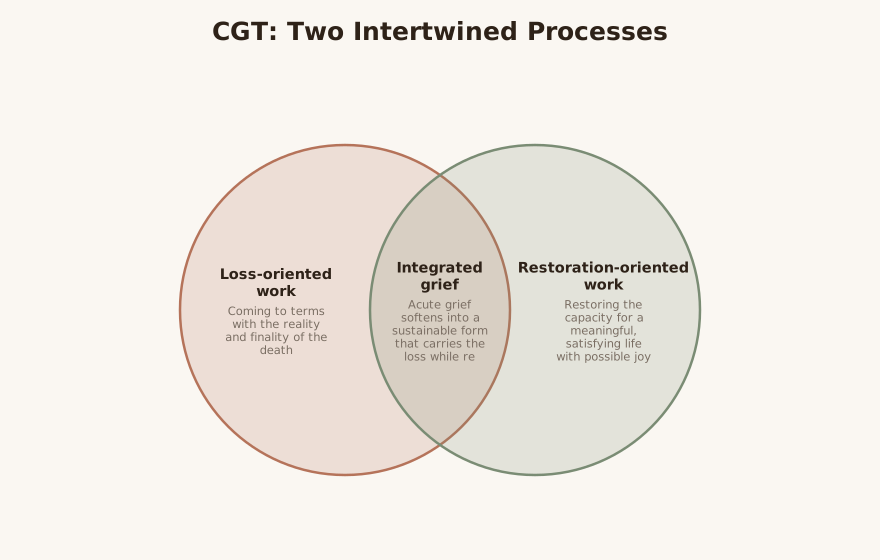
The organizing principle of CGT is that grief after a significant loss is natural and does not require treatment, but that grief can become “complicated” — stuck in a state of intense, persistent, and impairing acute grief — when something interferes with the mind’s natural adaptive process 5. The treatment’s central goal is therefore not to remove grief but to remove the obstacles to its integration, so that acute grief can soften into a sustainable, integrated form in which the person carries the loss while re-engaging with life 5.
Two intertwined processes anchor the work, mirroring the dual process model: coming to terms with the reality and finality of the death (loss-oriented work) and restoring the capacity for a meaningful and satisfying life with the possibility of joy (restoration-oriented work) 5. CGT proposes that complicated grief is sustained by characteristic complicating processes — most notably persistent avoidance of reminders of the loss, recurrent counterfactual and ruminative thinking (“if only” and “what if”), and the loss of a sense of purpose or a viable future 5. The treatment is structured into phases, beginning with psychoeducation and history, moving through the core revisiting and exposure procedures, and closing with consolidation and relapse prevention 4. A further principle is that the bereaved person remains connected to the deceased; the aim is to transform and re-locate that bond, not to sever it 5.
Rando’s Complicated Mourning and Anticipatory Mourning
A separate and older clinical lineage runs alongside Shear’s protocol and Worden’s tasks: the work of Therese A. Rando, whose Treatment of Complicated Mourning (1993) was the first book devoted specifically to grief that has gone awry 8. Rando’s contribution is not an alternative session protocol but a process map and a vocabulary — one many clinicians use to formulate where mourning has stalled before selecting a treatment such as CGT LLM. Her terminology is deliberate: she distinguishes grief, the reaction to a loss, from mourning, the wider set of conscious and unconscious processes by which a person adapts to that loss and to the assumptive world it has overturned 11. That distinction is why her framework describes processes rather than tasks, and why she argued for “anticipatory mourning” in place of “anticipatory grief” — the second term names only the feeling, while the first names the work 9.
The six R processes of mourning
Rando organizes mourning into six processes, grouped under three broad phases — avoidance, confrontation, and accommodation 8:
- Recognize the loss — acknowledging and understanding that the death has occurred; this is the single process of the avoidance phase 8.
- React to the separation — experiencing, identifying, and expressing the pain and the full range of reactions to the loss, including reactions to secondary losses 8.
- Recollect and re-experience the deceased and the relationship — realistically reviewing and remembering the person who died and reviving the feelings attached to the relationship 8.
- Relinquish the old attachments to the deceased and the old assumptive world — releasing what cannot continue in its former form, including the assumptions about life that the death has invalidated; processes two through four make up the confrontation phase 8.
- Readjust to move adaptively into the new world without forgetting the old — developing a revised relationship to the deceased, new ways of being in the world, and a new identity 8.
- Reinvest — putting emotional energy back into new people, roles, and goals; with readjustment this forms the accommodation phase 8.
The clinical payoff is Rando’s operational definition of the syndrome: complicated mourning is present when, taking into account the time elapsed since the death, there is some compromise, distortion, or failure of one or more of the six R processes 8. This converts “complicated grief” from a global impression into a locatable question — which process is blocked, and what is blocking it LLM. Framed that way, the six R’s sit comfortably alongside CGT rather than competing with it: a stalled recognize or react points toward the loss-oriented revisiting procedures, while a stalled readjust or reinvest points toward the restoration-oriented and motivational components LLM.
Anticipatory mourning
Rando’s second major contribution is the expansion of anticipatory grief into anticipatory mourning 9. Her earlier work on clinical intervention with the dying and their caregivers had already located grief in the period before a death rather than only after it 10. The mature framework reframes that period far more broadly: a process set in motion by awareness of a life-threatening or terminal condition in oneself or a loved one, involving the recognition of associated losses in the past, present, and future 12. Losses of the past are the shared history and the version of the relationship that can no longer be regained; losses of the present are the capacities, roles, and ordinary exchanges visibly eroding now; losses of the future are the anticipated events and years that will not be shared 12.
Rando describes anticipatory mourning as encompassing several simultaneous operations rather than a single emotional state — grief and mourning, coping, interaction, psychosocial reorganization, planning, balancing conflicting demands, and facilitating an appropriate death 12. It is also not the exclusive province of the survivor-to-be: the dying person, their loved ones, and professional or volunteer caregivers each undergo it from their own vantage point 9. This matters clinically for family caregivers and for patients with advanced or terminal illness, whose distress is often misread as premature or pathological when it is the ordinary work of mourning a loss already underway LLM.
Two cautions follow for CGT specifically LLM. The intuitive idea that anticipatory mourning “uses up” grief in advance and lightens what comes after does not hold as a simple subtraction, so a long illness should not be taken as evidence that later grief will be uncomplicated LLM. And anticipatory grief and anticipatory caregiver grief are legitimate problems-for-work in their own right before a death, but CGT is a post-loss treatment: its revisiting procedures presuppose a death that has already occurred and are not indicated for a client whose loved one is still living LLM.
LLM-generated illustrative example (not a guideline): A daughter caring for her mother through advanced dementia is told she is “grieving too early”; naming her experience as anticipatory mourning — losses of the past in the mother who no longer recognizes her, of the present in the caregiving role that has replaced their relationship, and of the future in the wedding her mother will not attend — legitimizes the work without implying she needs a post-loss grief protocol LLM.
Interventions & Techniques
CGT is delivered through a defined set of procedures, several of which are distinctive to the treatment 6. Early sessions emphasize psychoeducation about the model of grief and a motivational component aimed at building hope and clarifying the person’s own aspirations for life going forward 5. Clients complete a daily grief monitoring diary to track the natural variability of their grief and to identify what intensifies or eases it 6.
The treatment’s signature technique is imaginal revisiting of the death: with eyes closed, the client recounts the story of the death in the present tense, and the retelling is recorded so the client can listen between sessions, a procedure adapted from exposure therapy for trauma 6. A parallel procedure, the imaginal conversation with the deceased, invites the client to address the person who died directly and to imagine their response, allowing unspoken feelings to be voiced and the bond to be re-experienced and revised 6. Situational revisiting — graded in-vivo exposure to people, places, and activities the client has been avoiding since the loss — addresses behavioral avoidance and restores access to ordinary life 6. Throughout, the clinician helps the client revisit memories of the deceased, including positive ones, and engages restoration-focused work such as setting personal goals and re-establishing relationships 5. Sessions typically involve a support person at points in the treatment, and the work concludes with reflection on progress and planning for the future 4.
LLM-generated illustrative example (not a guideline): A man whose wife died suddenly has not entered their kitchen, where she collapsed, in eight months; situational revisiting builds a graded plan from standing in the doorway to making coffee there, while imaginal revisiting of the morning she died gradually loosens the intrusive replay that had kept the room sealed off LLM.
Evidence Base
The maturity of CGT is best described as established: it is supported by multiple randomized controlled trials conducted by independent and overlapping research groups 3. The foundational trial randomized adults with complicated grief to CGT or to interpersonal psychotherapy (IPT), a credible active comparator, and found that CGT produced significantly higher response rates and faster improvement than IPT 1. This was a meaningful result because it showed that a grief-specific treatment outperformed a respected general psychotherapy for the same patients 1.
A subsequent large optimization trial tested CGT against IPT and examined the added value of the antidepressant citalopram in a placebo-controlled design 2. The trial found that CGT was the more effective psychotherapy for complicated grief symptoms, and that adding an antidepressant did not improve grief outcomes beyond CGT itself, though medication had value for co-occurring depressive symptoms 2. Taken together with reviews of the broader field, the evidence indicates that grief-targeted cognitive-behavioral and exposure-based treatments, of which CGT is the most studied exemplar, are efficacious for prolonged grief disorder 3. Honest caveats remain LLM. Much of the strongest evidence comes from the developers’ own research programs, and effectiveness in routine, non-specialist settings is less extensively documented than efficacy in trials 3. Generalization across cultures, loss types, and underrepresented populations is still maturing, and the field continues to compare CGT with newer or briefer protocols 3.
Populations & Indications
CGT is indicated for adults who meet criteria for prolonged or complicated grief — that is, bereaved people whose acute grief has persisted at an intense, impairing level well beyond the early period of mourning, typically defined as at least six to twelve months after the death 4. The trials that established the treatment enrolled bereaved adults across a range of relationships to the deceased and causes of death, including older adults bereaved of a spouse 1. It is particularly relevant for losses that are sudden, violent, or otherwise traumatic, where avoidance and intrusive imagery tend to be prominent 6.
Because CGT was developed in part through suicide-prevention–oriented work, it is explicitly applicable to survivors of suicide loss, a population at elevated risk of complicated grief and of suicidal ideation themselves 6. The treatment is appropriate for people bereaved by deaths from chronic or terminal illness as well as by acute events, and it has been used with clients who carry comorbid depression or post-traumatic stress, provided the grief syndrome is the primary target 5. The defining indication is not the type of loss but the presence of persistent, impairing grief that has failed to integrate 5.
Problems-for-Work
CGT maps onto several discrete problems-for-work that a clinician can name and target LLM. For prolonged grief disorder and complicated grief as overarching syndromes, the whole protocol is indicated, sequencing loss- and restoration-oriented procedures to move stuck grief toward integration 4. For persistent yearning and preoccupation with the deceased, the imaginal conversation and revisiting of memories help the client re-experience and gradually transform the attachment bond 6.
For avoidance of reminders of the loss, situational revisiting provides graded in-vivo exposure that restores access to avoided places, activities, and relationships 6. For maladaptive grief-related thoughts and self-blame, including counterfactual “if only” rumination, the revisiting procedures and reflective discussion loosen the grip of these recurrent cognitions 5. For functional impairment after bereavement and stalled re-engagement with life and goals, the restoration-oriented and motivational components rebuild aspirations, structure, and connection 5.
LLM-generated illustrative example (not a guideline): A woman bereaved by her son’s overdose is consumed by “I should have known” rumination and has stopped seeing friends; the clinician pairs revisiting of the day she found him with restoration work that sets one small social goal per week, so that the self-blaming replay and the social withdrawal are addressed as two linked but distinct problems-for-work LLM.
Contraindications, Cautions & Cultural Humility
There are few absolute contraindications, but several cautions are important LLM. Because the revisiting procedures involve emotionally intense exposure to the story of the death, clinicians should assess for acute suicidality, severe untreated depression, and active substance use, and stabilize or sequence treatment accordingly before undertaking imaginal revisiting 6. The treatment is designed for complicated, not normal, grief; applying an intensive exposure protocol to a person who is grieving adaptively risks pathologizing a natural process and is not indicated 5. Clinicians should also be prepared for the fact that grief intensity often rises before it eases during revisiting, and should frame this for the client in advance LLM.
Cultural humility is essential because mourning practices, the meaning of death, and norms about continuing connection to the deceased vary profoundly across communities LLM. What counts as “prolonged” or “complicated” must be interpreted against the client’s own cultural and religious context rather than against a single timeline, and the clinician should treat the client as the authority on the meaning of their loss 5. The continuing-bonds orientation of CGT, which respects an ongoing relationship with the deceased, is often a point of alignment with culturally grounded mourning traditions, but it should be enacted in the client’s idiom, not the clinician’s LLM.
Treatment-Plan Suggestions & SMART Objectives
| Goal | SMART objective (example) | Mechanism |
|---|---|---|
| Build motivation and a sense of a viable future | Client will identify two personal aspirations and one concrete step toward each by week 4 | Motivational and restoration-oriented work 5 |
| Track grief variability and triggers | Client will complete the daily grief monitoring diary at least 5 days per week for 3 weeks | Grief monitoring 6 |
| Accept the reality and finality of the death | Client will complete imaginal revisiting of the death across 3 sessions with a 2-point drop in peak distress rating by week 8 | Imaginal revisiting / exposure 6 |
| Re-experience and re-locate the attachment bond | Client will complete one imaginal conversation with the deceased and reflect on it by week 9 | Imaginal conversation with the deceased 6 |
| Reduce avoidance of reminders | Client will complete a graded situational-revisiting hierarchy, reaching the top avoided activity by week 11 | Situational (in-vivo) revisiting 6 |
| Reduce self-blaming and counterfactual rumination | Client will reappraise one “if only” belief against the actual circumstances in session by week 10 | Cognitive reflection within revisiting 5 |
| Restore engagement with relationships and roles | Client will resume two previously valued activities or contacts weekly by week 13 | Restoration-oriented re-engagement 5 |
| Consolidate gains and plan for setbacks | Client will articulate a written relapse-prevention plan for anniversaries and reminders by week 16 | Consolidation and aftercare 4 |
Common Misconceptions
A frequent misconception is that CGT, with its exposure-based revisiting, aims to help the client “let go of” or sever their connection to the person who died LLM. In fact the treatment is explicitly attachment-based and works to transform and preserve the bond, helping the client carry the relationship forward in an integrated way rather than relinquish it 5. A second misconception is that complicated grief is simply depression following a loss and that antidepressants are the treatment of choice; the optimization trial showed that the grief-specific psychotherapy, not medication, drove improvement in grief itself 2.
A third error is to assume any competent bereavement counseling equals CGT LLM. The randomized comparison against interpersonal psychotherapy demonstrated that the specific CGT procedures outperformed a credible general therapy, indicating that the active ingredients are not generic support but the targeted revisiting and restoration work 1. Finally, some clinicians believe the treatment is open-ended; CGT is a defined, roughly 16-session protocol with a clear arc, not indefinite grief counseling 1.
Training & Certification
CGT is a manualized treatment, and competent delivery depends on training in its specific procedures rather than on grief counseling experience alone 4. The Center for Prolonged Grief at Columbia University serves as the central hub for the treatment manual, clinician training, and dissemination of the model 4. Foundational learning typically begins with the published treatment manual and with introductory presentations by the developer that lay out the model and its rationale 7. Clinicians seeking to deliver the protocol with fidelity generally pursue structured training and supervised practice in the core techniques — grief monitoring, imaginal revisiting, imaginal conversation, and situational revisiting — because these exposure-based procedures require skill to deliver safely and effectively 6. Familiarity with the diagnostic criteria for prolonged grief disorder and with validated grief-severity measures supports appropriate case selection and outcome tracking 4.
Key Terms
- Prolonged Grief Disorder (PGD) — the formally recognized syndrome of persistent, intense, impairing grief that CGT is designed to treat 4.
- Complicated grief — the earlier term for grief that is stuck in an acute, unintegrated state; effectively synonymous with PGD in this literature 5.
- Integrated grief — the adaptive end-state in which the loss is accommodated and the person re-engages with life while remaining bonded to the deceased 5.
- Imaginal revisiting — recounting the story of the death in the present tense, recorded for between-session listening, to reduce avoidance and intrusive distress 6.
- Imaginal conversation with the deceased — a procedure in which the client addresses the person who died and imagines their response 6.
- Situational revisiting — graded in-vivo exposure to avoided places, activities, and reminders 6.
- Dual process — the loss-oriented and restoration-oriented twin goals around which the treatment is organized 5.
- Mourning (Rando’s usage) — the conscious and unconscious processes of adapting to a loss, distinguished from grief, which is the reaction to it 11.
- Six R processes — Rando’s map of mourning — recognize, react, recollect and re-experience, relinquish, readjust, reinvest — grouped into avoidance, confrontation, and accommodation phases 8.
- Complicated mourning (Rando’s definition) — a compromise, distortion, or failure of one or more of the six R processes, judged against the time elapsed since the death 8.
- Anticipatory mourning — mourning of past, present, and feared-future losses that begins before a death, experienced by the dying person, loved ones, and caregivers alike 9.
- Assumptive world — the set of beliefs and expectations about life that a death invalidates and that mourning must revise 8.
Resources & Further Reading
▶ Watch — a video introduction to this concept:
- Shear et al. (2005). Treatment of Complicated Grief: A Randomized Controlled Trial (JAMA)
- Shear et al. (2016). Optimizing Treatment of Complicated Grief: A Randomized Clinical Trial (JAMA Psychiatry, PDF)
- State of the Science: Psychotherapeutic Interventions for Prolonged Grief Disorder (PMC)
- Prolonged Grief Treatment Manual — Center for Prolonged Grief, Columbia
- CE Corner: New paths for people with prolonged grief disorder (APA)
- Complicated Grief Treatment (CGT) — Suicide Prevention Resource Center fact sheet (PDF)
- Introduction to Complicated Grief Treatment — M. Katherine Shear (YouTube)
- Rando, T. A. (1993). Treatment of Complicated Mourning (Research Press — catalog record)
- Rando, T. A. (Ed.) (2000). Clinical Dimensions of Anticipatory Mourning (Research Press — catalog record)
- Rando, T. A. (1984). Grief, Dying, and Death: Clinical Interventions for Caregivers (Research Press — catalog record)
- Rando, T. A. (2013). On achieving clarity regarding complicated grief (in Stroebe, Schut, & van den Bout, Complicated Grief, Routledge)
- Martino et al. (2022). Anticipatory Mourning and Narrative Meaning-Making in the Younger Breast Cancer Experience (Behavioral Sciences, PMC)
Reflective / Supervision Questions
- How do I distinguish a client whose grief is genuinely complicated and would benefit from CGT from one who is grieving intensely but adaptively, and what would change my mind in either direction? LLM
- When I plan imaginal or situational revisiting, how do I assess and manage risk — suicidality, dissociation, substance use — before and during the exposure work? 6
- How comfortable am I with grief intensity rising during revisiting, and how does my own discomfort shape whether I press forward or pull back? LLM
- Whose cultural and spiritual framework defines what a “prolonged” or “complicated” grief looks like for this client, and how do I keep the client as the authority on the meaning of their loss? 5
- For a survivor of suicide or violent loss, how do I balance the exposure-based core of CGT with the need for stabilization and safety planning? 6
- If I map this client’s stuckness onto Rando’s six R processes, which process is actually compromised, and does that change which CGT procedure I lead with? 8
- When a client is mourning a loss that has not yet happened, am I offering support for anticipatory mourning, or am I reaching for a post-loss protocol before there is a loss to revisit? 9