
Type & Discipline
PANIC/GRIEF is a construct drawn from affective neuroscience, not a treatment model or a stand-alone diagnosis LLM. It names one of seven genetically provided, subcortically situated primary-process emotional systems first mapped by Jaak Panksepp 1. Within that taxonomy it is the separation-distress system — the circuitry that generates the acute psychic pain of social loss and the motivational engine of attachment 1. For clinicians, its value is explanatory rather than procedural: it offers a neurobiological vocabulary for why losing, or fearing the loss of, an attachment figure hurts in a way that feels categorically different from physical fear or anger 1. Understanding the construct does not prescribe a technique; it reframes presentations such as grief, separation anxiety, panic, and a major subtype of depression as expressions of a single, evolutionarily ancient distress circuit 1. This article treats PANIC/GRIEF as a lens that can be layered onto attachment-oriented and emotion-focused work, while staying honest about which claims are established and which remain hypotheses LLM.
Creators & Lineage
The system was named and neurally mapped by Jaak Panksepp, the affective neuroscientist who founded the field and capitalized the seven primary systems to mark their primary-process nature 1. The depression-focused synthesis most relevant to clinicians is Panksepp’s work with Douglas Watt, who extended John Bowlby’s account of separation, protest, and despair into a neurobiological model 1. Bowlby’s attachment theory is the conceptual parent: Panksepp’s contribution was to identify the actual brain circuitry beneath Bowlby’s “protest” and “despair” phases 1. The construct sits within Panksepp’s broader Seven Primary Emotional Systems — SEEKING, RAGE, FEAR, LUST, CARE, PANIC/GRIEF, and PLAY 1. More recent custodians, including Christian Montag and colleagues, have consolidated the framework and developed personality measures derived from it 2. The lineage thus braids three strands: Bowlbian attachment theory, Pankseppian affective neuroscience, and the oxytocin/endogenous-opioid social-bonding neurochemistry that the system runs on 1.
Core Principles
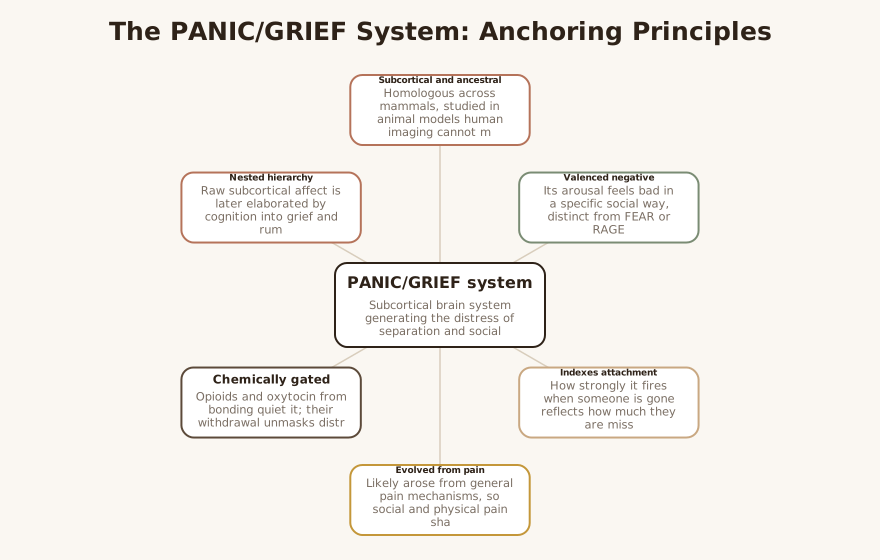
Several principles anchor the construct. First, primary emotional systems are subcortical and ancestral — homologous across mammals, which is why their causal anatomy can be studied in animal models that human imaging cannot match 1. Second, PANIC/GRIEF is valenced negative: its arousal feels bad in a specific, social way, distinct from FEAR or RAGE 1. Third, the system indexes attachment — Panksepp argued that how strongly the system fires when someone is gone reflects how much that person is missed; if someone is never missed, no attachment existed 1. Fourth, the system likely evolved from general pain mechanisms, which grounds the now-familiar idea that “social pain” and physical pain share machinery 1. Fifth, its activity is chemically gated: contact and bonding release endogenous opioids and oxytocin that quiet the system, while their withdrawal unmasks distress 45. Finally, the construct sits inside a nested hierarchy in which raw subcortical affect is later elaborated by cognition — separation panic in an infant becomes grief, loneliness, and rumination in a reflective adult 5.
Interventions & Techniques
PANIC/GRIEF is a construct, so it carries no proprietary techniques of its own; clinical application means choosing established modalities whose mechanisms plausibly engage the system LLM. The source literature points in one direction: because the system is quieted by social bonding and its opioid/oxytocin chemistry, interventions that promote reconnection and reattachment are the logical lever 1. Panksepp and Watt explicitly argued that psychotherapy promoting the positive hedonics of the CARE (nurturance, empathy) and PLAY systems may improve outcomes and offer long-term protection against depressive relapse 1. Translated into practice, that favors attachment-based and emotion-focused approaches that deepen rather than suppress attachment affect, restore felt safety with significant others, and rebuild social engagement LLM. Adjuncts that re-recruit the SEEKING system — behavioral activation, re-engagement with goals and meaning — address the despair phase in which SEEKING has shut down 1. The construct cautions against treating attachment pain purely as a cognitive error to be disputed; the affect is a real signal from an ancient system, and the work is to metabolize and re-anchor it socially LLM.
LLM-generated illustrative example (not a guideline): A client whose partner has moved out describes a “physical ache” and an inability to be alone. Rather than challenging the thought “I can’t cope,” the clinician names the ache as the separation-distress system firing — an old, adaptive alarm for lost connection — and the work turns toward tolerable contact, grieving, and rebuilding a support network. LLM
Evidence Base
Honesty here requires a clean split. The construct itself is established: the separation-distress system has a mapped neuroanatomy, a characterized neurochemistry, and cross-species homology — birds possess a comparable system, and its circuitry has been localized through brain-stimulation mapping in animals 1. The neuroanatomy is reported consistently: PANIC/GRIEF circuitry begins in the periaqueductal gray, ascends through the dorsomedial thalamus, and terminates in basal forebrain nuclei and the subcallosal anterior cingulate 1. Corroborating reviews add the bed nucleus of the stria terminalis and ventral septal area to that map 3. The neurochemistry is likewise specified: declining opioid and oxytocin tone plus elevated corticotropin-releasing factor and glutamatergic drive promote separation calls, while opioids, oxytocin, and prolactin reduce them 13. What is not established is the clinical translation. The depression model — sustained PANIC overactivation cascading into a SEEKING-shutdown “despair” phase — is a theoretically grounded extension of Bowlby, not a settled mechanism, and the authors note the protest-to-despair transition remains poorly understood 1. The associated pharmacology (ultra-low-dose buprenorphine, oxytocin or prolactin facilitators) is explicitly hypothesis-stage; Panksepp and Watt note that addiction phobia “precluded full empirical evaluation” of opioid antidepressants 1. Treat the circuit as real and the therapeutics as preliminary LLM.
Populations & Indications
The construct is most illuminating wherever the presenting pain is fundamentally about lost or threatened connection LLM. That includes individuals in grief and bereavement, for whom the framework normalizes the bodily intensity of loss 1. It speaks to people with separation anxiety and children and adolescents, in whom separation distress is most raw and least cognitively buffered 5. It is relevant to people with attachment trauma, where early disruptions in the opioid/oxytocin bonding chemistry may sensitize the system 5. It maps onto a major subtype of depression — Panksepp long regarded depression as substantially a PANIC/GRIEF phenomenon, with social loss as its biggest epidemiological stressor 14. And it offers a frame for panic disorder, where the construct invites attention to underlying separation themes rather than treating panic as purely a misfiring fear alarm LLM. Across all of these, indication is conceptual: the construct helps formulate, not diagnose LLM.
Problems-for-Work
The construct generates concrete clinical targets. For complicated grief, it frames prolonged, non-resolving distress as a separation-distress system that has not been able to re-anchor, validating intensity without pathologizing it 1. For major depressive disorder of the social-loss subtype, it directs attention to two layers — the residual psychic pain of separation and the diminished SEEKING that produces lassitude and anhedonia — suggesting that reconnection and re-engagement be worked in parallel 1. For loneliness and social loss, the explainer literature describes a self-perpetuating loop in which isolation lowers the very bonding chemistry that would relieve it 5. For abandonment fears and attachment-related distress, the construct reframes hypervigilance to a partner’s availability as an over-tuned alarm rather than a character flaw LLM. For separation anxiety in younger clients, it supports graded, supported separation that lets the system learn safety LLM.
LLM-generated illustrative example (not a guideline): A teenager refuses school and reports nausea each morning before leaving home. Formulated through PANIC/GRIEF, the somatic distress is read as separation alarm rather than defiance, and the plan pairs graded, supported separations with reliable reunion routines. LLM
Contraindications, Cautions & Cultural Humility
There are no “contraindications” for a construct, but there are real cautions LLM. First, do not pathologize normal grief: separation distress after a genuine loss is the system working correctly, and the goal is metabolizing it, not eliminating it 1. Second, resist neuro-reductionism — telling a grieving client their pain is “just opioids withdrawing” can feel invalidating and is scientifically over-confident given the construct’s preliminary clinical translation LLM. Third, be cautious with the pharmacological narrative: the explainer sources make brisk claims about opioids as fast antidepressants, but the primary literature treats this as untested and addiction-laden, so it must not migrate into clinical guidance 15. Fourth, exercise cultural humility about grief and separation norms — the duration, expression, and social choreography of mourning vary widely across cultures, and what looks like “complicated” grief in one context may be normative in another LLM. The construct describes a universal substrate; its surface expression is culturally shaped LLM.
Treatment-Plan Suggestions & SMART Objectives
| Goal | SMART objective (example) | Mechanism |
|---|---|---|
| Reduce acute separation distress | Within 8 weeks, client reports a 30% drop in distress-rating during planned separations from a key attachment figure | Repeated supported separation-and-reunion allows the system to register safety, lowering protest-phase arousal 1 |
| Re-anchor social connection | Over 6 weeks, client initiates two meaningful in-person contacts weekly, logged in session | Restored bonding raises endogenous opioid/oxytocin tone that quiets PANIC/GRIEF 45 |
| Reactivate SEEKING in despair | Within 4 weeks, client resumes one valued goal-directed activity 3x/week | Behavioral re-engagement counters the SEEKING-shutdown of the despair phase 1 |
| Process complicated grief | Over 12 sessions, client narrates the loss without dissociating, rated by clinician observation | Tolerated emotional approach lets separation affect be metabolized rather than avoided 1 |
| Build affect-labeling capacity | Within 6 weeks, client names the separation-distress signal vs. fear/anger in 4 of 5 logged episodes | Distinguishing primary systems reduces conflation and reactive secondary responses 1 |
| Recruit CARE and PLAY | Over 8 weeks, client engages in one nurturing and one playful social activity weekly | Positive social systems offer hypothesized protective, mood-lifting effects 1 |
| Reduce abandonment-driven reactivity | Within 10 weeks, client uses a self-soothing skill before contacting a partner in 70% of urge episodes | Down-regulating an over-tuned separation alarm interrupts protest-driven behavior LLM |
Common Misconceptions
Several errors recur. The first is treating PANIC/GRIEF as the fear system — the name misleads, because the “panic” here is separation panic, anatomically and chemically distinct from the FEAR circuit 1. The second is assuming the construct is a therapy one can be certified in; it is a neuroscience model, not a modality LLM. The third is collapsing it into a serotonin-deficit story of depression — the whole point of Panksepp and Watt’s argument is that general amine theories fail to explain why depression specifically hurts, which the separation-distress account does 1. A fourth misconception is that the opioid pharmacology is ready for clinical use; the primary literature treats it as promising but unevaluated 1. A fifth is reading “social pain shares machinery with physical pain” as mere metaphor — Panksepp’s claim is that the separation system likely evolved from physical-pain mechanisms, a literal evolutionary hypothesis 1.
Training & Certification
There is no certification in PANIC/GRIEF because it is a construct, not a credentialed treatment LLM. Clinicians who want to work fluently with it train instead in the modalities that engage attachment affect — emotion-focused and attachment-based therapies — and in the underlying affective neuroscience LLM. The accessible entry points are Panksepp’s own primary writing on the seven systems and the depression synthesis with Watt, supplemented by consolidating reviews from Montag and colleagues that summarize the principles and the derived personality measures 12. Familiarity with Bowlbian attachment theory is effectively prerequisite, since the protest-despair model is its direct descendant 1. For most practitioners the realistic goal is conceptual fluency — using the construct to formulate cases and explain affect to clients — rather than any formal designation LLM.
Key Terms
Separation distress / protest — the acute, agitated response to social loss, Bowlby’s “protest,” that follows separation especially in the young 1. Despair phase — the later behavioral shutdown, marked by lassitude and diminished SEEKING, into which prolonged protest can cascade 1. SEEKING — the dopaminergic appetitive system whose down-regulation produces depressive anhedonia and apathy 1. CARE / PLAY — positive social systems whose recruitment Panksepp proposed as protective and therapeutic 1. Endogenous opioids — neuropeptides released by bonding that quiet separation distress 45. Oxytocin and prolactin — neurochemicals that reduce separation-distress responses 3. Periaqueductal gray (PAG) — midbrain origin of the PANIC/GRIEF circuit 1. Subcallosal anterior cingulate — forebrain terminus of the circuit, a deep-brain-stimulation target in treatment-resistant depression 1.
Resources & Further Reading
▶ Watch — a video introduction to this concept:
- Panksepp & Watt (2011), Why does depression hurt? PANIC/GRIEF and SEEKING in depressive affect
- Montag & Panksepp, Selected Principles of Pankseppian Affective Neuroscience (PMC full text)
- Selected Principles of Pankseppian Affective Neuroscience (Frontiers in Neuroscience full text)
- The Seven Emotional Systems of Jaak Panksepp (explainer)
- PANIC/GRIEF (clinical explainer)
- Separation Distress and Panic (book chapter)
- Primary-process separation-distress (PANIC/GRIEF) and reward eagerness (SEEKING) in the ancestral genesis of depression (book chapter)
Reflective / Supervision Questions
- When a client’s distress is fundamentally about lost connection, do I find myself disputing the thought rather than honoring the affective signal — and what would change if I treated the pain as an ancient system working as designed? LLM
- Can I reliably distinguish, in my own formulation, separation distress (PANIC/GRIEF) from fear-driven anxiety, and does that distinction change the intervention I reach for? LLM
- For a depressed client, am I attending to both layers — the residual pain of loss and the shut-down of SEEKING — or defaulting to one? LLM
- How do I hold the construct’s explanatory power without sliding into neuro-reductionism that invalidates a grieving client? LLM
- Where might my own cultural assumptions about “normal” versus “complicated” grief be shaping whom I judge to be stuck? LLM
- Am I representing the opioid/oxytocin pharmacology to clients and supervisees as the preliminary hypothesis it is, rather than settled treatment? LLM