
Type & Discipline
The Dual Process Model of Coping with Bereavement (DPM) is a theoretical model within the psychology of grief and bereavement 1. It is not a manualized treatment protocol but a descriptive account of how people cope adaptively after a death, and of the stressors and coping processes that bereavement sets in motion 1. Clinically, it functions as a conceptual lens — a way of understanding what a grieving client is doing and what a healthier trajectory might look like — rather than a step-by-step intervention sequence LLM. Because it describes process rather than prescribing technique, the DPM is most useful when integrated into an existing therapeutic frame rather than applied as a standalone therapy LLM.
The model belongs to the broader family of process-oriented grief theories that arose in deliberate contrast to stage and phase models, and it sits alongside frameworks such as Worden’s task model and the continuing bonds tradition in the post-1990s reconceptualization of mourning 3. Its disciplinary home is empirical and clinical bereavement research, and its authors framed it explicitly as a research-generating heuristic open to revision 2.
Creators & Lineage
The DPM was developed by Margaret Stroebe and Henk Schut, bereavement researchers at Utrecht University, and articulated in their 1999 Death Studies paper “The Dual Process Model of Coping with Bereavement: Rationale and Description” 1. The model emerged from dissatisfaction with two prevailing ideas: that grief proceeds through fixed stages, and that “grief work” — the sustained, effortful confrontation of loss — is uniformly necessary for healthy adjustment 1. Stroebe and Schut argued that the grief-work hypothesis was both under-supported and culturally narrow, and that a more complete account had to include the practical, restorative demands of life after loss 1.
A decade later, the authors revisited the model in “The Dual Process Model of Coping with Bereavement: A Decade On,” refining its constructs, responding to critiques, and acknowledging which elements had and had not been empirically supported 2. This follow-up is important for clinicians because the authors themselves are candid about the model’s evidentiary limits and about the difficulty of measuring its central mechanism 2. Subsequent investigators have tested DPM constructs in specific populations, including older adults, extending the lineage into later-life bereavement research 6.
Core Principles
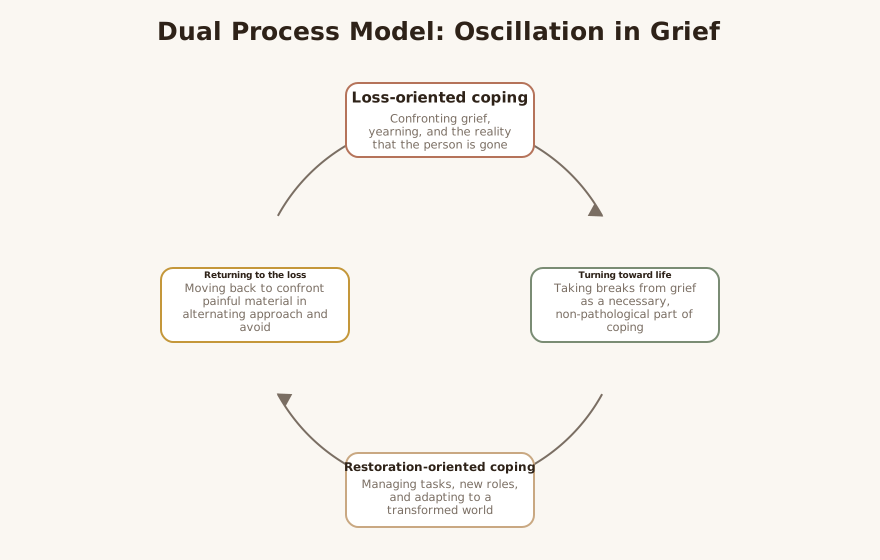
The DPM proposes that bereaved people face two qualitatively different categories of stressor 1. Loss-oriented stressors center on the loss itself — grief, yearning, rumination about the deceased, sorrow, and the emotional work of confronting that the person is gone 1. Restoration-oriented stressors center on the secondary consequences of loss — managing practical tasks, taking on new roles and responsibilities, building a changed identity, and re-engaging with everyday life 1. Restoration here does not mean “getting over it”; it means adapting to a transformed world 3.
The model’s defining claim is oscillation: adaptive coping involves moving back and forth between confronting the loss and attending to restoration, alternately approaching and avoiding each kind of stressor 1. Rather than grieving continuously, healthy mourners take breaks from grief, and those breaks are not pathological denial but a necessary part of the process 4. Oscillation also operates between confrontation and avoidance within each orientation, so that a person both faces and turns away from painful material over time 1.
A further principle is that everyday life experience continues throughout — the bereaved person is not in a sealed grieving state but is always also living, working, and relating 4. Stroebe and Schut later emphasized that what matters is the dynamic regulation of attention between these processes, and that problems can arise when a person becomes stuck in one orientation, either unable to disengage from loss-oriented rumination or rigidly avoiding it through relentless restoration activity 2. The model thereby reframes “avoidance” itself: temporary, flexible avoidance is functional, whereas chronic, rigid avoidance is not 2.
Interventions & Techniques
The DPM does not specify a fixed set of procedures; clinical applications are best described as DPM-informed and are layered onto whatever modality the clinician already uses LLM. The first move is usually normalization — explaining oscillation and validating that taking breaks from grief, laughing, returning to work, or feeling temporary relief does not betray the deceased 4. For many clients this directly relieves guilt about not grieving “correctly” or “enough” 7.
A second application is assessment of coping balance: where is this client spending time? A client locked in loss-orientation may benefit from gentle, structured support for restoration tasks, while a client who is over-functioning and never confronting the loss may need permission and scaffolding to approach grief 2. Because rigid dominance of either orientation is the concern, the therapeutic aim is flexibility of movement rather than a target ratio 2.
LLM-generated illustrative example (not a guideline): A widower three months out reports that he has “kept busy” — repainting the house, taking on extra shifts — and has not cried since the funeral. Rather than pushing him to “feel his feelings,” the clinician names the restoration-orientation he has been living in, validates that it has kept him upright, and then collaboratively introduces small, time-limited loss-oriented contact (looking at one photograph, writing one short letter) so that approach and avoidance can begin to alternate. LLM
Concrete DPM-informed techniques drawn from compatible modalities include structuring sessions to touch both orientations, scheduling restoration-oriented behavioral tasks, using exposure-style graded contact with avoided grief cues, and explicitly building in permission for breaks LLM. The model pairs naturally with behavioral activation, with cognitive work targeting beliefs like “if I stop grieving I’ll forget her,” and with meaning-oriented and narrative approaches LLM.
Evidence Base
The DPM’s evidentiary status is best described as established as a framework but thinner as a tested mechanism 2. It is among the most widely cited and clinically adopted contemporary grief models, has strong face validity, and has reshaped how practitioners conceptualize mourning away from linear stages 3. In that sense its influence is well-established 3.
However, the authors themselves, in the 2010 “Decade On” review, are explicit that the core construct — oscillation — is difficult to operationalize and has been hard to measure directly, so the central mechanism remains under-tested compared with the strength of the model’s adoption 2. Much supporting evidence is indirect or correlational, and the model has functioned more as a generator of hypotheses than as a closed, validated theory 2. Empirical examinations in specific groups, such as a study of loss and restoration in later life, offer partial support for the model’s distinction between orientations while also illustrating the measurement challenges 6. Clinicians should therefore treat the DPM as a credible, useful organizing framework, not as an intervention with a robust randomized-trial evidence base behind a defined procedure LLM.
Populations & Indications
The DPM was developed for bereaved adults generally and is broadly applicable across loss types, including the death of a spouse, partner, parent, or child 1. It is particularly well-suited to clients who present as “stuck” — either unable to disengage from grief or rigidly avoiding it — because the model directly addresses imbalance between orientations 2. It is frequently used with widows and widowers and with bereaved parents and partners, where both the emotional loss and the restructuring of daily life are pronounced 7.
The model has been examined specifically in older adults, a population for whom restoration demands (managing a household alone, navigating new financial or caregiving roles) can be especially salient and for whom the DPM’s dual focus maps well onto lived experience 6. It is also a helpful lens for clients showing features of prolonged or complicated grief, where oscillation appears to have collapsed into one dominant mode 2.
Problems-for-Work
The model translates into several discrete problems-for-work that clinicians can name and track LLM.
- Avoidance of grief cues / loss-oriented confrontation. A client who systematically avoids reminders of the deceased can be supported in graded, tolerable approach so that avoidance becomes flexible rather than total 2.
- Inability to disengage from rumination or yearning. A client who cannot leave loss-orientation may be helped to build restorative footholds — small re-engagements with work, relationships, or routine 2.
- Difficulty resuming roles and daily functioning. Restoration tasks such as managing finances or household roles become explicit collaborative targets 1.
- Guilt about taking breaks from grief. Psychoeducation that breaks are adaptive directly addresses the belief that respite equals betrayal 4.
- Role and identity disruption after loss. The model frames identity reconstruction as legitimate restorative work rather than a distraction from “real” grieving 1.
Contraindications, Cautions & Cultural Humility
The DPM is a low-risk conceptual framework rather than an invasive procedure, so it has few hard contraindications, but several cautions matter LLM. First, the model should not be wielded prescriptively — telling a client they are oscillating “wrong” or pushing a particular balance can replicate the very rigidity the model warns against; the therapeutic stance is to support flexibility, not impose a schedule 2. Second, the original grief-work critique was partly a cultural one: Stroebe and Schut argued that the assumption that everyone must intensively confront loss is culturally specific, so clinicians should hold expectations about “healthy” grieving lightly across cultural, religious, and individual differences 1.
Mourning rituals, the meaning of continued bonds with the deceased, expected timelines, and the acceptability of visible distress vary widely across cultures, and the balance between loss- and restoration-oriented coping that looks adaptive in one context may not transfer to another LLM. Finally, the DPM describes normal adaptive grief and is not itself a diagnostic instrument; where a client meets criteria for prolonged grief disorder, depression, or trauma, the model can inform but should not replace appropriate assessment and treatment planning LLM.
Treatment-Plan Suggestions & SMART Objectives
| Goal | SMART objective (example) | Mechanism |
|---|---|---|
| Restore flexible oscillation | Within 8 weeks, client will report at least one daily instance of intentionally shifting attention between grief and a restorative activity, logged in a simple diary | Re-establishes adaptive movement between orientations 1 |
| Reduce guilt about respite | Within 4 sessions, client will verbally endorse that taking breaks from grief is adaptive, rated on a 0–10 belief scale shifting by ≥3 points | Cognitive reframe of breaks as functional, not betrayal 4 |
| Build restoration-oriented engagement | Over 6 weeks, client will resume or initiate two concrete daily-life roles (e.g., one household, one social) and report on adjustment weekly | Activates restoration-oriented coping and identity rebuilding 1 |
| Tolerate loss-oriented confrontation | Within 6 weeks, client will complete three graded, time-limited contacts with avoided grief cues without escalating distress beyond a pre-agreed threshold | Converts rigid avoidance into flexible, tolerable approach 2 |
| Interrupt rumination lock | Within 8 weeks, client will reduce self-reported uninterrupted rumination episodes from daily to ≤2 per week using a planned restorative shift | Enables disengagement from dominant loss-orientation 2 |
| Reconstruct disrupted identity | Over 10 weeks, client will articulate two elements of a revised self-narrative incorporating the loss, documented in session | Supports identity adaptation as restorative work 1 |
| Normalize the grief course | Within 2 sessions, client will describe their own grief in DPM terms and identify their current dominant orientation | Psychoeducation reduces pathologizing of normal fluctuation 3 |
Common Misconceptions
A frequent misconception is that the DPM is a stage model in which a person moves from loss-orientation “to” restoration-orientation; in fact the model’s whole point is non-linear, back-and-forth oscillation with no fixed endpoint 1. A second is that restoration-orientation means “moving on” or “getting over” the loss — it means adapting to a changed life, and continuing connection to the deceased is fully compatible with it 3.
A third misconception is that avoidance is always pathological; the DPM explicitly treats temporary, flexible avoidance as a healthy regulatory move, reserving concern for rigid, chronic avoidance 2. A fourth is that the model is a validated treatment protocol; it is a descriptive framework whose central mechanism the authors acknowledge is still under-tested 2. Finally, some assume oscillation must be balanced 50/50, when the model only requires flexible movement, not a particular ratio 2.
Training & Certification
There is no formal certification in the Dual Process Model, and none is required to apply it LLM. The DPM is part of standard graduate and continuing-education curricula on grief and bereavement, and clinicians typically encounter it within broader thanatology or grief-therapy training rather than as a credentialed modality LLM. The most direct way to develop competence is to read the primary sources — the 1999 rationale paper and the 2010 review — and to integrate the model under supervision into a modality in which one is already trained, such as cognitive behavioral therapy or a meaning-oriented approach 12. Organizations focused on bereavement support also provide accessible practitioner-oriented overviews of the model 5.
Key Terms
- Loss-oriented coping — confronting and processing the loss itself, including grief, yearning, and rumination about the deceased 1.
- Restoration-oriented coping — adapting to the secondary consequences of loss: new roles, tasks, identity, and re-engagement with life 1.
- Oscillation — the dynamic, non-linear alternation between (and within) the two orientations that defines adaptive coping 1.
- Confrontation–avoidance — the regulatory dimension along which a person approaches or turns away from stressors; flexible avoidance is adaptive, rigid avoidance is not 2.
- Everyday life experience — the ongoing background of living, working, and relating that continues throughout bereavement 4.
- Grief-work hypothesis — the older assumption, which the DPM critiques, that intensive confrontation of loss is universally required for healthy adjustment 1.
Resources & Further Reading
▶ Watch — a video introduction to this concept:
- Stroebe & Schut (1999), Death Studies — Rationale and Description
- Stroebe & Schut (2010), OMEGA — A Decade On
- Richardson (2010), Loss and restoration in later life (PubMed)
- Dual process model of coping — Wikipedia
- Dual Process Model of Grief (Stroebe & Schut) — The Loss Foundation
- Grief Theory 101: The Dual Process Model of Grief — What’s Your Grief
- The Dual-Process Model of Grief — Psychology Today
Reflective / Supervision Questions
- When I assess a grieving client, do I implicitly expect linear progress, and how might that bias nudge them toward one orientation over the other? LLM
- Am I able to distinguish a client’s flexible, adaptive avoidance from rigid, chronic avoidance, and what observable markers do I use? LLM
- How do my own cultural assumptions about “proper” grieving shape which orientation I unconsciously validate in session? LLM
- For a client who is stuck, am I helping restore flexible movement between orientations, or am I prescribing a balance that imposes a new rigidity? LLM
- Where am I treating the DPM as if it were an evidence-validated procedure rather than a useful framework, and does that overconfidence affect how I plan treatment? LLM