
Type & Discipline
Meaning reconstruction in grief is a theoretical model and clinical framework rather than a single manualized protocol, situated at the intersection of thanatology, counseling psychology, and constructivist psychotherapy 1. It belongs to the family of constructivist grief theories, which treat human beings as active meaning-makers who organize experience through self-narratives and personal constructs rather than as passive recipients of stressful events 1. Within this tradition, bereavement is understood not primarily as a set of symptoms to be reduced but as a disruption of the meaning structures through which a person has anchored identity, relationships, and expectations of the world 5. The model therefore functions less as a stand-alone modality and more as an organizing lens that can inform assessment, formulation, and a wide range of grief-focused interventions LLM. Clinicians most often encounter it integrated with narrative, existential, and cognitive-behavioral methods rather than practiced in isolation LLM.
Creators & Lineage
The model is most closely associated with Robert A. Neimeyer, whose constructivist program reframed grief work around the central process of reconstructing a world of meaning disrupted by loss 3. Neimeyer’s edited volume Meaning Reconstruction and the Experience of Loss consolidated this perspective and gathered empirical and clinical contributions that positioned meaning-making as the central process of grieving 2. His later writing extended the framework specifically to complicated grief, arguing that constructivist concepts could account for why some losses overwhelm a person’s capacity to assimilate them 1.
The lineage draws on several intellectual currents LLM. From constructivist psychology and personal construct theory it inherits the premise that people anticipate and interpret events through self-authored systems of meaning 3. From narrative therapy it borrows the practices of storying and reauthoring lived experience LLM. The dual process model of coping with bereavement contributes the idea that mourners oscillate between loss-oriented and restoration-oriented activity, a rhythm that meaning reconstruction situates within ongoing identity revision LLM. Continuing bonds theory supplies the corollary that healthy grieving often involves transforming, rather than severing, the relationship with the deceased LLM.
Core Principles
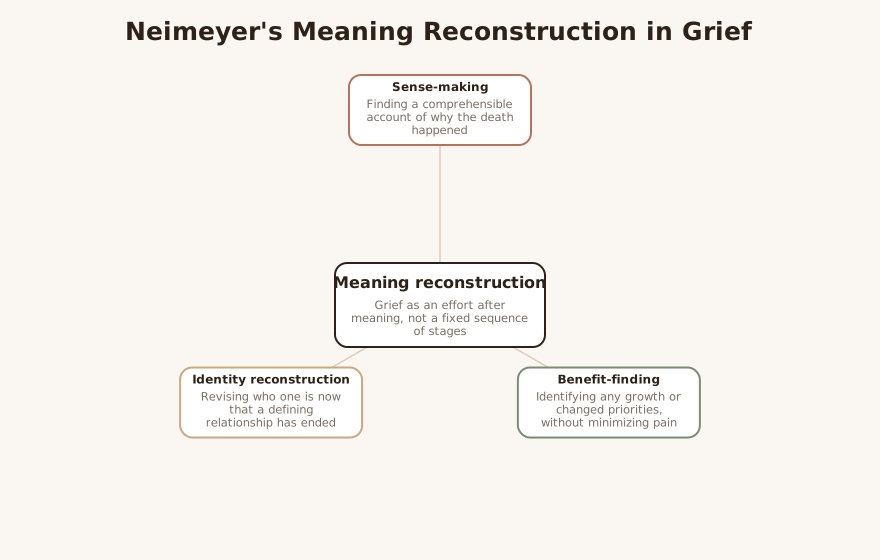
The foundational claim is that significant loss can shatter the “assumptive world” — the largely tacit set of beliefs about safety, predictability, justice, and one’s own life story that organize daily functioning 4. When a death contradicts these assumptions, the bereaved person faces the task of reconstructing a coherent account of self and world that can accommodate the loss 4. Grief, in this view, is fundamentally an effort after meaning rather than a fixed sequence of stages to be passed through 5.
Neimeyer and colleagues describe meaning-making across several interrelated processes LLM. Sense-making concerns finding a comprehensible account of why the death happened and how it fits one’s understanding of the world 4. Benefit-finding concerns identifying any growth, value, or changed priorities that can emerge in the aftermath, without minimizing the pain of the loss 4. Identity reconstruction concerns revising one’s sense of who one is now that a defining relationship has ended 3. A further principle is that grief is profoundly relational and contextual, shaped by family, culture, and community systems of meaning rather than occurring solely inside the individual 2. Failure to reconstruct meaning is proposed as a key pathway into complicated and prolonged forms of grief 1.
Interventions & Techniques
Because the framework is integrative, its techniques are drawn from narrative, expressive, and constructivist traditions and aimed at reorganizing the survivor’s account of the loss LLM. Narrative retelling invites the client to recount the story of the death and the relationship in detail, allowing fragmented or avoided material to be assimilated into a more coherent account 4. Restorative retelling specifically revisits the circumstances of a traumatic death to reduce intrusive imagery while preserving connection to the person who died LLM. Therapeutic writing, including unsent letters to the deceased and journaling, externalizes meaning-making and supports reauthoring LLM.
Techniques for continuing bonds — imagined dialogues, memory books, or rituals — help the client transform the relationship rather than relinquish it LLM. Existentially oriented questions explore how the loss has changed the client’s assumptions about purpose, mortality, and what now matters 4. Across these methods, the clinician works as a collaborative editor of the client’s emerging story rather than an expert who supplies the correct interpretation 5. The aim is consistently a “good enough” account that restores a workable sense of coherence and significance, not a tidy resolution that erases the loss LLM.
LLM-generated illustrative example (not a guideline): A widow who repeatedly says “none of it makes sense anymore” is invited, over several sessions, to retell the night her husband died, then to write him a letter naming what she still wants him to know; the work gradually shifts her from a stalled, incoherent account toward a narrative in which her caregiving had meaning and her bond with him continues in changed form LLM.
Evidence Base
The maturity of this framework is best described as established at the level of theory and process, with a still-developing base of controlled outcome trials LLM. The strongest support is correlational and prospective: across multiple studies, the ability to make sense of a loss and to find benefit in its aftermath consistently predicts better bereavement adjustment, and difficulty making meaning predicts more severe and prolonged grief 3. Neimeyer has explicitly framed this as an evolving research program in which conceptual development and empirical testing inform one another over time 3.
Honesty about limits is warranted LLM. Meaning-making as a measurable mediator of grief outcomes is well supported, but meaning reconstruction as a discrete, manualized treatment has been tested in fewer randomized trials than, for example, cognitive-behavioral therapy for prolonged grief LLM. Much of the evidence relies on self-report and on samples that are not always representative of traumatic-loss or marginalized populations LLM. The model’s breadth is both a strength and a methodological challenge, since its integrative nature makes it harder to isolate a single active ingredient LLM. Clinicians should therefore present it as a well-founded organizing framework rather than as a procedure with the trial density of more narrowly defined protocols 1.
Populations & Indications
The framework was developed with bereaved adults and is most clearly indicated when a death has disrupted a person’s sense of meaning, identity, or assumptive world 5. It is frequently applied with people who have lost a child or spouse, where the loss tends to be highly identity-defining and the assumptive world is severely challenged 4. Survivors of traumatic or sudden loss, including survivors of suicide loss, are a central population, because such deaths often violate expectations about safety, justice, and the natural order, intensifying the struggle to make sense 1.
It is particularly relevant for clients presenting with complicated or prolonged grief, where meaning-making has stalled and the loss remains unintegrated months or years later 1. Caregivers after a death may also benefit, especially when their identity had been organized around the caregiving role and its ending leaves a meaning vacuum LLM. The model is intended to be culturally and developmentally adaptable, since the specific meanings disrupted by a death are always embedded in a particular relational and cultural context 2.
Problems-for-Work
The framework maps onto several clinical problems-for-work LLM. For prolonged grief disorder and complicated grief, the work targets the stalled assimilation of the loss and the inability to construct a forward-looking life story 1. For a disrupted assumptive world and loss of meaning, intervention focuses on rebuilding beliefs about predictability and significance that the death has overturned 4. For traumatic loss, restorative retelling addresses intrusive imagery while preserving meaning and connection LLM.
For existential distress and depression following loss, the work engages questions of purpose and value that have collapsed in the wake of the death 4. For identity disruption after loss, the focus is reauthoring a viable self-narrative after a defining relationship has ended 3. For survivor guilt, sense-making and narrative reconstruction help the client locate the death within a more bearable and accurate account of responsibility LLM.
LLM-generated illustrative example (not a guideline): A man bereaved by his brother’s suicide arrives convinced he “should have seen it coming,” a belief that has frozen his grief; sense-making work gently tests the assumption against the actual evidence, and narrative reconstruction lets him hold both his grief and a more bearable account of what he could and could not have known, easing his survivor guilt LLM.
Contraindications, Cautions & Cultural Humility
There are few absolute contraindications, but several cautions matter LLM. Pushing for benefit-finding or “meaning” too early — particularly in acute or traumatic grief — risks invalidating raw pain and can feel like pressure to find a silver lining the client does not feel LLM. The model explicitly resists prescribing that every loss must yield growth, and clinicians should follow rather than force the client’s readiness 4. When acute trauma symptoms, suicidality, or severe depression dominate, stabilization and risk management take precedence over meaning-oriented retelling LLM.
Cultural humility is central rather than optional, because the assumptive world and the meanings disrupted by a death are inseparable from cultural, religious, and family systems 2. What counts as a coherent or restorative account of a death varies widely across communities, and clinicians should treat the client and their context as the authority on meaning rather than importing their own frameworks 5. The collaborative, non-expert stance the model recommends is itself a safeguard against imposing meaning 5.
Treatment-Plan Suggestions & SMART Objectives
| Goal | SMART objective (example) | Mechanism |
|---|---|---|
| Restore a coherent account of the death | Client will narrate the full story of the loss across 3 sessions with reduced gaps or avoidance by week 6 | Sense-making and narrative assimilation 4 |
| Reduce intrusive trauma imagery | Client will report a 2-point drop on a distress rating during restorative retelling of the death scene by week 8 | Restorative retelling LLM |
| Reauthor identity after loss | Client will articulate two revised life roles or values in writing by week 10 | Identity reconstruction 3 |
| Transform the bond with the deceased | Client will complete one continuing-bonds ritual (letter, memory book) and report its meaning by week 7 | Continuing bonds LLM |
| Address survivor guilt | Client will reappraise one guilt-laden belief against evidence in session by week 9 | Sense-making and cognitive reappraisal LLM |
| Rebuild the assumptive world | Client will identify two restored beliefs about safety or purpose by week 12 | Assumptive-world repair 4 |
| Re-engage with valued activity | Client will resume one previously meaningful activity weekly by week 10 | Restoration-oriented coping LLM |
Common Misconceptions
A frequent misconception is that meaning reconstruction requires the client to find something positive in the death or to “make sense of” a senseless loss LLM. The model instead treats sense-making as one possible process and accepts that some losses resist full explanation, with the goal being a workable rather than a complete account 4. A second misconception is that grief proceeds through fixed stages and that meaning is the final stage; the framework explicitly rejects rigid stage models in favor of an ongoing, non-linear effort after meaning 5.
A third error is reading “continuing bonds” as a failure to detach, when the model views a transformed, sustained connection to the deceased as compatible with healthy adjustment LLM. Finally, some clinicians assume meaning reconstruction is an alternative to evidence-based grief treatment; it is better understood as a complementary organizing framework that can be integrated with cognitive-behavioral and exposure-based methods LLM.
Training & Certification
There is no single licensing body or mandatory certification for meaning reconstruction, as it is a theoretical framework rather than a proprietary protocol LLM. Foundational learning typically comes from Neimeyer’s writings, including the edited volume that consolidated the approach and the journal literature extending it to complicated grief 2. Clinicians commonly deepen competence through grief-focused continuing education, workshops, and supervised practice in narrative and constructivist methods LLM. Familiarity with adjacent evidence-based grief treatments and with measures of grief severity supports responsible application, particularly when working with prolonged grief disorder and traumatic loss LLM.
Key Terms
- Assumptive world — the tacit web of beliefs about safety, predictability, and identity that a death can shatter 4.
- Sense-making — finding a comprehensible account of how and why the loss occurred 4.
- Benefit-finding — identifying value, growth, or changed priorities in the aftermath, without minimizing pain 4.
- Identity reconstruction — revising one’s self-narrative after a defining relationship ends 3.
- Reauthoring — the narrative practice of retelling and revising one’s life story to accommodate the loss LLM.
- Continuing bonds — a transformed, ongoing connection to the deceased compatible with adjustment LLM.
- Complicated grief — a stalled, prolonged grief response linked to failed meaning reconstruction in this model 1.
Resources & Further Reading
▶ Watch — a video introduction to this concept:
- Neimeyer, R. A. (2006). Complicated Grief and the Quest for Meaning: A Constructivist Contribution (Omega, SAGE)
- Neimeyer, R. A. (Ed.). Meaning Reconstruction & the Experience of Loss (APA Books)
- Neimeyer, R. A. Meaning reconstruction in the wake of loss: Evolution of a research program (Semantic Scholar)
- Hibberd, R. Meaning Reconstruction in Bereavement: Sense and Significance (PDF)
- The Loss Foundation. Meaning Reconstruction Model (Robert Neimeyer) — Overview
Reflective / Supervision Questions
- When have I encouraged a client toward “meaning” or benefit-finding faster than their grief was ready for, and how would I recognize that pressure in the room? LLM
- How do I distinguish a client whose grief is stalled in meaning-making from one who is grieving at their own legitimate pace? LLM
- Whose framework of meaning am I drawing on when I help a client make sense of a death, and how do I keep the client as the authority on their own cultural and spiritual world? LLM
- How do I hold the tension between honoring continuing bonds and supporting a client’s re-engagement with life? LLM
- For clients with prolonged grief disorder or traumatic loss, how do I decide when meaning-oriented retelling should yield to stabilization and risk management? LLM