
Type & Discipline
Feedback-Informed Treatment (FIT) and Routine Outcome Monitoring (ROM) are not therapies but a meta-framework laid over whatever model a clinician already practices, drawn from clinical psychology and the broader psychotherapy outcome-research tradition 4. ROM refers to the systematic, repeated measurement of a client’s symptom or functioning status over the course of care, while FIT adds the structured delivery of that measurement back to the dyad so it can shape the next clinical decision 3. Both belong to the family of measurement-based care and sit conceptually within the common-factors model, because their target is the therapeutic relationship and the client’s lived response rather than any disorder-specific technique 6. The practice is explicitly pantheoretical: a psychodynamic, cognitive-behavioral, or emotion-focused clinician can each layer ROM onto existing work without abandoning their orientation 4. In short, FIT is a clinical-decision-support discipline that treats the client’s own ratings as the primary signal for whether treatment is working LLM.
Creators & Lineage
The contemporary outcome-feedback literature is most closely associated with Michael J. Lambert, whose program of research built and tested the practice of delivering session-by-session progress data to therapists 1. Lambert’s work grew out of the broader tradition of psychotherapy outcome measurement and the recognition that clinicians are poor at detecting deterioration on their own 3. Scott D. Miller, working through the International Center for Clinical Excellence (ICCE), translated this research into the FIT brand and the brief ultra-short scales most often used in real-world practice 5. Barry Duncan contributed to the same lineage of brief alliance and outcome measurement that made routine session-by-session feedback feasible in ordinary caseloads LLM. These threads converge with therapeutic alliance research and the evidence-based-practice movement, which together reframed measurement not as a research luxury but as a routine clinical obligation 2. The result is a family of approaches that share one commitment: the client’s perspective, captured quantitatively and frequently, is the compass for care 6.
Core Principles
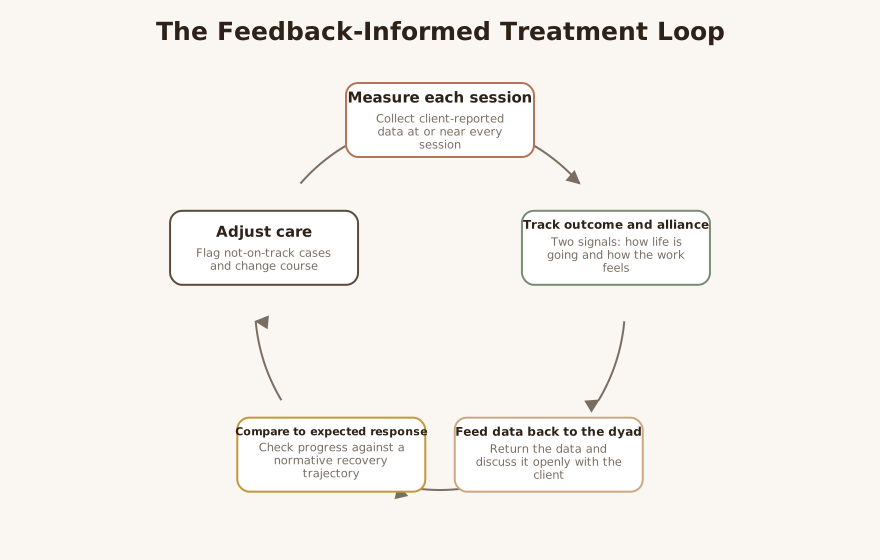
The first principle is that subjective improvement should be measured directly from the client rather than inferred from clinician impression, because unaided clinical judgment systematically overestimates progress and misses worsening 3. The second is frequency: measurement is taken every session, or nearly so, so that drift can be caught early rather than at a distant review point 5. The third is that two distinct signals matter — outcome (how the client is doing in life and symptoms) and the alliance (how the work and relationship feel to the client) — and both are tracked 6. The fourth principle is feedback itself: data is only useful if it is returned to the therapist and ideally discussed openly with the client, turning a measure into a conversation 4. A fifth principle is the use of expected-treatment-response trajectories, where a client’s progress is compared against a normative recovery curve so that “not-on-track” cases can be flagged for clinical attention 1. Finally, FIT is a humility practice: it assumes the clinician’s read can be wrong and builds in a routine mechanism to discover that LLM.
Interventions & Techniques
The central technique is administering an ultra-brief outcome measure at the start of each session and an alliance measure at the end, each typically taking under a minute to complete 5. Commonly used instruments include the Outcome Rating Scale and Session Rating Scale in the FIT tradition, and longer self-report measures such as the Outcome Questionnaire family in the Lambert ROM tradition 4. Scores are plotted against a client’s own history and against expected-response benchmarks, generating alerts when a case is deteriorating or stalling 1. When a “not-on-track” signal appears, clinical-support tools or problem-solving algorithms prompt the therapist to consider the alliance, motivation, social support, and the need for a different approach or higher level of care 1. The alliance score is used not as a report card but as an invitation to repair: a low or declining rating is raised directly with the client to surface and resolve a rupture 6. Done well, the numbers are a structured doorway into a clinical conversation rather than an end in themselves 4.
LLM-generated illustrative example (not a guideline): A clinician notices a client’s outcome score has dropped for two consecutive sessions while the alliance score also dipped. Rather than pressing forward with the planned exposure work, the clinician opens the next session by sharing the graph: “Your ratings tell me something shifted — I’d rather understand that than assume.” The client discloses she felt rushed last week, the dyad renegotiates pacing, and scores recover over the following sessions LLM.
Evidence Base
The maturity of FIT/ROM is best described as established: it rests on multiple meta-analyses and a sizable randomized literature, not on isolated studies 1. Lambert and colleagues’ meta-analysis of routine outcome monitoring found that collecting and delivering progress feedback produces a small but reliable improvement in outcomes overall 1. Critically, the benefit is concentrated among clients who are not responding well: feedback meaningfully reduces deterioration and improves recovery rates in not-on-track cases, while the average effect across all clients is modest 1. Narrative and methodological reviews converge on the same picture — effects are real and clinically worthwhile but heterogeneous, depending heavily on how feedback is implemented and whether clinicians actually act on it 2. The 2023 Psychotherapy Research review similarly concludes that ROM and feedback can enhance outcomes and reduce dropout, while cautioning that effect sizes vary and implementation quality is a major moderator 3. Honest framing for clinicians: this is not a dramatic main effect for the average client, but a meaningful safety net that prevents the worst outcomes and a tool whose value scales with fidelity of use LLM.
Populations & Indications
FIT/ROM is broadly indicated across psychotherapy clients because it is pantheoretical and diagnosis-agnostic, having been studied in general adult outpatient populations 4. It has been applied to adults in individual treatment and extended to adolescents and to couples and relationship work, where divergent partner ratings can themselves be clinically informative 3. The framework is especially indicated for clients at risk of dropout, since feedback has been linked to reduced premature termination 3. It is also well-suited to clients presenting with common conditions such as major depressive disorder and generalized anxiety disorder, where validated brief self-report measures track the construct of interest closely 2. Across diverse clinical populations, the routine elicitation of the client’s own perspective can help surface mismatches between clinician assumptions and client experience 6. The strongest indication of all is any case where the clinician is uncertain whether treatment is helping — precisely the situation FIT was designed to illuminate LLM.
Problems-for-Work
For treatment nonresponse, ROM operationalizes the problem: a flat or declining trajectory against the expected-response curve makes stalled care visible and prompts a course correction rather than passive continuation 1. For symptom deterioration, feedback’s clearest documented benefit is catching clients who are getting worse, which is exactly the subgroup where unaided clinicians most often fail to notice 1. For premature termination, monitoring and acting on dropping engagement or alliance scores is associated with keeping more clients in care 3. For therapeutic alliance ruptures, a falling Session Rating Scale score gives the clinician permission and a concrete prompt to name the strain and attempt repair 6. For low treatment engagement, the act of reviewing the client’s own ratings each session can itself increase collaboration and a sense of being heard 4.
LLM-generated illustrative example (not a guideline): A client with major depressive disorder shows steady weekly improvement on his outcome measure for six weeks, then plateaus. The data prompts the clinician to ask what changed; the client mentions a new work stressor that earlier sessions had not addressed, and the treatment plan is updated to target it. The plateau, made visible by the graph, becomes the agenda LLM.
For relationship conflict in couples work, comparing each partner’s separate ratings can reveal asymmetries in distress or alliance that a joint conversation alone might obscure 3. For posttraumatic stress disorder, generalized anxiety disorder, and depression, tracking a validated brief measure session to session lets the dyad see whether the chosen approach is moving the target symptoms or whether a different strategy is warranted 2.
Contraindications, Cautions & Cultural Humility
FIT has no formal contraindications, but its value collapses if measurement becomes a bureaucratic ritual that is collected and never discussed or acted upon 5. Reviews are explicit that implementation quality is the dominant moderator: feedback only helps when clinicians genuinely engage with it and change course in response 2. A central caution is misusing scores as a clinician performance metric or a surveillance tool, which corrupts the data and damages the very alliance FIT is meant to protect 4. Numbers must always be interpreted with the client and held lightly against clinical context rather than treated as objective verdicts on the work 6. Cultural humility is essential: self-report norms, expected-response curves, and the meaning of disclosing distress to a provider are shaped by culture, language, and prior experience with systems of care, so an “on-track” line is not universal LLM. Measures should be administered in the client’s preferred language where possible, and a low or guarded score should prompt curiosity about whether the instrument fits the person, not a default assumption that the client is non-adherent LLM.
Treatment-Plan Suggestions & SMART Objectives
| Goal | SMART objective (example) | Mechanism |
|---|---|---|
| Detect early deterioration | Client completes a brief outcome measure at the start of every session for 8 consecutive weeks, reviewed by clinician each time | Repeated measurement makes worsening visible against an expected-response trajectory 1 |
| Reduce dropout risk | Clinician reviews alliance score at the end of each session and addresses any score below the client’s baseline within that session, across the next 6 sessions | Acting on alliance feedback is linked to reduced premature termination 3 |
| Repair alliance ruptures | When the Session Rating Scale declines, client and clinician name and discuss the rupture in the following session, with a repair plan documented | Open feedback converts a low score into a repair conversation 6 |
| Improve depression outcome tracking | Client’s depression-relevant outcome score is graphed weekly and trajectory reviewed jointly every 4th session for 12 weeks | Direct client-reported measurement tracks the symptom construct more accurately than impression 2 |
| Trigger course correction on nonresponse | If outcome scores show no reliable gain over 4 sessions, clinician initiates a documented treatment-plan review using a clinical-support algorithm | Not-on-track signals prompt structured problem-solving rather than passive continuation 1 |
| Increase engagement and collaboration | Client and clinician review the outcome graph together at the start of each session and co-set the agenda from it, for the episode of care | Sharing data increases the client’s sense of being heard and involved 4 |
| Embed feedback as routine practice | Clinician administers outcome and alliance measures in at least 90% of sessions over a 3-month period and discusses results with the client | Fidelity of implementation is the primary driver of benefit 5 |
Common Misconceptions
A frequent misconception is that the measures are a verdict on the therapist’s competence; in fact they are a signal about the work and the relationship, and misusing them as performance scores undermines their purpose 4. Another is that FIT replaces clinical judgment, when in practice it is meant to augment judgment by catching the cases clinicians reliably miss, especially deterioration 1. Some clinicians assume the average effect is large and are disappointed; the honest reading is that the overall effect is modest and concentrated in not-on-track clients 1. There is also a belief that simply collecting forms is enough — but the evidence shows that benefit depends on actually feeding back and acting on the data, not on data collection alone 2. Finally, some assume FIT belongs only to a particular school of therapy, whereas it is explicitly pantheoretical and compatible with any orientation 6.
Training & Certification
The FIT approach is supported by structured implementation resources, including Scott D. Miller’s ICCE manuals and the operational guidance in “Implementing Feedback-Informed Treatment” 5. The American Psychological Association publishes a practitioner volume, “Feedback-Informed Treatment in Clinical Practice,” that orients clinicians to the framework and its application 4. Introductory explainers, such as the Sentio University overview, provide an accessible entry point for clinicians new to the model 6. Beyond reading, competent practice requires learning the specific measures, the expected-response benchmarking, and the clinical-support steps for not-on-track cases, which the implementation literature lays out 1. Because fidelity drives outcomes, training that emphasizes how to discuss scores with clients and how to act on alerts is more valuable than training focused only on administration 2.
Key Terms
Routine Outcome Monitoring (ROM): the systematic, repeated measurement of a client’s outcome over the course of treatment 3. Feedback-Informed Treatment (FIT): ROM plus the structured return and discussion of that data with the dyad to guide care 6. Outcome measure: a brief self-report of the client’s symptoms and functioning, administered each session 5. Alliance measure: a brief client rating of the relationship and the fit of the work, used to surface ruptures 6. Expected treatment response: a normative recovery trajectory against which an individual client’s progress is compared 1. Not-on-track (NOT) case: a client whose progress falls below the expected trajectory, flagged for clinical attention 1. Clinical-support tools: structured prompts that guide the clinician’s response when a not-on-track alert fires 1.
Resources & Further Reading
▶ Watch — a video introduction to this concept:
- Lambert, Whipple & Kleinstäuber — Collecting and delivering progress feedback: A meta-analysis of routine outcome monitoring
- Using Progress Feedback to Enhance Treatment Outcomes: A Narrative Review (PMC)
- Routine Outcome Monitoring (ROM) and Feedback: Research Review and Recommendations (Psychotherapy Research, 2023)
- Feedback-Informed Treatment in Clinical Practice (APA Books)
- Implementing Feedback-Informed Treatment (Scott D. Miller / ICCE)
- Feedback Informed Treatment (Sentio University explainer)
Reflective / Supervision Questions
- Of your current caseload, which clients are you assuming are improving without any client-reported data to confirm it, and how would you know if you were wrong? LLM
- When a client’s score drops or an alliance rating dips, what is your honest internal reaction — curiosity, defensiveness, or avoidance — and how does that shape whether you raise it? 4
- Are you collecting measures that you never actually discuss or act on, and if so, what would it take to close that loop? 2
- How might culture, language, or prior experiences of care be shaping a client’s ratings, and have you checked whether the measure fits this person? LLM
- For your not-on-track cases, do you have a concrete, repeatable plan for what to change, or do you tend to continue the same approach? 1