
Type & Discipline
The Dodo Bird Verdict is not a therapy you practice; it is a finding and an interpretive position within psychotherapy outcome research.17 Its core claim is that when bona fide psychotherapies — those built on coherent theory and delivered by competent clinicians — are compared head to head for many common presenting problems, they produce roughly equivalent outcomes, with no one approach reliably superior to the others.12 The name comes from a line in Lewis Carroll’s Alice’s Adventures in Wonderland, where the Dodo, asked to judge a chaotic race, declares: “Everybody has won, and all must have prizes.”15 The verdict belongs to the discipline of psychotherapy research and sits squarely in the common-factors tradition, which holds that elements shared across therapies — the relationship, expectancy, a believable rationale — account for most of the change clients experience.47 Because it is a research conclusion rather than a treatment protocol, the practical question for clinicians is not “how do I do the Dodo Bird Verdict?” but “what does this finding tell me about how to deliver the therapies I already use?” LLM
Creators & Lineage
The idea was first articulated by Saul Rosenzweig in 1936, who observed that diverse psychotherapies often prove similarly successful and borrowed the Dodo’s verdict to name the puzzle.15 For decades it remained a provocative aside. The empirical turn came in 1975, when Lester Luborsky, Barton Singer, and Lise Luborsky published one of the first systematic comparative reviews and found few significant differences in outcome among the major therapies of the day.1 The position was then developed and pressed hardest by Bruce E. Wampold, whose 1997 meta-analysis of studies comparing bona fide treatments gave the verdict its modern empirical statement and its memorable subtitle, “Empirically, ‘all must have prizes.’”2 Wampold and Imel later embedded the verdict within a broader contextual model of psychotherapy, which argues that healing flows primarily through the therapeutic relationship, the client’s expectations, and engagement in a meaningful set of actions, rather than through ingredients specific to any one brand.4 The lineage thus runs from common-factors theory and early alliance research toward the contextual model, and stands in deliberate tension with the specific-ingredient / evidence-based-practice framing that treats named techniques as the active mechanism.47
Core Principles
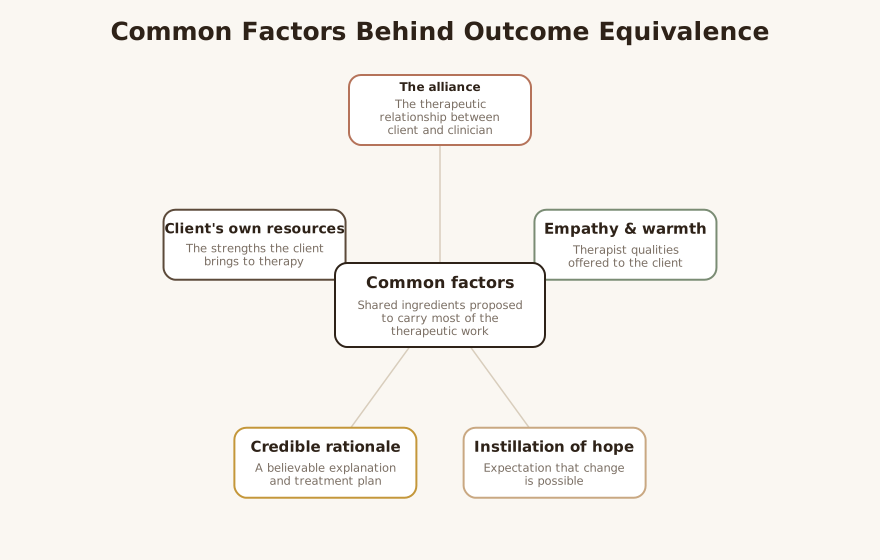
Several propositions hold the verdict together. First, the comparison is restricted to bona fide therapies — treatments intended to be therapeutic, grounded in psychological principles, and delivered by trained clinicians; the verdict deliberately excludes sham or intent-to-fail control conditions, because the claim is about real therapies competing, not therapy versus nothing.27 Second, the consistent finding within that restricted comparison is outcome equivalence: across many studies, the differences between bona fide approaches are small and statistically difficult to distinguish from zero.2 Third, the favored explanation is that common factors carry most of the therapeutic work — the alliance, therapist empathy and warmth, the instillation of hope, a credible treatment rationale, and the client’s own resources — rather than the distinctive techniques that differentiate the brands.14 Fourth, and crucially, the verdict does not claim that psychotherapy doesn’t work; it claims the opposite — that psychotherapy is broadly effective, and that the effectiveness is largely transtheoretical.47 Fifth, the contextual model adds that therapist effects (which clinician you see) and the alliance can rival or exceed the contribution of the specific model, with therapist effects often estimated to account for several percent of outcome variance.45
Interventions & Techniques
Because the Dodo Bird Verdict is a finding rather than a modality, it has no techniques of its own; what it generates is a set of common-factors-informed practices that any clinician can layer onto a recognized therapy.47 LLM In practical terms, taking the verdict seriously means investing deliberately in the elements the research says travel across all therapies.4 LLM These include: forming and repairing the therapeutic alliance as a primary clinical task, not background noise; collaborative goal consensus so the client agrees with and is invested in the direction of treatment; conveying a credible, coherent rationale for why the chosen approach should help; and cultivating positive expectancy and hope without overpromising.47 LLM A second, more accountable practice the verdict motivates is routine outcome and alliance monitoring — using brief validated measures session by session to detect clients who are not improving or whose alliance is straining, so the clinician can adjust before dropout or deterioration.4 LLM A third is attending to therapist allegiance: because clinicians tend to get better results with treatments they believe in, the verdict invites honest reflection on whether you are delivering an approach with conviction.24 LLM None of this replaces competent delivery of a specific evidence-based protocol; it surrounds that delivery with the relational and procedural conditions under which any protocol works best.7 LLM
Evidence Base
The maturity of the literature is established but genuinely contested, and an honest clinician should hold both halves of that sentence at once.37 On the supportive side: Rosenzweig’s 1936 observation has been repeatedly echoed; Luborsky and colleagues’ 1975 review found few reliable between-treatment differences; and Wampold et al.’s 1997 meta-analysis of bona fide comparisons found the differences between treatments to be uniformly small and statistically indistinguishable from zero, the strongest empirical statement of the verdict to date.12 Wampold and Imel’s contextual-model synthesis assembles a large body of evidence that common factors — alliance, expectancy, therapist effects — predict outcome at least as strongly as specific techniques.4
On the critical side, the verdict has been qualified in several durable ways. The “misleading Dodo Bird” critique argues that partitioning outcome variance into “common” versus “specific” factors is conceptually slippery, and that the verdict’s rhetorical strength has outrun what the variance data can actually support.3 More concretely, specific-treatment advantages do exist for particular disorders: exposure-based and cognitive-behavioral treatments outperform other approaches for several anxiety presentations, with reported effect sizes in the range of roughly 0.51–0.62 for anxiety disorders, and the evidence is strongest where mechanism is well understood (e.g., exposure for phobias and OCD).17 LLM Allegiance effects muddy the comparison literature on both sides, since researchers tend to find that their preferred therapy wins.12 And the verdict says little about presentations where therapies are not interchangeable.7 LLM
Honest read: Equivalence holds reasonably well on average across bona fide therapies for many common conditions, especially depression and several anxiety states — but it does not hold uniformly. For specific disorders with well-validated specific treatments, the choice of method can matter, and the “all must have prizes” slogan oversells a real but bounded finding.237 LLM
Populations & Indications
As a research conclusion, the verdict’s “population” is the broad span of adults in psychotherapy for the common, non-emergent presentations that fill outpatient practice — depression, generalized anxiety, adjustment difficulties, interpersonal distress — where the comparative literature is densest and equivalence is best supported.24 Its most direct audience, however, is clinicians, trainees, and researchers, for whom it functions as a corrective against brand loyalty and as an argument for cultivating relational skill alongside technical fluency.57 LLM The verdict is most relevant when a client could plausibly be helped by more than one reasonable approach and the clinician is choosing among them; it is least applicable at the edges — acute risk, presentations with a clearly superior specific treatment, or populations underrepresented in the trials.7 LLM
Problems-for-Work
The verdict reframes several recurring clinical and supervisory problems.47
- Treatment selection decisions. For a depressed adult with no clear indication for one method over another, the verdict supports choosing among bona fide options on the basis of client preference, fit, and clinician competence rather than assuming one brand is decisively superior.24 LLM
- Therapeutic alliance. The verdict elevates alliance from a “soft” variable to a primary lever of change, justifying explicit attention to rupture and repair.47 LLM
- Psychotherapy outcomes. It supports building routine outcome monitoring into care, since the data say who improves is not well predicted by which brand alone.4 LLM
- Common vs. specific factors debate. It gives clinicians a balanced frame: honor common factors without dismissing the real specific advantages that exist for certain disorders.37 LLM
- Treatment efficacy questions. When a client asks “is this the best therapy for me?”, the verdict equips the clinician to answer honestly about equivalence and its limits.17 LLM
LLM-generated illustrative example (not a guideline): A new client requests “the most evidence-based therapy” for low mood. Rather than insisting on a single brand, the clinician explains that several well-supported therapies work comparably for depression, recommends one she delivers competently and believes in, names the plan collaboratively, and begins session-by-session symptom tracking to catch non-response early. LLM
Contraindications, Cautions & Cultural Humility
The chief hazard is misreading equivalence as license.37 LLM “All therapies are equal” can be misheard as “any therapy will do,” “technique doesn’t matter,” or “I needn’t bother learning a protocol well” — none of which the evidence supports.37 LLM The verdict applies to bona fide therapies competently delivered; it offers no cover for vague, unstructured, or improvised work.2 LLM It also must not override the clear specific-treatment advantages that exist for some conditions — withholding exposure-based treatment from a client with OCD or a specific phobia on the grounds that “it’s all the same” would be a misapplication.7 LLM Culturally, the comparative trials behind the verdict have historically over-sampled certain populations, so equivalence claims may not generalize cleanly across cultural, linguistic, and identity contexts; the common factors themselves — what counts as a credible rationale, an appropriate relationship, or a hopeful frame — are culturally shaped, and require humility and adaptation rather than assumed universality.47 LLM
Treatment-Plan Suggestions & SMART Objectives
Because the Dodo Bird Verdict is a research finding and not a billable modality, the goals below are framed as clinician- and practice-level objectives: ways to operationalize common factors within whatever recognized therapy you are already delivering. LLM Each links to the relevant mechanism the outcome literature implicates.47
| Goal | SMART objective (example) | Mechanism |
|---|---|---|
| Strengthen the therapeutic alliance | Administer a brief alliance measure (e.g., a session-rating scale) at the end of ≥80% of sessions for 8 weeks and review trends | Alliance / relationship |
| Build routine outcome monitoring | Implement a validated symptom measure at every session for all new cases within one quarter, with a defined non-response review trigger | Feedback / expectancy |
| Establish collaborative goal consensus | Within the first 2 sessions, co-document 2–3 client-endorsed goals and confirm agreement on the treatment rationale | Goal consensus / collaboration |
| Cultivate positive, realistic expectancy | In the first session of each new case, provide a coherent rationale and a hopeful, honest prognosis statement | Hope / expectancy |
| Detect and repair alliance ruptures | When alliance scores drop, raise it explicitly within the next session and document the repair attempt, tracked over a quarter | Alliance repair |
| Examine clinician allegiance | In monthly supervision, identify one approach delivered without conviction and a plan to build competence or refer | Allegiance / fidelity |
| Preserve specific-treatment fit | For every new case, screen for conditions with a clearly superior specific treatment and route accordingly within 2 sessions | Specific effects (boundary check) |
| Reduce premature dropout | Lower first-month dropout by a defined margin over two quarters via early alliance and expectancy attention | Common factors composite |
These objectives are illustrative; adapt them to your setting and measure with validated instruments. LLM
Common Misconceptions
- “All therapies are equally effective for everything.” The equivalence holds on average across bona fide therapies for many common problems, not uniformly; specific advantages exist for some disorders.237 LLM
- “The verdict means technique doesn’t matter.” It means technique is not the main driver of variance between competently delivered bona fide therapies — not that competent, structured delivery is dispensable.47 LLM
- “The Dodo Bird Verdict says psychotherapy doesn’t work.” The opposite: it presumes psychotherapy is effective and asks why, locating the answer largely in shared factors.45 LLM
- “It compares therapy to placebo or no treatment.” The verdict is about bona fide therapies competing with each other; sham conditions are excluded by design.27 LLM
- “It’s a settled fact.” It is an influential and well-supported but actively debated position, with serious critiques of how the common-versus-specific variance is partitioned.3 LLM
Training & Certification
There is no certification in the Dodo Bird Verdict, because it is a research conclusion, not a clinical credential.1 LLM The relevant competencies are instead developed through the broader literatures it sits within: training in common-factors and alliance-focused practice, in routine outcome and alliance monitoring (feedback-informed treatment), and in maintaining competence across the recognized evidence-based therapies one delivers.47 LLM Clinicians typically encounter the verdict in graduate coursework on psychotherapy research and the common-versus-specific-factors debate, and deepen their understanding through Wampold and Imel’s The Great Psychotherapy Debate and the surrounding meta-analytic literature.34 LLM
Key Terms
- Bona fide psychotherapy — a treatment intended to be therapeutic, grounded in psychological theory, and delivered by a trained clinician; the only therapies the verdict compares.27
- Common factors — elements shared across therapies (alliance, empathy, expectancy, credible rationale) proposed to drive most change.14
- Specific factors / specific effects — the distinctive techniques unique to a given approach.37
- Therapeutic alliance — the bond and collaborative agreement between client and clinician on goals and tasks.4
- Contextual model — Wampold and Imel’s framework locating healing in the relationship, expectancy, and meaningful action rather than specific ingredients.4
- Allegiance effect — the tendency for studies to favor the therapy the researchers prefer.12
- Therapist effects — outcome variance attributable to which clinician a client sees, often several percent of the total.45
Resources & Further Reading
▶ Watch — a video introduction to this concept:
Foundational research & reviews - Wampold et al. (1997) — A meta-analysis of outcome studies comparing bona fide psychotherapies (ResearchGate) - The misleading Dodo Bird verdict — common vs. specific variance (ScienceDirect) - Elliott — Dodo Bird Verdict in Psychotherapy (Wiley Online Library)
Books - Wampold & Imel — The Great Psychotherapy Debate (2nd ed., Routledge)
Clinician explainers - Simply Psychology — Are All Psychological Therapies Equally Effective? - Scientific American — Are All Psychotherapies Created Equal? - Wikipedia — Dodo bird verdict
Related wiki concepts: Common factors theory · Therapeutic alliance research · Contextual model of psychotherapy · Evidence-based practice. Explore in the graph: filter by Therapeutic alliance or Psychotherapy outcomes.
Reflective / Supervision Questions
- When I tell a client a particular therapy is “the best” for them, how much of that claim rests on evidence versus my own allegiance?
- Which approaches in my repertoire do I deliver without real conviction, and is that quietly costing my clients?
- Do I treat the alliance as a primary clinical task, or as pleasant background to “the real intervention”?
- Where do I risk misusing equivalence as an excuse to skip a clearly indicated specific treatment, such as exposure for OCD?
- How might the common factors I rely on — credible rationale, appropriate relationship, instilled hope — look different across my clients’ cultural and identity contexts?
- If I measured outcomes session by session, what would the data say about which of my clients are actually improving?