
Type & Discipline
Therapist effects is a research construct within psychotherapy outcome research, not a treatment modality or technique LLM. It names the portion of variability in client outcomes that is attributable to the individual clinician — that is, to who the therapist is — rather than to the treatment protocol, the diagnosis, or the patient 1. Methodologically, the construct is operationalized through multilevel (hierarchical) statistical models in which patients are nested within therapists and therapists are treated as a random factor, allowing the analyst to partition outcome variance into patient-level and therapist-level components 1.
The construct sits at the intersection of outcome research, the common-factors tradition, and the literature on clinical expertise LLM. Its practical importance is that it reframes the central question of effectiveness: rather than asking only “which treatment works?”, it asks “which therapist works, and what can be done about the ones who consistently do not?” LLM. Because the answer has direct implications for measurement, supervision, and training, the construct has become a cornerstone of feedback-informed and deliberate-practice approaches to clinical development 5.
Creators & Lineage
Interest in therapist-level variance grew out of reanalyses of clinical-trial data in the 1980s and 1990s, which found that the proportion of outcome variance attributable to therapists ranged widely — from essentially 0% to as much as 13.5% across studies, and up to nearly 50% in some individual treatment groups 1. These early estimates were unstable because trials enrolled few patients per therapist, used different statistical models, and disagreed on whether to treat therapists as a fixed or a random factor 1.
Bruce Wampold and George S. (Jeb) Brown moved the construct from controlled trials into routine practice with their landmark 2005 naturalistic study of 6,146 patients seen by approximately 581 therapists in a managed-care network 1. Wampold, with Zac Imel, later embedded therapist effects within the broader Contextual Model of psychotherapy in The Great Psychotherapy Debate, arguing that differences between bona fide treatments are small relative to the variance contributed by the therapist and the relationship 4. In the United Kingdom, David Saxon and Michael Barkham extended the work into large Improving Access to Psychological Therapies (IAPT) datasets, quantifying how therapist effects interact with treatment dose, modality, and completion 2. John Okiishi and Scott Miller are associated in this lineage with the practice of ranking clinicians by their measured outcomes and with the popular notion of the consistently superior “supershrink,” though the formal variance estimates rest on the Wampold, Brown, Saxon, and Barkham datasets LLM.
Core Principles
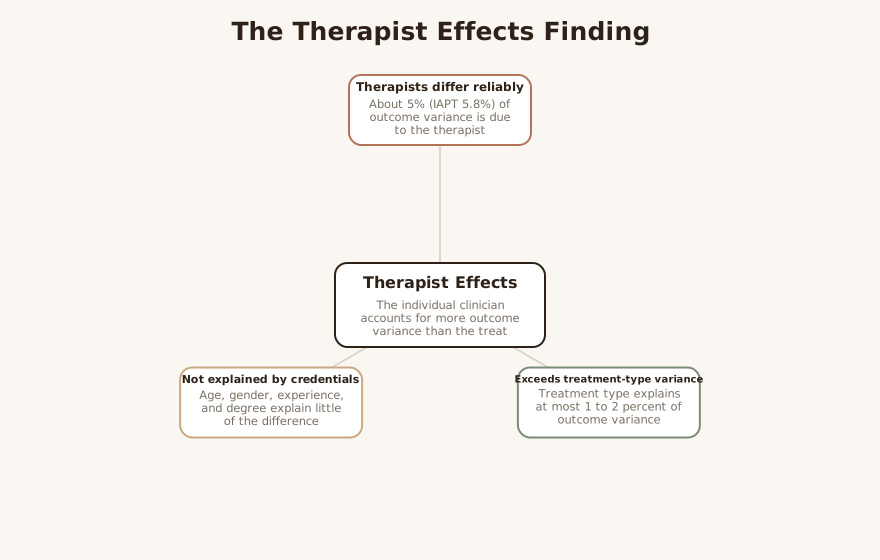
The first principle is that therapists differ reliably in their outcomes, and the difference is not trivial. After adjusting for the initial severity of each patient, Wampold and Brown found that about 5% of the variation in outcomes was due to therapists 1. In the IAPT data, the comparable case-mix-adjusted therapist effect was 5.8% 2. These figures are modest in absolute terms but large relative to the contribution of the treatment method itself LLM.
The second principle is that therapist variance exceeds treatment-type variance. Wampold and Brown noted that the proportion of variance attributable to the type of treatment delivered is “at most 1% or 2%,” and that the variance attributable to the alliance — the most studied common factor — is around 5% 1. In other words, the choice of therapist plausibly matters as much as or more than the choice of evidence-based protocol LLM.
The third principle is that the usual demographic and credential variables do not explain the difference. Patient age, gender, and diagnosis, as well as therapist age, gender, years of experience, and professional degree, accounted for little of the variability in outcomes among therapists 1. Effectiveness is therefore not reducible to seniority or licensure type LLM.
The fourth principle is that the effect is contextual and grows with engagement. In the IAPT analysis the therapist effect was negligible for patients who dropped out but rose to 11.2% among completers, indicating that therapist differences express themselves most strongly when treatment actually proceeds 2.
Interventions & Techniques
Because therapist effects is a construct rather than a protocol, its “interventions” are the practices clinicians and systems use to measure, surface, and narrow the variance LLM.
Routine outcome monitoring (ROM). Administering a brief, validated symptom or functioning measure at each session — in the original study, a 30-item adaptation of the Outcome Questionnaire — lets clinicians track each client’s trajectory against an expected course 1. The APA Interdivisional Task Force rated collecting client feedback as a demonstrably effective element of the therapy relationship 5.
Feedback-informed treatment. Wampold and Brown observed that providing therapists with feedback about their patients’ outcomes relative to the average trajectory of change for patients with the same initial severity “appears to increase the likelihood of positive outcomes” 1. Comparing one’s own results to normative data is presented as prudent clinical practice 1.
Relationship cultivation. The Task Force concluded that empathy, the alliance (in individual, youth, and family therapy), and cohesion (in group therapy) are demonstrably effective, with goal consensus, collaboration, and positive regard rated probably effective 5. Deliberately strengthening these elements is a direct route to better therapist-level outcomes LLM.
Responsiveness and adaptation. The Task Force rated adapting treatment to patient reactance/resistance, preferences, culture, and religion/spirituality as demonstrably effective adaptations 5. Effective therapists tailor their approach to the person in front of them rather than applying a protocol uniformly LLM.
Deliberate practice. Identifying specific interpersonal weaknesses through outcome data and rehearsing them under supervision is the developmental engine implied by the construct LLM.
Evidence Base
The maturity of this construct is best described as established. The core finding has been replicated across reanalyses of randomized trials and across large naturalistic datasets, using the most defensible statistical approach — treating therapists as a random factor in multilevel models, which generalizes to therapists in general rather than to the particular clinicians sampled 1. Wampold and Brown’s residualizing on initial severity is important: because they adjusted for how impaired each patient was at intake, the therapist effect is not merely an artifact of some clinicians being assigned easier cases 1.
The magnitude is modest but robust. Estimates cluster around 5–8% of outcome variance in adjusted models, with about 5% in the managed-care sample and 5.8% in the IAPT sample 12. Crucially, this is consistently larger than the 1–2% attributable to treatment type 1. The effect is also dose-dependent: it is near zero for dropouts and rises to 11.2% among completers 2.
The clinical stakes are concrete. In the IAPT data, above-average therapists were over twice as effective as below-average therapists, with a mean recovery rate of 63.7% versus 25.6%, and a mean pre-post PHQ-9 change of 9.9 points versus 4.2 points 2. By contrast, the difference between modalities was small: cognitive behavioral therapy showed slightly more pre-post change than counseling (7.3 vs. 6.3 PHQ-9 points), a Cohen’s d of only 0.16 2. The variance between therapists dwarfed the variance between treatments LLM.
A 2025 study sharpened the picture of what distinguishes effective therapists: better interpersonal skills predicted improved treatment outcomes, and the association was strongest when treating severely distressed patients 3. Those skills were assessed with a performance task in which clinicians respond to brief video clips of alliance ruptures, with responses rated for qualities such as warmth/acceptance, collaboration, and problem focus 3. The honest caveat is that, while the existence of therapist effects is well established, the field is still maturing in pinpointing and reliably training the specific therapist behaviors that drive them 4.
Populations & Indications
Therapist effects has been demonstrated chiefly in adult outpatient psychotherapy, with samples dominated by depressive disorders (roughly 46% of patients in the managed-care study), adjustment disorders (about 30%), and anxiety disorders (about 11%) 1. The IAPT replications likewise concerned adults treated for common mental health problems with CBT or counseling 2.
The construct is most indicated — that is, most worth attending to clinically — wherever outcomes can be measured and where treatment actually proceeds, because the effect is largest among completers 2. It is especially salient for severely distressed or high-impairment clients, with whom therapist interpersonal skill matters most 3. The Task Force’s conclusions, which underpin the relational mechanisms behind therapist effects, span individual, youth, family, and group modalities 5.
Problems-for-Work
Premature termination / dropout. Because above-average therapists in the IAPT data had fewer dropouts and achieved more change per session, attending to early engagement is a direct lever on therapist-level outcomes 2.
LLM-generated illustrative example (not a guideline): A clinician notices that three clients have quietly disengaged after session two. Reviewing session-by-session outcome scores reveals each had a worsening alliance item that went unaddressed; the clinician begins explicitly checking the alliance at the end of every early session. LLM
Non-response and deterioration. Routine outcome monitoring flags clients whose trajectories fall below the expected course for their initial severity, prompting a change of approach before stagnation hardens 1.
Variable effectiveness across a caseload. Comparing one’s outcomes to normative data can reveal that a clinician does well with some presentations and poorly with others, focusing supervision and deliberate practice 1.
LLM-generated illustrative example (not a guideline): A therapist’s aggregated data show strong results with anxiety but weak results with co-occurring depression and adjustment problems; supervision targets case formulation and behavioral activation for that subgroup. LLM
Weak or ruptured alliance. Since the alliance and empathy are demonstrably effective, naming and repairing ruptures is a high-yield problem-for-work 5.
Contraindications, Cautions & Cultural Humility
There are no “contraindications” to a construct, but there are serious cautions in how it is used LLM. The most important is that outcome data must not be weaponized. Rankings derived from small caseloads are statistically unstable; Wampold and Brown restricted their analyses to therapists with at least four patients and warned about the bias introduced when there are few patients per therapist 1. Using crude league tables to discipline clinicians risks punishing those who carry more complex or higher-severity caseloads LLM.
Case mix must be adjusted before any comparison. The therapist effect is only interpretable after controlling for initial severity; raw outcome comparisons that ignore who walked in the door are misleading 1. A clinician serving more impaired clients may show smaller raw gains while being highly effective for that population LLM.
On cultural humility, the foundational datasets are a limitation. The managed-care study explicitly lacked data on patient race, education, or income, because the payer did not capture it 1. Conclusions about therapist effectiveness therefore rest on samples whose cultural composition is largely unknown, and clinicians should be cautious about generalizing benchmarks across populations not represented in the research LLM. Encouragingly, the Task Force rated adapting therapy to a client’s culture, religion, and spirituality as a demonstrably effective practice, which positions cultural responsiveness as part of what makes a therapist effective rather than a separate add-on 5.
Treatment-Plan Suggestions & SMART Objectives
| Goal | SMART objective (example) | Mechanism |
|---|---|---|
| Establish measurement-based feedback | Client completes a validated session-by-session outcome measure at every session for 8 consecutive weeks, reviewed jointly each session | Routine outcome monitoring surfaces off-track cases early 1 |
| Strengthen the therapeutic alliance | Clinician elicits and documents client feedback on the alliance at the close of each of the first 4 sessions | Alliance and feedback are demonstrably effective relationship elements 5 |
| Reduce early dropout | Client and clinician agree on shared goals and tasks by session 2, recorded in the plan, and re-confirm at session 4 | Goal consensus and collaboration support engagement and completion 52 |
| Improve clinician responsiveness | Clinician adapts approach to the client’s stated preferences and reactance level, reviewed in supervision monthly | Tailoring to patient characteristics is demonstrably effective 5 |
| Address non-response | When the client’s score falls below the expected trajectory for two consecutive sessions, the clinician revises the formulation within 1 session | Feedback relative to normative trajectories increases positive outcomes 1 |
| Build therapist interpersonal skill | Clinician completes a structured deliberate-practice exercise on alliance-rupture responses biweekly for 12 weeks | Interpersonal skills predict outcome, especially with severe distress 3 |
| Benchmark caseload outcomes | Clinician reviews case-mix-adjusted aggregate outcomes against normative data each quarter | Comparison to norms guides targeted skill development 1 |
Common Misconceptions
“More experienced therapists get better results.” The data do not support this; therapist years of experience accounted for little of the variability in outcomes 1. Experience and effectiveness are not the same thing LLM.
“It’s the treatment that matters, not the therapist.” Treatment type accounts for at most 1–2% of outcome variance, while the therapist accounts for roughly 5% — the construct inverts the intuition that the protocol is the active ingredient 1.
“A higher degree means better outcomes.” Professional degree (doctoral vs. master’s vs. medical) accounted for little of the between-therapist variability 1.
“Effective therapists succeed by avoiding hard cases.” Because the estimates adjust for initial severity, the therapist effect is not an artifact of easier caseloads 1.
“If a protocol is delivered with fidelity, the relationship is secondary.” The Task Force concluded the opposite: efforts to promulgate evidence-based practices without including the relationship are “seriously incomplete and potentially misleading” 5.
Training & Certification
There is no certification in therapist effects, because it is a research construct rather than a modality LLM. What the construct prescribes for training is concrete: the APA Interdivisional Task Force recommended that programs provide competency-based training in the demonstrably and probably effective elements of the therapy relationship, and that clinicians routinely monitor patients’ responses to the relationship and to treatment 5.
In practice, the developmental pathway combines routine outcome monitoring, feedback-informed treatment, and deliberate practice, so that a clinician can identify personal performance gaps from data and rehearse them deliberately 15. The facilitative-interpersonal-skills performance task — responding to standardized alliance-rupture clips — offers one structured way both to assess and to train the interpersonal abilities that distinguish more effective therapists 3. Wampold has discussed the qualities and actions of effective therapists and the broader expertise literature in publicly available talks aimed at clinicians 6.
Key Terms
Therapist effect — the proportion of variance in client outcomes attributable to the individual therapist, estimated by treating therapists as a random factor in a multilevel model 1.
Random vs. fixed factor — modeling therapists as random allows conclusions to generalize to therapists in general, whereas a fixed model restricts conclusions to the specific therapists studied 1.
Case-mix adjustment — statistically controlling for patients’ initial severity so that therapist comparisons are not contaminated by who was assigned which clients 1.
Routine outcome monitoring (ROM) — systematic, repeated administration of a brief validated outcome measure to track each client’s progress 1.
Feedback-informed treatment — using outcome feedback, often against normative trajectories, to adjust care and improve results 1.
Facilitative interpersonal skills (FIS) — therapist abilities such as warmth/acceptance, collaboration, and problem focus, measured via responses to standardized alliance-rupture video clips, that predict outcome 3.
Contextual Model — Wampold and Imel’s framework in which common factors and the therapist contribute more to outcome than specific treatment ingredients 4.
Supershrink — informal term for a clinician whose measured outcomes consistently and substantially exceed peers’ LLM.
Resources & Further Reading
▶ Watch — a video introduction to this concept:
- Wampold & Brown (2005), Estimating Variability in Outcomes Attributable to Therapists (full PDF)
- The Relationship Between Therapist Effects and Therapy Delivery Factors (PMC)
- Elucidating therapist differences: Therapists’ interpersonal skills and treatment outcome (ScienceDirect)
- The Great Psychotherapy Debate (2nd ed.), Wampold & Imel (Routledge)
- Conclusions of the APA Divisions 12 & 29 Task Force on Evidence-Based Therapy Relationships
- Bruce Wampold on Qualities and Actions of Effective Therapists (YouTube)
Reflective / Supervision Questions
- Do I currently have any objective, case-mix-aware data on my own outcomes — and if not, what is stopping me from collecting it?
- When a client disengages early, do I treat it as the client’s ambivalence or as information about my own engagement skills?
- Which presentations or populations do I suspect I am less effective with, and how would I know if I am right?
- How do I respond when an outcome measure tells me a case is off track — do I adapt, or do I attribute it to the client?
- If therapist interpersonal skill matters most with severely distressed clients, how do I deliberately rehearse responding to ruptures rather than only discussing them?
- How can my supervisor or peer-consultation group help surface my blind spots without turning outcome data into a performance threat?