
Type & Discipline
The reflecting team is best understood as a clinical technique and a stance toward conversation rather than a stand-alone modality; it is a way of organizing the talk among therapists, observers, and clients within systemic family therapy and the broader collaborative tradition 1. The defining move is structural and almost embarrassingly simple: instead of a team of professionals watching a family from behind a one-way mirror and then conferring privately about them, the team shares its reflections openly, in front of and within earshot of the family, who then respond to what they heard 1. The original arrangement reversed the lighting and sound between two rooms so that the family, having been interviewed, could sit and listen while the team talked, and then switch back to comment on the team’s comments 1.
The discipline is family and systemic therapy, but the reflecting team has migrated well beyond it LLM. It is used in narrative therapy, in collaborative and dialogical practice, in supervision, and even as a method for case discussion in general medical settings, where a team reflects aloud on a presented case in front of the presenting clinician 4. What unifies these uses is not a fixed protocol but a posture: the conversation that was once hidden becomes visible, and the people being talked about are present to overhear, absorb, and answer 1.
Because it is a technique embedded in larger modalities rather than a free-standing treatment, the clinician should hold the reflecting team as one practice within a coherent collaborative stance, not as a procedure that works on its own LLM. Its power depends on the surrounding ethics — tentativeness, respect, and a genuine relinquishing of expert authority — without which the same structure can become a clever way of delivering verdicts at the family rather than reflections with them 3.
Creators & Lineage
The reflecting team was developed by the Norwegian psychiatrist Tom Andersen and his colleagues in Tromsø in the mid-1980s, and announced to the wider field in his 1987 paper in Family Process 1. Andersen’s account describes an almost accidental origin: working within the Milan-style systemic tradition, his team grew uneasy with the secrecy of the observation room — the way professionals withdrew to talk about a family and then returned to deliver an intervention 1. On one occasion the team simply suggested sharing their thoughts with the family directly, the lighting was switched, and the reflecting process was born 1.
The lineage is explicitly systemic and increasingly postmodern LLM. The most proximate parent is systemic family therapy, particularly the Milan school, whose use of the one-way mirror and the consulting team Andersen inherited and then deliberately turned inside out 1. The reflecting team also grew alongside collaborative and dialogical therapy — the work associated with Harlene Anderson and Harry Goolishian — which shared Andersen’s distrust of the therapist-as-expert and his interest in therapy as a generative conversation among equals LLM. Underlying all of this is social constructionism, the premise that meaning and even problems are co-created in language, so that changing the conversation can change the reality it describes 6.
The practice was taken up and extended within narrative therapy, most influentially by Michael White, who reframed reflecting-team work through the anthropological idea of “definitional ceremony” — a structured occasion in which a person’s preferred identity is witnessed, acknowledged, and authenticated by an audience 5. White’s reading shifted the emphasis from the team’s clever observations toward the family’s experience of being meaningfully witnessed, and toward the retelling and re-retelling of a life in front of caring outsiders 5. The narrative tradition continues to teach and document reflecting practices, including through the Dulwich Centre’s training materials 7.
Core Principles
The first principle is openness: there are to be no secret conversations about the family 1. Whatever the team thinks worth saying should be sayable in the family’s presence, which both dissolves the hidden hierarchy of the mirror and changes what the team is willing to say, since it must now be said respectfully and to someone’s face 1. This openness is the ethical heart of the method, and later commentators have argued that the manner of reflecting — its tentativeness and respect — matters more than any technical feature of the format 3.
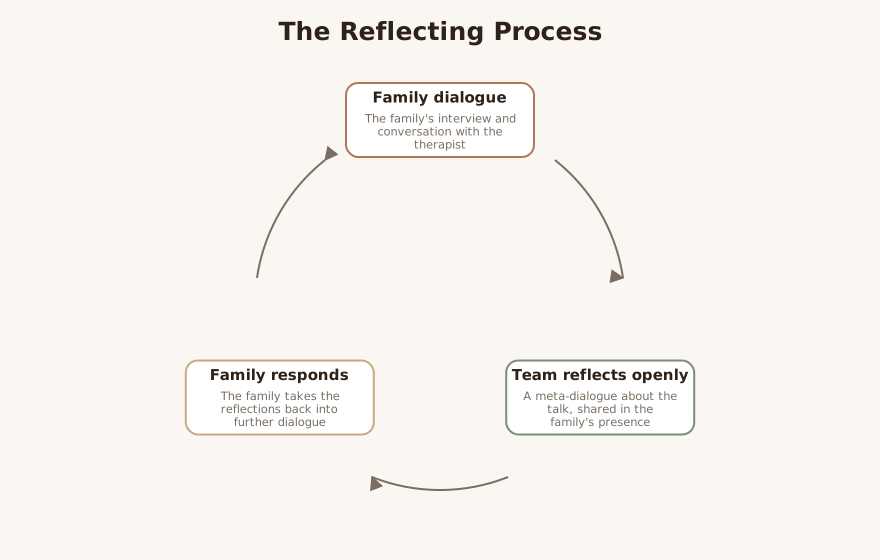
A second principle is the distinction between dialogue and meta-dialogue, captured in Andersen’s subtitle 1. The family’s interview is the dialogue; the team’s reflecting talk is a meta-dialogue about that conversation, which the family then takes back into a further dialogue 1. Therapy becomes a series of shifting positions — talking, then listening to others talk about the talk, then talking again — and it is the movement between these positions, the alternation of inner and outer conversation, that generates new meaning 1.
A third principle is offering differences that are suitable but not too unusual 1. Andersen held that for a reflection to be useful it must introduce a difference the family can actually take in — a perspective different enough to be new but not so foreign as to be rejected; reflections that are too ordinary make no difference, and those that are too strange are dismissed 1. A fourth principle is multiplicity and tentativeness: the team offers several possible understandings rather than one authoritative formulation, framed as wonderings, hunches, and questions, so the family remains free to take what fits and leave the rest 2. A fifth, foregrounded by the ethics literature, is respect and non-imposition — the team speaks as if the family were listening, because they are, and the entire stance presumes the family’s competence to author their own meanings 3.
Interventions & Techniques
The classic structure has two rooms and a clear sequence 1. The therapist interviews the family while the team observes; at a natural pause, the arrangement switches — sound and light move to the team’s room — and the team reflects aloud while the family listens; then it switches back, and the therapist invites the family to respond to anything in the team’s talk that caught their attention 1. Contemporary practice often dispenses with the mirror and the two rooms entirely: the team simply turns its chairs, or moves to the centre of the room, reflects, and then withdraws to let the family comment 2.
The substance of the technique lies in how the team talks 2. Reflections are offered tentatively and in the conditional — “I found myself wondering…”, “It might be that…”, “I’m not sure, but I noticed…” — rather than as interpretations or recommendations 2. Team members speak to one another, not at the family, which lets the family overhear without being put on the spot to agree or defend 2. Reflections stay close to what was actually said and seen, build on the family’s own words and images, and deliberately include positive connotations and noticed strengths alongside any new perspective 2. Crucially, the team offers a spread of views rather than converging on one, preserving the family’s freedom to choose 2.
White’s definitional-ceremony format adds a further discipline to the team’s response 5. After the telling, outsider-witnesses are asked not to evaluate or advise but to answer a structured set of questions: which expression caught their attention, what image of the person’s life or identity it evoked, what in their own life or work made that expression resonate, and where listening has moved or transported them 5. This keeps reflections experience-near and centred on the family rather than on the team’s expertise 5.
LLM-generated illustrative example (not a guideline): A family arrives stuck in a familiar fight: a teenage daughter who “never talks” and parents who “always interrogate.” After the interview, the team turns its chairs and reflects to one another. One member says, “I was struck that when she described the long drives, she said her dad turns the radio down — I wondered if that was its own kind of talking.” Another adds, “I noticed how carefully the mother chose her words; it looked less like interrogation to me and more like fear of saying the wrong thing.” The family, listening, is not told what to do. When the chairs turn back, the daughter says quietly, “The radio thing is true.” A new conversation begins from a difference the family could take in LLM.
Evidence Base
The honest label for the reflecting team’s maturity is established as a practice but thin on controlled outcome evidence LLM. It is a recognized, widely taught, and durable technique with a substantial conceptual and clinical literature spanning three decades, from Andersen’s seminal paper through dedicated scholarly reviews 12. That a body of work large enough to review exists, and that the practice has spread from family therapy into supervision, training, and medical case discussion, is itself a marker of maturity rather than novelty 24.
Where clinicians should calibrate carefully is the kind of evidence LLM. The review literature describes the reflecting team’s strengths — its capacity to flatten hierarchy, to make families feel heard, and to generate new perspectives — but also catalogues real challenges and notes that the empirical base rests heavily on case reports, clinical description, and qualitative accounts rather than on a deep bench of randomized controlled trials comparing reflecting-team work head-to-head against other approaches 2. The dedicated review by Brownlee and colleagues is candid that the practice’s clinical implications are drawn substantially from theory and practitioner experience 2.
A second strand of the literature is frankly ethical and philosophical rather than outcome-focused, concerned with what reflecting processes ask of the practitioner — the relinquishing of expert authority, the discipline of respect, the risk of misusing the format 3. The fair summary for practice is that the reflecting team is a well-theorized, ethically rich, widely adopted technique whose qualitative and clinical evidence is genuine but whose controlled outcome evidence is limited; it is responsibly presented to clients and supervisees as a credible, well-established practice within systemic and narrative therapy rather than as a trial-proven intervention for any specific diagnosis 2LLM.
Populations & Indications
The reflecting team was developed for, and is most at home with, families — including multi-stressed families facing several converging difficulties — where multiple perspectives in the room can address a system rather than an individual 16. Couples are a natural fit, since the alternation of talking and listening lets each partner overhear a reflection on the relationship without having to defend a position in real time LLM. Children and adolescents are well served by a format that does not single them out as the diagnosed problem and that lets them listen rather than be interrogated, which can lower the stakes for a guarded young person 6LLM.
Beyond the family room, the technique extends to group therapy participants and to clients and practitioners from collaborative or dialogical contexts, who are already oriented to therapy as a shared conversation rather than an expert procedure 6. It has also been adapted as a method of professional case discussion, in which a team reflects on a presented case in front of the presenting clinician — an indication that has reached general practice and medical education 4.
The general indication is any situation in which a single authoritative formulation would be unhelpful or alienating, and in which a respectful multiplicity of perspectives, offered openly, is more likely to invite movement LLM. The signature indication is a family or couple who feel talked-about, judged, or unheard, for whom the experience of overhearing themselves spoken of carefully and generously is itself the therapeutic event 5LLM.
Problems-for-Work
In family conflict and relationship conflict, the reflecting team interrupts the entrenched fight by introducing differences the family can take in, while the alternation of talking and listening lowers the pressure to win the argument in the moment 12. In communication problems, the format models a different way of talking — tentative, curious, building on what others said — and lets family members overhear their own words reframed, which can loosen a fixed pattern of misunderstanding 2.
In parent-child relational problems, the team’s refusal to locate the problem in the child, combined with its noticing of strengths and overlooked moments of connection, offers an alternative to the cycle of blame 6LLM. In family disruption due to illness, where a household is reorganizing around a member’s condition, a reflecting team can witness the strain and the coping without either minimizing the burden or reducing the family to the illness LLM.
LLM-generated illustrative example (not a guideline): A couple seeks help after a serious diagnosis has rearranged their life: one partner has become “the patient,” the other “the carer,” and both feel the marriage has vanished into the illness. The reflecting team, after the interview, reflects to one another: “I noticed they still finish each other’s sentences”; “I was moved that he called the appointments our appointments.” The couple, listening, is reminded of a relationship the diagnosis had eclipsed. The reflection does not solve the illness; it returns the couple a thread of themselves to pull on LLM.
For clients who feel unheard or invalidated, the experience of being witnessed — having one’s words attended to closely and acknowledged by an audience — is the active ingredient, and White’s definitional-ceremony framing makes this witnessing the explicit centre of the work 5. In stuck or polarized family narratives, the multiplicity of reflections offers exits from a single dominant story, opening room for a different account to be told and retold 5LLM. And in adjustment problems, a reflecting conversation can hold the difficulty of a transition while surfacing the family’s existing resources for meeting it LLM.
Contraindications, Cautions & Cultural Humility
The central caution is that the open format can be experienced as exposure rather than support LLM. Hearing oneself talked about, even kindly, can be unsettling, and for families in acute crisis, in the grip of high conflict, or carrying significant shame, the experience of being observed and reflected upon may feel intrusive or shaming if the team is not exquisitely careful 2. The reflecting team is not a substitute for risk assessment or crisis management; with active safety concerns, severe psychopathology, or volatile family violence, the format should at most be integrated within a more comprehensive, safety-prioritizing plan, and never deployed for its own sake 2LLM.
A second caution, foregrounded by the ethics literature, is that the structure is not self-justifying 3. The same arrangement that can be respectful and freeing can, in the wrong hands, become a way of delivering covert verdicts or clever interpretations at a family while hiding behind the appearance of openness 3. Andersen’s legacy is precisely the insistence that the manner — tentativeness, respect, the genuine relinquishing of expert authority — is the method, not the room layout 3. Reflections that are too certain, too unusual, or too clearly aimed at “moving” the family violate the principle of offering a difference the family can freely accept or decline 1.
Cultural humility matters because the practice’s premises are not culturally neutral LLM. The format assumes that families are comfortable being observed and spoken of in front of strangers, that overhearing reflections is experienced as respectful rather than as gossip, and that authority can be safely flattened — assumptions that may not hold for clients from hierarchical or collectivist contexts who expect, and may be reassured by, a more directive expert stance LLM. The team’s composition and language carry power; reflections framed in one cultural idiom may land very differently across difference LLM. The honest stance is to introduce the format transparently, secure genuine consent, watch the family’s response closely, and fit the practice to the family rather than the family to the practice 3LLM.
Treatment-Plan Suggestions & SMART Objectives
| Goal | SMART objective (example) | Mechanism |
|---|---|---|
| Reduce the family’s sense of being judged | Within the first reflecting session, each family member names one team reflection they found respectful or accurate | Open, in-the-room reflection dissolves the hidden hierarchy of the observation room 1 |
| Introduce a usable new perspective | Family identifies one team reflection that offered a “difference” they could take in, by the end of two sessions | Reflections offer a difference suitable but not too unusual to be received 1 |
| Lower in-session reactivity in conflict | During reflecting segments, family members listen without interrupting for the full team reflection, across three sessions | Alternation of talking and listening removes the pressure to defend a position in the moment 1 |
| Increase felt sense of being heard | Client articulates, in their own words, what it was like to be witnessed by the team, each reflecting session | Being acknowledged by an audience is the active ingredient of definitional-ceremony witnessing 5 |
| Surface overlooked strengths and connection | Family names one strength or moment of connection the team noticed that they had not, within two sessions | Reflections deliberately include positive connotation and noticed competence 2 |
| Open a polarized family narrative | Family describes one alternative account of the problem prompted by the team’s multiple reflections, over four weeks | Multiplicity of tentative reflections provides exits from a single dominant story 2 |
| Preserve client agency over meaning | Family demonstrates choosing which reflections to take up and which to leave, each session | Tentative, multiple offerings keep the family free to accept or decline 2 |
| Safeguard the ethics of the process | Clinician documents that reflections were offered tentatively and respectfully, and that consent to the format was confirmed, each session | The manner of reflecting — respect and non-imposition — is the method, not the structure 3 |
Common Misconceptions
The first misconception is that the reflecting team is just a brainstorming or supervision huddle that happens to occur in front of the family; in fact the openness is the point, and the family’s overhearing and responding is a structural and ethical feature, not an incidental one 1. A second is that the team’s job is to deliver clever interpretations or a unified formulation; the practice deliberately offers multiple, tentative, conditional reflections so the family remains free to choose, and a single authoritative verdict betrays the method 2.
A third misconception is that the technique requires a one-way mirror and two rooms; the original setup is one historically convenient arrangement, and contemporary practice routinely reflects by simply turning chairs in a single room 2. A fourth is that reflecting positively means flattery or avoiding hard truths; the discipline is to notice genuine strengths and to introduce a real difference, neither empty praise nor blunt confrontation 12. A fifth is that, because it is a “soft” conversational method, it is therefore evidence-free; it rests on a reviewable clinical and qualitative literature and decades of practice, even as its controlled outcome evidence remains limited 2. A sixth is that the structure does the work on its own; the ethics literature is emphatic that the respectful, tentative manner of reflecting is what makes the format helpful rather than harmful 3.
Training & Certification
There is no single license or board that owns the reflecting team; it is learned as part of training in systemic family therapy, narrative therapy, and collaborative practice, and added to a clinician’s existing scope rather than credentialed separately 16. The foundational text remains Andersen’s 1987 paper, which clinicians and supervisees can read directly, and the scholarly reviews provide an accessible synthesis of the practice’s strengths, challenges, and clinical implications for those new to it 12.
Within the narrative tradition, training in reflecting practices and the definitional-ceremony format is offered through institutions such as the Dulwich Centre, whose written materials and video resources demonstrate the outsider-witness structure and the experience-near questions that guide it 57. The reflecting approach has also been written up as a teachable method for case discussion in medical and general-practice settings, broadening where and how clinicians encounter it 4. The practical path for a licensed clinician is to study Andersen’s account and the reviews, observe the practice demonstrated, and then rehearse the tentative, multiple, respectful style of reflecting under supervision — paying particular attention to the ethics of the manner rather than the mechanics of the room 3LLM.
Key Terms
Reflecting team — a group of observing professionals who share their reflections openly in the family’s presence, after which the family responds, rather than conferring privately behind a mirror 1. Reflecting process — the broader, room-independent practice and stance of open, tentative, respectful reflection, of which the team is one instance 3. Dialogue and meta-dialogue — Andersen’s distinction between the family’s interview (dialogue) and the team’s reflecting talk about that conversation (meta-dialogue), which the family then takes back into further dialogue 1. A difference that makes a difference — the principle that a useful reflection must be different enough to be new but not so unusual as to be rejected 1. Tentativeness — the conditional, wondering manner (“it might be that…”) in which reflections are offered to preserve the family’s freedom to choose 2. Outsider-witness / definitional ceremony — Michael White’s reframing of reflecting work as a structured occasion in which an audience acknowledges and authenticates a person’s preferred identity 5. The ethics of reflecting — the principle, central to Andersen’s legacy, that the respectful, non-imposing manner of reflecting is the method itself 3.
Resources & Further Reading
- Andersen, T. (1987). The Reflecting Team: Dialogue and Meta-Dialogue in Clinical Work — Family Process
- Brownlee, Vis & McKenna (2009). Review of the Reflecting Team Process: Strengths, Challenges, and Clinical Implications — The Family Journal
- The legacy of Tom Andersen: The ethics of reflecting processes (2018) — PubMed
- The reflecting team: a new approach to case discussion (2019) — British Journal of General Practice
- Reflecting-Teamwork as Definitional Ceremony (Michael White) — Dulwich Centre
- Chapter 3: The Reflecting Team in Family Therapy — University of Pretoria repository
- Dulwich Centre Foundation: Narrative Therapy — YouTube
Reflective / Supervision Questions
- When you reflect in front of a family, how do you tell the difference between a reflection that offers a usable difference and one that is really a clever interpretation aimed at moving them? LLM
- How do you keep your reflections tentative and conditional under the pressure to sound competent in front of colleagues and clients? LLM
- What tells you that a family is experiencing the open format as respectful witnessing rather than as exposure or being talked-about, and what would you do if you read the latter? LLM
- Given that the manner of reflecting matters more than the room layout, how do you supervise or coach the ethics of reflecting rather than just its mechanics? LLM
- With a family from a hierarchical or collectivist context who may expect a directive expert, how do you introduce and adapt the reflecting format without abandoning it or imposing it? LLM
- How do you ensure your team’s reflections deliberately notice genuine strengths without sliding into empty flattery that the family will rightly distrust? LLM
- Given that the controlled outcome evidence for reflecting teams is limited while the clinical and ethical literature is rich, how would you describe the practice honestly to a supervisee or a referring colleague? LLM