
Type & Discipline
Open Dialogue is a framework for organizing mental health care, not a single manualized psychotherapy technique LLM. It is best understood as a network-based, dialogical approach to acute psychiatric crisis and psychosis that combines a way of structuring services with a particular therapeutic stance in the room 5. Its disciplinary home is community psychiatry: it was developed inside a public catchment-area service and is concerned with how an entire system of care responds to a person in crisis, not only with what happens in an individual session 2. The approach grew out of an earlier Finnish tradition called Need-Adapted Treatment, which held that care should be flexibly tailored to the specific, changing needs of each patient and family rather than applied as a fixed protocol 5. Open Dialogue is the most developed expression of that tradition and is sometimes described as both a system of care and a form of therapeutic conversation 4.
Because it operates at the level of the service system, Open Dialogue cuts across professional boundaries: psychiatrists, psychologists, nurses, and social workers are trained in the same family-therapy and dialogical skills and work as integrated teams 5. This makes it a genuinely cross-disciplinary framework rather than a discipline-specific modality LLM.
Creators & Lineage
The approach was developed primarily in Finland from the 1980s onward, with Jaakko Seikkula and his colleagues at Keropudas Hospital in the Western Lapland region of Tornio as its central architects 5. The broader Need-Adapted Treatment tradition from which Open Dialogue emerged is associated with the Finnish psychiatrist Yrjö Alanen and his Turku group, who argued in the 1980s that treatment for psychosis should be individually fitted, psychotherapeutically informed, and family-oriented rather than uniformly medication-led 5. Seikkula’s collaborator Birgitta Alakare led the clinical and psychiatric side of the Western Lapland service and is a co-author on its key outcome reports 1.
The international articulation of the approach owes much to Mary Olson, who co-authored with Seikkula the influential account of its “poetics and micropolitics” that brought the model to an English-speaking clinical audience 2. Its intellectual lineage is explicitly systemic: it draws on family systems therapy, on systemic and network therapy, and on the reflecting-team practices associated with the Norwegian psychiatrist Tom Andersen, in which clinicians talk openly about their impressions in front of the family rather than behind closed doors 5. Philosophically it is grounded in social constructionism and in the dialogical philosophy of Mikhail Bakhtin, whose idea that meaning is made between people in dialogue rather than inside one mind is central to the model’s understanding of how psychosis can be made shareable in language 2.
Core Principles
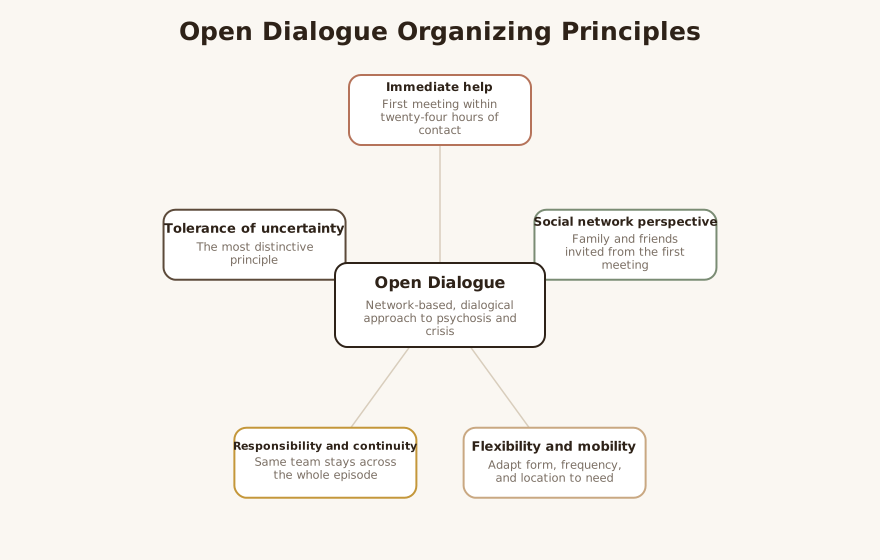
Open Dialogue is usually summarized through a set of organizing principles that describe both how the service is run and how clinicians conduct themselves 4. The first is immediate help: the team offers a first meeting within twenty-four hours of the initial contact, so that the crisis is met while it is still open and before positions harden 4. The second is a social network perspective: the people connected to the person in crisis — family, partners, friends, and relevant professionals — are invited from the very first meeting and are treated as partners in care rather than as bystanders 4.
The third principle is flexibility and mobility, meaning the service adapts the form, frequency, and location of help to the changing needs of each situation, which is the direct inheritance from Need-Adapted Treatment 4. The fourth is responsibility and psychological continuity: whoever is first contacted takes responsibility for organizing the first meeting, and the same team stays with the person and network across the whole episode and, where needed, across years, so that relationships are not fractured by handoffs 4. The fifth and most distinctive is tolerance of uncertainty: the team deliberately resists premature conclusions, rapid diagnostic closure, and reflexive decisions to medicate or hospitalize, holding the situation open long enough for a shared understanding to emerge in dialogue 4. Major treatment decisions are made transparently, in the meeting, with the network present, rather than by clinicians conferring privately 2.
The underlying clinical stance is dialogism itself: the aim of the treatment meeting is not primarily to interpret or to fix, but to generate dialogue in which every voice, including the voice expressing psychotic experience, can be heard and responded to 2. The model holds that psychotic utterances are meaningful communications about unbearable experience, and that recovery is supported when those experiences can be put into shared words 2.
Interventions & Techniques
The central practice is the treatment meeting, an open conversation that includes the person in crisis, their network, and at least two clinicians from the team 2. The meeting is the primary site of both assessment and intervention; there is deliberately no separate, hidden case conference where the “real” decisions are made 2. Clinicians work to respond to each utterance so that the person feels heard, a stance often described as responsivity, and they prioritize generating dialogue over reaching conclusions 2.
A signature technique borrowed from the reflecting-team tradition is the reflecting conversation: within the meeting, the clinicians turn to one another and speak aloud, tentatively, about what they have heard and what it stirs in them, while the family listens 5. This makes the clinicians’ thinking transparent and offers the family new perspectives without imposing them 5. Clinicians also attend closely to their own emotional responses and to moments of silence, treating the embodied and affective texture of the meeting as clinical information 2.
In the more recent Peer-supported Open Dialogue adaptation developed in the United Kingdom, the model is extended by integrating trained peer workers with lived experience into the dialogical teams and by adding mindfulness-informed practices to support clinicians’ presence and capacity to tolerate distress 3.
LLM-generated illustrative example (not a guideline): A nineteen-year-old is brought to services after several weeks of believing the neighbors are broadcasting his thoughts. Rather than booking an individual intake and a medication review, the team convenes a meeting the next day with the young man, his parents, and his older sister. The two clinicians ask open questions and respond to each thing he says, then pause to reflect aloud to each other — “I notice how frightening it must be to feel watched, and I also hear how much the family wants to protect him” — without rushing to label or decide. Medication and hospitalization stay on the table as shared, openly discussed options rather than as foregone conclusions LLM.
Evidence Base
The honest position is that Open Dialogue is an established and internationally influential framework whose most striking outcome claims rest on a thin and methodologically limited evidence base LLM. The best-known data come from the Western Lapland Project, a series of naturalistic studies in a single Finnish region 1. Across these reports, cohorts of first-episode psychosis patients treated under the comprehensive Open Dialogue system showed encouraging long-term results, including relatively low use of antipsychotic medication, comparatively few residual psychotic symptoms, and high rates of return to work or study, with outcomes reported as stable over extended follow-up 1. These figures have driven much of the international interest in the approach 4.
The limitations must be stated plainly LLM. The Western Lapland findings are not from randomized controlled trials; they are observational outcomes from one well-resourced service in a small, relatively stable population, which limits how confidently they can be generalized 1. Qualitative work adds a complementary kind of evidence: people who received first-episode psychosis care under Open Dialogue-based services have described valuing being heard, the inclusion of their families, and continuity of relationship, while also identifying limits and unmet needs in their experience of the approach 6. To address the gap in controlled evidence, the United Kingdom has mounted larger formal evaluation, including the development and implementation study of Peer-supported Open Dialogue within the National Health Service and the associated ODDESSI program of research, which set out to test the approach against treatment as usual under more rigorous conditions 3 4. The defensible summary for clinicians is that Open Dialogue is a coherent, humane, and promising framework with real but still-maturing evidence, and that it should not be presented as a proven superior treatment for psychosis pending stronger trial data LLM.
Populations & Indications
The approach was designed for and is most associated with people experiencing first-episode psychosis, where its emphasis on early, network-inclusive response is intended to alter the trajectory of the illness before it becomes entrenched 1. It is more broadly indicated for individuals in acute psychiatric crisis, where the twenty-four-hour response and the convening of the network are core features 4. Because the model treats the social network as the unit of care, families and social networks are themselves central participants and beneficiaries rather than peripheral informants 4.
It is frequently applied with adolescents and young adults, the developmental window in which first-episode psychosis and many acute crises emerge and in which keeping the family system engaged is especially valuable LLM. It has also been used with people carrying severe and persistent mental illness, for whom the principle of psychological continuity — the same team over years — directly addresses the fragmentation common in their care 4. Developed inside a public catchment-area service, the framework is oriented toward underserved community mental health populations and aims to deliver intensive, relationship-based care within ordinary public services rather than as a private specialty offering 2.
Problems-for-Work
Open Dialogue maps most directly onto the schizophrenia spectrum and other psychotic disorders and, within that, onto first-episode psychosis and acute psychotic crisis, which are the conditions around which the model was built 1. Its dialogical handling of psychotic experience — treating hallucinated or delusional content as a meaningful, shareable communication rather than as noise to be suppressed — is the mechanism most specific to these problems 2.
LLM-generated illustrative example (not a guideline): In a treatment meeting, a woman with brief psychotic disorder describes a “voice” that tells her she is being punished. Instead of correcting or reassuring her, the clinicians stay curious — “What does the voice seem to be afraid of for you?” — which lets her family hear the fear underneath the symptom and respond to it, loosening the isolation around the experience LLM.
The framework is also applied to crises involving psychotic features in mood disorders, including bipolar disorder with psychotic features, where the same network-based, decision-transparent stance applies LLM. Its network orientation makes it well suited to situations dominated by family conflict, where the meeting becomes a place to surface and hold opposing voices, and to social isolation, which the deliberate convening of a network directly counters 4. Because the team takes early responsibility and maintains continuity, the approach is also relevant to treatment disengagement, a frequent and dangerous problem in early psychosis, and the transparency of decisions about risk speaks to the management of suicidal ideation within the network rather than in isolation 4 2.
Contraindications, Cautions & Cultural Humility
Open Dialogue is a delaying-and-holding stance toward diagnosis and medication, and that stance has limits LLM. Tolerance of uncertainty must never become tolerance of unmanaged danger: where there is imminent risk of serious harm to self or others, or a clear need for acute medical or psychiatric stabilization, safety must take precedence, and within the model major decisions including hospitalization and medication remain available and are simply made transparently with the network rather than withheld 2. The approach is also demanding of resources — rapid response, two clinicians per meeting, the same team over time — and a service that adopts its language without its structure risks offering a hollow version of it 4 LLM.
Convening the network requires genuine, informed consent: bringing family and others into the room is powerful but can be experienced as exposing or coercive, and clinicians must attend to whose interests are served when the network is assembled LLM. There is also a legitimate caution that practitioners not over-promise the medication-light outcomes reported in Western Lapland, which emerged from a particular system and population and may not transfer 1.
Cultural humility is essential because both “family” and “openness” are culturally shaped LLM. The model assumes a network that can and should be gathered and that will speak relatively freely, an assumption that may not hold where family relationships are strained, geographically dispersed, unsafe, or governed by norms about privacy, hierarchy, and what may be said in front of whom LLM. The clinician should treat the network meeting as an offer calibrated to the person’s own relational world rather than as a universal procedure, and should remain alert to power differences in the room across gender, generation, and culture LLM.
Treatment-Plan Suggestions & SMART Objectives
The objectives below translate Open Dialogue’s principles into documentable goals that can be pursued within a recognized, network-oriented psychotherapy, rather than presenting the framework as a stand-alone proven treatment LLM.
| Goal | SMART objective (example) | Mechanism |
|---|---|---|
| Engage the social network in care | Within 2 weeks, convene an initial network meeting including the client and at least 2 chosen support people, and hold a network meeting at least every 2 weeks for 8 weeks | Social network perspective and immediate help 4 |
| Reduce treatment disengagement | Over 12 weeks, client and team maintain the same core clinicians across all meetings, with no more than 1 missed contact unaddressed for over 48 hours | Responsibility and psychological continuity 4 |
| Make psychotic experience shareable | Within 8 sessions, client will describe one distressing experience (e.g., a voice or belief) aloud in a network meeting and have it responded to without correction | Dialogical, responsive conversation 2 |
| Improve transparency of major decisions | For each decision about medication or level of care over 12 weeks, document that it was discussed openly in a meeting with the network present | Tolerance of uncertainty; transparent decision-making 2 |
| Reduce social isolation | Over 8 weeks, client will identify and re-engage 2 supportive relationships and report increased contact, tracked weekly | Network mobilization 4 |
| De-escalate family conflict | Within 10 meetings, family members will each voice their perspective in a reflecting conversation and report feeling heard on a brief self-report measure | Reflecting-team practice; multi-voiced dialogue 5 |
| Support recovery of role functioning | Within 6 months, client will take 1 concrete step toward return to work, study, or a valued activity, reviewed in network meetings | Need-adapted, flexible care toward functional recovery 1 |
Common Misconceptions
A frequent misconception is that Open Dialogue is an anti-medication or anti-psychiatry stance; in fact medication and hospitalization remain available within the model and are not refused, they are simply approached cautiously and decided transparently with the network rather than reflexively 2. A related error is reading the low medication rates from Western Lapland as a treatment instruction; those were naturalistic outcomes of one comprehensive system and should not be generalized into a directive to withhold antipsychotics 1.
Another misconception is that Open Dialogue is just family therapy under a new name; while it is rooted in family systems and reflecting-team traditions, it is distinguished by its service-level principles — immediate response, continuity of the same team, and a whole system organized around dialogue — not only by what happens in a single conversation 4 5. It is also wrong to equate “tolerance of uncertainty” with passivity or with ignoring risk; it is a disciplined refusal to foreclose understanding prematurely, held alongside, not instead of, attention to safety 2. Finally, clinicians sometimes assume the evidence is settled; the more accurate view is that the approach is influential and promising but still being tested in larger controlled studies 3.
Training & Certification
Open Dialogue is taught through dedicated post-qualification training programs in which licensed mental health professionals — psychiatrists, psychologists, nurses, and social workers — learn the family-therapy and dialogical skills the model requires and are trained to work as integrated teams 5. Foundation and longer practitioner trainings exist internationally, and entire services have adopted the approach by training their staff together so that the principles operate at the level of the system, not just the individual clinician 4.
In the United Kingdom, a structured training was developed for the Peer-supported Open Dialogue adaptation, which incorporates peer workers with lived experience and mindfulness practice alongside the core dialogical training, and which has been delivered and evaluated within National Health Service settings 3. University-linked programs such as the ODDESSI research group at UCL anchor both the training and the formal research base for the approach 4. There is no single universal credential; clinicians should look for trainings that teach the full set of principles and ideally embed them in a team and service context, since the model is difficult to enact authentically as a solo practitioner LLM.
Key Terms
Need-Adapted Treatment — the earlier Finnish tradition, associated with Yrjö Alanen, of flexibly fitting care to each patient’s and family’s changing needs, from which Open Dialogue grew 5. Treatment meeting — the open conversation including the person, their network, and at least two clinicians, which is the primary site of assessment and intervention 2. Tolerance of uncertainty — the disciplined practice of resisting premature diagnostic, medication, or hospitalization decisions to keep understanding open 4. Social network perspective — inviting family and other significant people into care from the first meeting as partners 4. Psychological continuity — keeping the same team with the person and network across the whole episode of care 4. Reflecting conversation — clinicians talking openly to each other about their impressions while the family listens, drawn from the reflecting-team tradition 5. Dialogism — the Bakhtin-influenced principle that meaning and recovery are generated between people in dialogue rather than inside one mind 2. Peer-supported Open Dialogue — the United Kingdom adaptation adding trained peer workers and mindfulness practice to the dialogical teams 3.
Resources & Further Reading
▶ Watch — a video introduction to this concept:
- Seikkula, Alakare & Aaltonen (2011) — Long-term stability of acute psychosis outcomes, Western Lapland Project (ResearchGate)
- Seikkula & Olson (2003) — The open dialogue approach to acute psychosis: its poetics and micropolitics (PubMed)
- Peer-supported Open Dialogue in the NHS — implementation and evaluation (BMC Psychiatry)
- Open Dialogue — ODDESSI research group, UCL Faculty of Brain Sciences
- Open Dialogue — Wikipedia
- Retrospective experiences of first-episode psychosis under Open Dialogue services — qualitative study (PMC)
Reflective / Supervision Questions
- When I invoke “tolerance of uncertainty,” am I genuinely holding space for understanding to emerge, or am I avoiding a difficult decision about risk that the situation actually demands LLM?
- Whose interests are served when I convene a client’s network, and how do I check that gathering the family is the client’s wish and not only my procedure LLM?
- Am I representing the evidence honestly — as a promising, established framework still under controlled study — rather than promising the medication-light outcomes reported from one Finnish region LLM?
- In my setting, can I actually offer the structural commitments this model requires (rapid response, two clinicians, continuity of team), and if not, what am I really offering when I call my work “Open Dialogue” LLM?
- How do culture, hierarchy, and safety shape what can be said in front of whom in the meeting, and am I attending to the quieter or more vulnerable voices in the room LLM?