
Type & Discipline
The cognitive theory of emotion in its Stoic form is a philosophical theory about what emotions are, not a treatment model or a school of psychotherapy 1. It belongs to the philosophy of emotion, the branch of philosophy that asks whether emotions are feelings, perceptions, judgments, or some combination of these 1. The Stoic version makes a strong and specific claim: an emotion is an act of assent to an evaluative judgment about what is good or bad for us, so that the emotion just is the acceptance of a value-laden belief rather than a brute physiological surge LLM. On this view, fear is the assented judgment “something bad is impending and I cannot bear it,” and anger is the assented judgment “I have been wrongfully harmed and the offender deserves retaliation” LLM.
For clinicians the categorical point is that this is philosophy, and any clinical use is an adaptation of the idea rather than the philosophy delivered raw LLM. What makes it unusually important for therapists is that, unlike most philosophical theories, this one was operationalized into mainstream practice: the cognitive theory of emotion is the conceptual taproot of cognitive and rational-emotive therapy, where the same structure reappears as the proposition that beliefs, not events, generate emotional disturbance LLM. Understanding the theory in its original form sharpens a clinician’s grasp of why cognitive interventions are supposed to work, and of where they reach their limits LLM.
Creators & Lineage
The cognitive theory of emotion has its sharpest ancient formulation in the Stoa, above all in Chrysippus (c. 279–206 BCE), the third head of the Stoic school, who held that the passions are forms of judgment or assent to “impressions” about value LLM. The Stoics distinguished the involuntary first flicker of arousal—the so-called “first movements”—from the full-blown passion, which requires the rational mind to assent to the impression that some external thing is genuinely good or bad LLM. Because assent is in principle up to us, the passions were treated as correctable errors of judgment rather than fixed forces of nature LLM. Epictetus (c. 50–135 CE) gave the idea its most quoted clinical-sounding expression: people are disturbed not by things but by their judgments about things LLM.
In modern philosophy this lineage is carried most prominently by Martha Nussbaum, whose neo-Stoic account defends emotions as evaluative judgments—“upheavals of thought” in which we acknowledge our own neediness and incompleteness before objects and people we do not fully control 2. Nussbaum’s project is to show that emotions are intelligent, cognitive appraisals of what matters to a person’s flourishing, not irrational interruptions of reason 3. This places the Stoic theory inside the broader contemporary family of cognitive or appraisal theories of emotion in philosophy and psychology, which hold that emotions are constituted by, or essentially involve, evaluative appraisals of a situation’s significance 1. The clinical descendants of this lineage are explicit: Albert Ellis credited Stoic philosophy, and Epictetus in particular, as a direct inspiration for Rational Emotive Behavior Therapy, and the same appraisal logic underwrites Beckian Cognitive Behavioral Therapy LLM.
Core Principles
The first principle is that emotions are cognitive, not brute feelings. On the Stoic view an emotion contains a propositional content—a judgment that something matters and is good or bad—so it can be true or false, reasonable or unreasonable, in a way a mere sensation cannot 1. Nussbaum sharpens this by arguing that emotions are evaluative appraisals that ascribe great importance to things and persons outside our full control, which is why they feel like upheavals: they register what we value and cannot guarantee 2.
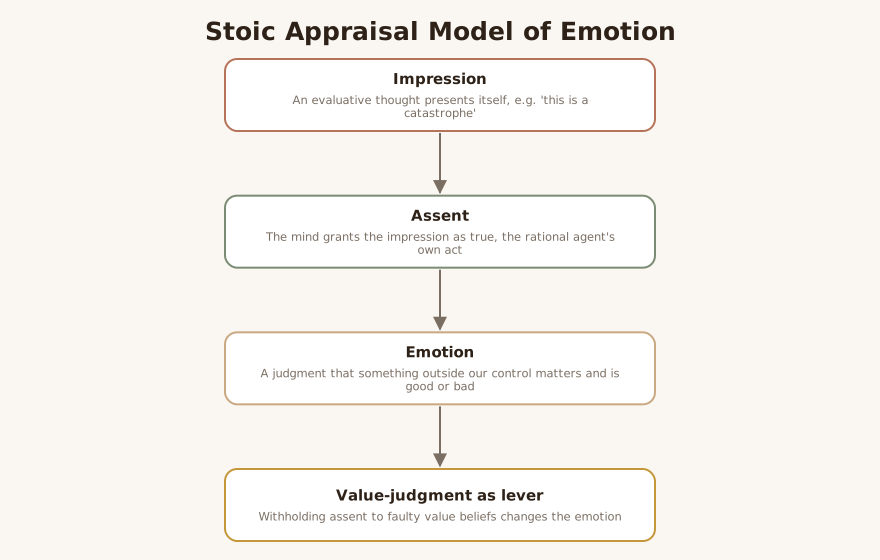
The second principle is assent. The Stoics held that an impression (“this is a catastrophe”) presents itself, but the emotion proper only arises when the mind assents to it as true LLM. Because assent is the rational agent’s own act, the disturbing emotion is, at least in principle, within the person’s power to grant or withhold—this is the conceptual hinge that makes the theory therapeutically usable LLM. The corollary is that disturbed feeling follows from faulty value-laden beliefs, typically the belief that something indifferent or external is necessary for one’s well-being LLM.
The third principle is the value-judgment as the lever of change. If the emotion is constituted by a judgment about value, then the route to changing the emotion runs through examining and revising that judgment rather than suppressing the feeling directly 1. Nussbaum’s version preserves the dignity of emotion here: revising the judgment is not the same as deadening oneself, because emotions are themselves a form of perceiving the world’s significance, and the goal is more accurate evaluation rather than emotional flatness 3. This is the principle that translates most directly into the consulting room as cognitive restructuring LLM.
Interventions & Techniques
The theory supplies no manual of its own, but it furnishes the logic for a recognizable set of techniques delivered inside cognitive and rational-emotive therapies LLM. The core move is identifying the evaluative judgment hidden inside a distressing emotion—asking not only “what are you feeling?” but “what are you telling yourself is good or bad, and how bad?”—which externalizes the appraisal so it can be examined LLM. This maps directly onto the activating-event/belief/consequence structure of Rational Emotive Behavior Therapy and onto the thought-record of Cognitive Behavioral Therapy LLM.
A second technique is disputation of faulty value-laden beliefs, the Stoic insistence that the impression be tested before it is assented to LLM. Clinically this becomes Socratic questioning of catastrophic, demanding, or absolutizing beliefs—“must” statements, “I can’t stand it” statements, and global evaluations of self or world LLM. A third is the dichotomy of control, the Epictetan separation of what is up to us (our judgments and responses) from what is not (others’ actions, outcomes, the past), used to redirect effort away from the uncontrollable and toward the appraisal that is actually modifiable LLM. A fourth is distancing or decentering: treating the impression as a hypothesis the mind has offered rather than a fact the mind must accept, which is the operational meaning of withholding assent LLM.
LLM-generated illustrative example (not a guideline): A client says, “If my presentation goes badly tomorrow, it will be unbearable and my career is over.” A clinician working from this model might reply, “Let’s separate the event from the verdict you’ve passed on it. You’re assenting to a judgment that this is catastrophic and that you couldn’t survive it—what evidence are we accepting too quickly?”—then test the “unbearable” and “career is over” appraisals one at a time, while leaving room for the realistic stakes. LLM
Evidence Base
Honesty requires distinguishing three different claims, because they have very different evidential statuses LLM. First, as a philosophical theory of emotion, the Stoic cognitive/appraisal view is established and historically central: it is one of the major positions in the philosophy of emotion, taken seriously and defended in contemporary work, and given a sustained modern defense by Nussbaum 1. Its place in the field is secure not because it has been proven by experiment but because it is a coherent, influential, and actively debated account of what emotions are 2.
Second, and most importantly for clinicians, the theory was operationalized into among the most empirically validated psychotherapies in existence. The proposition that emotional disturbance follows from evaluative beliefs rather than events directly is the engine of Cognitive Behavioral Therapy and Rational Emotive Behavior Therapy, and the efficacy of cognitive interventions is some of the strongest evidence in the field LLM. So while the philosophical theory qua theory has not been “tested in a trial,” its central mechanism—change the appraisal, change the emotion—has been operationalized, manualized, and supported across a large outcome literature LLM. This is a stronger and more honest claim than saying the idea is merely “unvalidated philosophy” LLM.
Third, the pure cognitivist thesis is philosophically and clinically contested. Critics argue that reducing emotion to evaluative judgment is over-rationalistic and leaves out powerful non-cognitive, physiological responses: fast bodily reactions—gut feelings, palpitations, skin responses mediated by the autonomic nervous system—that appear to precede or bypass conscious appraisal 4. The Jamesian “bear” example is the classic challenge: the pounding heart and surge of adrenaline arrive before, not after, the conscious judgment of danger, suggesting emotion is at least partly physiological rather than purely a judgment 5. Critics also note that the Stoic account struggles to explain emotional responses to music, art, nature, and ecstatic or contemplative states, which seem to act directly on the body rather than through reasoned evaluation 4. The mature clinical position is therefore: use the cognitive theory as a powerful and well-operationalized lever, while recognizing it is a partial account of emotion and pairing it with somatic and experiential methods where appraisal alone is insufficient LLM.
Populations & Indications
The model fits best where presenting distress is plausibly driven by identifiable evaluative beliefs that the client can learn to examine LLM. Adults in psychotherapy with intact reflective capacity are the core population, because the technique depends on a client’s ability to notice and question the judgments embedded in their feelings LLM. People with anxiety disorders are a strong indication, since anxiety so often rides on catastrophic appraisal—judgments that a feared outcome is both likely and unsurvivable—which is precisely the “faulty value-laden belief” the theory targets LLM.
Individuals experiencing anger problems are an especially apt fit, because anger in the Stoic analysis is the assented judgment that one has been wrongfully harmed and that retaliation is warranted, making the appraisal unusually visible and disputable LLM. Adults with depression often hold rigid, global evaluations of self, world, and future, and the appraisal model gives a structured way to test those verdicts LLM. People coping with adversity or loss can use the dichotomy of control to separate the uncontrollable event from the modifiable interpretation, though here the limits of the theory matter most LLM. People seeking philosophical resilience—clients drawn to Stoic practice as a framework for living rather than as symptom relief—are a natural fit, since the theory was designed as a philosophy of life before it was anything clinical LLM.
Problems-for-Work
Catastrophic thinking. The model directly targets the appraisal “this is unbearable and ruinous,” externalizing it as a judgment that can be examined for evidence rather than a fact that must be accepted LLM. A client predicting disaster from a minor setback can be guided to test the magnification before assenting to it LLM.
Generalized anxiety disorder. Chronic worry is reframed as a chain of catastrophic appraisals about uncertain futures, and the dichotomy of control is used to redirect attention from uncontrollable outcomes to modifiable judgments and actions LLM.
Anger and irritability. Because anger is, on this analysis, the judgment of wrongful harm plus a demand for retribution, work proceeds by surfacing the implicit “should” and the assumption of deliberate injury, then testing both LLM.
Maladaptive beliefs and low frustration tolerance. Rigid demands (“I must succeed,” “I can’t stand discomfort”) are the paradigm faulty value-laden beliefs; disputation aims to convert absolutist demands into preferences and to challenge the “I can’t bear it” appraisal that drives distress intolerance LLM.
Major depressive disorder. Global self-condemning evaluations are treated as judgments to be tested rather than truths to be lived under, integrated with behavioral activation and standard depression treatment LLM.
Grief and existential distress. Here the theory is used with deliberate restraint: the dichotomy of control can ease the secondary suffering of “this should not have happened,” but the clinician must not imply that the loss itself is a mere error of judgment to be corrected LLM.
Contraindications, Cautions & Cultural Humility
The gravest clinical risk is that the cognitive theory can be weaponized into invalidation or blame LLM. If emotions are “just judgments you assented to,” a careless application slides into “you chose to feel this” or “your trauma response is a thinking error,” which is both clinically harmful and a misreading of the theory’s own distinction between the involuntary first movement and the assented passion LLM. This is exactly the gap the critics press: the model under-weights fast, body-based, autonomic responses that do not pass through deliberate appraisal, and treating those as mere faulty beliefs can shame a client for a physiological reaction they did not author 4. Survivors of trauma, in particular, may have emotional responses that are pre-reflective and embodied, and a purely cognitive frame risks dismissing them as “disturbances of the body” to be reasoned away rather than processed 5.
A second caution concerns suppression masquerading as reappraisal LLM. Critics note that a rationality-first stance can become suspicious of visceral emotional states and prone to over-controlling them, and clinicians should be alert that some clients use “disputing the thought” to avoid feeling rather than to think more clearly 4. Where appraisal work is reaching its limit—when emotion is somatic, ecstatic, aesthetic, or trauma-driven—the honest move is to pair cognitive methods with experiential, somatic, or emotion-focused approaches rather than to push harder on the judgment 5.
Cultural humility is essential LLM. Stoicism is a specific Greco-Roman tradition with its own value commitments, and its ideal of emotional self-mastery through reason can collide with cultural frameworks in which emotional expression, communal mourning, or spiritual experience are valued goods rather than errors LLM. The clinician should offer the appraisal structure as a tool, not as a verdict on which emotions are rational, and should hold the client’s cultural and spiritual sources of meaning as legitimate rather than as impressions to be disputed LLM.
Treatment-Plan Suggestions & SMART Objectives
| Goal | SMART objective (example) | Mechanism |
|---|---|---|
| Reduce catastrophic appraisal in anxiety | Over 6 sessions, client will complete a thought record on 3 anxiety episodes per week, identifying and rating the catastrophic judgment | Externalizing the appraisal so assent can be examined rather than automatic LLM |
| Decrease anger reactivity | Within 8 weeks, client will, in 80% of logged anger events, name the implicit “wrongful harm” judgment before responding | Surfacing the value-judgment that constitutes the anger interrupts the assent LLM |
| Raise frustration tolerance | Over 4 weeks, client will reframe 5 “I can’t stand it” appraisals into “I dislike but can tolerate” statements and act accordingly | Disputing the absolutizing belief reduces distress intolerance LLM |
| Apply the dichotomy of control | By week 6, client will sort presenting worries into controllable vs. uncontrollable in session 3+ times and redirect effort accordingly | Reallocating effort from uncontrollable events to modifiable judgments LLM |
| Test depressive global evaluations | Within 8 weeks, client will gather evidence for and against 3 self-condemning beliefs and revise each into a specific, testable statement | Replacing global verdicts with calibrated appraisals LLM |
| Reduce secondary suffering in grief/adversity | Across treatment, client will distinguish the loss itself from the “this should not have happened” appraisal in 3 sessions | Easing demand-based secondary distress without invalidating the loss LLM |
| Build reflective distance from impressions | Over 6 sessions, client will practice labeling 4 distressing thoughts per week as “an impression, not a fact” | Withholding automatic assent (decentering) weakens the disturbing emotion LLM |
| Integrate somatic awareness with appraisal | Within 6 weeks, client will pair each cognitive reframe with a brief body-based grounding step in 5 logged episodes | Addressing the non-cognitive component the pure model omits LLM |
Common Misconceptions
“Stoicism means suppressing your emotions.” The cognitive theory is not about stuffing feelings down but about examining the value-judgments that constitute them; the Stoic target is the unreasonable passion built on a false appraisal, not feeling as such LLM. Nussbaum’s defense makes the opposite point—that emotions are intelligent perceptions of what matters and deserve to be taken seriously rather than silenced 2.
“If emotions are judgments, then you choose to feel everything and can just think your way out.” The Stoics themselves distinguished the involuntary first movement of arousal from the assented passion, so the theory does not claim every emotional flicker is chosen LLM. Critics add that fast, autonomic, body-based responses can precede any conscious judgment at all, which is why a “just reason your way out of it” reading is both clinically and philosophically naive 4.
“The cognitive theory is the complete and correct account of emotion.” It is a major and influential account, not a settled fact; the pure cognitivist version is contested precisely because it under-explains the physiology of emotion and our responses to music, art, and embodied experience 5. Treating it as the whole truth invites exactly the over-rationalistic practice the critics warn against 4.
“This is just abstract philosophy with no clinical traction.” On the contrary, it is the conceptual ancestor of CBT and REBT and was explicitly cited as such by Ellis, making it one of the few philosophical theories of emotion with a direct line into evidence-based practice LLM.
Training & Certification
There is no certification in “the cognitive theory of emotion,” because it is a philosophical theory rather than a clinical credential LLM. Clinicians who want to use its logic competently should train in the established modalities that operationalize it—Cognitive Behavioral Therapy and Rational Emotive Behavior Therapy—through recognized coursework and supervision, where appraisal-focused techniques are taught with their indications and limits LLM. Reading the primary and defining secondary sources—the Stoic material and Nussbaum’s Upheavals of Thought—gives a more accurate grasp of the theory than slogans like “you are not disturbed by events,” and guards against the suppression and blame misreadings 2. Supervision matters here because the very power of the appraisal frame creates the risk of invalidating embodied and trauma-driven emotion, and a clinician needs feedback to notice when disputation has tipped into dismissal LLM.
Key Terms
Assent — the rational mind’s act of accepting an impression as true; in the Stoic theory the emotion proper arises only when the mind assents to an evaluative impression LLM.
Impression — the initial presentation to the mind that something is the case or matters in some way; impressions can be examined and refused rather than automatically accepted LLM.
First movement — the involuntary initial flicker of arousal that precedes assent; its existence shows the Stoics did not claim every emotional reaction is chosen LLM.
Evaluative judgment / appraisal — the value-laden assessment of a situation’s significance that, on the cognitive theory, constitutes the emotion 1.
Upheaval of thought — Nussbaum’s term for emotions as cognitive appraisals that register our attachment to objects and persons outside our full control 2.
Dichotomy of control — the Epictetan distinction between what is up to us (our judgments and responses) and what is not (external events and outcomes), used to redirect appraisal and effort LLM.
Resources & Further Reading
▶ Watch — a video introduction to this concept:
- Emotion (Stanford Encyclopedia of Philosophy)
- Upheavals of Thought: The Intelligence of Emotions, Nussbaum (Cambridge University Press)
- Nussbaum on the cognitive nature of emotions (Manuscrito)
- What the Neo-Stoic theory of emotions misses out (History of Emotions Blog, QMUL)
- What the Stoic account of the emotions leaves out (Philosophy for Life — Jules Evans)
Reflective / Supervision Questions
- When I help a client dispute a distressing belief, am I helping them think more accurately, or am I implicitly teaching them to suppress and avoid the feeling? LLM
- How do I distinguish a client’s correctable catastrophic appraisal from an embodied, autonomic, or trauma-driven response that should be met somatically rather than disputed? 5
- Where is the line between validating Stoic self-mastery and inadvertently communicating that the client “chose” or is to blame for their emotional pain? LLM
- For this particular client, does the appraisal model fit their cultural and spiritual frame, or am I imposing a Greco-Roman ideal of reason over emotion? LLM
- When cognitive disputation stalls, do I push harder on the judgment, or do I recognize the limits of the pure cognitive theory and bring in experiential and body-based methods? 4
- Am I representing this work honestly—as the well-operationalized core of CBT and REBT—without overclaiming that the philosophical theory itself has been “proven”? LLM