
Type & Discipline
The Cognitive Appraisal Theory of Stress and Emotion is a theoretical model rather than a discrete treatment protocol LLM. It sits within health and social psychology and belongs to the broader family of stress-and-coping models 2. Its central and most enduring claim is that psychological stress is not a property of the environment, nor purely a property of the person, but a relationship between the two that is mediated by how the person interprets, or appraises, what is happening 1. Because the model locates the active ingredient in meaning-making rather than in the stressor itself, it is sometimes called the transactional model of stress and coping 3.
For practicing clinicians, the most important orientation point is this: appraisal theory explains why the same event produces panic in one client and mild concern in another, but it does not, by itself, prescribe a session structure LLM. It is a conceptual lens that lives inside cognitive and behavioral therapies, and it is delivered through those modalities rather than billed as a standalone therapy LLM.
Creators & Lineage
The theory is associated above all with Richard S. Lazarus, whose work on stress and emotion spanned several decades, and with Susan Folkman, his collaborator on the model’s most influential statement 1. Their 1984 book, Stress, Appraisal, and Coping, formalized the transactional account and remains the canonical reference 1. Lazarus’s earlier experimental work, including studies in which participants’ emotional and physiological reactions to a distressing film were shaped by the interpretive instructions they were given, supplied the empirical roots of the appraisal concept 5.
The model descends from and feeds into a recognizable lineage LLM. It is a cognitive theory of emotion, holding that cognition precedes and shapes emotional response, and it stands alongside the cognitive theories of emotion that informed cognitive therapy 6. It is the parent of modern coping theory, including the now-standard distinction between problem-focused and emotion-focused coping 2. And it is conceptually adjacent to Cognitive Behavioral Therapy, with which it shares the premise that interpretation, not the event, drives the response, even though the two developed in partly separate research traditions LLM. Lazarus’s position was the subject of a well-known debate with Robert Zajonc over whether emotion can occur without prior cognitive appraisal, a dispute that sharpened the theory’s claims about the primacy of cognition 6.
Core Principles
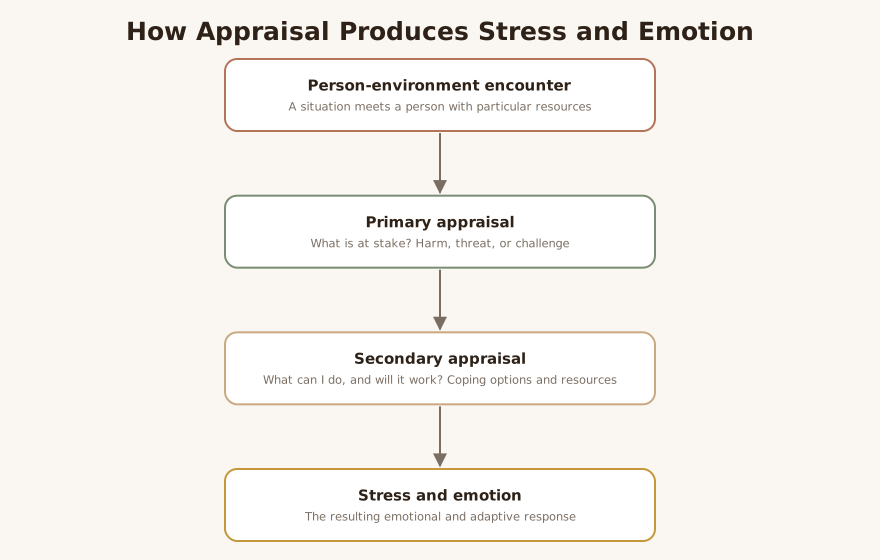
The first principle is the transaction: stress arises from a particular kind of person-environment relationship, one the person judges to tax or exceed their resources and to endanger their wellbeing 1. Neither the situation alone nor the individual alone is sufficient; it is the fit, or misfit, between demand and capacity that matters 3.
The second principle is primary appraisal, the evaluation of what is at stake 1. Here the person asks, in effect, “Is this relevant to me, and if so, is it good or bad?” 4. A situation may be appraised as irrelevant, as benign-positive, or as stressful; stressful appraisals further divide into harm or loss (damage already done), threat (anticipated harm), and challenge (the prospect of gain or growth through effort) 2. The challenge appraisal is clinically important because it carries positive affect and mobilizes effort rather than avoidance 2.
The third principle is secondary appraisal, the evaluation of coping options and resources 1. Here the question is “What can I do about it, and will it work?” 4. Secondary appraisal weighs perceived control, available coping strategies, and expectations about their effectiveness 3. Primary and secondary appraisal are not strictly sequential; they interact continuously, and a strong sense of coping capacity can downgrade a threat appraisal in real time 2.
The fourth principle is reappraisal: appraisals are dynamic and revised as the situation unfolds and as new information arrives, which is what makes the model transactional rather than static 3. The fifth principle is coping itself, the changing cognitive and behavioral efforts to manage demands appraised as taxing 1. Lazarus and Folkman distinguished problem-focused coping, aimed at altering the stressor, from emotion-focused coping, aimed at regulating the distress it provokes, and held that both have their place depending on appraised controllability 2.
Interventions & Techniques
Because the theory identifies appraisal as the leverage point, the interventions it implies are those that surface, examine, and modify appraisals LLM. In practice these are drawn from the cognitive-behavioral toolkit rather than invented anew LLM.
Appraisal mapping is a useful starting technique: helping the client articulate, for a specific stressor, both their primary appraisal (what is at stake) and their secondary appraisal (what they believe they can do) 4. Making these often-automatic judgments explicit is itself frequently therapeutic LLM. Cognitive restructuring then targets distorted or rigid appraisals, for example catastrophic threat appraisals or globally negative estimates of coping capacity LLM. Reframing toward a challenge appraisal, where genuinely appropriate, can shift the affective tone of an encounter and increase approach behavior 2.
On the secondary-appraisal side, building and rehearsing concrete coping skills raises the person’s appraised resources and thereby lowers the stress response 3. Matching coping style to controllability is a teachable heuristic: problem-focused strategies for stressors the client can influence, emotion-focused or acceptance strategies for those they cannot 2. Many established programs operationalize these ideas, including stress inoculation training, problem-solving therapy, and structured stress-management interventions LLM.
LLM-generated illustrative example (not a guideline): A client facing a performance review appraises it as a near-certain threat to their job (primary) and rates their ability to influence the outcome as near zero (secondary). The clinician helps separate the realistic stakes from the catastrophic forecast, then identifies controllable actions (preparing specifics, requesting feedback), shifting the secondary appraisal from helpless to partly agentic LLM.
Evidence Base
The maturity of this model is best described as established LLM. It is among the most influential and most cited frameworks in stress research, foundational to the field and durable across decades 2. The broad architecture, that appraisals mediate the link between events and emotional or physiological outcomes, and that coping shapes adaptation, enjoys wide empirical support 3.
Honesty requires distinguishing the theory’s standing from the evidence for any particular intervention LLM. The theory’s theoretical standing is strong; the efficacy evidence lives in the CBT-family treatments that operationalize it, not in the model as an abstraction LLM. Several substantive critiques deserve a clinician’s attention LLM. First, the constructs are difficult to operationalize and measure precisely, and much supporting data is self-report and cross-sectional, which weakens causal inference 2. Second, there is a circularity concern: appraisal is often inferred from the very emotion it is meant to explain, making the relationship hard to test cleanly LLM. Third, the model’s claim that cognitive appraisal precedes emotion was contested in the Lazarus-Zajonc debate, with Zajonc arguing that some affective responses can occur without prior cognition 6. Fourth, what counts as a threat versus a challenge varies substantially across individuals and cultures, limiting universal predictions LLM. None of these dethrone the model; they mark where a clinician should hold it as a flexible heuristic rather than a precise law LLM.
Populations & Indications
The appraisal lens is broadly applicable across adult populations and is especially useful wherever the meaning a person assigns to a stressor is doing visible work LLM. It is widely applied with adults navigating ordinary and acute life stressors 3.
People with chronic illness are a strong indication, because illness presents recurring appraisals of threat, loss, and uncertain control that directly shape distress and adherence LLM. Caregivers facing sustained demand and ambiguous loss benefit from work on both the stakes they perceive and their appraised resources LLM. People under occupational stress, where workload and control are constantly being weighed, map naturally onto the primary-secondary appraisal structure 3. Trauma-exposed populations can be understood partly through threat and harm appraisals and through beliefs about safety and control, though here the model is a supplement to trauma-specific treatment, not a replacement LLM. Older adults, who often face accumulating losses alongside shifting coping repertoires, are a further fitting population LLM.
Problems-for-Work
The model is well suited to a range of presenting problems, with the common thread that appraisal and coping are clinically modifiable LLM.
For acute stress and adjustment disorders, the work centers on examining a recent stressor’s primary appraisal and expanding the client’s secondary-appraisal sense of options LLM. For chronic stress and burnout, the focus shifts to recurring threat appraisals, eroded coping resources, and the imbalance between sustained demand and capacity 3. For anxiety, threat appraisals are typically inflated and coping appraisals deflated, making the primary-secondary distinction a clean target LLM.
LLM-generated illustrative example (not a guideline): A client with health anxiety appraises a benign bodily sensation as a sign of serious disease (inflated threat) and doubts they could cope with bad news (deflated secondary appraisal). Sessions test the threat estimate against evidence and rehearse a concrete coping plan, lowering both components LLM.
For coping deficits, the intervention is explicit skill-building matched to controllability 2. For chronic illness adjustment and caregiver strain, work distinguishes what can be changed (problem-focused) from what must be accommodated (emotion-focused) 2. For emotion dysregulation, reappraisal is itself a regulation strategy, and naming the appraisal that drives an emotional surge can interrupt it LLM. For PTSD, appraisals of threat, blame, and safety are addressed as part of, not instead of, evidence-based trauma treatment LLM.
Contraindications, Cautions & Cultural Humility
There are few absolute contraindications to thinking in appraisal terms, but there are important cautions LLM. The model should never be used to imply that distress is the client’s fault for “appraising wrongly,” which risks invalidation and can compound shame, especially in trauma and oppression-related stress LLM. Some stressors are genuinely overwhelming and not primarily a matter of distorted appraisal; reframing real danger or real injustice as a perception problem is a clinical and ethical error LLM.
Cultural humility is essential because what registers as threat, what counts as a coping resource, and which coping styles are valued differ markedly across cultural and individual contexts LLM. The model itself acknowledges that appraisal depends on personal and situational factors, including commitments, beliefs, and resources that are culturally shaped 1. Clinicians should avoid importing a default that problem-focused, individually agentic coping is superior; for stressors a client cannot control, or within collectivist or faith-based frameworks, emotion-focused, relational, or acceptance-based coping may be the adaptive choice 2. When acute risk, severe trauma, or systemic adversity is present, appraisal work is adjunctive and should not delay safety planning or specialized treatment LLM.
Treatment-Plan Suggestions & SMART Objectives
| Goal | SMART objective (example) | Mechanism |
|---|---|---|
| Increase awareness of automatic appraisals | Client will identify the primary and secondary appraisal for at least 3 stressors per week in a log for 4 weeks | Makes implicit threat and coping judgments explicit for examination 4 |
| Reduce inflated threat appraisals | Client will use a thought record to test and reframe catastrophic threat appraisals in at least 2 situations weekly for 6 weeks | Cognitive restructuring of primary appraisal LLM |
| Strengthen perceived coping capacity | Client will rehearse and apply one concrete coping skill in a real stressor weekly for 8 weeks, rating perceived control before and after | Raises secondary-appraisal resources, lowering stress response 3 |
| Match coping to controllability | Client will classify weekly stressors as controllable vs uncontrollable and select an appropriate coping strategy for each, 4 of 5 sessions | Aligns problem- vs emotion-focused coping with appraised control 2 |
| Build challenge appraisals | Client will reframe one anticipated stressor per week as a challenge with identified potential gains for 4 weeks | Shifts affect toward approach and effort 2 |
| Improve emotion regulation via reappraisal | Client will apply a reappraisal strategy during 3 emotional surges per week, logging the appraisal that triggered the surge, for 6 weeks | Reappraisal as an in-the-moment regulation mechanism LLM |
| Reduce caregiver/illness-related distress | Client will distinguish changeable from unchangeable aspects of a recurring stressor and apply matched coping weekly for 8 weeks | Reduces strain by accommodating uncontrollable demands 2 |
Common Misconceptions
A frequent misconception is that the theory says events do not matter and that “it’s all in your head” LLM. The transactional claim is the opposite: stress is a relationship between real demands and real resources, with appraisal as the mediator, not the sole cause 1. A second misconception is that primary and secondary appraisal happen in a fixed temporal order; in fact they interact continuously and reciprocally 2.
A third is that emotion-focused coping is inferior to problem-focused coping; the theory holds that each is adaptive in the right context, particularly that emotion-focused coping fits stressors that cannot be changed 2. A fourth is that the model is itself a treatment with its own evidence base; rather, it is a framework whose interventions are validated within CBT-family therapies LLM. A fifth, addressed in the Lazarus-Zajonc debate, is that all emotion must follow conscious appraisal; the theory’s defenders allow that appraisal can be rapid and non-conscious, but the strict precedence claim remains contested 6.
Training & Certification
There is no certification in “cognitive appraisal theory” as such, because it is a theoretical model rather than a credentialed therapy LLM. Clinicians acquire it as part of foundational training in stress, coping, and cognitive theories of emotion, and most encounter it through coursework grounded in Lazarus and Folkman’s writing 1. Accessible secondary overviews, including research-database summaries and practitioner explainers, are widely available for review 3.
The applied skills, appraisal mapping, cognitive restructuring, and coping-skills training, are learned and supervised within training in their parent modalities, principally Cognitive Behavioral Therapy and its structured derivatives such as stress inoculation training and problem-solving therapy LLM. Clinicians seeking competence should therefore pursue CBT training and supervision and treat appraisal theory as the explanatory backbone of that work LLM.
Key Terms
Transaction: the person-environment relationship from which stress arises, judged to tax or exceed resources 1.
Primary appraisal: the evaluation of what is at stake in an encounter, sorted into irrelevant, benign-positive, or stressful (harm/loss, threat, challenge) 2.
Secondary appraisal: the evaluation of coping options, resources, and the expectation that they will work 4.
Reappraisal: the revision of an appraisal as the situation changes or new information arrives, making the model dynamic 3.
Coping: the changing cognitive and behavioral efforts to manage demands appraised as taxing, divided into problem-focused and emotion-focused 2.
Challenge appraisal: a stressful appraisal carrying the prospect of gain or growth, associated with positive affect and mobilized effort 2.
Resources & Further Reading
▶ Watch — a video introduction to this concept:
- Lazarus, R. S., & Folkman, S. (1984). Stress, Appraisal, and Coping (Springer)
- Lazarus and Folkman’s Psychological Stress and Coping Theory — Wiley Handbook chapter
- Transactional model of stress and coping — EBSCO Research Starters
- Lazarus and Folkman’s Transactional Model of Stress and Coping — MindTools
- Lazarus’s Cognitive Appraisal Theory — JoVE Science Education (video)
- Cognitive appraisal — Wikipedia
Reflective / Supervision Questions
- When a client’s distress seems disproportionate to the event, am I attending to their primary and secondary appraisals, or am I quietly judging their reaction as irrational? LLM
- Where might I be defaulting to problem-focused coping for stressors the client genuinely cannot control, and overlooking adaptive emotion-focused or acceptance strategies? LLM
- How do my own cultural assumptions shape what I treat as a “realistic” threat appraisal or a “good” coping resource for this client? LLM
- Am I using appraisal language in a way that invites collaboration, or in a way that risks implying the client is at fault for feeling distressed? LLM
- For trauma-exposed or acutely at-risk clients, am I keeping appraisal work adjunctive to safety planning and specialized treatment rather than substituting for it? LLM
- Can I name, for a current case, which billable modality I am working within and which specific appraisal-based technique I am using inside it? LLM