
Type & Discipline
Narrative career counseling is a standalone counseling modality situated within counseling psychology and vocational psychology, in which career is understood not as a fixed match between traits and jobs but as an evolving personal story the client authors over time 4. It belongs to the constructivist and social-constructionist family of career interventions, sharing assumptions with narrative therapy while keeping vocational identity and the meaning of work as its central concern 4. The approach is most fully articulated through Mark Savickas’s Career Construction Theory and the broader Life Design paradigm, which reframe career development as a process of making meaning across the unfolding life course 1. Rather than asking “what occupation fits this person’s measured interests,” the narrative practitioner asks “what story is this person trying to live, and how can work advance it” 5. In clinical settings, this makes the modality a natural complement to psychotherapy when career distress and identity questions are entangled with mood, anxiety, or adjustment difficulties LLM.
Creators & Lineage
The dominant architect of the contemporary approach is Mark Savickas, whose Career Construction Theory positions narrative as the mechanism through which individuals build a vocational self and adapt to occupational transitions 2. Savickas and an international group of collaborators formalized the Life Design paradigm in 2009, proposing a flexible, lifelong, and contextual model suited to the unstable careers of the twenty-first century 1. His applied method is laid out for practitioners in the second edition of Career Counseling within the APA Theories of Psychotherapy series 6. Larry Cochran is the other figure consistently named in this tradition; narrative career frameworks list him alongside Savickas as a developer of an alternative narrative model, and his work foregrounds career as a coherent life story with plot, agency, and dramatic structure 4. Beyond these two, the field credits constructivist contributors such as Peavy, Brott, McMahon, and Patton for developing narrative techniques and mapping tools 4. The lineage thus runs from constructivist and social-constructionist epistemology, through narrative therapy’s “re-authoring” stance, into a career-specific application that retains the clinical sensibility of working with a client’s lived story LLM.
Core Principles
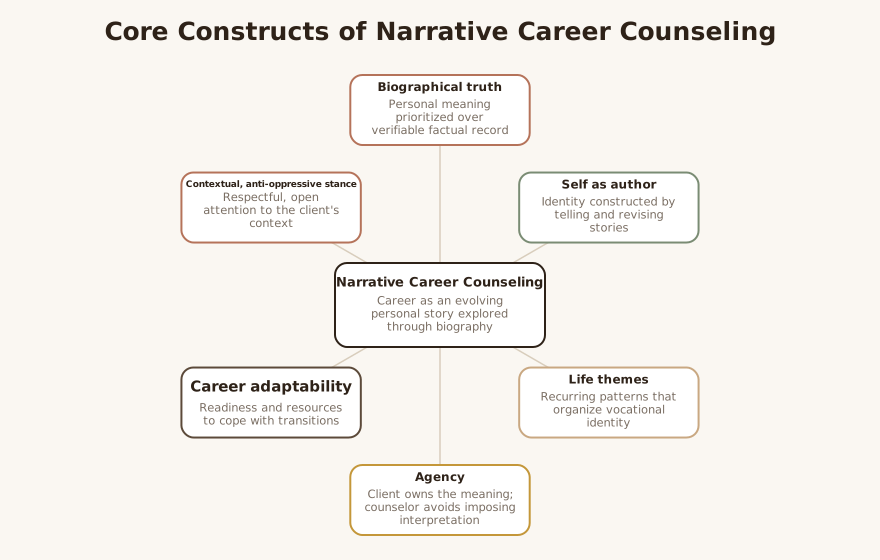
The foundational premise is that “life as lived is subjective” and that career exploration should center on biographical narrative rather than objective trait-matching alone 4. What the client produces in counseling is narrative or biographical truth — significance that is meaningful to the individual — rather than a verifiable factual record, so the counselor prioritizes personal meaning over accuracy 4. The self is treated as an autobiographical author who constructs identity and coherence by telling and revising stories 3. Running through these stories are life themes: recurring patterns, often rooted in early experience, that organize a person’s preoccupations and shape vocational identity 3. A second principle is agency: the client writes the story while the counselor refrains from imposing interpretations, so ownership of meaning stays with the person throughout 4. Career adaptability — the readiness and resources to cope with transitions and the tasks they impose — is the developmental capacity the work aims to strengthen 2. Finally, the approach is explicitly contextual and anti-oppressive, requiring practitioners to be respectful and open, attentive to how clients understand events and their impacts within their social worlds 4. Together these commitments shift the counselor from expert assessor to a collaborator who helps the client hear and reshape their own story LLM.
Interventions & Techniques
The signature instrument is the Career Construction Interview, a structured set of biographical prompts that surface the raw material of a client’s narrative 3. Its core questions ask about role models admired in childhood, favorite magazines, television shows, or websites, a favorite story or book, favored mottos or sayings, school subjects, and early recollections 4. Each prompt is interpreted for what it reveals: role models map qualities the client is building toward, favored media point to preferred environments and interests, the favorite story often mirrors the client’s own plot, and the motto carries self-advice for the present challenge 3. Early recollections are read for the life theme — frequently a way the client has turned a private hurt or preoccupation into a direction of effort 3. The counseling process moves through construction, deconstruction, reconstruction, and co-construction: the client builds the story, the counselor helps loosen constraining or self-limiting versions of it, the story is reassembled around a clarified theme, and a forward-looking narrative is jointly composed 3. A central aim is to transform problem-saturated stories into hopeful ones, converting hurt into purpose and contribution 3. Sessions typically follow a recognizable arc — establishing a collaborative contract, exploring stories, identifying themes and relating them to future goals, and clarifying concrete action steps with later reality-testing 4. Complementary mapping techniques include life-space maps, life lines, genograms, life-role circles, goal maps, and the résumé used as a narrative tool rather than a mere credential list 4.
LLM-generated illustrative example (not a guideline): A 34-year-old considering leaving nursing names a childhood role model who “fixed broken things,” a favorite story about a reluctant leader, and an early memory of organizing other children during a crisis; the counselor and client read these as a theme of bringing order to chaos, reframing the contemplated move toward clinical operations not as abandoning care but as a continuation of the same story LLM.
Evidence Base
The maturity of narrative career counseling is best described as established: it rests on a substantial theoretical literature, a formalized paradigm, and a documented applied method, and it is taught and practiced internationally 1. Career Construction Theory has been elaborated across peer-reviewed work that specifies the role of narrative in vocational identity and adaptability 2. Its applied framework is codified in a major professional series, signaling acceptance as a recognized psychotherapeutic approach to career concerns 6. At the same time, honesty about the evidence requires acknowledging its shape: the base leans heavily on theory-building, qualitative inquiry, and case demonstration, and practitioners note there is no single comprehensive handbook, with flexibility emphasized over rigid protocol 4. Research examples exist but remain limited in scope, and the modality’s defining outcome — enhanced meaning-making — is intrinsically harder to quantify than a job-placement rate 4. Compared with manualized, randomized-trial-heavy interventions, large controlled trials of narrative career counseling are sparse, so clinicians should present it as a well-developed and theoretically coherent approach rather than one carried by a deep RCT literature LLM. For many career and identity concerns, that level of evidence is reasonable, but it should be communicated transparently to clients and supervisors LLM.
Populations & Indications
The approach is designed for adults in career transition, where the central task is making sense of disruption and composing a viable next chapter 1. It fits young adults and students who are forming a first occupational identity and need help articulating what they want work to mean 5. Professionals and mid-career changers benefit when accumulated experience has outrun their original story and a re-authoring is needed to integrate who they have become 5. Unemployed individuals — particularly those facing involuntary loss — are a core population, since the work can convert a demoralizing rupture into a coherent, agentic account of next steps 4. The Life Design rationale explicitly targets the unstable, boundaryless careers of the contemporary economy, where lifelong adaptability matters more than a one-time match 1. Clinically, the modality is indicated when a client’s distress is organized around questions of identity, meaning, and direction rather than around a discrete skills deficit LLM. It is a strong fit when career confusion is interwoven with broader life transitions, because the narrative frame treats work and life as a single unfolding story LLM.
Problems-for-Work
Career indecision is the prototypical problem-for-work: the counselor helps the undecided client surface a life theme that quietly already organizes their preferences, so that “deciding” becomes recognizing a story rather than choosing among abstractions 3. Vocational confusion and lack of meaning are addressed by moving from trait-matching to biographical exploration, restoring personal significance to the question of what to do 4. Identity concerns are central, since the modality treats the self as an authored narrative that can be examined and revised 3. Life transitions — graduation, layoff, relocation, midlife reappraisal — are worked by strengthening career adaptability and composing continuity across the break 2. Work-related stress and adjustment difficulties can be reframed when the stressor is reread as a chapter that does not fit the client’s deeper theme, opening room for change LLM. Low self-efficacy is approached indirectly: as the client recognizes a thread of agency already present in their early recollections and role models, a more capable self-story becomes available 3. In each case the unit of work is the story, and progress is movement from a constrained, problem-saturated account toward a hopeful, action-oriented one 3.
LLM-generated illustrative example (not a guideline): A recently laid-off client presents with work-related stress and low self-efficacy; tracing a motto she has repeated for years — “start where you are” — the counselor helps her reread the layoff as a forced starting point rather than a verdict on her worth, and she drafts two exploratory steps consistent with that theme LLM.
Contraindications, Cautions & Cultural Humility
Narrative career counseling is not a substitute for treatment of acute psychiatric crisis; when a client presents with active risk, severe untreated mood or anxiety disorder, or trauma that destabilizes the storytelling process, stabilization and appropriate clinical care take precedence over biographical exploration LLM. Because the Career Construction Interview deliberately reaches into early recollections and formative hurts, it can activate painful material, and a counselor without the clinical training to contain that should refer or collaborate rather than proceed alone LLM. The method’s strength — prioritizing meaning over factual accuracy — is also a caution: the counselor must avoid imposing an interpretation, since the client is the one who writes the story and retains ownership of its meaning 4. Cultural humility is structurally required, not optional: practitioners are expected to be respectful, open, and anti-oppressive, attending closely to how clients understand events within their own contexts 4. The very notion of “career as authored self-story” carries individualist assumptions that may not map onto collectivist, family-centered, or economically constrained life worlds, so the counselor should hold the frame lightly and let the client’s cultural meanings lead LLM. Where structural barriers — discrimination, poverty, caregiving obligations — shape vocational options, re-authoring a story must not become a way of relocating systemic problems inside the individual LLM.
Treatment-Plan Suggestions & SMART Objectives
| Goal | SMART objective (example) | Mechanism |
|---|---|---|
| Reduce career indecision | Within 6 sessions, client will complete a Career Construction Interview and name one life theme that organizes their occupational preferences | Surfacing the implicit narrative converts choice-paralysis into recognition of an existing pattern 3 |
| Clarify vocational identity | In 8 weeks, client will articulate a one-paragraph “occupational self-story” linking a childhood role model to a current aspiration | Self-as-author construct externalizes identity for examination and revision 3 |
| Restore meaning in work | Within 4 sessions, client will identify two themes that make a contemplated role personally significant, rated subjectively each session | Shift from trait-matching to biographical meaning-making 4 |
| Strengthen career adaptability | Over 6 weeks, client will define and rehearse three concrete steps for an anticipated transition | Building adaptability resources for coping with change 2 |
| Re-author a problem-saturated story | By session 8, client will reframe one self-limiting career belief into a hopeful alternative account in their own words | Deconstruction and reconstruction of constraining narrative 3 |
| Increase vocational self-efficacy | Within 5 sessions, client will locate two early recollections evidencing personal agency and connect them to a present goal | Recognizing agency already present in the life theme 3 |
| Convert involuntary job loss into direction | Within 4 weeks, client will produce a forward-looking narrative of next steps and reality-test one with an external contact | Turning rupture into an agentic, contributory story 4 |
Common Misconceptions
A first misconception is that narrative career counseling is just storytelling without rigor; in fact it follows a defined process of construction, deconstruction, reconstruction, and co-construction with interpretable prompts 3. A second is that it discards assessment entirely — it does not necessarily replace interest inventories, but it reframes their results inside a biographical narrative rather than treating them as the verdict 4. A third is that the counselor’s job is to interpret the client’s story and hand back conclusions; the model insists the client writes the story and the counselor refrains from imposing meaning 4. A fourth is that it is identical to narrative therapy; while it borrows the re-authoring stance, its target is vocational identity and the meaning of work within the Life Design paradigm 1. A fifth is that “meaning over accuracy” licenses fabrication, when the point is that biographical truth — what is significant to the client — is the legitimate working material 4. Finally, some assume it suits only the highly verbal or privileged; the mapping techniques and the anti-oppressive framing are intended to make it adaptable across contexts 4.
Training & Certification
There is no single licensure specific to narrative career counseling; it is a method practiced within the existing credentials of counselors, psychologists, and career development professionals LLM. The primary route to competence is study of the source theory and method, anchored by Savickas’s Career Counseling in the APA Theories of Psychotherapy series, which functions as the closest thing to a practitioner text 6. Foundational reading includes the Life Design paradigm statement and the articulation of narrative’s role in Career Construction Theory 1. Practitioners themselves note the absence of a comprehensive handbook, so training emphasizes supervised practice and flexible application rather than adherence to a fixed protocol 4. Workshops and continuing-education offerings in career construction and the Career Construction Interview are the typical experiential path, ideally paired with supervision because the interview reaches into emotionally significant early material LLM. Counselors already trained in narrative therapy or constructivist methods will find the transfer of skills substantial LLM.
Key Terms
Career Construction Theory — Savickas’s framework explaining how individuals build vocational identity and adaptability through narrative 2. Life Design paradigm — the lifelong, holistic, contextual model of career intervention for unstable contemporary careers 1. Career Construction Interview — the structured biographical prompt set used to elicit the client’s vocational story 3. Life theme — a recurring pattern, often from early experience, that organizes a person’s preoccupations and vocational direction 3. Career adaptability — the readiness and resources to cope with transitions and developmental tasks 2. Self as author — the construct of the person as autobiographical narrator who constructs and revises identity 3. Re-authoring — the deconstruction and reconstruction of a constraining story into a hopeful, agentic one 3. Biographical truth — meaning significant to the individual, prioritized over factual accuracy 4.
Resources & Further Reading
▶ Watch — a video introduction to this concept:
- Life Designing: A Paradigm for Career Construction in the 21st Century (Savickas et al., 2009, Journal of Vocational Behavior)
- The Role of Narrative in Career Construction Theory (Savickas, 2011, Journal of Vocational Behavior)
- Innovating Counseling for Self- and Career Construction (Savickas)
- Narrative Career Counselling — National Guidance Research Forum (Warwick/IER)
- Career Construction Theory & Life Design (Narrative approach) — Marcr
- Career Counseling (Savickas, 2nd ed., 2019, APA Theories of Psychotherapy Series)
Reflective / Supervision Questions
- When a client’s career story feels “stuck,” am I helping them re-author it, or am I quietly supplying my own preferred ending 4?
- How do I distinguish a clinically appropriate exploration of painful early recollections from material that warrants stabilization or referral first LLM?
- Whose definition of a “good career” is operating in the room — the client’s life theme, or my own cultural and class assumptions about meaningful work 4?
- When structural barriers constrain a client’s options, am I careful not to re-author a systemic problem into a personal one LLM?
- How honestly am I representing the evidence base — as theoretically rich and established, but not carried by large controlled trials — to clients and supervisors 4?
- What would it look like to strengthen this client’s career adaptability rather than solve a single decision for them 2?