
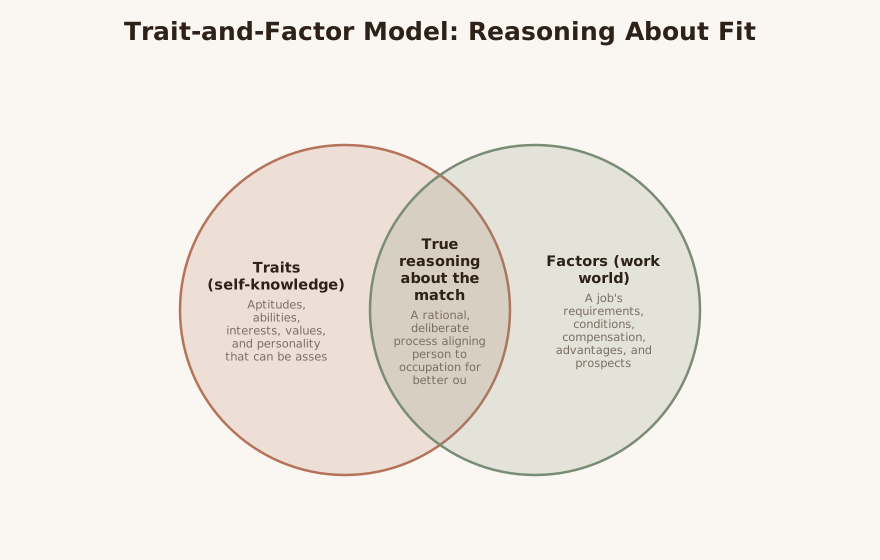
The trait-and-factor model is the oldest formal framework in career counseling and one of the oldest in applied psychology of any kind. Articulated by Frank Parsons in his posthumously published Choosing a Vocation (1909), it proposed a deceptively simple logic: a wise vocational choice follows from accurate self-knowledge, accurate knowledge of the work world, and disciplined reasoning about the fit between the two 1. More than a century later, every “career assessment plus interpretation” workflow a clinician has ever used descends from it 4. For practicing therapists, the model is less a treatment than a reasoning structure — a way to organize vocational material that clients increasingly bring into general mental-health work.
Type & Discipline
Trait-and-factor is a theory within vocational psychology and counseling, belonging to the broader family of career theories 4. It is most precisely classified as a differentialist approach: it rests on the differential-psychology tradition that people reliably differ from one another on stable, measurable characteristics, and that those individual differences can be matched against the differing demands of occupations 6. It is not a psychotherapy in the clinical sense, has no theory of psychopathology, and makes no claims about unconscious process or developmental stages LLM. Its proper scope is decisional and informational — helping a person choose, prepare for, or adjust within work 1.
Creators & Lineage
Frank Parsons (1854–1908) is the originator. An engineer, lawyer, and social reformer working with young people in Boston, he founded the Vocation Bureau and laid out the model in Choosing a Vocation, published the year after his death 1. The book is widely regarded as the founding document of the vocational-guidance movement 6.
Parsons’ ideas remained largely conceptual until the 1930s, when the Minnesota Employment Stabilization Research Institute applied emerging statistical and psychometric methods to operationalize them 4. Edmund G. Williamson then adapted these Minnesota techniques for college students, and the University of Minnesota became the center of what is sometimes called “the Minnesota point of view” 4. The lineage runs forward from there: John Holland’s RIASEC theory and the Theory of Work Adjustment — both developed at Minnesota — are direct descendants, and the contemporary O*NET occupational database is, in a real sense, the fulfillment of Parsons’ call for systematic knowledge of the work world 4. The model is thus the trunk from which modern person-environment (P×E) fit theory grew 2.
Core Principles
The model rests on a small set of assumptions, stated plainly by Parsons and refined by later writers LLM.
- People differ in stable, measurable traits. Individuals possess aptitudes, abilities, interests, values, and personality characteristics that can be assessed and that differ predictably across persons 6.
- Occupations differ in measurable factors. Jobs vary in the requirements, conditions, compensation, advantages, disadvantages, and prospects they present 1.
- A better match yields better outcomes. The foundational logic is that people excel at tasks suited to their natural abilities, find such work more satisfying, and are consequently more productive 5.
- Choice can be reasoned. With good information on both sides, the person can engage in “true reasoning” about fit — a rational, deliberate process rather than chance or drift 1.
Parsons’ own formulation remains the cleanest statement of the framework. He named three “broad factors” in the wise choice of a vocation:
“(1) a clear understanding of yourself, your aptitudes, abilities, interests, ambitions, resources, limitations, and their causes; (2) a knowledge of the requirements and conditions of success, advantages and disadvantages, compensation, opportunities, and prospects in different lines of work; (3) true reasoning on the relations of these two groups of facts.” 1
Modern scholarship reframes this triad as person-environment fit: the degree of correspondence between the individual and the work environment predicts satisfaction and tenure, and the counselor’s task is to improve that correspondence 2.
Interventions & Techniques
In practice the model unfolds as a three-step counseling sequence: a client interview, psychometric assessment of work-relevant traits, and interpretation that connects the results to occupational classification systems 4.
- Structured self-analysis. Parsons pioneered written self-examination schedules, asking applicants to assess physical characteristics, mental abilities, education, reading and work history, and character before meeting the counselor — so the person arrived prepared for deeper discussion 1.
- The clinical interview. Detailed questioning about health, education, reading habits, work experience, and personal character forms the backbone of data-gathering 1.
- Standardized testing. Following the Minnesota refinement, formal measures of interests, aptitudes, and abilities became central; Parsons himself used practical tests of memory, reaction time, and manual dexterity where relevant to a specific occupation 14.
- Occupational information. The person investigates real occupations — required skills, education, conditions, and local availability — to populate the “factor” side of the equation 5.
- Interpretation and reasoning. The counselor helps the client integrate self-data and occupational data, then build an action roadmap: short- and long-term goals, education or training paths, relevant experience (volunteering, part-time roles), networking, and regular progress monitoring 5.
Crucially, even in Parsons’ original conception the counselor is a guide, not a decider — “no person may decide for another what occupation he should choose” 1.
Evidence Base
Honesty about maturity matters here: trait-and-factor is best understood as a historical foundation rather than a contemporary, manualized, trial-tested intervention LLM. There is no body of randomized controlled trials evaluating “trait-and-factor counseling” as a discrete protocol, and it would be anachronistic to expect one LLM. Its empirical credibility instead derives from its descendants: the P×E fit tradition, Holland’s RIASEC, and the Theory of Work Adjustment have generated decades of correlational evidence linking person-environment correspondence to satisfaction and tenure, and trait-and-factor is the conceptual parent of all three 24.
The original approach drew a sharp and lasting critique. It was labeled “test and tell” — charged with emphasizing testing over counseling and ignoring how affective factors, personal history, and social influence shape decisions beyond objective information 4. Defenders have argued that this caricatures the model, and that properly understood — as a P×E fit reasoning process embedded in a genuine counseling relationship — it remains valid and useful 23. The reframing as person-environment fit is, in effect, the field’s answer to the “test and tell” charge 2.
Populations & Indications
The model is most apt when a person faces a concrete vocational decision and would benefit from structured self- and occupational knowledge LLM. Typical populations include adolescents and college students doing educational and early-career planning, young adults entering the workforce, career changers and job seekers weighing options, and veterans transitioning to civilian work who must translate prior roles into civilian occupational factors 54. It suits clients who are information-poor rather than emotionally blocked — those for whom better data and clearer reasoning would genuinely move the decision LLM.
Problems-for-Work
Trait-and-factor reasoning maps naturally onto the vocational problems clinicians encounter, often woven into broader presentations LLM.
- Career indecision and vocational uncertainty — when a client cannot choose, structured self-assessment plus occupational information narrows the field and makes “true reasoning” possible 15.
- Occupational mismatch and job dissatisfaction — reframing the complaint as poor person-environment correspondence locates the problem in fit rather than personal failure and points toward either environment change or self-development 2.
- Underemployment and educational planning difficulties — mapping current traits against the factors of better-fitting or higher-skilled roles clarifies the training path required 5.
- Work-related stress — distinguishing stress arising from genuine misfit (wrong factors) from stress that is portable across jobs guides whether the intervention is vocational or clinical LLM.
- Identity confusion — for some clients, building an accurate, articulated self-portrait of abilities, interests, and values is itself stabilizing LLM.
LLM-generated illustrative example (not a guideline): A 24-year-old, two years into an accounting role he dislikes, presents with low mood and Sunday-night dread. Rather than treating the job as a fixed given, the clinician introduces trait-and-factor reasoning: an interest inventory surfaces strong investigative and social interests with weak conventional ones, and occupational exploration reveals that data-analysis and teaching roles align better. The “dread” is reframed as a fit signal, and the work shifts to a concrete retraining roadmap. LLM
Contraindications, Cautions & Cultural Humility
The model’s chief danger is over-application LLM. Used as the sole intervention it risks “lazy career guidance” — a mechanical test-and-tell process that ignores client change over time and the dynamism of modern labor markets 6. Its original assumptions reflect an early-20th-century, Fordist-Taylorist world of stable, predictable jobs and rigid class structures, and those assumptions do not transfer cleanly to precarious, rapidly shifting careers 6. Treating traits as wholly fixed and the counselor as the all-knowing expert is both empirically and ethically outdated; contemporary practice positions the client, not the advisor, as the expert on their own life 6.
Cultural humility is essential: occupational “opportunities” and “prospects” are not equally available across race, class, gender, immigration status, or disability, and a naive matching exercise can quietly pathologize structural barriers as personal misfit LLM. Assessment instruments carry their own norming and bias limitations, and interest or aptitude scores must be interpreted with awareness of the client’s access and history rather than as neutral facts LLM. The model also has no purchase on psychopathology; when affective or relational difficulty is driving the vocational complaint, trait-and-factor is an adjunct, not the treatment LLM.
Treatment-Plan Suggestions & SMART Objectives
| Goal | SMART objective (example) | Mechanism |
|---|---|---|
| Build accurate self-knowledge | Within 3 sessions, client will complete a structured self-assessment of interests, abilities, and values and name top 3 of each | Self-analysis schedule 1 |
| Develop work-world knowledge | Within 4 weeks, client will research 5 occupations and document requirements, conditions, and local availability for each | Occupational information 5 |
| Reduce career indecision | Within 6 sessions, client will narrow options to 2 best-fit occupations using explicit trait-to-factor comparison | “True reasoning” on fit 1 |
| Reframe job dissatisfaction as fit | By session 4, client will identify 3 specific person-environment mismatches in current role | Person-environment fit analysis 2 |
| Address underemployment | Within 8 weeks, client will identify the training/credential path for one higher-fit role and enroll or apply | Trait-to-factor gap mapping 5 |
| Create an actionable roadmap | By session 5, client will produce a written plan with short- and long-term goals, training steps, and a monitoring schedule | Action planning 5 |
| Translate prior experience (veterans) | Within 4 weeks, client will map military roles to 3 civilian occupational factor profiles | Factor translation 4 |
| Sustain progress | Client will review the roadmap monthly and revise as priorities shift over the next quarter | Ongoing process orientation 5 |
Common Misconceptions
- “It’s just giving a test and reading the printout.” The “test and tell” reputation is the critique, not the design; even Parsons embedded testing in a relationship and reserved the decision for the client 41.
- “It says traits are permanently fixed.” The original framing leans deterministic, but modern P×E fit explicitly treats correspondence as something that can be improved through self-development or environment change 26.
- “It’s obsolete.” Its determinism is dated, but the core matching logic persists in virtually every contemporary career tool and assessment workflow 64.
- “The counselor picks the job.” Parsons was explicit that no one may decide another’s vocation; the counselor guides reasoning 1.
Training & Certification
There is no certification in “trait-and-factor counseling” as such; it is foundational content within career counseling and counseling-psychology training rather than a credentialed modality LLM. Competence is built through graduate coursework in career development, supervised practice in vocational assessment, and familiarity with the descendant frameworks (Holland’s RIASEC, the Theory of Work Adjustment) and contemporary tools such as O*NET 4. Clinicians should also be trained in the responsible administration and interpretation of interest and aptitude instruments, including their norming and bias limitations LLM.
Key Terms
- Trait — a stable, measurable individual characteristic (aptitude, interest, value, ability) on the person side of the equation 6.
- Factor — a measurable characteristic of an occupation (requirements, conditions, compensation, prospects) on the environment side 1.
- True reasoning — Parsons’ term for the deliberate integration of self-knowledge and occupational knowledge to reach a fit-based choice 1.
- Person-environment (P×E) fit — the degree of correspondence between individual and work environment; the modern reframing of the model 2.
- Test and tell — the critique that the approach over-emphasizes testing and under-emphasizes counseling and affect 4.
- Differentialism — the differential-psychology tradition of individual differences that underwrites the model 6.
Resources & Further Reading
▶ Watch — a video introduction to this concept:
- Parsons, F. (1909). Choosing a Vocation — full text
- Chartrand, J. M. (1991). The Evolution of Trait-and-Factor Career Counseling: A Person × Environment Fit Approach
- In Defense of Trait-and-Factor Theory (Springer)
- Trait-Factor Counseling — iResearchNet
- Parsons’ Theory: Match Your Traits to Career Factors — Alberta alis
- Differentialism / Trait and Factor Theory — Marcr
- Trait-Factor Counseling — SAGE Encyclopedia of Counseling
Reflective / Supervision Questions
- When a client brings a vocational complaint, how do I distinguish a genuine person-environment misfit from distress that would travel with them to any job? LLM
- Whose “true reasoning” am I privileging — the client’s, or my own assumptions about what a good fit looks like for them? LLM
- Where might my use of assessment instruments quietly treat structural barriers (access, discrimination, economic constraint) as individual misfit? LLM
- Am I using matching as a starting structure for collaborative exploration, or sliding into “test and tell”? 4
- How do I hold the tension between the model’s stable-trait assumptions and a client who is actively changing? 6