
Type & Discipline
Stepped care is not a therapy; it is a framework for organizing how therapies are delivered across a population 1. It belongs to health services research and clinical psychology, and it answers a system-level question rather than a within-session one: given limited specialist time and many people in need, in what sequence and at what intensity should treatments be offered 1. The defining logic is to start most people with the least intensive intervention likely to produce significant health gain, to monitor whether that intervention is working, and to step the client up to something more intensive only when it is not 1.
This places stepped care in the family of integrated and organized care models, alongside collaborative care and measurement-based care, all of which try to match resource to need at the level of a service rather than an individual clinician’s preference 5. Because it is a delivery architecture, stepped care can wrap around almost any evidence-based modality—guided self-help, low-intensity cognitive behavioral therapy, high-intensity face-to-face therapy, or medication—rather than competing with them 4. Understanding it as scaffolding rather than as a treatment is the first step to using it well LLM.
Creators & Lineage
The conceptual roots of stepped care lie in chronic-disease management, where titrating treatment intensity to response was already routine, and the idea was imported into mental health services as demand for psychological therapy outstripped supply 1. Peter Bower and Simon Gilbody gave the model its most influential articulation for psychological therapies, framing it around access, effectiveness, and efficiency and making explicit the assumptions on which it rests 1. Their 2005 narrative review remains the standard reference point for what stepped care claims and what it requires to be true 1.
The most consequential real-world embodiment is England’s Improving Access to Psychological Therapies (IAPT) programme, championed by the clinical psychologist David M. Clark and the economist Richard Layard, which operationalized stepped care at national scale and is now known as NHS Talking Therapies 4. IAPT translated the National Institute for Health and Care Excellence (NICE) guidance into a tiered service: low-intensity interventions delivered by Psychological Wellbeing Practitioners for milder presentations, with stepping up to high-intensity therapy for those who do not improve or who present more severely 4. Subsequent implementation and scoping research—including large multi-site analyses and reviews of stepped care in primary mental health settings—has refined and, in places, challenged the original model 25.
Core Principles
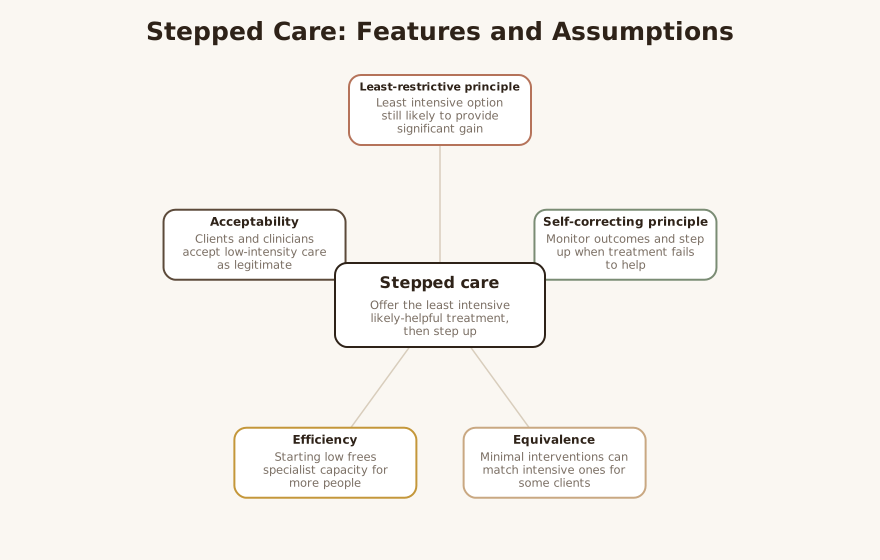
Bower and Gilbody describe two features that, together, define genuine stepped care 1. The first is the least-restrictive principle: the recommended treatment should be the least intensive of those available that is still likely to provide significant health gain, which in publicly funded systems usually means the option requiring less specialist therapist time 1. The second is the self-correcting principle: the system systematically monitors outcomes and steps care up when the current treatment fails to achieve meaningful gain, rather than attributing non-response to a client’s motivation 1.
Underneath these two features sit three assumptions that must hold for the model to deliver on its promise 1. The assumption of equivalence holds that minimal interventions can produce outcomes comparable to more intensive therapies for at least some clients 1. The assumption of efficiency holds that beginning with less intensive treatment frees specialist capacity and allows scarce resources to reach more people 1. The assumption of acceptability holds that both clients and clinicians will accept low-intensity interventions and the stepping structure as legitimate care 1. Each assumption is empirical and contestable, and stepped care is only as sound as these assumptions are in a given population LLM.
A third operating principle, often underappreciated, is that stepped care is inseparable from measurement 4. Without systematic, repeated outcome monitoring there is no signal to trigger a step up, and the self-correcting feature collapses into a one-shot allocation 2. IAPT’s session-by-session use of the PHQ-9 and GAD-7 is therefore not an add-on but the mechanism that makes the model function 4.
Interventions & Techniques
In practice, a stepped care system is built from a graded menu of interventions ordered by intensity 4. At the lower steps sit watchful waiting, psychoeducation, guided self-help based on cognitive behavioral therapy, computerized CBT, behavioral activation, and structured physical activity, typically delivered by less specialized but trained and supervised practitioners 4. At the higher steps sit face-to-face high-intensity therapy, combined psychological and pharmacological treatment, and specialist or crisis services for the most severe or complex presentations 4.
The connective tissue between steps is a set of procedures rather than a technique in the clinical sense 4. Initial assessment and triage assign an entry point matched to severity, so that clients with mild-to-moderate symptoms typically start low and those with moderate-to-severe symptoms, post-traumatic stress disorder, or significant risk may enter directly at a higher step 4. Routine outcome monitoring at each contact generates the data on which stepping decisions are made 4. Defined review points and decision rules then determine whether a client continues, steps up, or is discharged 2.
LLM-generated illustrative example (not a guideline): A primary care client with mild depression begins with eight sessions of guided self-help and completes a PHQ-9 at each contact. By session four her score has barely moved, which—rather than being read as low motivation—triggers a review and a planned step up to high-intensity cognitive behavioral therapy, with the earlier work treated as a deliberate first step rather than a failure LLM.
Evidence Base
Honesty about maturity matters here, because “established” describes the framework’s adoption more than a settled verdict on its superiority 1. Stepped care is established in the sense that it is widely implemented, embedded in national guidance, and extensively studied; the effectiveness of stepped care across mental health disorders has been synthesized in an umbrella review of meta-analyses 3. The clearest case for the model rests on access and efficiency rather than on producing better clinical outcomes than alternative arrangements 1.
The implementation evidence is sobering and should temper enthusiasm. A large four-site analysis of nearly 7,700 patients found that the ratio of low- to high-intensity treatment varied roughly 40-fold between services, indicating that “stepped care” in name covered fundamentally different practices in reality 2. Most strikingly, rates of stepping up from low- to high-intensity treatment were less than 10% across all sites, and the assessment of treatment effect to aid clinical decision-making appeared deficient—meaning the self-correcting mechanism that defines the model was frequently not operating 2. Attrition was substantial, with 21–34% of referrals lost before assessment 2.
Set against this, IAPT demonstrates that the model can deliver when implemented with discipline 4. Its session-by-session monitoring achieved pre- and post-treatment data completeness above 99% at one demonstration site, against roughly 6% under conventional protocols, and early demonstration sites reported recovery in around 55–56% of patients 4. National recovery rates in the programme’s second year averaged about 40% against a 50% target, and services with better outcomes were those that implemented stepped care principles and adequate treatment doses more faithfully 4. The honest summary is that stepped care is a reasonable, efficient organizing principle whose benefits depend heavily on implementation quality, particularly on whether outcomes are actually monitored and clients are actually stepped up 24.
Populations & Indications
Stepped care is best indicated for high-prevalence, mild-to-moderate presentations where a meaningful proportion of people will respond to lower-intensity help, principally depression and the common anxiety disorders 4. It is the dominant model in primary mental health care and is especially attractive where demand vastly exceeds specialist supply, which is its founding rationale 1. Scoping reviews describe its use across primary mental health services and a range of settings as a way to widen access 5.
The framework has been applied across the lifespan and across resource contexts, including older adults, adolescents and young people, and underserved or low-resource populations where conserving specialist time is critical 5. It is particularly suited to people who are early in their help-seeking, who prefer to try a less intensive option first, or who are waiting for specialist therapy and would otherwise receive nothing 1. The model also supports a self-correcting pathway for clients whose needs turn out to be greater than initially assumed, provided the stepping mechanism actually functions 2.
Problems-for-Work
Stepped care addresses several distinct problems, some clinical and some systemic 1.
Limited access to therapy is the prototypical target: by reserving intensive treatment for those who need it, the model aims to extend some form of evidence-based help to far more people than a specialist-only system could reach 1. Mild-to-moderate depression and common anxiety disorders are the conditions for which low-intensity entry points such as guided self-help and computerized CBT are designed, making them the natural first-step population 4.
Non-response to first-line treatment is handled, in principle, by the self-correcting step-up; the practical problem-for-work is ensuring that non-response is detected and acted on rather than missed 2. Inefficient allocation of specialist time is targeted by routing simpler presentations away from scarce high-intensity clinicians 1. Absence of systematic outcome monitoring is itself a problem the model surfaces, because stepped care cannot function without measurement, which is why building reliable monitoring is often the highest-yield improvement a service can make 24.
LLM-generated illustrative example (not a guideline): A community clinic with a six-month waitlist introduces a low-intensity first step and routine PHQ-9/GAD-7 tracking. Many clients improve at the lower step and are discharged, the waitlist for high-intensity therapy shortens, and the clients who do not improve are now identifiable and prioritized for stepping up rather than languishing undetected LLM.
Contraindications, Cautions & Cultural Humility
Stepped care is a population logic, and its central caution is that population logic can fail the individual in front of you 1. Starting low is inappropriate for clients whose presentation warrants direct entry to high-intensity care—those with severe depression, post-traumatic stress disorder, significant suicidality, psychosis, or marked complexity—and good systems build direct-access pathways precisely so that these clients are not routed through a low step they do not need 4. Treating “start low” as a rigid rule rather than a default is a misuse of the model LLM.
The most documented real-world hazard is that the step-up rarely happens, with observed rates under 10% in routine practice, which means a client who is not improving can be left at an ineffective step by default 2. Clinicians working within a stepped service should therefore treat reliable monitoring and active review as non-negotiable, not optional, and should advocate for clients who are not responding 2. Equally, the assumption of acceptability cannot be taken for granted: some clients experience a low-intensity first offer as being fobbed off, and clinicians should name the rationale and the explicit plan to step up 1.
Cultural humility is essential because the model’s assumptions of equivalence and acceptability are not culture-neutral 1. Self-directed, text-based, or computerized low-intensity interventions presuppose literacy, language match, digital access, and a self-help orientation that may not fit every client, and offering them uncritically can widen rather than narrow disparities in access 5. The clinician’s task is to ensure that the least-intensive option offered is genuinely likely to help this client, in this context, and to step up promptly when it is not LLM.
Treatment-Plan Suggestions & SMART Objectives
The following objectives are illustrative scaffolding for documenting work organized within a stepped care framework and must be individualized LLM. Because stepped care is a delivery logic, the mechanisms below describe how sequencing and monitoring are intended to produce change 1.
| Goal | SMART objective (example) | Mechanism |
|---|---|---|
| Establish an appropriate entry step | Complete a structured assessment with PHQ-9 and GAD-7 at intake and assign a matched starting step within 2 weeks | Severity-matched triage routes intensity to need 4 |
| Engage with a low-intensity first step | Attend and complete at least 4 of 6 guided self-help sessions over 8 weeks | Tests the equivalence assumption that minimal intervention may suffice 1 |
| Track response systematically | Record a validated outcome measure at every session for the full episode | Routine monitoring supplies the signal that triggers stepping 4 |
| Detect and act on non-response | Review outcome trajectory at a defined point and decide continue/step-up/discharge | Operationalizes the self-correcting feature 2 |
| Step up when indicated | If symptoms have not meaningfully improved by review, begin high-intensity therapy within 2 weeks | Counters the documented failure to step up in routine practice 2 |
| Conserve specialist capacity | Discharge clients who reach recovery at a lower step with a relapse-prevention plan | Reserves intensive resource for those who need it 1 |
| Confirm acceptability of the plan | Elicit and document the client’s understanding of the stepped plan at the first session | Supports the acceptability assumption and informed engagement 1 |
Common Misconceptions
A first misconception is that stepped care means everyone must start at the bottom 4. The model is explicitly severity-matched, and clients whose presentation warrants it should enter directly at a higher step; rigid universal “start low” allocation is a distortion, not the model 4. A second misconception is that stepped care is primarily a cost-cutting device; its founding rationale is widening access by using resources efficiently, and conflating efficiency with cheapness invites under-treatment 1.
A third misconception is that allocating someone to a low step is the whole intervention 2. Stepped care is defined as much by its self-correcting mechanism as by its starting point, and a service that allocates but never monitors or steps up is not really practising stepped care, however it labels itself 2. A fourth is that the framework has proven itself superior to alternatives across the board; the more accurate reading is that its access and efficiency case is stronger than its case for better clinical outcomes than other arrangements, and that real-world results hinge on implementation fidelity 12.
Training & Certification
There is no single certification to “practise stepped care,” because it is a service framework implemented by teams rather than a modality credentialed at the individual level LLM. Competence is distributed: low-intensity steps are typically delivered by specifically trained practitioners—such as IAPT’s Psychological Wellbeing Practitioners—working to defined protocols under supervision, while higher steps are delivered by therapists credentialed in the relevant high-intensity modality 4. The IAPT model treated workforce training as central, deliberately training thousands of new low- and high-intensity practitioners to make the stepped system viable at scale 4.
For clinicians, the practical learning task is less about a new technique and more about working fluently within the architecture: conducting severity-matched triage, embedding routine outcome measurement into every contact, and applying clear decision rules for stepping up 2. For service leaders, the key competence is implementation fidelity—designing pathways, monitoring the low-to-high ratio and step-up rates, and auditing whether the self-correcting mechanism actually operates, since these are precisely the points at which routine practice has been shown to drift from the model 2.
Key Terms
- Least-restrictive principle — the recommendation to offer the least intensive treatment still likely to provide significant health gain 1.
- Self-correcting mechanism — systematic outcome monitoring that triggers a step up when the current treatment is not working 1.
- Equivalence, efficiency, acceptability — the three assumptions stepped care depends on: that minimal interventions can suffice for some, that they free resources, and that clients and clinicians accept them 1.
- Low-intensity intervention — lower-resource, often guided-self-help or computerized treatments delivered by trained practitioners at the lower steps 4.
- High-intensity intervention — face-to-face specialist therapy at the higher steps for non-responders or more severe presentations 4.
- Stepping up — moving a non-responding client to a more intensive treatment; observed in under 10% of cases in one routine-practice study 2.
- Routine outcome monitoring — repeated, often session-by-session, use of validated measures such as the PHQ-9 and GAD-7 to drive decisions 4.
- Watchful waiting — a deliberate low step of active monitoring without immediate intervention for very mild presentations 4.
Resources & Further Reading
▶ Watch — a video introduction to this concept:
- Stepped care in psychological therapies: access, effectiveness and efficiency (Bower & Gilbody, British Journal of Psychiatry)
- Delivering stepped care: an analysis of implementation in routine practice (Implementation Science)
- Effectiveness of stepped care for mental health disorders: an umbrella review of meta-analyses (ScienceDirect)
- Implementing NICE guidelines for the psychological treatment of depression and anxiety: the IAPT experience (Clark)
- Exploring the Stepped Care Model in Delivering Primary Mental Health Services — a scoping review (International Journal of Mental Health Nursing)
Reflective / Supervision Questions
- For a current client placed at a low step, can you point to the outcome data that would tell you it is time to step up, and is that data actually being collected? 2
- Where in your service does the self-correcting mechanism break down, and what would it take to raise the step-up rate above the single digits seen in routine practice? 2
- Are you offering low-intensity interventions because they genuinely fit this client, or because they are the default—and does the client experience the offer as care or as being deflected? 1
- For which presentations should you override “start low” and route directly to high-intensity care, and are those pathways available to you? 4
- Do the low-intensity options you rely on assume literacy, language, or digital access that some of your clients lack, and how does that affect equity? 5
- Are you describing stepped care to clients honestly—as an efficient, monitored sequence with a clear plan to step up—rather than overstating that the lowest step will be enough? 1