
Type & Discipline
Social Skills Training (SST) is a modality within clinical psychology — more precisely, a structured behavioral package rather than a single technique LLM. It sits in the family of behavioral skills interventions, sharing its operant and social-learning lineage with assertiveness training, behavioral rehearsal, and the broader skills-acquisition tradition LLM. Its defining feature is procedural: a repeating teaching loop of instruction, modeling, behavioral rehearsal (role-play), feedback and reinforcement, and homework assignments designed to transfer the skill into daily life 3. Across the literature this loop is applied to interpersonal targets ranging from making eye contact and starting a conversation to assertiveness and conflict de-escalation 1.
Unlike insight-oriented or purely cognitive therapies, SST treats social difficulty as a skill deficit that can be taught the way any motor or behavioral repertoire is taught — by breaking it into components, demonstrating each, having the client practice, and reinforcing successive approximations 3. This framing is what makes SST portable across very different populations and settings, from inpatient psychiatric rehabilitation to school classrooms LLM.
Creators & Lineage
SST grew out of the behavior-therapy movement of the 1960s–1970s, when clinicians began applying operant conditioning and Bandura’s social-learning principles to interpersonal behavior LLM. The most influential figure in the serious-mental-illness application is Robert Paul Liberman of UCLA, who developed the UCLA Social and Independent Living Skills modules — packaged curricula covering domains such as medication self-management, community living, and social interaction, which have been translated into multiple languages and disseminated internationally 3. Alan Bellack and Kim Mueser co-authored a foundational manual, Social Skills Training for Schizophrenia (Guilford Press, 2004), that operationalized the approach for routine clinical use 3.
A parallel developmental lineage runs through Arnold Goldstein and Ellen McGinnis, whose Skillstreaming programs adapted the modeling–rehearsal–feedback–transfer method for children and adolescents, including the widely used Skillstreaming the Elementary School Child curriculum 5. Skillstreaming remains an actively distributed prosocial-skills program for school and clinical settings 4. The adult psychiatric and the child-and-adolescent branches share the same procedural DNA but diverge in their target behaviors and developmental framing LLM.
Core Principles
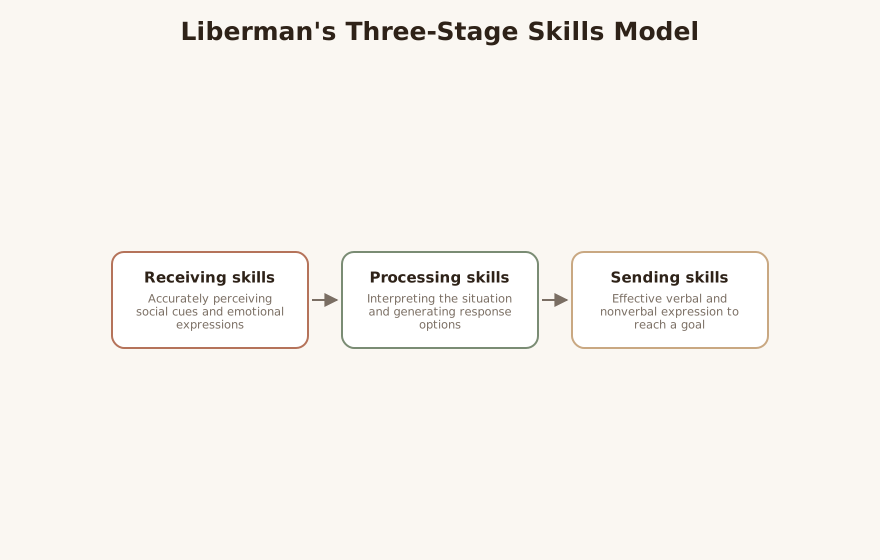
SST rests on a small set of behavioral commitments LLM. First, social competence is decomposable: complex interactions can be broken into discrete, teachable sub-skills 3. Liberman’s framework describes a three-stage information-processing model — receiving skills (accurately perceiving social cues and emotional expressions), processing skills (correctly interpreting the social situation and generating response options), and sending skills (effective verbal and nonverbal expression to achieve a goal) 3. A deficit can occur at any stage, and assessment aims to locate where the chain breaks LLM.
Second, skills are built through guided practice, not insight LLM. The clinician demonstrates (models) the target behavior, the client rehearses it in role-play, and the clinician delivers immediate positive and corrective feedback before the client tries again 3. Third, generalization must be engineered, not assumed: because trained skills do not automatically transfer to real life, homework and in-vivo practice are not optional add-ons but core to the method 3. This last principle is also where the modality’s central empirical vulnerability lives 1.
Interventions & Techniques
The canonical SST session follows five linked procedures 3:
- Instruction and goal-setting — identifying the problem situation and specifying a concrete target behavior 3.
- Modeling — the clinician (or a peer/video) demonstrates the desired behavior so the client sees what success looks like 3.
- Behavioral rehearsal — the client practices the skill in a structured role-play, often repeated with escalating realism 3.
- Feedback and reinforcement — positive feedback reinforces what worked, and corrective feedback shapes the next attempt 3.
- Homework and generalization — in-vivo assignments with real-world reinforcement carry the skill out of the office 3.
Beyond the core loop, several refinements have improved outcomes LLM. Errorless learning breaks a task into small steps and uses prompting and reinforcement so the client rarely practices the wrong response; it has outperformed conventional trial-and-error teaching for entry-level tasks in schizophrenia 3. Explicit generalization techniques built into the training — rather than left to chance — increase the likelihood that skills transfer to everyday settings 3. Integrations with cognitive remediation (for example, Cognitive Enhancement Therapy, which pairs neurocognitive training with social-skills work) have shown greater gains than supportive therapy on combined cognitive and social-adjustment measures over two years 3.
LLM-generated illustrative example (not a guideline): A clinician working with a withdrawn client targets “asking a coworker to lunch.” The clinician first models the sequence (greeting, brief small talk, the invitation, graceful handling of a “no”), then the client role-plays it twice while the clinician praises the warm opener and reshapes a too-abrupt ask, and the week’s homework is to greet one coworker daily and report back LLM.
Evidence Base
SST is an established intervention, but honesty about magnitude matters. The most rigorous synthesis in psychosis is the Turner et al. meta-analysis of 27 randomized controlled trials (N = 1,437) 2. It found a small effect on negative symptoms versus all comparators (Hedges’ g = 0.19), rising to g = 0.31 against treatment-as-usual 2. Social competency showed a small-to-moderate benefit (g = 0.33), and general psychopathology improved (g = 0.32 vs all comparators, g = 0.40 vs TAU) 2. SST did not demonstrate superiority for positive symptoms 2. Several of these effects were maintained at follow-up, with negative-symptom benefit persisting at the longest follow-up (g = 0.23) 2.
The qualitative literature is consistent: older reviews cite over 50 studies documenting significant improvements in social knowledge and behavior, with gains retained for up to two years 3. The recurring caveat — stated plainly by both the meta-analysis and the schizophrenia review — is generalization: improvements in trained, clinic-based skills have historically transferred poorly to community settings unless generalization is deliberately programmed 13. The practical reading is that SST reliably teaches the targeted skills and modestly improves functioning and symptoms, but its ceiling is set by how well the clinician engineers transfer to the client’s actual life LLM.
Populations & Indications
The deepest evidence base is in serious mental illness, particularly schizophrenia, where SST is a standard component of psychiatric rehabilitation and the named developers built their careers 3. Within that population, SST has been adapted for vocational rehabilitation — Liberman’s Workplace Fundamentals Module supplements supported employment by teaching stress management, stigma navigation, and coworker communication, and a cohort of young patients receiving it alongside supported employment reached a 93% rate of returning to regular school or work within a year 3. The use of SST specifically to help people with serious mental illness find and keep a job is a recognized clinical application 6.
For children and adolescents, the Skillstreaming curricula apply the same method to prosocial development in school and clinical settings 45. Beyond these, SST is widely used clinically for social anxiety and for autistic clients building interpersonal competence — the modality’s skill-deficit framing fits both, though those indications are noted here as standard clinical practice rather than as conclusions of the provided meta-analytic sources LLM.
Problems-for-Work
- Interpersonal skill deficits. The core indication — the client lacks specific behaviors (initiating conversation, maintaining topic, reading cues) that SST teaches directly through the modeling–rehearsal–feedback loop 3.
- Social withdrawal and isolation. Often downstream of negative symptoms; SST’s small but durable effect on negative symptoms makes it a reasonable component of a withdrawal-focused plan 2.
- Negative symptoms of psychosis. Avolition and flat affect that blunt social engagement; SST shows a measurable, maintained effect here 2.
- Assertiveness and conflict difficulties. Trainable targets — saying no, making requests, managing disagreement — addressed through assertiveness-oriented rehearsal 1.
- Workplace and job-retention difficulties. Job-specific social demands (asking for help, handling correction, navigating coworkers) addressed through vocational SST modules 36.
LLM-generated illustrative example (not a guideline): For a client whose isolation is driven by anxious misreading of neutral faces, the clinician anchors work at the receiving stage — practicing accurate cue identification from photos and short clips — before moving to sending skills, because rehearsing better delivery is wasted if the client keeps misperceiving the room LLM.
Contraindications, Cautions & Cultural Humility
SST has no absolute contraindications, but several cautions apply LLM. When social difficulty is driven primarily by acute psychosis, severe depression, or active substance use rather than by a true skill deficit, stabilizing the underlying state usually takes precedence over skills drilling LLM. The receiving–processing–sending model is a useful diagnostic tool here: a client who has the skills but cannot deploy them under acute symptom load needs a different intervention than one with a genuine repertoire gap 3.
Cultural humility is essential because “social competence” is culturally defined LLM. Norms for eye contact, directness, assertiveness, personal space, and emotional expression vary across cultures, and a curriculum built on majority-culture norms can pathologize behavior that is appropriate in the client’s own context LLM. Clinicians should treat target behaviors as collaboratively negotiated rather than prescribed, and should be especially cautious applying assertiveness norms across gender and cultural lines LLM. The same caution extends to autistic clients: SST aimed at suppressing natural behaviors (rather than expanding a chosen repertoire) raises ethical concerns about masking, so goals should center the client’s own social aims LLM.
Treatment-Plan Suggestions & SMART Objectives
| Goal | SMART objective (example) | Mechanism |
|---|---|---|
| Improve conversation initiation | Within 8 weeks, client will initiate a brief conversation with a peer at least 3x/week, logged in homework | Modeling + behavioral rehearsal + in-vivo homework 3 |
| Build assertive refusal | Within 6 sessions, client will role-play and then enact one assertive “no” in a real situation, reported back | Behavioral rehearsal with corrective feedback 1 |
| Reduce social withdrawal | Over 12 weeks, client will attend one structured social activity weekly, tracked on a calendar | Reinforced exposure + skills generalization 3 |
| Strengthen cue perception | Within 4 weeks, client will correctly identify target emotion in 8/10 facial-expression trials | Receiving-skills training (information-processing model) 3 |
| Improve job-related social skills | Within 10 sessions, client will rehearse and then use one workplace request (e.g., asking for help) on the job | Workplace-fundamentals SST + in-vivo transfer 3 |
| Increase eye contact / nonverbal sending | Within 6 weeks, client will sustain appropriate eye contact through a 3-minute role-play in 3 consecutive sessions | Sending-skills shaping with reinforcement 3 |
| Generalize a trained skill to home | Each week, client completes and reviews one in-vivo homework assignment applying the session’s skill | Engineered generalization (homework + reinforcement) 3 |
Common Misconceptions
“SST is just teaching manners or scripts.” It is a behavioral protocol with a defined teaching loop and an information-processing model underneath it, not rote etiquette coaching 3. “Once the client can do it in session, the work is done.” This is the field’s most consequential error — trained skills demonstrably fail to transfer unless generalization is deliberately programmed, which is why homework is central rather than optional 13. “SST cures negative symptoms.” The honest reading of the strongest meta-analysis is a small effect on negative symptoms (g ≈ 0.19–0.31), useful as one component of rehabilitation rather than a stand-alone solution 2. “It’s only for severe mental illness.” While the deepest evidence is in psychosis, the same method underlies child prosocial curricula and is applied across anxiety and autism populations 45LLM.
Training & Certification
SST is taught through published manuals and packaged curricula rather than gated by a single licensing body LLM. The Bellack-and-Mueser Social Skills Training for Schizophrenia manual and Liberman’s UCLA modules are the standard reference points for adult psychiatric work 3. For child and adolescent practice, the Skillstreaming program provides structured curricula, leader’s guides, and materials distributed through Research Press 45. In practice, competence is built by learning the five-step procedure, rehearsing it under supervision, and adopting a published module appropriate to the population rather than by obtaining a freestanding SST credential LLM.
Key Terms
- Behavioral rehearsal — structured role-play in which the client practices a target skill before using it in real life 3.
- Modeling — demonstration of the desired behavior by clinician, peer, or video so the client can imitate it 3.
- Generalization — transfer of a trained skill from the clinic to everyday settings; the modality’s chief challenge 1.
- Receiving / processing / sending skills — Liberman’s three-stage information-processing model of social competence 3.
- Errorless learning — a teaching method that uses prompting to minimize incorrect responses during skill acquisition 3.
- Workplace Fundamentals Module — a vocational SST curriculum supplementing supported employment 3.
- Skillstreaming — Goldstein and McGinnis’s prosocial-skills program adapting SST for children and adolescents 4.
Resources & Further Reading
▶ Watch — a video introduction to this concept:
- Turner et al. — A Meta-Analysis of Social Skills Training and Related Interventions for Psychosis (PubMed abstract)
- Turner et al. — A Meta-Analysis of Social Skills Training and Related Interventions for Psychosis (PMC full text)
- Kopelowicz, Liberman & Zarate — Recent Advances in Social Skills Training for Schizophrenia (PMC)
- Skillstreaming — official program site (Goldstein & McGinnis)
- Skillstreaming the Elementary School Child (Research Press)
- Social Skills Training to Help Mentally Ill Persons Find and Keep a Job (Psychiatric Services)
Reflective / Supervision Questions
- For a given client, can you locate the deficit at the receiving, processing, or sending stage — and does your plan target the right one LLM?
- What concrete mechanism in your treatment plan engineers generalization, rather than hoping in-session gains transfer on their own 1?
- Are the target behaviors you are teaching genuinely the client’s social goals, or are they majority-culture norms you are importing LLM?
- Given the modest effect sizes, how is SST positioned within the broader rehabilitation plan rather than carrying it alone 2?
- For an autistic client, are your objectives expanding a chosen repertoire or quietly training masking LLM?
- How will you know the skill has actually transferred — what observable, real-world marker are you tracking 3?