
Type & Discipline
Research Domain Criteria (RDoC) is a research classification framework, not a clinical diagnostic system and not a treatment modality 1. It was developed within psychiatry and clinical neuroscience by the U.S. National Institute of Mental Health (NIMH) 1. Its purpose is to provide a research framework that organizes the study of mental disorders around fundamental dimensions of functioning rather than around symptom-defined diagnostic categories 3. Conceptually it belongs to the family of dimensional nosologies — approaches that describe psychopathology along continuous dimensions that cut across, rather than respect, the boundaries of categorical diagnoses 3.
For practicing clinicians the single most important framing is this: RDoC is a way of structuring research questions and, by extension, dimensional case formulation; it is not something you “deliver,” and it does not yet supply validated bedside instruments or a coding system for clinical encounters 13. Understanding it well, however, gives a coherent vocabulary for the transdiagnostic, mechanism-oriented thinking that increasingly informs everyday practice LLM.
Creators & Lineage
RDoC originated from the 2008 NIMH Strategic Plan, which called for the development of new ways of classifying mental disorders based on dimensions of observable behavior and neurobiological measures 6. The project was formally launched in 2010 6. Thomas Insel, then NIMH director, was its highest-profile champion, and Bruce Cuthbert served as the project’s coordinator and primary architect 6. Insel and Cuthbert’s 2014 American Journal of Psychiatry paper, “The NIMH Research Domain Criteria (RDoC) Project: Precision Medicine for Psychiatry,” is the canonical statement of the framework’s rationale 3.
The intellectual lineage is a reaction against the limits of symptom-based categorical diagnosis 6. Insel argued that DSM diagnoses, while reliable, are based on consensus clusters of clinical symptoms rather than on any objective laboratory measure, and therefore lack biological validity 6. RDoC positions itself as the research-side complement to that critique: where DSM asks “which category does this patient fit,” RDoC asks “what underlying systems are functioning abnormally, and how do those map across the spectrum from health to illness” 3. It sits alongside other dimensional and transdiagnostic movements in modern nosology as part of a broader shift away from purely categorical thinking LLM.
Core Principles
RDoC rests on a small set of organizing commitments. First, psychopathology is best understood in terms of functional domains — broad systems of human functioning that are disrupted, to varying degrees, across many disorders 2. Second, each domain is studied across multiple units of analysis, from the molecular to the behavioral, so that findings at one level can be related to another 6. Third, the relevant variables are dimensional: they range continuously from normal to abnormal rather than being present-or-absent 3. Fourth, the framework is explicitly transdiagnostic and agnostic to existing categories — investigators are encouraged to recruit and analyze samples by domain function rather than by DSM label 3.
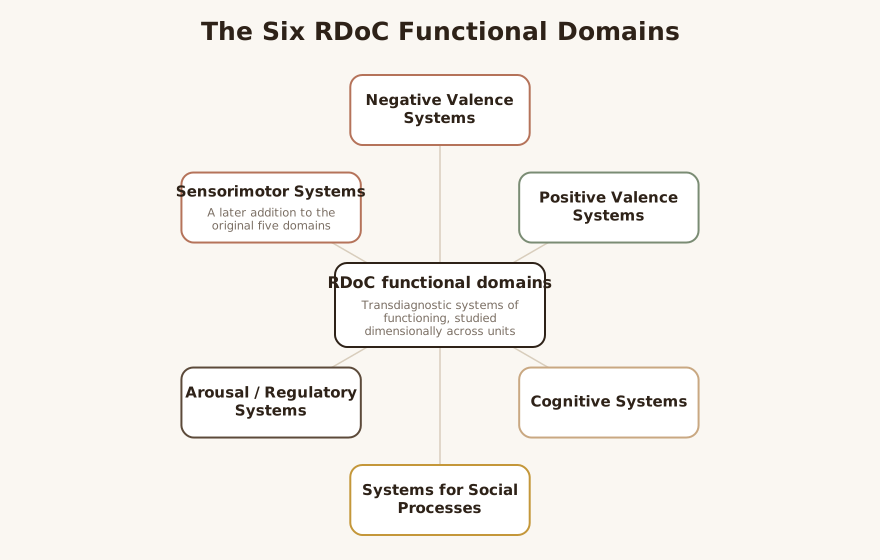
The framework is typically depicted as a matrix. The rows are the functional domains and their constituent constructs; the columns are the units of analysis 26. The current domains are Negative Valence Systems, Positive Valence Systems, Cognitive Systems, Systems for Social Processes, Arousal/Regulatory Systems, and Sensorimotor Systems 2. The Sensorimotor Systems domain was a later addition to the original five, reflecting the framework’s intent to evolve with evidence 2. The units of analysis are genes, molecules, cells, circuits, physiology, behavior, self-reports, and paradigms (experimental tasks) 6.
Each domain is further decomposed into constructs and subconstructs 2. For example, Negative Valence Systems includes Acute Threat (fear), Potential Threat (anxiety), Sustained Threat, Loss, and Frustrative Nonreward; Positive Valence Systems includes Reward Responsiveness, Reward Learning, and Reward Valuation; Cognitive Systems includes Attention, Perception, Declarative Memory, Language, Cognitive Control, and Working Memory; and Systems for Social Processes includes Affiliation and Attachment, Social Communication, and the perception and understanding of self and others 2. This granularity is what makes RDoC a research tool: each construct is meant to be operationalized and measured 2.
Interventions & Techniques
RDoC does not prescribe interventions — it is a framework for organizing inquiry, not a therapy 1. There is no “RDoC protocol,” no manualized treatment, and no certification to deliver it 1. What RDoC offers the clinician is a way of formulating and measuring, which can then inform the selection of established, evidence-based treatments LLM.
In practice, clinically minded use of RDoC looks like dimensional, mechanism-oriented assessment. A clinician influenced by the framework might characterize a patient not only by diagnosis but by where they sit on relevant domain constructs — for instance, marked anhedonia (low Positive Valence reward responsiveness) alongside elevated threat sensitivity (Negative Valence) and intact cognitive control 2. That profile then guides which established interventions to prioritize, such as behavioral activation for reward-system disengagement or exposure-based work for threat hypersensitivity LLM. The “technique,” then, is transdiagnostic formulation plus measurement-based care, with RDoC supplying the map of targets rather than the treatment itself LLM.
LLM-generated illustrative example (not a guideline): A clinician sees two clients — one with a depression diagnosis, one with social anxiety — who both present with pervasive anhedonia and blunted response to previously rewarding activities. Rather than treating them solely by their differing categorical labels, the clinician formulates a shared reward-system target and applies behavioral activation to both, tracking change in reward responsiveness over time LLM.
Evidence Base
The maturity of RDoC must be stated carefully. As a research and funding framework, RDoC is well established: it has shaped a large body of NIMH-funded investigation and generated a substantial literature since its launch 4. A 2017 systematic review covering the framework’s first six years documented its rapid uptake across studies and the breadth of domains and units of analysis it had been applied to, while also noting that the field was still early in translating domain-level findings into validated clinical applications 4.
What is not established is RDoC as a clinical tool. It has no validated diagnostic instrument, no treatment-outcome trials demonstrating that “RDoC-based care” outperforms standard diagnosis-led care, and no bedside biomarker that reliably assigns an individual patient to a domain profile 13. The framework was explicitly designed for future development rather than immediate clinical replacement of DSM 6. Insel and Cuthbert framed it as the research substrate for a future “precision medicine for psychiatry,” not as a present-day clinical product 3. The honest summary for clinicians is therefore: established as a research paradigm with a mature literature, but pre-clinical as an applied diagnostic or therapeutic system 34.
Populations & Indications
Because RDoC is a research framework, “indications” are better read as where the dimensional, transdiagnostic lens is most useful for formulation rather than as treatment indications LLM. The framework is deliberately population-broad: it applies across diagnostic categories and across the lifespan, with the matrix designed to incorporate developmental trajectories so that the same domain can be studied in children, adolescents, and adults 23.
It is especially clarifying for transdiagnostic and comorbid presentations — patients whose problems cut across DSM boundaries, where a single dimension (say, threat hypersensitivity or reward dysfunction) better explains the clinical picture than any one categorical label 3. It is also a natural fit for clinicians already practicing measurement-based and transdiagnostic care, who can use domain constructs to organize what they track and target LLM. Conversely, RDoC offers little guidance where a categorical diagnosis is required for a specific protocol or where the clinical task is acute and diagnosis-driven LLM.
Problems-for-Work
The domains map naturally onto recurring clinical problems-for-work, with the caveat that the mapping informs formulation rather than dictating a specific therapy LLM.
- Anhedonia and reduced reward responsiveness correspond to the Positive Valence Systems domain, particularly Reward Responsiveness and Reward Valuation 2. Application: framing persistent loss of pleasure as a reward-system target that may respond to behavioral activation regardless of the overarching diagnosis LLM.
- Pathological anxiety and threat hypersensitivity map to Negative Valence Systems constructs such as Acute Threat (fear) and Potential Threat (anxiety) 2. Application: distinguishing anticipatory anxiety (potential threat) from acute fear responses to guide exposure design LLM.
- Cognitive control and working-memory difficulties fall under Cognitive Systems 2. Application: identifying executive-function load as a maintaining factor and adjusting the pace and structure of skills work LLM.
- Social affiliation and attachment difficulties sit within Systems for Social Processes 2. Application: targeting affiliation and social communication as explicit dimensions in interpersonally focused work LLM.
- Arousal and sleep/circadian dysregulation belong to Arousal/Regulatory Systems 2. Application: treating sleep and circadian disruption as a transdiagnostic target rather than a downstream symptom of a single disorder LLM.
Contraindications, Cautions & Cultural Humility
The chief caution is misuse: RDoC is not validated for clinical diagnosis, treatment assignment, or documentation, and presenting it as such would overstate the evidence 13. It should not displace a competent categorical diagnostic process where that is clinically or administratively required 6. Because there is no validated instrument that assigns an individual to a domain profile, any “RDoC profile” a clinician constructs is a formulation heuristic, not a measurement with established reliability for that purpose 1.
A second caution is reductionism. The framework’s emphasis on units of analysis from genes to circuits can tempt practitioners toward an overly biological reading of distress 3. The framework itself includes behavior and self-report as legitimate units of analysis, but its neuroscience framing has drawn criticism for underweighting social and environmental context 6. Clinicians should hold the biological language lightly and keep lived experience, social determinants, and meaning central LLM.
Cultural humility is essential here precisely because RDoC’s constructs and the paradigms used to measure them were largely developed and normed within specific research populations 4. Threat appraisal, reward, affiliation, and social communication are all culturally shaped, and what reads as dysregulation in one cultural frame may be adaptive or normative in another LLM. The dimensional lens should sharpen, not flatten, attention to a client’s context, language, and identity LLM.
Treatment-Plan Suggestions & SMART Objectives
The following illustrate how RDoC domains can inform measurable, dimensionally framed objectives. RDoC supplies the target; the treatment is an established, evidence-based modality chosen by the clinician LLM.
| Goal | SMART objective (example) | Mechanism |
|---|---|---|
| Reduce anhedonia (Positive Valence) | Client will schedule and complete 3 previously rewarding activities per week for 6 consecutive weeks, with self-rated pleasure rising by 2 points on a 0–10 scale | Re-engaging the reward system via behavioral activation 2 |
| Lower threat hypersensitivity (Negative Valence) | Client will complete a graded exposure hierarchy of 8 items over 8 weeks, with peak distress dropping below 4/10 on at least 5 items | Threat-response extinction through repeated, structured exposure 2 |
| Strengthen cognitive control (Cognitive Systems) | Client will apply a structured problem-solving sequence to 2 stressors per week for 8 weeks, logging completion | Recruiting cognitive control and goal-maintenance processes 2 |
| Improve affiliation (Social Processes) | Client will initiate 2 supportive social contacts weekly for 6 weeks and rate connectedness afterward | Activating affiliation and social-communication systems 2 |
| Stabilize arousal/sleep (Arousal/Regulatory) | Client will maintain a consistent sleep–wake schedule (±30 min) on 6 of 7 nights for 4 weeks | Restoring circadian and arousal regulation 2 |
| Reduce frustrative nonreward reactivity (Negative Valence) | Client will use a distress-tolerance skill at the first sign of frustration in 70% of logged episodes over 4 weeks | Down-regulating frustrative-nonreward responses 2 |
| Build dimensional self-monitoring | Client will complete a brief domain-targeted self-report measure weekly for 8 weeks to track change | Measurement-based care across functional dimensions 3 |
Common Misconceptions
A first misconception is that RDoC is a new diagnostic system meant to replace the DSM in the clinic 6. It is not; it was designed as a research framework for future development, and its creators positioned it as complementary to, not a clinical substitute for, categorical diagnosis 36. A second is that RDoC is purely biological or genetic — in fact behavior, self-report, and experimental paradigms are explicit units of analysis alongside genes, molecules, cells, and circuits 6. A third is that the framework is fixed; the addition of the Sensorimotor Systems domain to the original five shows that it is intended to evolve with evidence 2. A fourth is that “established” means clinically validated: RDoC is established as a research paradigm with a large literature, but it is not an established clinical or therapeutic intervention 34.
Training & Certification
There is no certification, license, or credential to “practice RDoC,” because it is a research framework rather than a treatment modality 1. Clinicians familiarize themselves with it through primary sources rather than through a training program 1. The NIMH maintains the authoritative public description of the framework, including detailed definitions of every domain, construct, and subconstruct, and guidance on developing RDoC-informed studies 12. The Insel and Cuthbert 2014 paper is the standard scholarly orientation 3, and an introductory overview by Cuthbert is available in video form for those who prefer a spoken summary 5. Competence here means understanding the matrix well enough to think dimensionally and transdiagnostically, then pairing that formulation with established, evidence-based treatments one is already trained to deliver LLM.
Key Terms
- Functional domain — a broad system of human functioning (e.g., Negative Valence, Positive Valence, Cognitive Systems) that is disrupted across many disorders and forms a row of the RDoC matrix 2.
- Construct / subconstruct — the more specific components into which each domain is divided (e.g., Acute Threat, Reward Responsiveness) 2.
- Units of analysis — the levels at which a construct is studied: genes, molecules, cells, circuits, physiology, behavior, self-reports, and paradigms 6.
- Paradigm — an experimental task or procedure used to elicit and measure a construct; it is itself a unit of analysis 6.
- Transdiagnostic — cutting across, and not bounded by, DSM diagnostic categories 3.
- Dimensional — varying continuously from normal to abnormal rather than being categorically present or absent 3.
- Precision medicine for psychiatry — the long-range aspiration to tailor treatment to an individual’s underlying functional and neurobiological profile, which RDoC was framed to advance 3.
Resources & Further Reading
- Research Domain Criteria (RDoC) — NIMH
- Definitions of the RDoC Domains and Constructs — NIMH
- Insel & Cuthbert, “The NIMH Research Domain Criteria (RDoC) Project: Precision Medicine for Psychiatry” (Am J Psychiatry, 2014)
- Six Years of Research on the NIMH’s RDoC Initiative: A Systematic Review (Frontiers, 2017)
- Introduction to RDoC (Bruce Cuthbert, NIMH) — video
- Research Domain Criteria — Wikipedia
Reflective / Supervision Questions
- For a current transdiagnostic or comorbid client, which one or two RDoC domains best capture the core of their distress, and does that reframing change what you would prioritize in treatment? LLM
- Where might a dimensional, mechanism-oriented formulation add value over the categorical diagnosis you are already using — and where would it add nothing but jargon? LLM
- How will you guard against the reductionism that RDoC’s neuroscience language can invite, keeping social context and lived meaning central? LLM
- The constructs and measurement paradigms were normed in particular populations; how might a given client’s cultural frame change what counts as dysregulation in reward, threat, or affiliation? LLM
- Because RDoC supplies targets but not treatments, how will you document the distinction between a dimensional formulation and the established modality you actually deliver? LLM