
Type & Discipline
The Cognitive Behavioral Analysis System of Psychotherapy (CBASP) is a manualized, individual outpatient psychotherapy developed within clinical psychology and designed specifically for the chronic forms of depression rather than for acute, single-episode illness 15. It is most accurately described as a synthesis model that integrates cognitive, behavioral, and interpersonal strategies into a single coherent treatment, rather than a loose eclectic blend 7. Among the empirically supported depression treatments catalogued by the American Psychological Association’s Society of Clinical Psychology (Division 12), CBASP is listed specifically under the indication of chronic depression, which distinguishes it from broader-spectrum therapies that target depression generically 1. In practice it sits at the intersection of the cognitive-behavioral and interpersonal traditions, which is why it is best understood as belonging to a hybrid cognitive-behavioral/interpersonal family 74.
Creators & Lineage
CBASP was created by James P. McCullough Jr. of Virginia Commonwealth University, who built the model explicitly as a synthesis of interpersonal, cognitive, and behavioral therapies aimed at chronic depression 7. The treatment is laid out in his foundational text, Treatment for Chronic Depression: Cognitive Behavioral Analysis System of Psychotherapy 5. Its theoretical lineage is unusually broad for a depression treatment. From the cognitive-behavioral tradition it borrows structured situational examination and behavioral skills practice; from interpersonal therapy it inherits a focus on the patient’s relationships and relational patterns 7. Its most distinctive theoretical borrowing, however, is from Piagetian developmental theory: McCullough framed chronically depressed patients as functioning, in their reasoning about interpersonal events, at a developmentally arrested, preoperational level of cognitive-emotional development 4. Behavioral learning theory supplies a further mechanism, with negative reinforcement (relief from distress) rather than positive reward serving as the primary driver of behavior change 4. Subsequent dissemination has been carried forward by collaborators and trialists including Martin Keller, who led the landmark comparative trial, and Elisabeth Schramm, who extended the work to early-onset chronic depression in European samples 23.
Core Principles
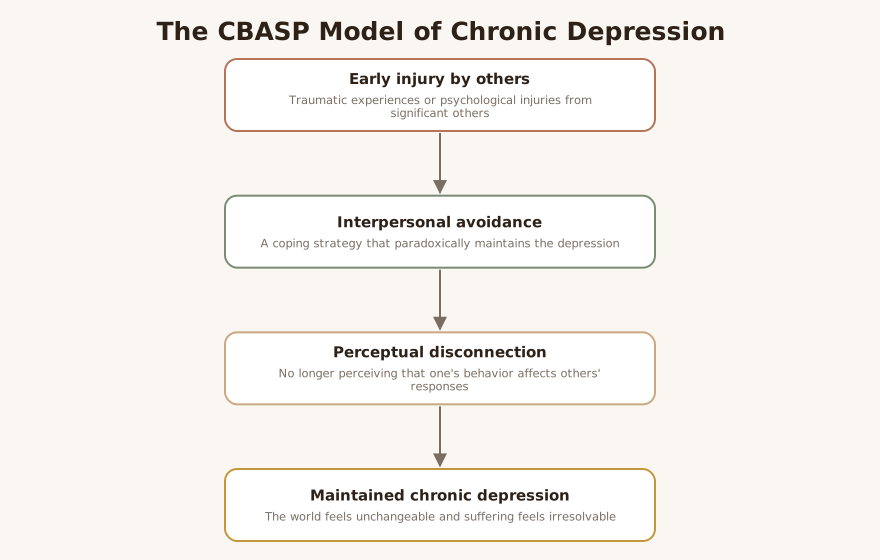
The organizing premise of CBASP is that chronic depression frequently arises from traumatic experiences or psychological injuries inflicted by significant others, after which the patient develops pervasive interpersonal avoidance as a coping strategy that paradoxically maintains the depression 7. McCullough proposed that these patients become “perceptually disconnected” from their environment: they no longer perceive a contingent relationship between their own behavior and the responses of others, so the world feels unchangeable and their suffering feels irresolvable 4. In Piagetian terms, their interpersonal reasoning is described as prelogical and global, resembling preoperational functioning 4.
The central therapeutic goal, therefore, is to help the patient recover perceived functionality — an experiential, felt awareness that their behavior produces consequences in other people, and that changing the behavior can change the consequence 4. Crucially, this is taught through lived experience within and outside the session rather than through insight or persuasion alone LLM. A second core principle is negative reinforcement: rather than relying on the therapist’s praise, CBASP arranges for the patient to discover that more skillful interpersonal behavior reduces their own distress, so the new behavior is maintained by the relief it produces 4. A third principle is that the therapeutic relationship itself is a primary instrument of change, with the therapist deliberately functioning as a real, responsive person rather than a neutral observer 4.
Interventions & Techniques
The workhorse technique of CBASP is Situational Analysis (SA), a structured procedure that occupies roughly 70% of treatment time 4. SA proceeds in two phases. In the elicitation phase, the patient describes a specific, time-limited interpersonal situation in concrete terms, narrates their own interpretations and behaviors, states the actual outcome, and then states the desired outcome — making any mismatch between what they wanted and what they got explicit 4. In the remediation phase, the therapist guides the patient to examine how their own interpretations and behaviors contributed to the undesired outcome, and to generate alternative interpretations and behaviors that would have moved the situation toward the desired result 4. Over many repetitions, this trains social problem-solving and repeatedly demonstrates the behavior-consequence contingency the patient had stopped perceiving 4.
Several relational techniques surround SA. Early in treatment the therapist takes a Significant Other History (SOH), in which the patient names the key figures who shaped them and the therapist derives a causal theory conclusion — the distinctive relational “stamp” each person left 4. From this the therapist constructs a transference hypothesis, a prediction of how the patient is likely to re-enact those learned interpersonal patterns with the therapist, typically organized around domains such as intimacy, disclosure of need, failure, and the expression of negative affect 4. When such a pattern is activated in session (a transference “hot spot”), the therapist uses the Interpersonal Discrimination Exercise (IDE), asking the patient to compare how a hurtful significant other would have responded with how the therapist actually responds, so the patient can register a “new and novel interpersonal reality” 4.
Underpinning these is disciplined personal involvement, McCullough’s “two-person psychology” in which both patient and therapist carry stimulus value 4. Rather than neutrality, the therapist offers controlled, intentional self-disclosure of their genuine reactions 4. A specific form of this is contingent personal responsivity, in which the therapist directly names the in-session impact of the patient’s behavior — for example, connecting a behavior to its relational consequence — and then redirects toward more adaptive alternatives 4.
LLM-generated illustrative example (not a guideline): A patient reports that she said nothing when a coworker took credit for her work, then “felt worthless for a week.” In the elicitation phase she states her desired outcome (“I wanted him to know it was mine”) and her actual outcome (“I said nothing and felt erased”). In remediation, the therapist helps her see that silence guaranteed the gap and rehearse a concrete alternative sentence she could have used. Later, when she falls silent with the therapist after mild disagreement, the therapist gently notes that her withdrawal makes him feel pushed away — and contrasts his staying-present response with the dismissive father from her Significant Other History LLM.
Evidence Base
CBASP’s evidence base is mature enough to be considered established for chronic depression, while remaining narrower than that of generic CBT for acute depression 1. The cornerstone is the large multicenter trial by Keller and colleagues, which randomized adults with chronic depression to CBASP alone, the antidepressant nefazodone alone, or their combination 2. The combination produced markedly better outcomes than either monotherapy: roughly 85% of combination-treatment completers achieved a clinically meaningful response, versus approximately 52% for CBASP alone and 55% for medication alone, with the two monotherapies performing comparably to each other 72.
A 2016 systematic review and meta-analysis aggregated six randomized controlled trials comprising 1,510 patients 3. It found a small overall posttreatment effect (Hedges’ g ≈ 0.34) but a more substantial advantage when CBASP was compared against treatment-as-usual (g ≈ 0.64–0.75), and superiority over interpersonal psychotherapy in head-to-head data 3. Against antidepressant monotherapy, CBASP and medication produced broadly similar effects, while the combination of CBASP plus medication outperformed medication alone 3. The review concluded that CBASP is effective for chronic depression, particularly when delivered at an adequate dose of roughly 18 or more sessions 3. A frequently cited secondary signal is that patients with early-onset chronic depression and childhood adversity may respond especially well to CBASP, although direct efficacy data specifically in trauma-exposed subgroups remain more limited than the headline trials 34. Clinicians wanting the primary literature can consult the bibliography maintained by the International CBASP Society 6.
Populations & Indications
CBASP was purpose-built for, and its evidence is strongest in, the chronic depressive presentations: persistent depressive disorder (dysthymia), chronic major depressive disorder, and depressive illness lasting two or more years 17. It is particularly indicated for early-onset chronic depression, where onset in adolescence is conceptualized as having interrupted normal interpersonal-developmental learning 74. It is also a reasonable choice for treatment-resistant depression, especially where prior medication trials have failed and where combination with pharmacotherapy is feasible 23. Because the model centers on relational injury by significant others, it is frequently applied with adults whose depression is intertwined with childhood maltreatment or trauma histories 74. The typical setting is psychiatric or behavioral-health outpatient care with adults 1.
Problems-for-Work
CBASP’s techniques map cleanly onto several discrete clinical problems LLM. Interpersonal avoidance is addressed directly, since the model views avoidance as the engine of chronic depression and uses SA and the therapeutic relationship to re-engage the patient with feared interpersonal contact 74. Social problem-solving deficits are the explicit target of Situational Analysis, which functions as repeated guided practice in matching behavior to desired outcomes 4. Maladaptive interpersonal patterns and relationship conflict are surfaced through the Significant Other History and transference hypothesis and revised through the Interpersonal Discrimination Exercise 4. Hopelessness, the felt sense that nothing one does matters, is countered as the patient accumulates lived evidence of behavior-consequence contingency, restoring perceived functionality 4. Childhood maltreatment sequelae are worked relationally, with disciplined personal involvement offering a corrective contrast to historical caregivers 74.
LLM-generated illustrative example (not a guideline): For a chronically depressed man whose presenting problem is “I have no friends and I never will,” the clinician might frame the work as a series of small SA exercises on ordinary social moments — a text he didn’t return, a lunch invitation he declined — using each to build the felt sense that his choices shape his isolation LLM.
Contraindications, Cautions & Cultural Humility
CBASP is not a generic depression treatment and should not be selected by default for acute, single-episode major depression, where its specific advantage over standard therapies has not been the focus of its trials 13. The model is also dose-sensitive: under-dosing below roughly 18 sessions risks blunting its effect, so it is a poor fit where only very brief contact is possible 3. Disciplined personal involvement carries real risk if undertaken without training, because intentional therapist self-disclosure can shade into boundary problems or gratification of therapist needs; McCullough framed it as disciplined precisely to keep it patient-centered and contingent, and it should be practiced within that structure and ideally with supervision 4LLM. Clinicians should also hold the model’s developmental framing lightly across cultural contexts: what counts as adaptive assertiveness, appropriate disclosure of need, or healthy interpersonal “outcomes” is culturally shaped, and the desired-outcome step of SA must be co-defined with the patient rather than imposed from the therapist’s norms LLM. As with any trauma-adjacent work, pacing and safety around childhood-maltreatment material warrant ordinary clinical caution LLM.
Treatment-Plan Suggestions & SMART Objectives
| Goal | SMART objective (example) | Mechanism |
|---|---|---|
| Reduce interpersonal avoidance | Within 8 weeks, patient initiates at least two previously avoided interpersonal contacts per week and logs each in session | Re-engagement via Situational Analysis and exposure to feared interpersonal stimuli 4 |
| Build social problem-solving | By session 12, patient independently completes the elicitation and remediation steps of one Situational Analysis with minimal prompting | Repeated SA practice transferring problem-solving skill to the patient 4 |
| Restore perceived functionality | Within 10 weeks, patient verbalizes the behavior-consequence link in 3 of 4 reviewed situations without therapist correction | Negative-reinforcement learning that adaptive behavior reduces distress 4 |
| Revise maladaptive relational patterns | Over treatment, patient discriminates therapist responses from a hurtful significant other’s in at least 3 IDE episodes | Significant Other History, transference hypothesis, and Interpersonal Discrimination Exercise 4 |
| Reduce hopelessness | By week 12, patient’s self-rated hopelessness on a standard measure decreases by a clinically meaningful margin | Accumulated lived evidence of contingency between action and outcome 4 |
| Improve depressive symptom burden | Complete an adequate dose of 18+ sessions and achieve a 50% reduction on a clinician-rated depression scale | Adequate-dose CBASP, alone or combined with pharmacotherapy 23 |
| Strengthen treatment response in resistant cases | Coordinate concurrent pharmacotherapy and attend combined treatment for the planned course | Combination of CBASP plus medication outperforming medication alone 23 |
Common Misconceptions
A frequent misconception is that CBASP is “just CBT with a relationship focus.” In fact it rests on a distinct developmental theory of arrested preoperational functioning and uses negative reinforcement and disciplined personal involvement as named mechanisms that standard CBT does not employ 47. A second is that the therapist’s self-disclosure is freewheeling; the model is explicit that personal involvement is disciplined and contingent on the patient’s in-session behavior, not casual or self-serving 4. A third is that CBASP is a general antidepressant treatment — its evidence and design are tied to chronic depression specifically 13. A fourth is the assumption that CBASP psychotherapy plus medication is always superior to either alone; the meta-analytic picture supports combination over medication monotherapy, but the two monotherapies performed comparably to each other in the landmark trial 23.
Training & Certification
CBASP is a structured, manual-based therapy, and the primary self-study resource is McCullough’s treatment manual, which lays out the procedures and case material in detail 5. Because techniques such as disciplined personal involvement and the Interpersonal Discrimination Exercise are skill-dependent and easy to misapply, formal training and supervised practice are advisable rather than manual-only learning 4LLM. The International CBASP Society serves as a professional hub and maintains the field’s research bibliography, and is a reasonable starting point for clinicians seeking workshops, training networks, and current literature 6. Adequate fidelity also means attending to dose, since the evidence favors a full course of roughly 18 or more sessions 3.
Key Terms
- Situational Analysis (SA): The core two-phase technique (elicitation and remediation) for analyzing specific interpersonal situations and closing the gap between actual and desired outcomes 4.
- Perceived functionality: The patient’s recovered felt awareness that their behavior produces consequences in others — the central treatment goal 4.
- Significant Other History (SOH): A structured review of key formative relationships from which causal theory conclusions are drawn 4.
- Transference hypothesis: A prediction, derived from the SOH, of how the patient will re-enact learned relational patterns with the therapist 4.
- Interpersonal Discrimination Exercise (IDE): An in-session technique contrasting a hurtful significant other’s likely response with the therapist’s actual response 4.
- Disciplined personal involvement: McCullough’s “two-person psychology” of intentional, contingent therapist responsiveness in place of neutrality 4.
- Contingent personal responsivity: The therapist’s explicit naming of the in-session impact of the patient’s behavior, linking behavior to relational consequence 4.
Resources & Further Reading
▶ Watch — a video introduction to this concept:
- Society of Clinical Psychology (APA Division 12): CBASP for Depression
- Keller et al. (2000), Nefazodone, CBASP, and Their Combination for Chronic Depression (NEJM)
- Negt et al. (2016), CBASP for chronic depression: systematic review and meta-analysis of RCTs (PMC)
- CBASP: a new psychotherapy for chronic depression (Cambridge Core, Advances in Psychiatric Treatment)
- McCullough, Treatment for Chronic Depression: CBASP (publisher page)
- International CBASP Society: Research bibliography
- Wikipedia: Cognitive behavioral analysis system of psychotherapy
Reflective / Supervision Questions
- When you use disciplined personal involvement, how do you verify that your disclosure is contingent on the patient’s behavior and in service of their learning, rather than discharging your own reaction? LLM
- In a patient’s Situational Analysis, are you co-defining the “desired outcome” with them, or importing your own cultural assumptions about what a good interpersonal result looks like? LLM
- How will you track whether the patient is actually recovering perceived functionality — the felt behavior-consequence link — versus merely complying with the SA format? LLM
- Given the dose-response evidence, how are you protecting an adequate course of treatment against premature termination or under-dosing? LLM
- For a treatment-resistant patient, when do you raise coordinating concurrent pharmacotherapy, and how do you frame the combination rationale without implying that psychotherapy alone has failed? LLM