
Type & Discipline
“Anxiety as the dizziness of freedom” is a philosophical concept, not a therapeutic modality or technique LLM. It originates in Søren Kierkegaard’s 1844 work The Concept of Anxiety, a text in the phenomenology of mood within the existentialist tradition 1. The core claim is compact: anxiety is “the dizziness of freedom” 6. As a concept it sits upstream of clinical practice — it shapes how a clinician understands a client’s anxiety rather than prescribing a specific intervention LLM. Its natural clinical home is existential psychotherapy and any approach willing to treat anxiety as meaningful information rather than only as a symptom to suppress LLM.
For practicing therapists, the value is interpretive. The concept reframes a subset of anxiety — the diffuse, objectless dread that intensifies around choice, identity, and the future — as something other than a malfunction to be eliminated 1. That reframe has direct consequences for case formulation, the therapeutic stance toward avoidance, and how we talk with clients about the discomfort that accompanies growth LLM.
Creators & Lineage
The concept is Kierkegaard’s, published under the pseudonym Vigilius Haufniensis — “the Watchman of Copenhagen” — a persona positioned as a philosophical sentinel warning of spiritual dangers 1. Writing within his theological and existential project, Kierkegaard treats anxiety as a structural feature of being human rather than a contingent disorder 1.
The concept’s clinical afterlife runs through twentieth-century existential and psychoanalytic thought LLM. Rollo May drew the connection between anxiety and creativity explicitly, holding that “the more creative the person… the more anxiety and guilt are potentially present,” because creating requires destroying old patterns and building new ones 3. Contemporary commentator Gary Cox extends Kierkegaard’s “dizziness of freedom” to the lived experience of young and emerging adults navigating choice and responsibility 4. Peter Slater bridges the philosophical concept to developmental psychoanalytic theory, linking Kierkegaard’s insight to Freud’s signal theory of anxiety, Klein’s persecutory and depressive anxieties, and Bion’s container/contained model 5. Psychologist James Hollis frames the willing acceptance of anxiety as “the path of personal growth” 2.
Within the broader lineage this concept anticipates existential psychotherapy and Yalom’s organization of the existential givens — particularly freedom and responsibility — and shares territory with Frankl’s logotherapy, where anxiety and meaning are intertwined LLM. Sartre’s later notion of “bad faith” can be read as a description of the maneuvers Kierkegaard’s anxiety provokes 4.
Core Principles
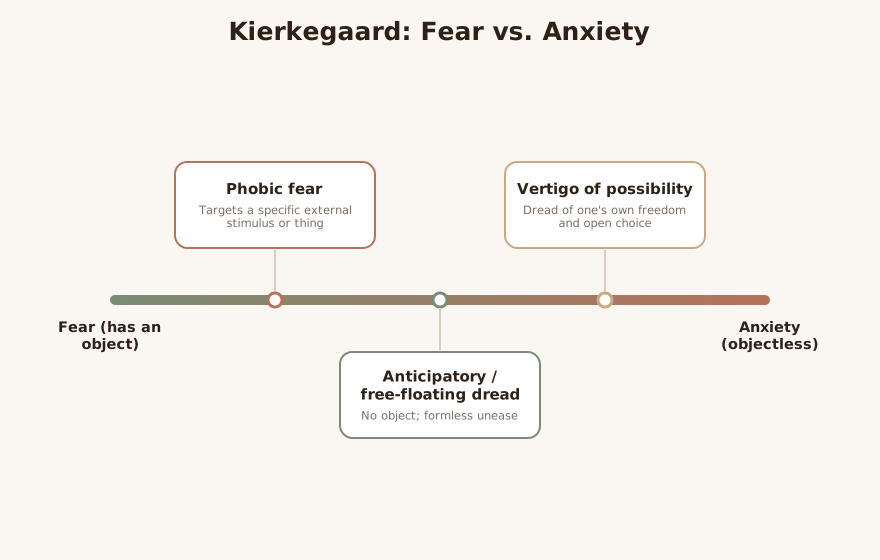
Anxiety is not fear. Kierkegaard’s foundational move is to distinguish anxiety from fear by its objectlessness: fear targets a specific thing, while anxiety confronts the formless dread of freedom and possibility itself 1. This is the same distinction modern clinicians draw between phobic fear (of a stimulus) and free-floating or anticipatory anxiety LLM.
Anxiety is the vertigo of possibility. The signature image is the person standing at a cliff edge: the deepest unease is not fear of falling but the “alarming possibility of being able” to jump — the recognition that nothing external compels the choice 2. Kierkegaard defines anxiety as “freedom’s actuality as the possibility of possibility,” distinguishing it from fear’s concrete objects 3.
Only a being who is free can be anxious. “If man were a beast or an angel, he would not be able to be in anxiety,” because only a creature suspended between necessity and pure spirit confronts open choice 2. Anxiety, in this reading, is the felt signature of freedom LLM.
Anxiety moves us from immediacy to reflection. Kierkegaard holds that anxiety “informs us of our choices, our self-awareness and personal responsibility,” carrying a person from un-self-conscious immediacy into self-conscious reflection 1. It is, paradoxically, a developmental engine 1.
Anxiety can be educative. Kierkegaard insists that “learning to know anxiety is an adventure which every man has to affront,” and that the one “who has learned rightly to be in anxiety has learned the most important thing” 12. Anxiety properly related to becomes “a serving spirit that against its will leads him where he wishes to go” 3. The clinical implication is not to eliminate anxiety but to change one’s relationship to it LLM.
Interventions & Techniques
The concept is not itself a technique, so what follows are clinically established interventions that can carry its logic — chosen and synthesized for fit, not prescribed by Kierkegaard LLM.
Reframing anxiety as a signal of freedom. Rather than treating diffuse anxiety only as pathology, the clinician helps the client locate the possibility the anxiety is announcing — the choice, the open future, the responsibility at stake 1. This is consistent with the educative reading: the goal is to “learn rightly to be in anxiety,” not to abolish it 2.
Working the cliff-edge phenomenology. When a client describes vertigo around a decision, naming the structure — “the dread here may be less about the option being bad and more about your recognizing that it’s genuinely yours to choose” — externalizes the experience and reduces the sense of malfunction 24.
Confronting avoidance of freedom. Cox describes the “flimsy psychological guard rails” — beliefs in fixed traits or fate — that let people deny their freedom and function, even as these are choices continually remade 4. Existential work gently surfaces these defenses so the client can own the choice they are already making 4.
Containment before exploration. Slater’s developmental reading is a corrective: before a client can tolerate the dizziness of freedom, they may need the therapeutic relationship to provide a containing function — processing unbearable affect and returning it in manageable form, as Bion described — so that symbolic thought and emotional tolerance can develop 5.
LLM-generated illustrative example (not a guideline): A graduate student presents with paralyzing dread before every major decision — which lab, which city, whether to stay in the program. Sessions reframe the dread: it spikes precisely where her freedom is real and the outcome is unguaranteed. The clinician and client distinguish this existential vertigo from her separate, treatable panic symptoms, and practice tolerating the discomfort of choosing rather than collapsing it into “I just can’t decide.” LLM
Evidence Base
Honesty requires a clear distinction here LLM. The concept is established — a canonical, centuries-influential idea in the philosophy of anxiety and a documented foundation for later existential psychology 1. Its maturity as an idea is not in question LLM.
What is not established is “dizziness of freedom” as an empirically validated treatment. It is a philosophical lens, not a manualized protocol with randomized controlled trials LLM. Claims that anxiety, properly managed, enables growth rather than only suffering are presented in the literature as conceptual and clinical-theoretical arguments — for example Slater’s integration of Kierkegaard with psychoanalytic developmental theory — rather than as outcome data 5. Rollo May’s link between anxiety and creativity is likewise a theoretical position 3. Clinicians should hold the concept as a formulation tool and pair it with evidence-based interventions for the presenting disorder, not substitute it for them LLM.
Populations & Indications
The concept is most resonant with clients whose anxiety has an existential rather than purely phobic structure LLM. Cox foregrounds emerging and young adults, who perpetually face this dizziness across career, relationship, and identity choices, where “every choice reflects your freedom, carrying the weight of responsibility and the possibility of choosing wrongly” 4.
It applies naturally to adults facing major life decisions, people in existential crisis, and philosophically minded clients who find symptom-only framings unsatisfying LLM. For people with anxiety disorders, the concept is an adjunctive lens: it can dignify and contextualize anxiety without displacing first-line treatment LLM. Slater’s developmental material extends relevance toward clients whose early containment was inadequate, where the capacity to tolerate freedom’s vertigo must first be built in the therapeutic relationship 5.
Problems-for-Work
Existential anxiety. The concept’s home territory — diffuse, objectless dread tied to freedom and possibility, which the clinician helps the client recognize and relate to rather than only suppress 16.
Decisional paralysis and indecisiveness. When a client cannot choose, the cliff-edge frame distinguishes “this option is dangerous” from “choosing is mine and unguaranteed,” loosening the freeze 24.
Avoidance of responsibility. Cox’s “psychological guard rails” name the self-deceptions by which clients disown their freedom; surfacing them is direct work on avoidance 4.
Fear of the future and meaninglessness. Anxiety about open possibility can be reframed from threat toward the field in which meaning and creativity become possible 3.
Demoralization and identity disturbance. Anxiety’s role in moving a person from immediacy to self-conscious reflection offers a developmental narrative for clients who feel stuck or unformed 1.
LLM-generated illustrative example (not a guideline): A client in his fifties, recently divorced, says everything feels meaningless and he “has no idea who he is anymore.” Work reframes the void: the collapse of an old structure has exposed genuine open possibility, and his anxiety is tracking that openness. The clinician pairs the existential reframe with behavioral activation, so meaning-making proceeds through action rather than rumination. LLM
Contraindications, Cautions & Cultural Humility
This is a lens, not a treatment, and it can be misapplied LLM. It is not first-line for acute, severe, or biologically driven anxiety. Telling a client in a panic crisis or with severe generalized anxiety disorder that their dread is “the dizziness of freedom” risks invalidation and can delay effective care; stabilize and treat first LLM. Slater’s developmental caution is relevant: a client without adequate internal containment may be flooded rather than freed by confronting open possibility, so containment precedes existential exploration 5.
Watch for romanticizing distress. The claim that anxiety is generative does not mean suffering is good; framing anxiety as a “serving spirit” is aspirational and should never minimize a client’s real pain 3. Note also Kierkegaard’s theological framing of anxiety in relation to sin — a heritage clinicians should translate carefully and not impose on clients of differing or no faith 1.
Cultural humility. The premise of radical individual freedom is culturally situated; clients from collectivist, religiously observant, or materially constrained contexts may experience choice as embedded in obligation and circumstance rather than as boundless individual possibility LLM. Cox himself concedes that “flimsy guard rails” of belief can be “vital for sustaining well-being, and even sanity,” a caution against stripping away a client’s stabilizing frameworks in the name of authenticity 4. The clinician’s task is to meet the client’s lived sense of agency, not to convert them to a philosophy LLM.
Treatment-Plan Suggestions & SMART Objectives
| Goal | SMART objective (example) | Mechanism |
|---|---|---|
| Reframe anxiety as a signal rather than a defect | Within 6 sessions, client will identify and name the specific freedom/choice underlying at least 3 episodes of diffuse anxiety in session | Anxiety distinguished from fear by its objectlessness; relating to it educatively 12 |
| Reduce decisional paralysis | Over 8 weeks, client will make and act on 2 previously avoided decisions, rating distress before and after | Cliff-edge phenomenology: separating “bad option” from “the choice is mine” 24 |
| Increase tolerance of uncertainty | Within 10 sessions, client will tolerate a 30-minute exposure to an unresolved decision without compulsive reassurance-seeking, twice weekly | Learning “rightly to be in anxiety” rather than discharging it 2 |
| Surface and revise avoidance of responsibility | By session 12, client will articulate 2 “psychological guard rails” used to disown choice and name the choice underneath | Identifying self-deception that denies freedom 4 |
| Build affect containment before exploration | Within 4 weeks, client will use 2 grounding/containment skills to down-regulate flooding before existential work begins | Containing function as precondition for symbolic tolerance 5 |
| Convert anxiety toward constructive action | Over 8 weeks, client will channel anxiety into one creative or values-based project, tracking weekly engagement | Anxiety as accompaniment to creating new possibility 3 |
| Reduce demoralization / restore agency | Within 8 sessions, client will report a felt shift from “stuck” to “choosing” on at least 3 logged occasions | Anxiety moving the person from immediacy to reflective self-authorship 1 |
Common Misconceptions
“Anxiety means something is wrong with me.” The concept holds the opposite at the structural level: only a free being can be anxious, and anxiety is the felt signature of confronting one’s own possibility 12. It is not, by itself, evidence of defect 2.
“The goal is to eliminate anxiety.” Kierkegaard’s aim is to learn “rightly to be in anxiety,” not to abolish it — a relationship change, not an extinction target 2. Clinically, this complements rather than contradicts symptom reduction for diagnosable disorders LLM.
“Anxiety equals fear.” They are categorically different in this framework: fear has an object; anxiety does not, confronting instead the formless possibility of freedom 1.
“This is just positive thinking about stress.” The concept does not claim anxiety is pleasant or harmless; it claims anxiety is meaningful and potentially formative — which is a different and more demanding proposition than reframing it as positive 3.
Training & Certification
There is no certification in “the dizziness of freedom”; it is a concept, not a credentialed method LLM. Clinicians who wish to use it skillfully typically train in existential psychotherapy more broadly, and ground themselves in the primary text, The Concept of Anxiety, and its psychological interpreters 1. Familiarity with Rollo May’s work on anxiety and creativity, and with the psychoanalytic developmental tradition (Freud’s signal anxiety, Klein, Bion) that Slater integrates, deepens competent application 35. Reading-level engagement plus supervision in existential or psychodynamic work is the practical path, rather than any formal certificate LLM.
Key Terms
- Anxiety (Angst): Objectless dread arising from freedom and possibility, distinct from fear 1.
- Dizziness of freedom: Kierkegaard’s metaphor for the vertigo of confronting one’s own open possibility 6.
- Possibility of possibility: Kierkegaard’s definition of anxiety as “freedom’s actuality” 3.
- Cliff-edge / vertigo: The image of dread as the “alarming possibility of being able” to act, not fear of the fall 2.
- Educative anxiety: Anxiety that, rightly related to, becomes “a serving spirit” leading toward growth 23.
- Psychological guard rails: Cox’s term for self-deceptions that let us deny our freedom and function 4.
- Containment (container/contained): Bion’s model, invoked by Slater, of processing unbearable affect into manageable form 5.
- Vigilius Haufniensis: Kierkegaard’s pseudonym for the text, “the Watchman of Copenhagen” 1.
Resources & Further Reading
▶ Watch — a video introduction to this concept:
- The Concept of Anxiety (Wikipedia) 1
- Søren Kierkegaard and the Psychology of Anxiety (Academy of Ideas) 2
- Kierkegaard on How to Channel Anxiety into Creativity (The Marginalian) 3
- Kierkegaard: Young, Free & Anxious (Philosophy Now) 4
- Anxiety: The Dizziness of Freedom — developmental factors through psychoanalytic thinking (IntechOpen) 5
- Anxiety is the dizziness of freedom (Goodreads quote) 6
Reflective / Supervision Questions
- When a client describes diffuse anxiety, how do I currently distinguish existential vertigo from a treatable anxiety disorder — and do I act on that distinction or default to symptom-suppression? LLM
- Where in my caseload might I be inadvertently invalidating a client by reframing acute distress as “the dizziness of freedom” before stabilization? 5
- What are my own “psychological guard rails,” and how might they shape how I respond to a client’s avoidance of choice? 4
- For a given client, is the work to build containment first, or is the client ready to confront open possibility now? 5
- How do I hold the tension between honoring a client’s stabilizing beliefs and inviting them to own their freedom and responsibility? 4
- Am I treating this concept as a formulation lens alongside evidence-based care, or am I letting it substitute for it? LLM