
Few interventions are as intuitively appealing — or as easy to deliver sloppily — as bringing an animal into the room. The appeal is real and the mechanisms are plausible, but “the client liked petting the dog” is not a treatment, and the literature’s central tension is precisely the gap between a widely felt clinical sense that animals help and a research base that is still catching up to it 1. For clinicians, the discipline lies in distinguishing goal-directed therapy from pleasant activity, and in holding the evidence honestly. LLM
Type & Discipline
Animal-assisted therapy (AAT) is an experiential, adjunctive psychotherapeutic modality in which a trained animal is deliberately incorporated into a treatment plan delivered by a credentialed health or human-service professional 5. The APA Dictionary defines it as “the use of trained animals to enhance an individual’s physical, social, emotional, or cognitive functioning,” noting that animals as varied as dogs, cats, horses, birds, and others have been used in a range of settings 5. What distinguishes therapy from informal contact is that the animal is integrated into a structured plan with documented, individualized goals against which progress is measured 5.
A standard and clinically important distinction is between animal-assisted therapy and animal-assisted activities (AAA) 1. AAT is goal-directed, delivered or directed by a professional, and documented; AAA covers more casual, motivational, or recreational contact — a therapy-dog visit to a hospital ward — that is not tied to specific treatment objectives 1. The systematic-review literature treats this boundary as essential, because much of what is loosely called “pet therapy” is in fact AAA, and conflating the two inflates apparent effects and muddies the evidence base 1. AAT sits within the broader family of experiential and adjunctive modalities; it is not a freestanding school of psychotherapy with its own theory of change but a delivery vehicle layered onto an established treatment frame LLM.
Creators & Lineage
The modern clinical lineage is usually traced to Boris Levinson, an American child psychologist who in the early 1960s noticed that his dog Jingles helped withdrawn child clients open up, and who coined the term “pet therapy” and argued for the deliberate use of animals as a treatment adjunct LLM. The intellectual roots run deeper than any single figure — accounts of animals in care settings predate Levinson — but he is the conventional point of origin for the formalized clinical idea LLM. The psychophysiological strand of the lineage is associated with Aaron Katcher, whose work on human–animal interaction examined measurable effects such as reductions in blood pressure and physiological arousal during contact with animals, lending a biological rationale to what had been a largely observational practice LLM.
The contemporary, manualized, counseling-oriented articulation of the field is associated with Cynthia Chandler, whose work helped standardize competencies, ethics, and supervision for clinicians integrating animals into therapy LLM. By the time the systematic reviews surveyed here were written, the field had matured into one with recognized professional standards, training pathways, and a distinction between certified therapy animals and the professionals who direct them 1. The practical lineage therefore has two threads a clinician should keep separate: a clinical thread (Levinson → counseling-based AAT) and a psychophysiological thread (Katcher → the autonomic and attachment-related mechanisms invoked to explain it) LLM.
Core Principles
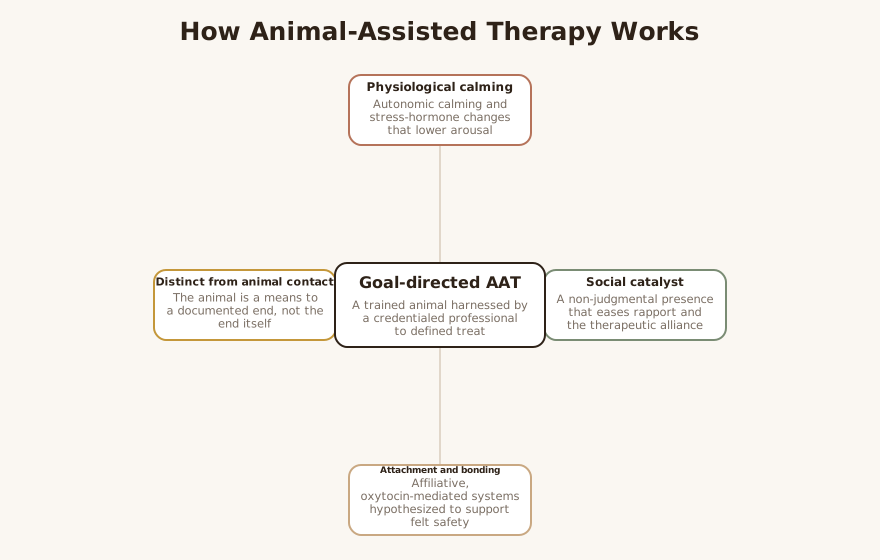
The first principle is goal-directedness: an animal’s presence is therapeutic only insofar as it is harnessed to defined treatment objectives, which is the formal line between AAT and mere animal contact 5. The APA definition’s emphasis on enhancing “physical, social, emotional, or cognitive functioning” reflects this — the animal is a means to a documented end, not the end itself 5.
The second principle concerns proposed mechanisms of change, which the literature frames at several levels 1. At the physiological level, interaction with animals is associated with autonomic calming and stress-hormone changes — reductions in arousal that can lower the threshold for engaging in difficult therapeutic work 13. At the relational level, the animal can serve as a non-judgmental presence and a “social catalyst” or “social lubricant,” easing the formation of rapport and the therapeutic alliance, particularly with clients who find direct interpersonal contact threatening 14. At the level of attachment and oxytocin-mediated bonding, human–animal interaction is hypothesized to activate affiliative systems that support felt safety 1.
The third principle is engagement and motivation: animals draw reluctant or guarded clients into treatment they might otherwise avoid or abandon, improving attendance and participation 4. Psychology Today’s clinical description frames AAT’s value substantially in terms of reducing anxiety, providing comfort, and lowering the barrier to disclosure 4. The fourth principle is embodiment and present-moment focus — the animal anchors the client in concrete, sensory, here-and-now experience, which is part of why the modality is classed as experiential LLM. None of these mechanisms is unique to AAT, which is one reason the modality is best understood as amplifying common factors rather than introducing a wholly novel mechanism of change LLM.
Interventions & Techniques
In practice, AAT is layered onto an existing treatment frame rather than replacing it, and the techniques vary by species and setting 1. Canine-assisted psychotherapy is the most studied form, in which a therapy dog is present during sessions and the clinician uses the dog deliberately — to model and practice nurturing behavior, to provide tactile soothing during exposure or trauma processing, to act as a bridge for clients who struggle to speak directly, and to make abstract therapeutic concepts concrete 1. The adolescent systematic review surveyed describes canine-assisted psychotherapy as an adjunct that augments rather than supplants the underlying psychotherapeutic approach 1.
Equine-assisted approaches form the other major branch and typically take place in a ground-based, experiential format: clients interact with horses through grooming, leading, and observation, with the horse’s responsiveness used as immediate feedback about the client’s affect, boundaries, and nonverbal communication 2. The CADTH review treats canine and equine therapies together as the two principal modalities under examination for mental-health indications 2. Across both, common technical moves include using the animal to co-regulate arousal (tactile contact to down-regulate before or during difficult content), to scaffold social skills (turn-taking, attunement, reading nonverbal cues), to support behavioral activation (caretaking tasks that mobilize a withdrawn or depressed client), and to externalize and metaphorize (using the animal’s behavior as a mirror for the client’s relational patterns) 12. A defining feature is the handler–therapist–animal triad: the animal is a trained partner with its own welfare needs, and the clinician must manage a three-way interaction rather than a dyad LLM.
LLM-generated illustrative example (not a guideline): A guarded 14-year-old who answers most questions with a shrug is invited to teach the therapy dog a simple command across several sessions. The therapist uses the shared task as a low-pressure context for talk, then gradually links the dog’s hesitation and trust-building to the client’s own experience of mistrust — the animal furnishing a metaphor the client can tolerate. The underlying treatment remains a structured adolescent psychotherapy; the dog is the engagement vehicle. LLM
Evidence Base
The honest summary is that AAT is established as an adjunctive modality with a substantial and generally favorable outcome literature, but one whose methodological quality is uneven — strong enough to support use as a complement, not strong enough to claim first-line status 12. The adolescent systematic review of canine-assisted psychotherapy found that, across the included studies, results were broadly promising for outcomes such as anxiety, depression, and trauma symptoms, while repeatedly flagging the limitations that constrain confidence: small sample sizes, heterogeneous interventions and outcome measures, frequent absence of robust control conditions, and inconsistent reporting 1. Its conclusion is characteristically cautious — that canine-assisted psychotherapy shows potential as an adjunct and warrants more rigorous trials 1.
The CADTH review of canine and equine therapy for mental health reaches a similarly tempered verdict, finding limited and lower-quality evidence and emphasizing that the existing studies do not permit strong conclusions about clinical effectiveness 2. This is an important counterweight to enthusiastic framing: a formal health-technology assessment landed on “evidence is limited,” not “evidence is conclusive” 2. The APA Services research roundup, surveying the broader literature, conveys both the breadth of reported benefits — across stress, mood, and engagement — and the recurring caution that much of the work is preliminary and that effect sizes and mechanisms are not yet firmly established 3. Across all three, the consistent pattern is favorable signal plus methodological caveat 123.
For a clinician, the defensible position is therefore dual: AAT has enough supportive evidence and theoretical plausibility to be offered as a structured adjunct, especially where it improves engagement, but it should not displace treatments with stronger first-line evidence for the presenting condition, and any benefit may operate substantially through common factors — alliance, arousal reduction, expectancy — rather than a mechanism unique to the animal 13LLM.
Populations & Indications
The populations best represented in the literature are children and adolescents, where canine-assisted psychotherapy has been studied as an engagement-enhancing adjunct for anxiety, depression, and trauma-related presentations 1. Trauma survivors and people with posttraumatic stress, including veterans, are a frequently cited indication, with the animal’s calming presence and the alliance-building effect proposed as particularly useful for clients who find direct trauma work or interpersonal trust difficult 14. Older adults appear prominently in the broader human–animal-interaction literature, often in relation to loneliness, mood, and physiological stress markers 3.
People with depression or anxiety are a core indication, reflecting both the autonomic-calming rationale and the modality’s documented use for reducing distress and providing comfort 34. People with autism spectrum conditions are commonly served, where animals are used to scaffold social engagement and communication, though the evidence here too is described as developing rather than settled 3. Inpatient, residential, and other institutional psychiatric populations are frequent settings, in part because AAT can lift engagement and mood in environments where motivation is low 34. The clearest clinical indication across these groups is a presentation in which engagement, arousal regulation, or alliance is the rate-limiting problem and an animal can plausibly address it as part of a larger plan LLM.
Problems-for-Work
AAT’s constructs map onto a recognizable cluster of presenting problems, and the mapping is most useful when the animal is tied to the specific mechanism the problem demands LLM.
- Low treatment engagement and alliance difficulties. Where a client is guarded, avoidant, or prematurely dropping out, the animal’s role as social catalyst directly targets the barrier, easing rapport and disclosure 14.
- Anxiety and physiological hyperarousal. Tactile contact and the calming presence of the animal are used to down-regulate arousal, lowering the threshold for tolerating difficult content 13.
- Posttraumatic stress. The non-judgmental presence and co-regulation support trauma-focused work, particularly for clients for whom interpersonal trust is itself a trauma reminder 14.
- Depression and behavioral-activation deficits. Caretaking and interaction tasks mobilize withdrawn clients and create structured, rewarding activity 4LLM.
- Social-skills deficits. Turn-taking, attunement, and reading nonverbal cues are practiced with the animal as a forgiving partner, especially relevant for younger clients and autistic clients 13.
- Loneliness and social isolation. Companionship and affiliative contact are mobilized directly, a long-standing focus of the older-adult literature 3.
LLM-generated illustrative example (not a guideline): A combat veteran who freezes when asked to recount a traumatic event is taught to keep one hand on the therapy dog during graded recounting. The clinician uses the tactile anchor and the dog’s steady presence to keep the client inside the window of tolerance while delivering a recognized trauma protocol; the dog supports affect regulation rather than serving as the treatment itself. LLM
Contraindications, Cautions & Cultural Humility
The first set of cautions is practical and safety-related: allergies, asthma, immunocompromise, infection-control requirements (especially in medical settings), fear of or prior trauma involving animals, and the risk of bites, scratches, or zoonotic transmission all screen clients out or demand modification LLM. A client with an animal phobia or an animal-related trauma is an obvious contraindication for that species, and consent must be genuinely informed and freely revocable LLM.
The second set concerns animal welfare and the welfare-as-ethics principle: the animal is a sentient co-participant, not equipment, and competent practice requires attention to the animal’s stress, fatigue, consent-to-participate cues, and limits, with the handler obligated to protect the animal as well as the client LLM. Failure here is both an ethical breach and a clinical risk, since a stressed animal behaves unpredictably LLM.
The third set is evidentiary humility: because the evidence is favorable but methodologically limited, AAT should be framed to clients as an adjunct of developing evidence, not as a proven cure, and it should not replace a better-supported first-line treatment for the presenting condition 12. Cultural humility matters because attitudes toward animals — which species are companions versus working animals, whether indoor animal contact is acceptable, religious considerations around specific animals such as dogs — vary widely, and a clinician should neither assume an animal will be welcome nor read a client’s discomfort as resistance LLM. Scope-of-practice limits also apply: AAT requires specific competence and a credentialed animal, and a therapist’s general license does not by itself confer competence to direct an animal in session 1LLM.
Treatment-Plan Suggestions & SMART Objectives
The objectives below translate AAT’s mechanisms — engagement, arousal regulation, social-skill practice, behavioral activation — into documentable goals delivered inside a recognized treatment frame, with the animal as a structured adjunct rather than a standalone service LLM.
| Goal | SMART objective (example) | Mechanism |
|---|---|---|
| Improve treatment engagement and alliance | Over 6 sessions, client will attend 5 of 6 scheduled sessions and initiate at least one disclosure per session, logged by clinician | Animal as social catalyst lowering the barrier to rapport and disclosure 14 |
| Reduce physiological hyperarousal | Within 8 weeks, client will use tactile contact with the therapy animal to reduce in-session distress (SUDS) by ≥2 points in 3 of 4 sessions | Autonomic calming and arousal reduction during interaction 13 |
| Support trauma processing within tolerance | Over 10 sessions, client will complete graded recounting of one index event while maintaining contact with the animal, without dissociation, in 3 sessions | Non-judgmental co-regulating presence supports trauma-focused work 14 |
| Increase behavioral activation in depression | Within 6 weeks, client will complete 2 animal-caretaking or interaction tasks per session and report mood change on a brief scale | Caretaking mobilizes withdrawn clients and creates rewarding activity 4 |
| Build social-communication skills | Over 8 weeks, client will demonstrate turn-taking and one accurate read of the animal’s nonverbal cue in 3 of 4 sessions | Animal as forgiving partner for attunement and nonverbal practice 13 |
| Reduce loneliness and isolation | Within 8 weeks, client will report increased felt connection and identify one human relationship to apply the same affiliative skills to | Affiliative contact and companionship mobilized in session 3 |
| Improve emotion-regulation skill use | Over 6 sessions, client will name their arousal state and apply one regulation skill with the animal present in 4 sessions | Present-moment embodied focus supports labeling and regulation 4LLM |
Common Misconceptions
“Any contact with an animal is animal-assisted therapy.” The field draws a firm line between goal-directed, professionally delivered, documented therapy and the more casual, motivational, or recreational animal-assisted activities; conflating them overstates the evidence and the practice 1. “AAT is a standalone treatment.” It is an adjunct layered onto an established treatment frame, not a freestanding therapy with its own complete theory of change 15. “The evidence is conclusive.” A formal health-technology assessment found the evidence limited and of lower quality, and the leading systematic review repeatedly flagged small samples and weak controls; the signal is favorable but the base is not yet strong 12. “The benefit is unique to the animal.” Much of the proposed effect runs through common factors — alliance, arousal reduction, engagement — that are not unique to AAT, which is part of why mechanism claims remain tentative 13LLM. “Pet ownership and AAT are the same thing.” AAT is a clinical procedure directed by a professional with a trained animal toward documented goals, not the general well-being of having a pet 5LLM. “The animal needs no protection.” Competent practice treats the animal’s welfare and stress limits as a core clinical responsibility, not an afterthought LLM.
Training & Certification
There is no single universal license for AAT, and the relevant credentialing operates at two distinct levels that clinicians frequently confuse LLM. The first is the animal–handler team: therapy animals are typically temperament-tested, trained, and certified through recognized animal-therapy organizations, and a “certified therapy dog” credential attests to the animal’s suitability, not to any human clinical competence 1. The second is the clinician’s own competence to direct an animal within therapy, which is acquired through specialized AAT training, coursework, and supervised practice on top of an underlying mental-health license 1LLM.
For a licensed therapist, the operative principle is that a general clinical license does not by itself confer competence in AAT; integrating an animal responsibly requires species-specific training, attention to animal welfare and safety, and familiarity with the AAT/AAA distinction and its ethics 1LLM. The credentials that govern scope remain the therapist’s mental-health licensure and the evidence-based modalities they are trained in, with AAT competencies and a certified animal added on top 1LLM.
Key Terms
- Animal-assisted therapy (AAT): goal-directed use of a trained animal within a documented treatment plan delivered by a credentialed professional to enhance physical, social, emotional, or cognitive functioning 5.
- Animal-assisted activities (AAA): more casual, motivational, or recreational animal contact that is not tied to specific, documented treatment goals 1.
- Canine-assisted psychotherapy: the most-studied form of AAT, in which a therapy dog is deliberately integrated into psychotherapy as an adjunct 1.
- Equine-assisted approaches: ground-based experiential work with horses, using the horse’s responsiveness as feedback on the client’s affect and relating 2.
- Social catalyst / social lubricant: the animal’s role in easing rapport, alliance, and disclosure 14.
- Handler–therapist–animal triad: the three-way structure of an AAT session, where the animal is a trained partner with its own welfare needs LLM.
- Adjunct: a treatment layered onto an established primary modality rather than replacing it 1.
Resources & Further Reading
▶ Watch — a video introduction to this concept:
- Incorporating animal-assisted therapy in mental health treatments for adolescents: A systematic review of canine assisted psychotherapy (PMC6336278)
- Canine and Equine Therapy for Mental Health: A Review of Clinical Effectiveness — CADTH (NBK549209)
- Research roundup: Animal-assisted therapy — APA Services
- Animal-Assisted Therapy — Psychology Today (Therapy Types)
- Animal-assisted therapy — APA Dictionary of Psychology
- Animal-Assisted Therapy Explained — YouTube
Reflective / Supervision Questions
- For this client, is the animal targeting an identifiable mechanism — engagement, arousal regulation, social-skill practice — or have I drifted into pleasant animal-assisted activity without a documented goal? 1
- Given that the evidence is favorable but methodologically limited, am I framing AAT to the client honestly as an adjunct of developing evidence, and have I confirmed it is not displacing a better-supported first-line treatment? 12
- How am I monitoring and protecting the animal’s welfare and stress limits within the session, and what is my plan if the animal signals it has had enough? LLM
- Have I screened adequately for allergies, animal phobia, animal-related trauma, infection-control needs, and cultural or religious considerations before introducing the animal? LLM
- Do I actually hold the specific AAT competence to direct this animal clinically, or am I relying on the animal’s certification to stand in for my own training? 1LLM
- When I attribute improvement to “the dog,” could the gain be running through common factors — alliance, expectancy, arousal reduction — that I should be cultivating regardless? 13LLM