
Type & Discipline
Absurdism is a philosophical position within the broader family of existentialism, not a treatment model or a school of psychotherapy 7. It is most closely associated with the French-Algerian writer Albert Camus, who articulated it as a literary and philosophical stance rather than a formal system 1. The core claim is that the human craving for meaning, clarity, and unity meets a universe that offers no such answers, and that the friction between this demand and that silence is what Camus names “the absurd” 4. Importantly, the absurd for Camus is not a property of the world alone or of the mind alone but of the relation between them—it arises in the confrontation 2.
For clinicians, the relevant point is categorical: absurdism belongs to philosophy, and any clinical use is borrowed and adapted, not delivered as the philosophy itself LLM. It enters the consulting room only through the existential and meaning-centered traditions that translated similar concerns—mortality, freedom, isolation, and meaninglessness—into therapeutic practice LLM. Treating absurdism as if it were an evidence-based intervention would be a category error LLM.
Creators & Lineage
Albert Camus (1913–1960) developed absurdism most fully in his 1942 philosophical essay The Myth of Sisyphus, which opens by declaring that the only truly serious philosophical problem is suicide—whether life is worth living once one concedes it has no inherent meaning 6. Camus won the Nobel Prize in Literature in 1957 and is regarded as one of the central figures of twentieth-century existential thought, though he himself resisted the “existentialist” label and distanced his work from that of Jean-Paul Sartre 3. His other major works, including the novels The Stranger and The Plague, dramatize absurdist themes in narrative form 1.
Camus drew on and reacted against a wider tradition. He engaged the phenomenological and existential philosophy of his era and explicitly rejected what he called “philosophical suicide”—the leap of faith he attributed to thinkers such as Kierkegaard, who he believed escaped the absurd by positing a transcendent meaning rather than facing the silence directly 2. Within psychotherapy, the lineage that carries absurdist concerns into clinical work runs through existential therapy and through Viktor Frankl’s logotherapy, which centers meaning as the primary human motivation, and shares historical and conceptual roots with Stoicism’s emphasis on what is and is not within our control LLM. Modern meaning-centered psychotherapies for the medically and terminally ill are the most direct contemporary clinical descendants of these existential concerns LLM.
Core Principles
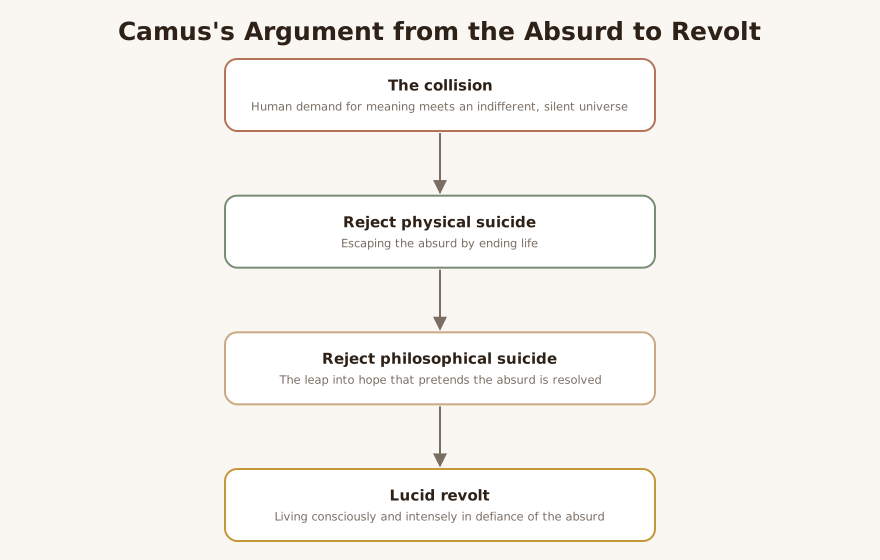
The first principle is the collision: human beings reach out for meaning, order, and permanence, and the universe returns only indifference and silence 4. The absurd is born of this confrontation between need and the world’s refusal to answer 2. Camus insists we hold both terms at once—neither denying our hunger for meaning nor pretending the universe supplies it 5.
The second principle is the rejection of two false exits. Camus argues that physical suicide is one escape from the absurd and “philosophical suicide”—the leap into religious or metaphysical hope that pretends the absurd has been resolved—is the other 6. He rejects both as evasions, because each dissolves one half of the tension that makes the absurd real 2. The honest response, he argues, is to keep the absurd alive by refusing both escapes 5.
The third principle is lucid revolt. Camus proposes that one can live in defiance of the absurd—conscious of it, refusing to flee it, and living all the more intensely because of it 1. He summarizes this with the image of Sisyphus, condemned by the gods to roll a boulder uphill forever only to watch it roll back down; Camus concludes that we must imagine Sisyphus happy, because his lucid acceptance of a meaningless task and his ownership of it constitute a victory over fate 4. Revolt, freedom, and passion are the three consequences Camus draws: revolt against the silence, freedom released by the absence of imposed meaning, and a passionate engagement with the quantity and intensity of experience 5.
Interventions & Techniques
Absurdism supplies no protocol, manual, or technique set of its own LLM. What it offers the clinician is a stance—a way of meeting a patient’s confrontation with meaninglessness without rushing to repair it with reassurance, religious appeal, or premature problem-solving LLM. The techniques below are existential and meaning-centered methods into which an absurdist sensibility can be folded; the framing is absurdist, the delivery is recognized psychotherapy LLM.
Clinicians can use validation of the confrontation: rather than treating a patient’s sense that “nothing means anything” as purely a depressive distortion to be challenged, the therapist can name it as a coherent, even courageous, recognition that deserves to be sat with before it is worked with LLM. Disentangling the two exits mirrors Camus directly—helping a patient notice when they are oscillating between despair (the impulse toward giving up) and forced positivity or magical hope (the leap that pretends the problem is solved), and inviting a third position of lucid acknowledgment LLM. Reframing toward self-authored meaning draws on the absurdist freedom claim: if the universe imposes no meaning, the patient is freed to create and own meaning rather than discover it LLM. Intensifying engagement with the present operationalizes Camus’s emphasis on quantity and quality of experience, overlapping cleanly with behavioral activation and values-based action LLM.
LLM-generated illustrative example (not a guideline): A bereaved client says, “I keep waiting for someone to tell me why she had to die, and there’s no answer that helps.” A clinician working from an absurdist stance might respond, “There may be no answer that fits the size of the loss. What if the work isn’t finding the reason, but deciding what you do with a life that won’t hand you one?”—then move into concrete values and activation work. LLM
Evidence Base
Honesty requires separating two very different claims LLM. As philosophy, absurdism is established and canonical: Camus’s formulation is taught, anthologized, and treated as a foundational twentieth-century contribution to existential thought, and his stature was formally recognized by the 1957 Nobel Prize 3. The Myth of Sisyphus remains a touchstone text in the philosophy of meaning and value 6.
As a clinical intervention, however, absurdism has no evidence base of its own LLM. There are no randomized controlled trials of “absurdist therapy,” no manualized protocol, and no outcome literature, because absurdism is not and was never intended to be a treatment LLM. Whatever clinical credibility it can claim is borrowed from the empirically studied traditions it informs—existential therapies, logotherapy and meaning-centered psychotherapies—whose evidence varies in quality and is generally weaker and less standardized than that for cognitive-behavioral approaches LLM. The defensible position for a practitioner is therefore: use absurdism as an interpretive and relational stance within an established modality, not as a standalone treatment, and do not represent it to patients or in documentation as an evidence-based therapy LLM.
Populations & Indications
Absurdist framing is most apt where the presenting distress is genuinely about meaning, mortality, and the silence of the world rather than about discrete symptoms with a clear behavioral target LLM. Adults in existential crisis—those reporting that their goals, beliefs, or life structure have collapsed and left them without orientation—are a primary fit, because the absurdist stance gives language to the collision they are living LLM. People facing terminal illness confront the mortality and meaning questions Camus addresses head-on, and the existential and meaning-centered traditions descended from this lineage were developed substantially for this population LLM.
People in midlife transition often present with a specifically absurdist texture—the recognition that achieved goals did not deliver promised meaning—where the freedom-to-create-meaning reframe can be generative LLM. Bereaved individuals wrestling with the unanswerable “why” of a death may be relieved rather than alienated by a stance that stops promising an answer and turns toward what can still be authored LLM. People with meaning-related distress more broadly—including those reporting chronic emptiness or anomie without meeting criteria for a mood disorder—may find an absurdist frame more fitting than a purely symptom-focused one LLM.
Problems-for-Work
Existential distress and meaninglessness. When a client reports that life feels pointless, absurdist framing reframes the perception itself as accurate-but-incomplete: the universe may indeed be silent, and the therapeutic question becomes what the client will build in that silence rather than whether the silence is real LLM.
Death anxiety. Camus places mortality at the center, and an absurdist stance can help a client stop seeking metaphysical guarantees and instead intensify present engagement, which often reduces the grip of anticipatory dread LLM.
Demoralization. Distinct from depression, demoralization involves loss of meaning, hope, and a sense of agency; an absurdist emphasis on lucid revolt and self-authored value targets exactly the helplessness-plus-meaninglessness that defines it LLM.
Existential depression. For clients whose low mood is organized around philosophical despair rather than purely vegetative or biological features, the absurdist refusal of both suicide and false hope offers a coherent third path, ideally integrated with standard depression treatment LLM.
Anomie. Where social or cultural anchors have dissolved, the freedom-to-create-meaning principle can reframe normlessness from a deficit into an (uncomfortable) opening for self-authored values LLM.
Contraindications, Cautions & Cultural Humility
Absurdist work is contraindicated or must be deferred where a client is in acute suicidal crisis: Camus’s text literally opens on the question of suicide, and a clinician must never let philosophical exploration substitute for risk assessment, safety planning, and stabilization LLM. With clients who are decompensating, psychotic, or in acute trauma activation, abstract confrontation with meaninglessness can deepen destabilization and should wait until the client is grounded and resourced LLM. The stance also demands timing: introducing the “universe is indifferent” frame too early, or to a client seeking comfort, can be experienced as cold, invalidating, or nihilistic rather than freeing LLM.
Cultural and spiritual humility is essential LLM. Camus explicitly rejected religious “leaps” as philosophical suicide, but a clinician must not import that judgment into the room 2. For many clients, faith and transcendent meaning are sources of genuine resilience and coherence, not evasions, and pathologizing them as “false exits” would be a serious ethical and cultural failure LLM. The right move is to use absurdism’s structure—holding the tension, refusing premature closure, authoring meaning—while leaving the client’s own metaphysical commitments intact and respected LLM. Absurdism is also a Western, individualist philosophy of self-authored meaning, which may not map onto collectivist or relational frameworks where meaning is communal rather than personally constructed LLM.
Treatment-Plan Suggestions & SMART Objectives
| Goal | SMART objective (example) | Mechanism |
|---|---|---|
| Reduce meaninglessness-driven distress | Within 8 weeks, client will identify and act on 3 self-chosen sources of meaning, logging engagement weekly | Self-authored meaning replaces searched-for external meaning LLM |
| Decrease death anxiety | Over 6 sessions, client will tolerate structured discussion of mortality with subjective distress dropping from 8/10 to 4/10 | Lucid acknowledgment reduces avoidance-driven dread LLM |
| Counter demoralization | Within 4 weeks, client will complete one value-aligned action per week despite reported pointlessness | Revolt-as-action restores agency independent of felt meaning LLM |
| Interrupt the “two false exits” pattern | By week 6, client will name in session when shifting between despair and forced hope, 3+ times | Metacognitive awareness sustains the tolerated middle position LLM |
| Increase present engagement | Over 8 weeks, client will schedule and complete 2 intensely engaging activities weekly | Quantity/quality of experience as Camusian response LLM |
| Rebuild orientation after collapse of structure (anomie) | Within 10 sessions, client will articulate a personal value statement and one weekly practice expressing it | Constructed values fill the normative vacuum LLM |
| Support meaning in terminal illness | Across treatment, client will complete a legacy/meaning exercise and report it as helpful | Meaning-centered engagement with finitude LLM |
Common Misconceptions
“Absurdism means nihilism—nothing matters, so give up.” This is the most damaging misreading LLM. Camus explicitly rejects suicide and despair; his conclusion is that we must imagine Sisyphus happy, that lucid revolt produces more life rather than less 5. Absurdism affirms living intensely, not surrendering 1.
“The absurd is just pessimism about the world.” Camus locates the absurd in the relation between human need and the world’s silence, not in the world being bad; it is structural, not merely a gloomy mood 2.
“Camus was an existentialist who agreed with Sartre.” Camus distanced himself from the existentialist label and from Sartre, and the two famously broke; treating them as interchangeable misrepresents him 3.
“Absurdism is a therapy.” It is a philosophy; any therapeutic use is an adaptation delivered through existential or meaning-centered psychotherapy, not a validated standalone treatment LLM.
Training & Certification
There is no certification in absurdism, because it is a philosophy rather than a clinical credential LLM. Clinicians who wish to work competently with the concerns absurdism raises should pursue training in the empirically grounded modalities that carry these themes—existential psychotherapy and meaning-centered psychotherapy—through recognized supervision, coursework, and reading of the primary clinical literature LLM. Direct engagement with Camus’s primary texts, especially The Myth of Sisyphus, gives the clinician a more accurate stance than secondhand summaries and guards against the nihilism misreading 6. Ongoing supervision is important because absurdist framing intersects directly with suicide risk, spirituality, and existential vulnerability, where missteps carry real clinical consequence LLM.
Key Terms
The absurd — the confrontation between the human demand for meaning and the universe’s silent indifference; located in the relation between the two, not in either alone 2.
Lucid revolt — Camus’s prescribed response: living consciously and intensely in defiance of the absurd, refusing both suicide and false hope 1.
Philosophical suicide — Camus’s term for escaping the absurd through a leap into religious or metaphysical meaning, which he regards as an evasion 6.
Sisyphus — the mythological figure condemned to roll a boulder uphill eternally, whom Camus uses as the emblem of meaningful struggle without external reward 4.
Revolt, freedom, passion — the three consequences Camus draws from accepting the absurd: defiance of the silence, liberty in the absence of imposed meaning, and intensity of lived experience 5.
Resources & Further Reading
▶ Watch — a video introduction to this concept:
- Albert Camus (Stanford Encyclopedia of Philosophy)
- Albert Camus (Internet Encyclopedia of Philosophy)
- Albert Camus — Existentialism, Absurdism, Nobel Prize (Britannica, Legacy)
- Camus on the Absurd: The Myth of Sisyphus (1000-Word Philosophy)
- The Myth of Sisyphus: Full Work Summary (SparkNotes)
- The Myth of Sisyphus (Britannica)
- Absurdism (Wikipedia)
Reflective / Supervision Questions
- When a client tells me life is meaningless, do I rush to repair that perception, and what is driving the urgency in me rather than in them? LLM
- Can I hold the absurdist tension—neither offering false reassurance nor sliding into nihilism—without needing to resolve it for the client? LLM
- How do I distinguish a client’s lucid confrontation with meaninglessness from a depressive cognition that requires symptom-focused intervention, and how would I treat both at once? LLM
- Am I respecting a client’s faith and transcendent sources of meaning rather than implicitly importing Camus’s judgment of them as evasion? LLM
- Have I conducted adequate suicide risk assessment before opening existential material, given that the founding text begins with the question of suicide? 6
- Does this philosophy fit my client’s cultural and relational framework, or am I imposing a Western, individualist model of self-authored meaning? LLM