
Type & Discipline
Worden’s Tasks of Mourning is a framework within thanatology and the broader developmental psychology of grief and bereavement 3. It is not a manualized, stand-alone treatment so much as an organizing model — a clinician’s “guideline” — for understanding what the work of mourning actually consists of and where it can stall 1. Worden developed it explicitly as a guide for the mental health practitioner, distinguishing the ordinary, expectable process of grief from the more intensive work required when mourning becomes complicated 1.
The framework’s signature move is conceptual. Where the popular stage models of the late twentieth century framed grief as a sequence of feelings the bereaved person passively passes through, Worden reframed mourning as a set of active tasks the survivor must accomplish 4. Because tasks imply agency and effort, the model gives both client and clinician something to do rather than merely something to wait out 4. In practice, clinicians most often apply the tasks as a formulation and treatment-planning lens within recognized grief-counseling and psychotherapeutic modalities rather than as a free-standing protocol LLM.
Creators & Lineage
The framework was developed by J. William Worden, a clinical psychologist whose handbook Grief Counseling and Grief Therapy: A Handbook for the Mental Health Practitioner became one of the most widely used texts in the field and is now in its fifth edition 3. Worden articulated the tasks-of-mourning approach as a practitioner-facing guideline, pairing the tasks themselves with a set of mediators that explain why two people facing apparently similar losses can grieve so differently 1.
Lineage matters for understanding the model’s framing. Worden built on, and deliberately departed from, the dominant grief paradigms that preceded him 4. Freud’s “grief work” tradition and the influential stage models — most famously the five stages associated with Kübler-Ross — had cast grief as something that happened to the bereaved, a more or less predictable emotional trajectory 4. Worden’s reframing of grief as active work was a direct response to the passivity and rigidity that clinicians encountered when they tried to apply stage thinking to real, non-linear mourning 4.
The model also sits in close dialogue with the frameworks that followed it. It is frequently taught alongside the dual process model of bereavement, which describes oscillation between confronting the loss and attending to the demands of ongoing life, and alongside continuing bonds, which reframes the survivor’s enduring relationship with the deceased LLM. Worden’s own revision of his fourth task — away from “withdrawing emotional energy” and toward relocating the deceased and finding an enduring connection — brought his framework into explicit alignment with continuing-bonds thinking 5. The model has also been read productively through a social work lens, which foregrounds the environmental, relational, and structural mediators that shape how mourning unfolds 2.
Core Principles
The framework rests on a small number of organizing ideas LLM.
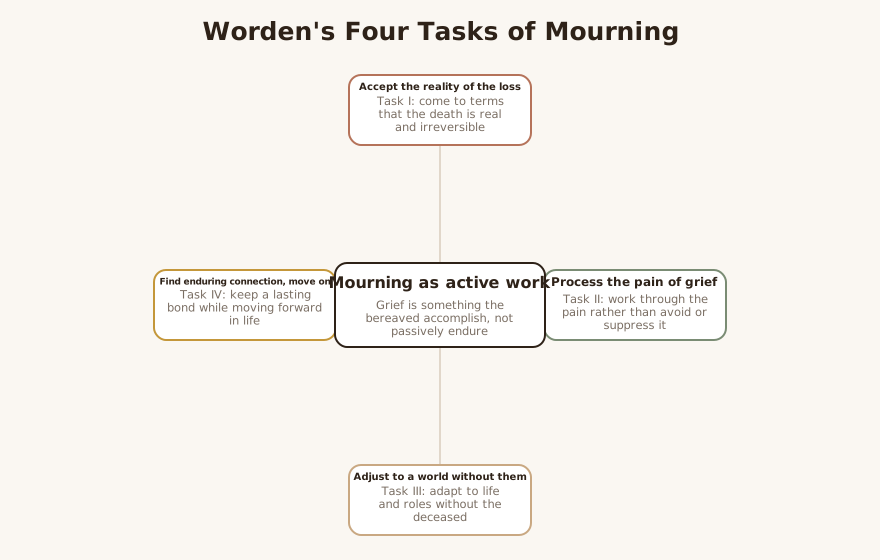
First, mourning is active work, not passive passage 4. The bereaved person is not simply enduring a timetable of feelings but accomplishing something — and the clinician’s job is to support that accomplishment 4.
Second, the work is organized into four tasks, which Worden numbered for convenience but did not intend as a strict sequence 5. The tasks can be revisited, worked in overlapping fashion, and returned to as anniversaries and life events reopen them 5.
- Task I — To accept the reality of the loss. The survivor must come to terms, intellectually and emotionally, with the fact that the person is dead and that reunion in this life is not possible; the opposite of this task is some form of denial — of the death itself, of its meaning, or of its irreversibility 5.
- Task II — To process the pain of grief. The bereaved must work through the physical, emotional, and behavioral pain of the loss rather than avoid, suppress, or short-circuit it; not everyone experiences pain identically, but it cannot simply be bypassed without consequence 4.
- Task III — To adjust to a world without the deceased. Worden specifies external adjustments (the practical roles and tasks the deceased used to fill), internal adjustments (the survivor’s sense of self and identity), and spiritual adjustments (assumptions about the world, meaning, and one’s place in it) 5.
- Task IV — To find an enduring connection with the deceased while embarking on a new life. In Worden’s revised formulation, the goal is not to sever the bond and “let go” but to find a place for the deceased in one’s emotional life that still allows continued living and loving 5.
Third, the framework pairs the tasks with mediators of mourning — the variables that determine how, and how well, a given person accomplishes the tasks 1. These include who the person was, the nature of the attachment, how the death occurred, the survivor’s history and personality, and the social and concurrent stressors surrounding the loss 1. The mediators are what make the model individualizing rather than one-size-fits-all 1.
Interventions & Techniques
Because the framework is a guideline rather than a fixed protocol, its techniques are woven into grief counseling and broader psychotherapy and are typically organized task by task LLM. Worden’s handbook frames a set of counseling principles and procedures designed to help the bereaved accomplish each task in turn 3.
Common task-aligned interventions include:
- For accepting reality (Task I): helping the survivor talk about the loss concretely — where, when, and how the death occurred — and gently using the language of death rather than euphemism; visiting the grave or site can support reality acceptance 5.
- For processing pain (Task II): creating a safe space to identify and express the full range of grief affect, including the less socially sanctioned feelings such as anger, relief, and guilt, and normalizing that pain is part of the work rather than a sign something is wrong 4.
- For adjusting to a changed world (Task III): practical problem-solving for the external roles the deceased filled, identity work for the internal shifts, and meaning-oriented exploration for the spiritual and assumptive disruptions 5.
- For enduring connection (Task IV): supporting the survivor to find a sustainable, comforting place for the deceased — through memory, ritual, letters, or carrying forward values — while encouraging re-engagement with life and new relationships 5.
Across tasks, clinicians assess the mediators to individualize the work: the strength and security of the attachment, the mode of death, the survivor’s coping style and history, and the surrounding social support and stressors 1. Worden also distinguishes ordinary grief counseling — facilitating the tasks in uncomplicated mourning — from grief therapy, the more specialized work required when mourning is absent, delayed, chronic, or otherwise complicated 3.
LLM-generated illustrative example (not a guideline): A man whose wife died six months ago still keeps her phone active and “texts” it daily, and becomes distressed whenever others speak of her in the past tense. Rather than labeling this pathological, the clinician formulates it against Task I — the reality of the death is not yet fully accepted — and against the mediators (a long, secure attachment; a sudden death). Work begins with reality-acceptance interventions before moving toward processing the pain of Task II. LLM
Evidence Base
The maturity of this framework should be characterized honestly. Worden’s Tasks of Mourning is an established, widely adopted, and clinically dominant framework — but its status rests more on decades of clinical utility, practitioner consensus, and a foundational handbook than on a large body of controlled trials of the model itself 3. Worden presented the tasks-and-mediators approach as a practitioner guideline, and its value has been primarily as an organizing and formulating tool rather than as an experimentally validated mechanism 1.
Several points support the “established” label. The handbook has reached a fifth edition and is among the most widely used texts in grief counseling and grief therapy, indicating sustained acceptance across the field 3. The framework has been examined and extended through additional professional lenses, including a social work analysis that situates the tasks within environmental and relational context — a sign of continued scholarly engagement rather than abandonment 2. And the model has been actively revised in response to the field’s evolution, most notably the reformulation of the fourth task to incorporate enduring connection rather than emotional withdrawal 5.
The honest caveats are equally important for clinicians LLM. The numbered tasks invite a misreading as a fixed sequence, which Worden did not intend and which the framework’s own non-linear logic contradicts 5. The model is descriptive and heuristic; it tells clinicians what work needs doing and what might impede it, but it does not by itself specify a tested, manualized dose-response treatment 1. Where empirical rigor and controlled outcomes are the priority — for example in complicated grief or prolonged grief disorder — clinicians typically pair the task formulation with more specifically evidenced protocols LLM.
Populations & Indications
The framework is broadly applicable across bereaved populations: bereaved adults, widows and widowers, bereaved parents, and bereaved children and adolescents LLM. Worden’s body of work extends explicitly to childhood bereavement, and the tasks framework adapts to developmental level, recognizing that a child’s accomplishment of each task unfolds alongside ongoing development 3. It also extends to anticipatory contexts — people in palliative and hospice care and the caregivers of the dying — where reality acceptance and adjustment begin before the death itself LLM.
Indications include the full range of normative grief, bereavement, mourning, and the loss of a loved one across the lifespan LLM. The framework is equally a tool for more severe presentations — complicated grief, prolonged grief disorder, traumatic loss, depression following bereavement, and adjustment difficulties after loss — where Worden’s distinction between grief counseling and grief therapy, and his attention to which task is stalled, becomes clinically decisive 3. The mediators of mourning provide the structured means of identifying who is at higher risk for complicated outcomes and why 1.
Problems-for-Work
- Grief and bereavement: using the four tasks as a shared map so the client knows what the work involves, and the clinician can locate where it is and is not progressing 4.
- Avoidance of grief / stalled mourning: identifying which task is being avoided — most often the reality of Task I or the pain of Task II — and intervening at that point rather than generically 5.
- Complicated grief / prolonged grief disorder: distinguishing ordinary grief counseling from the more intensive grief therapy that absent, delayed, or chronic mourning requires, and assessing the mediators that drove the complication 3.
- Adjustment difficulties after loss: working Task III’s external, internal, and spiritual adjustments to support re-engagement with a changed world 5.
- Loss of an enduring relationship: supporting Task IV — finding a sustainable, comforting connection with the deceased that still allows new living and loving 5.
LLM-generated illustrative example (not a guideline): A widow two years out is functioning well at work but says she “can’t feel anything” about her husband and avoids any reminder of him. The clinician formulates this as delayed or inhibited grief — Task II has been bypassed — and, attending to the mediators (an ambivalent attachment, a caregiving-exhausted survivor), begins carefully facilitating access to the avoided pain rather than pushing toward “moving on.” LLM
Contraindications, Cautions & Cultural Humility
The framework is a formulation tool, not a script, and its main hazards are misapplications LLM. The most common is treating the four numbered tasks as a mandatory, linear sequence and judging clients who do not “progress” in order — a reading Worden’s own non-linear, revisitable model contradicts 5. A second hazard is using the tasks to pace or push grief — for instance, pressing a client to “process the pain” before reality acceptance is in place, or urging premature “moving on” under the banner of Task IV LLM.
Clinicians should be cautious where grief is entangled with trauma, severe depression, or active suicidality; in those situations the standard clinical priorities — stabilization, risk assessment, and trauma-informed sequencing — take precedence over task-focused grief work LLM. Worden’s distinction between grief counseling and grief therapy is itself a caution: not all mourning needs formal intervention, and over-treating normative grief is its own risk 3.
Cultural humility is essential. What counts as “accepting the reality” of a death, what mourning rituals are expected, and what an “enduring connection” should look like are all culturally and spiritually patterned, and a task that looks unaccomplished through one cultural lens may be fully and appropriately completed through another LLM. Reading the framework through a social work lens makes this explicit, foregrounding the environmental, relational, and structural mediators — support, resources, concurrent stressors — that shape whether and how a person can do the work of mourning 2. Clinicians should therefore apply the tasks within the client’s own meaning, faith, and cultural framework rather than imposing a normative timetable LLM.
Treatment-Plan Suggestions & SMART Objectives
| Goal | SMART objective (example) | Mechanism |
|---|---|---|
| Accept the reality of the loss (Task I) | Within 4 sessions, client will narrate the circumstances of the death in concrete, non-euphemistic language and identify 2 reality-anchoring practices (e.g., visiting the grave), rated for distress 0-10 | Supports Task I; reduces denial and disbelief 5 |
| Process the pain of grief (Task II) | Over 6 weeks, client will identify and express at least 3 distinct grief emotions (including a less-sanctioned one such as anger, relief, or guilt) in session without immediate suppression | Facilitates working through Task II rather than avoidance 4 |
| Adjust externally to a changed world (Task III) | Within 8 sessions, client will assume or delegate 2 practical roles previously held by the deceased and report increased daily functioning | Operationalizes external adjustment of Task III 5 |
| Rebuild identity and assumptive world (Task III) | Over 6 sessions, client will articulate 2 ways their sense of self and worldview have shifted and name 1 reconstructed source of meaning | Addresses internal and spiritual adjustment of Task III 5 |
| Find an enduring connection (Task IV) | Within 2 months, client will establish 1 sustainable commemorative practice while initiating or resuming 1 valued relationship or activity | Supports Task IV: connection alongside re-engagement 5 |
| Identify which task is stalled | By session 3, clinician and client will jointly map current grief against the 4 tasks and the relevant mediators, documenting the primary point of impasse | Targets intervention to the stalled task; individualizes via mediators 1 |
| Differentiate counseling from grief therapy | By session 2, clinician will screen for absent, delayed, or chronic mourning and route to grief therapy procedures if complicated grief is indicated | Matches intensity of intervention to presentation 3 |
| Reduce avoidance in complicated grief | Within 10 sessions, client will reduce avoidance behaviors tied to the death (tracked weekly) and complete graded exposure to 2 avoided reminders | Unblocks Task I/II in complicated mourning 3 |
Common Misconceptions
- “The four tasks are a fixed sequence you complete in order.” Worden numbered the tasks for convenience, not as a strict, one-way staircase; they overlap, recur, and reopen with anniversaries and life events 5.
- “Tasks of mourning is just a relabeled version of the five stages.” It is a deliberate departure from stage thinking — recasting grief as active work the survivor does rather than feelings the survivor passively passes through 4.
- “The goal of grief is to let go and detach from the deceased.” Worden revised his fourth task precisely to reject this; the aim is an enduring connection that coexists with continued living, not severance 5.
- “Everyone has to feel intense pain in the same way to grieve properly.” Pain must be worked through rather than bypassed, but its form and intensity vary, shaped by the mediators of mourning 4.
- “The model is an evidence-based, manualized treatment.” It is an established and influential framework and practitioner guideline; its outcome evidence is more clinical-consensus and handbook-based than controlled-trial-based 1.
- “All grief needs grief therapy.” Worden distinguishes ordinary grief counseling, which facilitates normative mourning, from grief therapy reserved for complicated presentations 3.
Training & Certification
There is no certification in “Tasks of Mourning” itself, consistent with its status as a framework rather than a licensable modality LLM. Clinicians typically encounter it within graduate coursework in counseling, social work, and clinical psychology, within thanatology and grief-counseling continuing education, and through Worden’s foundational handbook, now in its fifth edition, which serves as the primary practitioner text 3. Worden’s own journal guideline for mental health practitioners remains a concise primary-source orientation to the tasks-and-mediators structure 1. Accessible introductions are available through clinical and grief-education resources, and practitioner-facing talks summarize the four tasks for working clinicians 456.
Key Terms
- Task of mourning: an active piece of work the bereaved must accomplish, in contrast to a stage to be passively passed through 4.
- Mediators of mourning: the variables (who the person was, the attachment, the mode of death, the survivor’s history and personality, social support, concurrent stressors) that shape how the tasks are accomplished 1.
- Reality acceptance (Task I): coming to terms intellectually and emotionally with the fact and irreversibility of the death 5.
- External / internal / spiritual adjustment (Task III): adapting to the deceased’s practical roles, to a changed sense of self, and to a disrupted assumptive world 5.
- Enduring connection (Task IV): finding a sustainable place for the deceased in one’s emotional life that still permits continued living and loving 5.
- Grief counseling vs. grief therapy: facilitating normative mourning versus the more specialized work required for complicated, absent, delayed, or chronic grief 3.
Resources & Further Reading
▶ Watch — a video introduction to this concept:
- Tasks and mediators of mourning: A guideline for the mental health practitioner (Worden, 1996) — In Session
- Worden’s tasks of mourning through a social work lens — Journal of Social Work Practice
- Grief Counseling and Grief Therapy: A Handbook for the Mental Health Practitioner (Fifth Edition) — Springer Publishing
- The 4 Tasks of Grieving — Psychology Today
- Worden’s Four Tasks of Mourning — What’s Your Grief
- William Worden: The Four Tasks of Mourning (YouTube)
Reflective / Supervision Questions
- For a given client, which of the four tasks is currently the point of impasse, and does my intervention actually target that task rather than a generic “grief support”? 5
- Am I holding the tasks as a flexible, revisitable map, or am I implicitly treating them as a sequence the client is “behind” on? 5
- Which mediators of mourning — attachment, mode of death, history, social support, concurrent stressors — are shaping this person’s grief, and have I assessed them explicitly? 1
- Where might my own cultural, spiritual, or training assumptions about “acceptance,” “moving on,” or “letting go” be coloring what I judge as accomplished or stalled? 2
- Is this presentation one for ordinary grief counseling, or does it meet the threshold for grief therapy — and am I matching the intensity of my approach accordingly? 3
- Within which established modality am I actually delivering this work, and does my formulation and documentation reflect the tasks framework as a lens within it? LLM