
Type & Discipline
The Dual Process Model (DPM) is a conceptual framework for understanding how people cope with bereavement, situated within developmental and health psychology and the broader field of grief and bereavement studies 3. It is not a manualized therapy or a sequence of stages to be completed; it is a descriptive model of the cognitive and behavioral processes that characterize adaptive coping after a death 1. Its central proposition is that healthy grieving involves a back-and-forth movement — an oscillation — between two distinct kinds of coping rather than a linear progression toward “recovery” 6.
Because DPM is a framework rather than a stand-alone treatment, clinicians apply it as an organizing lens within recognized bereavement and psychotherapeutic modalities, using it to formulate where a given client is over- or under-engaging and to time interventions accordingly LLM. Understood this way, DPM is less a thing you “do” than a map of what adaptive coping looks like, against which a clinician can locate a client’s current pattern LLM.
Creators & Lineage
The model was developed by Margaret Stroebe and Henk Schut, researchers at Utrecht University, and laid out in their foundational 1999 paper in Death Studies 1. They revisited and refined it in an influential 2010 review, “A Decade On,” which addressed accumulated criticisms and clarified the construct 2.
DPM emerged as a deliberate corrective to two earlier traditions. The first was the “grief work” hypothesis, descended from Freud, which held that the bereaved must actively and continuously confront and process the loss in order to recover, and that avoidance was inherently pathological 4. The second was the family of stage and phase models, most popularly associated with Kübler-Ross, which implied that grief moves through a fixed, universal sequence toward resolution 4. Stroebe and Schut argued that both over-emphasized confronting the loss and neglected the equally necessary work of rebuilding a life — and that taking breaks from grief was not denial but adaptive regulation 6.
The model sits in active dialogue with adjacent grief frameworks. It is frequently paired with Continuing Bonds (Klass, Silverman, and Nickman), which describes the evolving symbolic relationship with the deceased; with Worden’s Tasks of Mourning, which similarly emphasizes active coping work; and with meaning reconstruction approaches (Neimeyer), which frame grief as the rebuilding of a coherent narrative LLM. It is most often positioned as a successor to, and corrective for, the stage models 4.
Core Principles
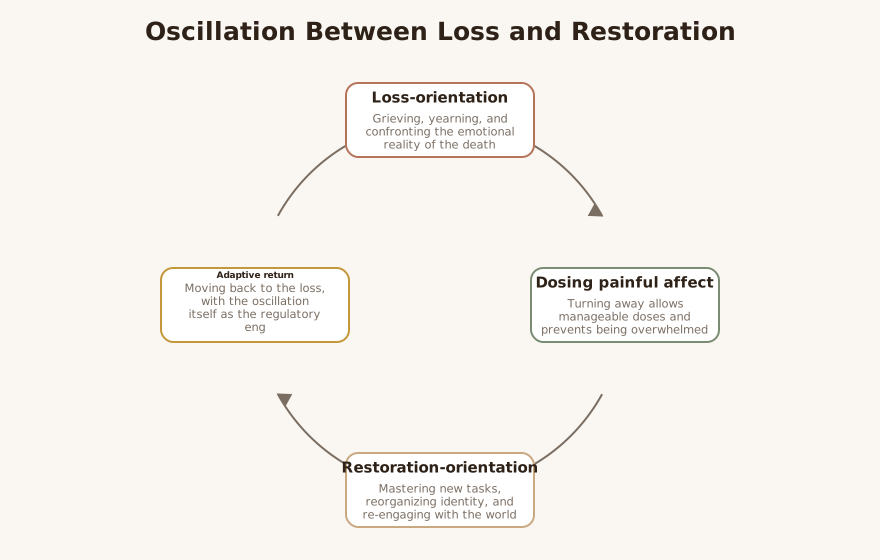
Two orientations. DPM proposes that bereaved people face two broad categories of stressor, each requiring its own coping. Loss-orientation concerns the loss itself: grieving, yearning, ruminating about the deceased, looking at photographs, crying, and confronting the emotional reality of the death 4. Restoration-orientation concerns the secondary, practical consequences of bereavement: mastering new tasks the deceased used to handle, reorganizing routines and identity, forming new relationships, and re-engaging with the world 4.
Oscillation is the mechanism. The model’s signature claim is that adaptive coping requires a dynamic alternation between these two orientations — and that the oscillation itself, not the completion of either, is the regulatory engine of healthy grief 6. The bereaved person confronts the loss for a time, then turns away from it to attend to life, then returns; this movement allows “dosing” of painful affect and prevents being overwhelmed by either relentless grief or relentless avoidance 5. Crucially, taking time away from grief is not denial but a necessary and healthy part of coping 6.
Avoidance is sometimes adaptive. Following directly from oscillation, DPM holds that there are times when confronting grief is appropriate and times when avoiding it — turning toward restoration — is appropriate 4. This directly contradicts the older grief-work assumption that any avoidance is pathological 4.
Everyday life experience. Stroebe and Schut later emphasized a third component layered onto the two orientations: the ongoing, ordinary experience of daily life, within which oscillation occurs and which itself includes a normal balance of confrontation and respite 2. There is no single “correct” ratio of the two orientations; the adaptive balance is individual and shifts over time 5.
Interventions & Techniques
Because DPM is a lens rather than a protocol, its “techniques” consist largely of using the model to assess balance and then deliberately supporting whichever orientation is being neglected, within a host modality LLM. Common applications include:
- Formulating the imbalance. The clinician maps where the client is stuck — chronically immersed in loss-orientation (e.g., relentless rumination, inability to function) or rigidly locked into restoration-orientation (e.g., frenetic busyness that forecloses grief) LLM.
- Permission-giving and psychoeducation. Normalizing that breaks from grief are healthy, and that attending to practical life is not betrayal, can relieve guilt in clients who believe “good” mourners must grieve constantly 6.
- Supporting loss-orientation when it is being avoided: grief-focused work such as reviewing memories, expressing yearning, and confronting the reality of the death LLM.
- Supporting restoration-orientation when it is being avoided: behavioral activation, graded mastery of new practical roles, identity-rebuilding, and re-engagement with relationships and activities LLM.
- Pacing and “dosing.” Helping the client titrate exposure to painful material so that oscillation, rather than overwhelm or rigid shutdown, becomes possible 5.
LLM-generated illustrative example (not a guideline): A widow six months out reports she cannot make herself look at her late husband’s belongings and instead fills every hour with work and errands. Rather than pushing her straight into grief, the clinician frames her busyness as one valid pole of coping that has become rigid, and collaboratively builds small, time-limited “loss-oriented” windows — fifteen minutes with a photo album — so that oscillation, not constant confrontation, is the goal. LLM
Evidence Base
The maturity of the evidence should be stated honestly. DPM is an established, highly influential framework with strong face validity and broad clinical uptake, but direct empirical testing of its central mechanism — oscillation — and of interventions explicitly derived from it remains comparatively limited 25. It is, in the words of accessible summaries, “one of the most well-respected and accepted theories of grief,” and it has reshaped how clinicians and the public understand mourning 4.
The construct’s appeal is largely that it matches clinical observation and lived experience: most bereaved people recognize the felt movement between confronting and setting aside their grief 5. In their 2010 review, Stroebe and Schut acknowledged that the model had been more widely cited and applied than rigorously tested, and they used the decade-on paper to sharpen definitions, respond to criticism, and call for stronger operationalization and measurement of oscillation 2. A practical obstacle has been that oscillation is intrinsically difficult to measure — it is a dynamic, moment-to-moment process rather than a static trait, and capturing it requires fine-grained, repeated assessment rather than a single questionnaire LLM.
For clinicians, the honest summary is this: DPM is an excellent organizing and psychoeducational framework with high clinical utility and intuitive validity, and it should be presented to clients and trainees as such — not as a treatment whose superiority over alternatives has been demonstrated in controlled outcome trials LLM.
Populations & Indications
DPM-informed work applies broadly across bereaved populations: bereaved adults, widows and widowers, bereaved parents, and bereaved children and adolescents LLM. It is frequently invoked in widowhood specifically, where the practical “restoration” demands — managing finances, household roles, and a reorganized identity once held jointly — are often as salient as the emotional loss 5. It also extends to those grieving sudden or traumatic loss, and to caregivers and family members in palliative contexts where anticipatory grief and practical reorganization already coexist LLM.
Indications include normative grief and bereavement, mourning, the loss of a loved one across the lifespan, and adjustment difficulties following loss LLM. The framework is also a useful formulation tool in more severe presentations — prolonged grief disorder and complicated grief — where a clinician may observe that oscillation has collapsed, with the client trapped at one pole (typically chronic, unremitting loss-orientation, but sometimes rigid restoration-oriented avoidance) LLM.
Problems-for-Work
- Grief and bereavement (normative): validating oscillation, relieving guilt about “taking breaks,” and helping the client recognize both orientations as legitimate coping 6.
- Avoidance of grief: when a client floods life with activity to avoid the loss, gently building tolerated loss-oriented windows so that grieving becomes accessible without overwhelm LLM.
- Avoidance of restoration tasks: when a client is so immersed in grief that practical life has collapsed, supporting graded re-engagement with concrete roles and activities LLM.
- Prolonged grief disorder / complicated grief: formulating the presentation as a breakdown of oscillation — stuckness at one pole — and targeting whichever orientation is foreclosed LLM.
- Rumination and grief-related preoccupation: distinguishing productive loss-oriented processing from unproductive rumination, and supporting the restorative pole to interrupt the loop LLM.
- Adjustment disorder following loss: using restoration-oriented behavioral work to rebuild identity and routine while honoring continued grief LLM.
LLM-generated illustrative example (not a guideline): A father whose adult child died by suicide describes spending most of each day searching online for “why,” unable to return to work or see friends. The clinician formulates this as oscillation collapsed into the loss pole, and — alongside trauma-informed grief work — collaboratively reintroduces small restoration-oriented steps (one work task, one social contact per week), framing them not as “moving on” but as the other half of healthy coping. LLM
Contraindications, Cautions & Cultural Humility
DPM is a descriptive framework, not a prescription, and several cautions follow. First, the model explicitly resists any fixed “correct” balance: clinicians should not impose a target ratio of loss to restoration, since the adaptive balance is individual and changes over time 5. Pushing a grieving person toward restoration prematurely — or, conversely, insisting they “do their grief work” when they are managing through respite — both misuse the model LLM.
Second, the framework should not be used to pathologize avoidance reflexively or to dismiss it reflexively; the clinical task is to assess whether a given pattern is a flexible part of oscillation or a rigid foreclosure of it 2. Where trauma, severe depression, or active suicidality are present, those clinical priorities take precedence, and loss-oriented confrontation in particular may need careful stabilization first LLM.
Cultural humility is essential. Mourning customs, the social acceptability of expressing grief, and the practical division of “restoration” labor are heavily culturally and gendered patterned, and a clinician’s assumptions about what a “balanced” griever looks like may reflect their own cultural frame rather than the client’s LLM. DPM’s two orientations should be filled in by the client’s own meaning, faith, kinship, and community context, not by a normative Western template LLM.
Treatment-Plan Suggestions & SMART Objectives
| Goal | SMART objective (example) | Mechanism |
|---|---|---|
| Psychoeducation on oscillation | Within 2 sessions, client will describe the two orientations in their own words and identify which they currently over-use, rated for understanding on a 0-10 scale | Normalizes both poles; reduces guilt about “taking breaks” from grief 6 |
| Restore access to loss-orientation | Over 4 weeks, client who is avoiding grief will engage in a time-limited loss-oriented activity (memory review, letter, photos) ≥2x/week without escalation to overwhelm | Re-establishes tolerated confrontation as one half of oscillation 4 |
| Restore access to restoration-orientation | Within 6 sessions, client immersed in grief will resume or initiate 2 practical/role tasks (e.g., a household responsibility, a return-to-work step) | Re-engages the restoration pole; rebuilds identity and routine 4 |
| Rebuild flexible oscillation | Over 8 weeks, client will report alternating between grieving and life-engagement across a typical week rather than being stuck at one pole, tracked in a brief log | Targets oscillation itself as the regulatory mechanism 6 |
| Reduce guilt about respite from grief | By session 4, client will reframe ≥2 instances of “not grieving” as adaptive coping rather than betrayal, self-rated | Corrects the grief-work assumption that avoidance is always pathological 4 |
| Titrate (“dose”) painful affect | Over 6 sessions, client will use a paced exposure plan to limit loss-oriented work to tolerable windows, reporting reduced overwhelm | Enables oscillation rather than flooding or shutdown 5 |
| Re-engage relationships and roles | Within 2 months, client will initiate 1 new or renewed social/role connection while maintaining chosen grief practices | Operationalizes the restoration orientation and everyday-life experience 2 |
Common Misconceptions
- “DPM is a set of stages to complete.” It is the opposite of a stage model; it describes a non-linear oscillation with no fixed endpoint or required sequence 4.
- “Avoiding grief is always unhealthy.” DPM holds that there are appropriate times to turn away from the loss toward restoration; respite is adaptive, not denial 6.
- “There is a correct balance of the two orientations.” The adaptive ratio is individual and shifts over time; the model prescribes no universal target 5.
- “Restoration-orientation means ‘getting over it’ or replacing the relationship.” It refers to coping with the secondary, practical and identity changes that bereavement imposes, and coexists with ongoing grief 4.
- “DPM is an empirically proven treatment.” It is an established and influential framework with strong face validity but limited direct outcome evidence; oscillation in particular is hard to measure 25.
Training & Certification
There is no certification in the Dual Process Model itself, consistent with its status as a framework rather than a modality LLM. Clinicians typically encounter it within graduate bereavement coursework, thanatology training, and grief-counseling continuing education, and they deliver DPM-informed work through credentials in host modalities such as cognitive behavioral therapy, behavioral activation, and complicated/prolonged grief treatments LLM. The foundational primary sources are the 1999 Death Studies paper and the 2010 “A Decade On” review by Stroebe and Schut 12, and accessible clinician- and public-facing orientations are available through grief-education organizations and resources 46.
Key Terms
- Loss-orientation: coping directed at the loss itself — grieving, yearning, rumination, and confronting the emotional reality of the death 4.
- Restoration-orientation: coping directed at the secondary consequences of bereavement — new tasks, roles, identity, routines, and relationships 4.
- Oscillation: the dynamic alternation between loss- and restoration-orientation, which DPM identifies as the regulatory mechanism of adaptive grief 6.
- Dosing: the regulation of painful affect by titrating confrontation with the loss, made possible by oscillation 5.
- Grief work (hypothesis): the older assumption that recovery requires continuous confrontation of the loss and that avoidance is pathological — which DPM corrects 4.
- Everyday life experience: the ordinary daily context, refined in the 2010 model, within which oscillation occurs 2.
Resources & Further Reading
▶ Watch — a video introduction to this concept:
- Stroebe, M., & Schut, H. (1999). The Dual Process Model of Coping with Bereavement: Rationale and Description. Death Studies.
- Stroebe, M., & Schut, H. (2010). The Dual Process Model of Coping with Bereavement: A Decade On. OMEGA.
- Dual process model of coping — Wikipedia
- Grief Theory 101: The Dual Process Model of Grief — What’s Your Grief
- The Dual-Process Model of Grief — Psychology Today
- Dual Process Model of Grief (Stroebe & Schut) — The Loss Foundation
Reflective / Supervision Questions
- When a client takes “breaks” from grief, do I read this as adaptive oscillation or as avoidance — and on what evidence do I base that read? 6
- For a stuck client, can I identify which orientation has become rigid and foreclosed, and does my intervention deliberately support the neglected pole? 2
- Where might my own assumptions about what a “balanced” griever looks like reflect my cultural, gendered, or training frame rather than the client’s? LLM
- Am I presenting DPM honestly to clients and trainees as a clinically useful framework rather than as an empirically proven treatment? 5
- Within which host modality am I actually delivering this work, and does my formulation make the loss/restoration imbalance explicit and actionable? LLM