
Type & Discipline
Twelve-Step Spirituality is not a discrete, manualized therapy but a recovery philosophy — the experiential and ethical framework that animates Alcoholics Anonymous (AA), Narcotics Anonymous (NA), and the broader family of twelve-step mutual-aid fellowships. LLM It belongs to the discipline of addiction recovery and to the twelve-step / mutual-aid family, and it is most usefully understood as the set of proposed change mechanisms — surrender to a self-defined Higher Power, rigorous moral inventory, making amends, and service to others — through which participation in those fellowships is thought to produce and sustain abstinence. LLM A central and clinically important nuance is that the spirituality of the Twelve Steps is deliberately non-doctrinal: the program asks the member to define a “Higher Power” for themselves, which is why researchers have framed the foundational question as whether AA is religious, spiritual, or neither 1.
For the practicing therapist, the relevant distinction is that the fellowships and their professional facilitation are established interventions with a substantial evidence base, whereas “spirituality” is one candidate mechanism within them — empirically real but partial, and not the whole of why mutual aid works 12. LLM This article treats the philosophy on its own terms, then situates it honestly within the mechanisms-of-behavior-change literature.
Creators & Lineage
The framework originates with Bill Wilson (Bill W.) and the co-founders of Alcoholics Anonymous in the 1930s, who distilled a sequence of spiritual practices — admitting powerlessness, turning one’s will over to a Higher Power, moral inventory, confession, amends, and carrying the message to others — into the Twelve Steps 3. LLM The conceptual ancestry runs through several streams: the early-twentieth-century Oxford Group’s emphasis on surrender, confession, and restitution; William James’s Varieties of Religious Experience and its account of transformative “spiritual awakenings”; and a pragmatic American tradition of religious experience untethered from any single creed. LLM
Within the clinical world, this philosophy was operationalized for delivery through 12-Step Facilitation (12-Step Facilitation), the manualized therapy that links clients to fellowships, and it sits alongside the Minnesota Model of addiction treatment, which embedded twelve-step principles into formal care 1. LLM More recently, a research lineage led by investigators such as John F. Kelly has subjected twelve-step spirituality to rigorous mechanisms-of-behavior-change analysis, asking not whether AA works but how, and specifically whether spiritual change carries its effect 12. The framework also shares conceptual territory with existential therapy (meaning, finitude, surrender of omnipotent control) and with spiritually integrated psychotherapy, which formalizes attention to the sacred within secular treatment 3. LLM
Core Principles
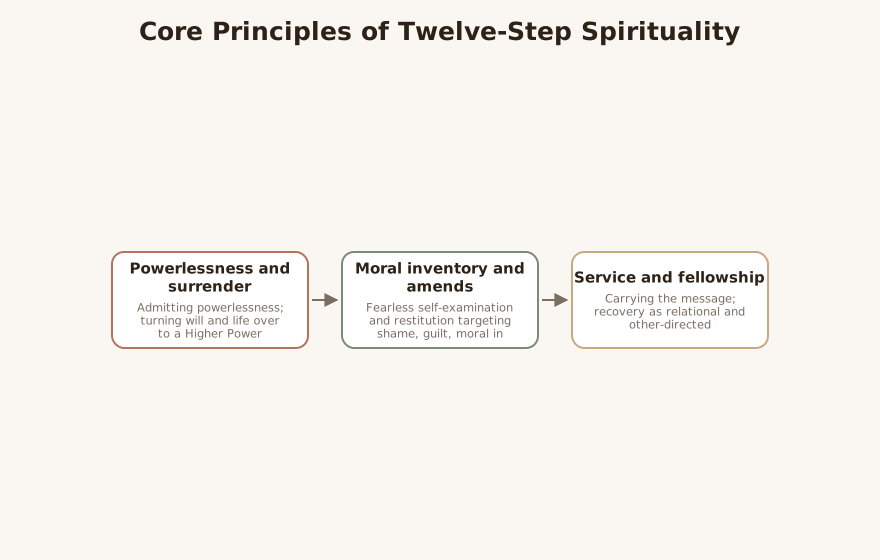
Several interlocking principles define the philosophy. The first is powerlessness and surrender: Step One’s admission that one is powerless over the substance, and Steps Two and Three’s decision to turn one’s will and life over to a Higher Power “as we understood Him” 3. LLM This is the conceptual heart and also the most contested element, because surrender appears, on its face, to be in tension with personal autonomy and agency 5. The philosophical literature has taken this tension seriously, arguing — through frameworks such as Foucault’s “care of the self” — that surrender can be reframed not as the abdication of agency but as an active, ongoing practice of ethical self-formation, a chosen discipline rather than passive helplessness 5.
A second principle is moral inventory and amends: the searching, fearless self-examination of Steps Four and Five and the restitution of Steps Eight and Nine, which target shame, guilt, and what clinicians would now recognize as moral injury 3. LLM A third is service and fellowship — Step Twelve’s injunction to carry the message — which operationalizes recovery as relational and other-directed rather than purely intrapsychic 3. LLM
Underlying all of these is the principle of the daily reprieve: in twelve-step philosophy recovery is not a one-time cure but a condition contingent on the daily maintenance of one’s “spiritual condition” through practices such as prayer, meditation, ongoing inventory, and service 4. LLM This reframes abstinence as a continuous practice rather than a fixed state, which has direct implications for how clinicians frame relapse prevention.
Interventions & Techniques
Because this is a philosophy enacted within fellowships rather than a clinician-administered protocol, its “techniques” are the program’s own practices, which a therapist references, supports, and processes rather than dispenses. LLM The signature practices include stepwork (written and conversational movement through the Twelve Steps, typically with a sponsor); sponsorship (an experienced member guiding a newer one); the moral inventory (structured self-examination of resentments, fears, and harms); making amends (direct restitution where possible); and prayer and meditation, classically the Eleventh-Step practice of seeking “conscious contact” with one’s Higher Power 34. LLM
For the clinician, the corresponding clinical techniques are largely facilitative and integrative: helping a client articulate a personally meaningful conception of a Higher Power, processing the affect that surfaces during inventory and amends, and using the “daily reprieve” frame to structure relapse-prevention planning 4. LLM Spiritually integrated psychotherapy provides a formal scaffold for doing this respectfully within secular practice 3. LLM
LLM-generated illustrative example (not a guideline): A client in early AA recovery brings intense shame after completing a Fourth-Step inventory, surfacing a years-old harm to an estranged sibling. Rather than redirecting away from the spiritual frame, the clinician works the affect directly — distinguishing healthy remorse from corrosive self-condemnation — and helps the client prepare for a Ninth-Step amends in a way that protects against re-traumatization and respects the sibling’s autonomy. The Step provides the structure; the clinician provides the containment LLM.
Evidence Base
The honest summary is this: the fellowships and their facilitation are established and effective, while spirituality as a mechanism is real but partial. LLM Twenty-five years of mechanisms-of-behavior-change research, synthesized by Kelly, conclude that AA works through a combination of mechanisms — mobilizing pro-abstinence social networks, boosting self-efficacy, improving coping, and reducing impulsivity — and that spirituality is one contributor rather than the dominant or sole pathway 1. The framing question of that work, “religious, spiritual, or neither,” is answered with nuance: AA’s active ingredients are substantially non-religious, even where spiritual change is present 1.
The most rigorous mechanistic studies test a lagged mediation model — increased attendance leads to increased spirituality, which in turn predicts reduced drinking — and find statistically reliable but modest mediation 2. In replication and extension work, spiritual beliefs and practices accounted for roughly 15% of the effect of twelve-step attendance on percent days abstinent and about 10% of the effect on drinking intensity, closely replicating an earlier finding of approximately 14% mediation in an outpatient sample 2. Tellingly, when investigators decomposed the construct, God Consciousness (prayer, meditation, direct spiritual experience) predicted drinking outcomes but was not itself driven by attendance, whereas formal religious practices increased with attendance but did not predict reduced drinking — suggesting the operative element is private spiritual experience, not institutional religiosity 2. The Journal of Religion and Health literature similarly positions twelve-step-related spirituality as a genuine but circumscribed contributor to recovery 3. The maturity of the modality is therefore best labeled established, while the spiritual mechanism specifically should be communicated to clients and supervisees as partially supported, not as the singular reason mutual aid works 12. LLM
Populations & Indications
The framework was developed by and for people with alcohol use disorder, and that remains its strongest indication, with extension to the broader range of substance use disorders through substance-specific fellowships such as NA 13. LLM It is well suited to people in recovery who are seeking a sustainable framework of meaning beyond symptom control, and to adults seeking explicitly spiritual recovery for whom a secular, skills-only model feels insufficient 3. LLM
Mutual-aid adaptations extend the model to family members in recovery (e.g., Al-Anon-type fellowships) and to people with behavioral addictions (gambling, sexual, eating-related), where the same architecture of inventory, surrender, and service is applied 3. LLM The framework is particularly indicated where the presenting picture includes existential distress, shame, guilt, or moral injury — the affective territory the inventory and amends steps were designed to address — and where spiritual emptiness is part of how the client narrates their addiction 3. LLM Because the spiritual mechanism is private and self-defined rather than doctrinal, clinicians should not assume a client’s religious background determines fit; the determining factor is the client’s openness to a self-authored conception of meaning or Higher Power 1.
Problems-for-Work
- Alcohol use disorder and substance use disorders. The framework’s core application; surrender, stepwork, and service support sustained abstinence, with spirituality carrying a modest portion of that effect 21. LLM
- Relapse prevention. The “daily reprieve” principle reframes abstinence as an ongoing maintained condition rather than a cured state, structuring continuous practice and vigilance 4. LLM
- Shame and guilt. The Fourth- and Fifth-Step inventory and the Eighth- and Ninth-Step amends provide a structured pathway for surfacing, articulating, and discharging shame and guilt 3. LLM
- Moral injury. Amends-making directly engages the harms a person has caused, offering a repair-and-restitution route to moral injury that purely cognitive approaches often skirt 3. LLM
- Existential distress and spiritual emptiness. The Higher-Power and meaning-making dimensions address the loss of orientation and purpose that frequently accompanies addiction, overlapping with existential therapy’s domain 3. LLM
LLM-generated illustrative example (not a guideline): A client several months abstinent reports a creeping flatness and sense that “staying sober isn’t enough” — sobriety without meaning. The clinician frames this as spiritual emptiness rather than incipient relapse, and supports the client’s tentative Eleventh-Step practice of brief daily meditation as one experiment in rebuilding orientation, while keeping the work secular and client-defined LLM.
Contraindications, Cautions & Cultural Humility
The most consequential caution is coercion of belief: mandating spiritual surrender or a Higher Power for a client who is atheist, agnostic, or whose worldview clashes with the language can be alienating and, in some legal contexts, problematic; the autonomy-versus-surrender tension is real and should be navigated, not steamrolled 5. LLM The evidence-based response is to honor the program’s own “as we understood Him” latitude and to offer genuine alternatives — secular mutual-aid such as SMART Recovery — rather than to present twelve-step spirituality as the only road 1. LLM
Clinicians should also avoid overselling the mechanism: because spirituality mediates only a modest share of outcomes, framing it as the reason recovery happens both overstates the data and risks implying that clients who do not have a spiritual awakening are failing the program 2. LLM The inventory and amends steps can also surface trauma and intense shame; in clients with significant trauma histories, this work should be paced and contained, not rushed for the sake of “working the steps.” LLM Cultural humility means recognizing that twelve-step language carries a Western, broadly Judeo-Christian inflection that may not map onto every client’s spiritual idiom, and inviting the client to translate concepts like “Higher Power” into terms native to their own tradition or to decline the spiritual frame entirely 5. LLM Finally, surrender should never be (mis)used to discourage appropriate medical care, including medication for addiction or co-occurring psychiatric treatment. LLM
Treatment-Plan Suggestions & SMART Objectives
| Goal | SMART objective (example) | Mechanism |
|---|---|---|
| Articulate a personally meaningful Higher Power | Client will write and share with clinician a one-paragraph description of a self-defined Higher Power within 4 sessions | Self-authored spiritual frame supports private spiritual experience (God Consciousness), the element linked to outcomes 2 |
| Reduce shame through moral inventory | Client will complete a written inventory of three core resentments and process them in session over 6 weeks | Structured self-examination targets shame and guilt 3 |
| Address moral injury via amends planning | Client will identify two relationships warranting amends and draft an approach for one, reviewed for safety, within 8 weeks | Restitution engages and repairs moral injury 3 |
| Establish daily maintenance practice | Client will engage in 10 minutes of prayer or meditation 5 days per week and log it for 4 weeks | “Daily reprieve” maintenance sustains spiritual condition and abstinence 4 |
| Build pro-recovery connection through service | Client will take on one service commitment (e.g., setting up a meeting) and report on it monthly | Service and fellowship as relational mechanism of change 1 |
| Sustain abstinence over follow-up | Client will maintain abstinence for 90 consecutive days while practicing daily-reprieve maintenance | Mutual-aid participation and spiritual practice partially mediate sustained abstinence 24 |
| Process surrender without loss of agency | Client will identify two areas of “letting go” and reframe each as an active choice in session over 6 weeks | Surrender reframed as ethical self-formation, preserving autonomy 5 |
Common Misconceptions
- “Twelve-step recovery requires religion.” The program is deliberately non-doctrinal and self-defined; research frames the open question precisely as whether AA is religious, spiritual, or neither, and finds the active ingredients are substantially non-religious 1.
- “Spirituality is the reason AA works.” Spirituality is one mechanism among several and mediates only a modest portion (roughly 10-15%) of the effect on drinking outcomes; social network and self-efficacy mechanisms carry substantial weight 21.
- “Surrender means giving up agency.” Philosophical analysis reframes surrender as an active practice of self-formation and care of the self rather than a passive abdication of will 5.
- “Formal religious observance drives the benefit.” Decomposition studies show that private spiritual experience (prayer, meditation) predicts outcomes while formal religious practice does not, even though attendance increases the latter 2.
- “Recovery is a cure once the steps are done.” Twelve-step philosophy explicitly holds recovery to be a daily reprieve contingent on ongoing maintenance, not a finished cure 4.
Training & Certification
There is no clinician certification in “twelve-step spirituality” as such, because it is a recovery philosophy rather than a proprietary therapy; competence comes from understanding the program from the inside and from formal training in the therapies that engage it. LLM Clinicians who wish to work with this framework are best served by training in 12-Step Facilitation, which has a published manual and protocol, and in spiritually integrated psychotherapy, which supplies the ethical scaffolding for addressing the sacred in secular care 13. LLM
Direct familiarity matters: attending open AA or NA meetings, reading the fellowship’s own literature, and understanding sponsorship and stepwork firsthand allow a clinician to reference the program accurately and to recognize when a client’s spiritual struggle is a feature of the work rather than a pathology 4. LLM Grounding in the mechanisms-of-behavior-change literature is equally important so that clinicians neither dismiss nor overstate the spiritual mechanism when educating clients and supervisees 12. LLM
Key Terms
- Higher Power: A self-defined source of help and meaning to which the member turns; deliberately non-doctrinal and individually interpreted 1. LLM
- Surrender / powerlessness: The Step One through Three movement of admitting powerlessness and turning one’s will over; philosophically reframed as active self-formation rather than passivity 5.
- Moral inventory: The Fourth- and Fifth-Step searching self-examination of resentments, fears, and harms, targeting shame and guilt 3. LLM
- Amends: The Eighth- and Ninth-Step restitution for harms caused, addressing moral injury 3. LLM
- Service: The Twelfth-Step practice of carrying the message; the relational, other-directed mechanism of recovery 1. LLM
- Daily reprieve: The principle that recovery is a maintained spiritual condition, not a one-time cure, requiring ongoing practice 4.
- God Consciousness: A research construct (prayer, meditation, direct spiritual experience) found to predict drinking outcomes, distinct from formal religious practice 2.
Resources & Further Reading
▶ Watch — a video introduction to this concept:
- Is Alcoholics Anonymous religious, spiritual, neither? Findings from 25 years of mechanisms of behavior change research (Kelly, Addiction 2017)
- Spirituality as a Change Mechanism in 12-Step Programs: A Replication, Extension, and Refinement (PMC)
- The Role of Twelve-Step-Related Spirituality in Addiction Recovery (Journal of Religion and Health)
- A Daily Reprieve Contingent on the Maintenance of Our Spiritual Condition (12 Step Philosophy)
- Is Twelve-Step Spirituality Compatible with Autonomy? Foucault, ‘Care of the Self,’ and Spiritual Surrender (Academia.edu)
Reflective / Supervision Questions
- When I introduce or support the Higher-Power concept, am I honoring the client’s own definition and right to decline, or am I importing my own spiritual assumptions? 15 LLM
- Am I representing spirituality to this client as one partial mechanism of recovery, or am I implying it is the reason mutual aid works and thereby setting up clients without a spiritual awakening to feel like failures? 2 LLM
- For a client who is atheist or agnostic, have I offered genuine secular alternatives (e.g., SMART Recovery) rather than presenting twelve-step spirituality as the only viable path? 1 LLM
- When inventory and amends work surfaces trauma and shame, am I pacing and containing it, or am I letting the momentum of “working the steps” override clinical judgment? 3 LLM
- How am I helping this client hold surrender and autonomy together, so that “letting go” reads as an active choice rather than an abdication of agency? 5 LLM
- Have I encountered the program directly enough — meetings, literature, sponsorship — to reference it accurately, and where are the edges of my own knowledge? 4 LLM