
The Relational Spirituality Model (RSM) is a framework for bringing clients’ spiritual, religious, and existential lives directly into the work of psychotherapy rather than bracketing them as outside the clinical frame 1. Developed at the Albert and Jessie Danielsen Institute at Boston University, it is built on relational psychodynamic and systemic foundations and is intended as an orienting framework for clinical services and training rather than a fixed, manualized protocol 2. For practicing therapists, its appeal is pragmatic: it offers a structured, non-pathologizing, pluralistic way to formulate how a client relates to the sacred, to themselves, and to others, and to recognize when those relationships are sustaining and when they are a source of suffering 1. This article summarizes the model, its constructs, the honest limits of its evidence, and how to use it as a formulation lens inside established treatment modalities LLM.
Type & Discipline
The Relational Spirituality Model is best understood as an integrative clinical framework within counseling and clinical psychology, situated in the broader discipline of the psychology of religion and spirituality 1. It is not a standalone, branded modality with its own session structure; rather, it is described by its developers as an orienting framework that builds on relational psychodynamic and systemic approaches and is applied across individual, couple, family, and group formats 2. Its disciplinary home is spiritually integrated care, and its applied uptake has been strongest in settings that already attend to existential and religious dimensions of distress, such as the Danielsen Institute and faith-sensitive community mental health contexts 1. In practice, clinicians use it as an assessment and case-conceptualization lens whose interventions are then delivered through recognized modalities LLM.
Creators & Lineage
The model was articulated principally by Steven J. Sandage together with David Rupert, George Stavros, and Nancy Gieseler Devor in their 2020 American Psychological Association volume, Relational Spirituality in Psychotherapy: Healing Suffering and Promoting Growth 1. The authors describe the model as synthesizing roughly thirty published empirical studies with their accumulated clinical experience at the Danielsen Institute 2. Intellectually, the framework draws together several streams: counseling psychology, the empirical psychology of religion and spirituality, attachment theory and its application to a felt relationship with the sacred, and contemporary spiritually integrated psychotherapy 1. Its relational emphasis reflects a deliberate move away from quantitative, individualistic conceptions of spirituality toward an account of the varied ways people relate to God, the sacred, and one another 1.
Core Principles
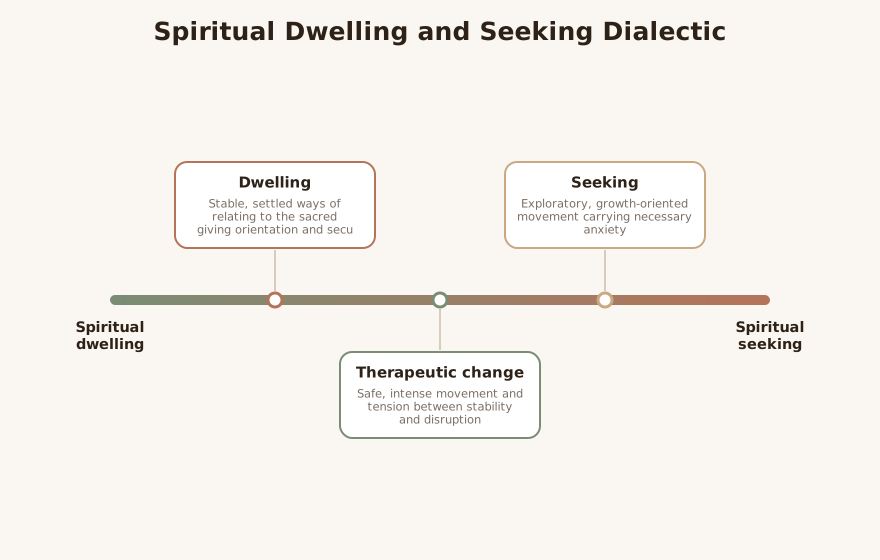
At the center of the model is a developmental dialectic between two modes of relating to the sacred: spiritual dwelling and spiritual seeking 1. Spiritual dwelling refers to stable, settled, comfortable ways of relating to the sacred that provide orientation, connection, and security; spiritual seeking refers to exploratory, growth-oriented movement that often carries necessary anxiety and disruption 1. The model frames therapeutic change as an intense yet safe process of movement and tension between dwelling and seeking, between stability and disruption, rather than as the simple removal of distress 1.
A second principle is that this process is supported by three developmental systems: attachment (the capacity for secure relational bonds), differentiation (the capacity to balance closeness with autonomy and to self-regulate emotionally under relational pressure), and intersubjectivity (the capacity for mutual, reciprocal understanding) 1. Assessment and intervention aim to restructure the client’s relationships with self, others, and the sacred along these systems 1. Differentiation of self is treated as especially central to mature spirituality, understood as the ability to hold intimacy and autonomy together without collapsing into isolation or enmeshment 1.
A third principle is pluralism. The framework is explicitly contextual and non-prescriptive about content, holding that religious and spiritual dynamics can range from salutary to harmful and that the same practice may sustain one client and constrain another 1. This makes spiritual and religious struggle a legitimate clinical focus in its own right rather than a symptom to be eliminated 2.
Interventions & Techniques
The Relational Spirituality Model does not supply a rigid protocol; it supplies a lens that sharpens assessment and shapes intervention inside other models 2. Assessment typically begins by locating the client along the dwelling–seeking dialectic and by exploring the quality of their attachment to the sacred, their level of differentiation, and their capacity for intersubjective relating 1. The clinician attends to where the client’s spiritual dwelling has become insufficient and a destabilizing seeking phase has opened, which is often the moment distress brings someone to treatment 1.
Two relational pathways are described as facilitating transformation and can be cultivated in session: intimacy, the experience of knowing and being known in relation to the sacred, which can itself be anxiety-provoking; and alterity, the genuine encounter with difference across cultural, racial, and religious lines 1. Techniques drawn from the framework include exploring images of and felt relationships with the sacred, working with spiritual struggles as meaningful relational material rather than error, supporting the client’s tolerance of the anxiety that accompanies seeking, and strengthening differentiation so the client can stay connected without losing themselves 1. Because the model is relational and systemic, it is readily applied to couples and families, where partners’ differing dwelling–seeking positions can be made explicit and worked with 2.
LLM-generated illustrative example (not a guideline): A client whose faith had long provided unquestioned stability arrives in crisis after a loss, saying their old certainties “no longer hold.” The therapist frames this not as a failure of faith but as a movement from dwelling into seeking, names the anxiety as expectable to that transition, and supports the client in tolerating uncertainty while strengthening their capacity to stay in relationship with both their tradition and their doubt. LLM
Evidence Base
The honest summary is that the Relational Spirituality Model is an emerging framework whose constituent constructs and client-preference patterns have correlational support, but whose efficacy as a treatment has not been established in controlled trials LLM. The authors ground the model in roughly thirty published empirical studies and decades of clinical experience, but that base is largely cross-sectional and correlational and speaks to the model’s component constructs rather than to outcomes from delivering the model as a packaged intervention 2.
The most directly relevant test examined client preferences and functioning in a sample of 101 adult clients at a northeastern community mental health center 3. Most clients wanted to engage spiritual, religious, and existential issues in treatment, and that preference was positively associated with both spiritual or religious commitment and questing 3. Clients’ ratings of their therapist’s diversity sensitivity were associated with their ratings of treatment progress over and above the working alliance, and clients’ spiritual well-being and spiritual struggles predicted psychosocial functioning over and above mental-health symptoms 3. These findings support the model’s premises — that spirituality is clinically salient and that attending to it matters — but they are associational, not evidence that RSM as a treatment produces superior outcomes 3.
Related construct research underpinning the model links differentiation of self and humility to virtues such as forgiveness, to intercultural competence, and to greater well-being, while spiritual grandiosity is inversely related to those outcomes 1. The couple-therapy training literature applies the same relational-spirituality lens to clinician competence, treating humility, differentiation, and hope as developmental resources for working across spiritual and cultural difference 4. None of this constitutes randomized evidence of treatment efficacy, and clinicians should present the model to clients and supervisees as a promising, theoretically rich framework rather than an empirically validated therapy LLM.
Populations & Indications
The framework is most directly applicable to religious and spiritual clients for whom relationship to the sacred is a live, organizing concern 1. It is well suited to people facing existential or life-transition crises, where settled spiritual dwelling has been disrupted and a destabilizing seeking phase has opened 1. Clients in grief or bereavement and patients facing terminal or chronic illness are natural populations, since loss and mortality activate both attachment systems and existential questions that the model is designed to hold 2. Because the model is relational and systemic, couples integrating faith are an indicated population, with partners often occupying different positions on the dwelling–seeking dialectic 2. Its explicit pluralism and emphasis on alterity make it appropriate for clients from diverse faith traditions, provided the clinician brings genuine intercultural competence rather than a single normative template 4.
Problems-for-Work
The lens applies to a range of presentations where spirituality is clinically salient LLM. For an explicit religious or spiritual problem (V62.89 / Z65.8), the model offers a non-pathologizing frame that treats the difficulty as relational and developmental rather than as a disorder 2. For religious and spiritual struggles, the dwelling–seeking dialectic clarifies whether the client is contending with the anxiety of a seeking phase or the rigidity of dwelling that no longer fits their life 1. For grief and bereavement and for existential distress, the clinician can work with disrupted attachment to the sacred and the search for meaning as the same relational process 2. For demoralization and loss of meaning and purpose, strengthening differentiation and hope supports the client’s capacity to stay engaged while tolerating uncertainty 4.
LLM-generated illustrative example (not a guideline): A veteran carrying moral injury describes feeling permanently cut off from a God they once trusted and from a community they can no longer face. The therapist formulates this as a rupture across attachment and intersubjectivity, works to make space for self-condemnation and difference without arbitrating its theology, and supports a tentative movement from frozen dwelling toward an honest, anxious seeking. LLM
For adjustment disorder and spiritual crisis tied to a concrete stressor, the model helps the clinician track how a precipitating event has destabilized the client’s relationship with self, others, and the sacred, and where repair is possible LLM.
Contraindications, Cautions & Cultural Humility
The most important scope condition is that this is a formulation framework, not a validated treatment, so it should never displace an evidence-based modality where one is indicated LLM. Spiritual struggle is not in itself pathology, and the model is explicit that religious and spiritual dynamics range from salutary to harmful; the clinician’s task is to follow the client’s own meaning rather than to repair “weak faith,” adjudicate religious truth, or steer the client toward the therapist’s spiritual conclusions 1. Pushing a client prematurely from dwelling into seeking can be destabilizing, and the anxiety the model describes as a normal feature of growth must be titrated to the client’s capacity rather than imposed LLM.
Cultural humility is structurally central to the model rather than an add-on: its emphasis on alterity and intercultural competence requires the clinician to treat the client’s tradition as the authority on its own meaning and to remain aware of the power they hold to define what counts as healthy spirituality 4. Spiritual grandiosity is identified as a risk for practitioners as well as clients, since a sense of spiritual superiority undermines the very competence the model prizes 1. Particular caution is warranted where the client’s religious environment is itself a source of harm, where relational-spirituality language could be co-opted to rationalize coercion or abuse LLM. Clinicians should also avoid assuming that every client wants spiritual material in treatment; consent and client preference, which the model itself foregrounds, govern whether and how spirituality enters the work 3.
Treatment-Plan Suggestions & SMART Objectives
| Goal | SMART objective (example) | Mechanism |
|---|---|---|
| Tolerate the anxiety of a spiritual seeking phase | Over 8 weeks, client will name 3 destabilizing spiritual questions and remain with each in session without avoidance, rating distress before and after | Supports movement through the dwelling–seeking dialectic 1 |
| Reduce demoralization tied to loss of meaning | Within 10 sessions, client will identify 2 sustaining sources of meaning and engage one valued activity weekly, tracking hope on a 0-10 scale | Recruits hope and differentiation as developmental resources 4 |
| Repair a felt rupture with the sacred | By session 8, client will articulate the meaning of the rupture and identify 1 step toward reconnection or reconstrual | Restructures attachment to the sacred 1 |
| Strengthen differentiation under relational pressure | Over 12 weeks, client will practice staying connected yet self-defined in 4 logged interactions, reporting reduced reactivity | Builds the differentiation system central to the model 1 |
| Process grief as disrupted attachment to the sacred | Within 6 sessions, client will describe how loss changed their relationship to the sacred and name 2 supports | Frames bereavement within the relational systems 2 |
| Engage spiritual material per client preference | In the first 3 sessions, client and clinician will collaboratively define which spiritual or existential issues to address and which to leave aside | Honors client preference shown to predict engagement 3 |
| Increase capacity for encountering difference (alterity) | Over 10 weeks, client will reflect on 3 encounters with differing beliefs without defensiveness, noting any shift | Cultivates the alterity pathway to transformation 1 |
Common Misconceptions
A frequent error is treating the Relational Spirituality Model as a validated, manualized therapy; it is an orienting framework whose components have correlational support but no controlled outcome trials 2. A second is assuming the goal is to stabilize or strengthen the client’s faith, when the model deliberately holds dwelling and seeking in tension and treats destabilization as a potential growth process rather than a failure 1. A third is conflating spirituality with a single quantity to be increased; the model reframes it relationally, as varied ways of relating to the sacred, self, and others 1. A fourth is assuming the framework requires the clinician to share or endorse the client’s beliefs, when its emphasis on alterity and humility points the other way 4. Finally, some assume any spiritual struggle is harmful and to be resolved, when the model treats struggle as meaningful and sometimes generative material 2.
Training & Certification
There is no licensure or formal certification in the Relational Spirituality Model as a discrete therapy LLM. Competence is built by combining the foundational text by Sandage and colleagues with supervised practice in spiritually integrated psychotherapy and grounding in the psychology of religion and spirituality 1. The Danielsen Institute frames the model as an orienting framework for both clinical services and clinician training, indicating that it is learned in an apprenticeship-like, supervised context rather than through a brief workshop 2. The couple-therapy training literature operationalizes competence in terms of cultivating humility, differentiation, and hope, suggesting that clinician development under this model is as much about the therapist’s own relational and spiritual maturity as about technique 4. Practitioners are best served by supervision from clinicians experienced in faith-sensitive, attachment-informed, and systemic work LLM.
Key Terms
- Spiritual dwelling: Stable, settled ways of relating to the sacred that provide orientation, connection, and security 1.
- Spiritual seeking: Exploratory, growth-oriented movement in relation to the sacred that often carries necessary anxiety and disruption 1.
- Dwelling–seeking dialectic: The developmental tension between stability and disruption that the model treats as the engine of change 1.
- Differentiation of self: The capacity to balance intimacy with autonomy and to self-regulate under relational pressure, treated as central to mature spirituality 1.
- Intersubjectivity: The capacity for mutual, reciprocal understanding between persons 1.
- Intimacy (pathway): The transformative experience of knowing and being known in relation to the sacred 1.
- Alterity (pathway): The transformative encounter with genuine difference across cultural, racial, and religious lines 1.
- Spiritual grandiosity: A sense of spiritual superiority that is inversely related to humility, intercultural competence, and well-being 1.
Resources & Further Reading
▶ Watch — a video introduction to this concept:
- Sandage, Rupert, Stavros & Devor (2020). Relational Spirituality in Psychotherapy: Healing Suffering and Promoting Growth — Danielsen Institute, Boston University 1
- Relational spirituality model in psychotherapy: Overview and case application (ResearchGate) 2
- Testing a relational spirituality model of psychotherapy clients’ preferences and functioning — Journal of Spirituality in Mental Health 3
- Spiritual and Religious Competence in Couple Therapy Training: A Relational Spirituality Perspective — Counseling and Values 4
Reflective / Supervision Questions
- Can I locate this client along the dwelling–seeking dialectic without privileging stability over growth or growth over stability? LLM
- Am I presenting the model to the client and to supervisees as a promising framework, or am I overclaiming it as an evidence-based treatment? LLM
- Whose spiritual conclusions am I serving — the client’s, my own, or those of an institution the client may be moving away from? LLM
- How am I titrating the anxiety of a seeking phase so that it remains generative rather than destabilizing? LLM
- Where might my own spiritual grandiosity or discomfort with difference be shaping what I attend to and what I avoid? LLM
- Have I confirmed that this client actually wants spiritual material in the work, and am I revisiting that consent as the work evolves? LLM
1: Sandage, S. J., Rupert, D., Stavros, G., & Devor, N. G. (2020). Relational Spirituality in Psychotherapy: Healing Suffering and Promoting Growth. Washington, DC: American Psychological Association. (Albert & Jessie Danielsen Institute, Boston University). 2: Relational spirituality model in psychotherapy: Overview and case application. ResearchGate (Publication 367473769). 3: Testing a relational spirituality model of psychotherapy clients’ preferences and functioning. Journal of Spirituality in Mental Health, 24(1). 4: Spiritual and Religious Competence in Couple Therapy Training: A Relational Spirituality Perspective. Counseling and Values, 69(3), 362.