
Type & Discipline
12-Step Facilitation is a manualized, professionally delivered clinical intervention within addiction treatment whose explicit aim is to engage clients with 12-step mutual-aid fellowships such as Alcoholics Anonymous (AA) and Narcotics Anonymous (NA) 3. It is important to distinguish 12-Step Facilitation from AA itself: AA is a free, peer-led mutual-help organization, whereas 12-Step Facilitation is a structured therapy a licensed clinician delivers to increase the likelihood and depth of a client’s affiliation with such groups 37. 12-Step Facilitation can range from a brief “warm handover” that links a client to meetings, to extended individual or group counseling that systematically works the early steps 3.
The modality sits in the family of mutual-aid-linked interventions and was operationalized for research as one of three treatments tested in Project MATCH, a five-year NIAAA multisite randomized trial comparing 12-Step Facilitation, Cognitive Behavioral / Coping Skills therapy, and Motivational Enhancement Therapy for alcohol use disorder 5. Its evidence maturity is best described as established, with high-certainty findings for alcohol use disorder 1. LLM
Creators & Lineage
The canonical 12-Step Facilitation protocol is the Twelve Step Facilitation Therapy Manual, authored by Joseph Nowinski, Stuart Baker, and Kathleen M. Carroll and published in 1995 by the National Institute on Alcohol Abuse and Alcoholism as Volume 1 of the Project MATCH Monograph Series 54. The manual provides a standardized protocol for “brief individual outpatient treatment for persons who satisfy the criteria for a diagnosis of alcohol dependence and abuse” 5.
12-Step Facilitation’s intellectual lineage runs directly from the 12-step mutual-aid tradition of AA and NA and the broader Minnesota Model of addiction treatment, which framed alcoholism as a treatable disease and embedded 12-step principles into formal care 5. The 12-Step Facilitation manual itself is “grounded in the concept of alcoholism as a spiritual and medical disease” and concentrates on the first five steps of AA 5. In contemporary practice 12-Step Facilitation is frequently delivered alongside, or sequenced with, Motivational Interviewing and CBT for addiction, which address ambivalence and coping skills that 12-Step Facilitation does not directly target 3. LLM
Core Principles
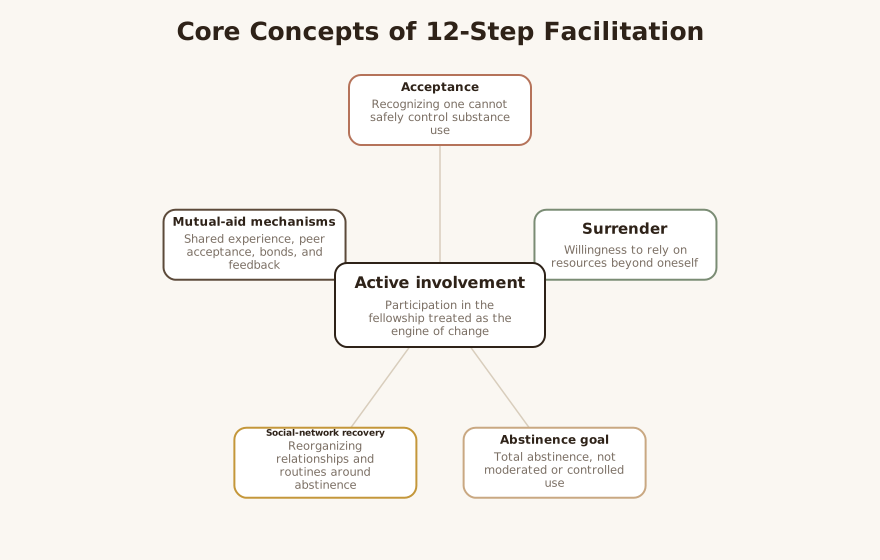
12-Step Facilitation rests on a disease model of addiction in which loss of control is central and abstinence — not controlled or moderated use — is the explicit goal 57. The therapist’s stance is that of an active advocate for 12-step involvement rather than a neutral, exploratory psychotherapist; the clinician explains, encourages, and troubleshoots fellowship participation 5. LLM
A small set of recurring concepts anchors the work. Acceptance addresses the recognition that one cannot safely control substance use; surrender corresponds to the work of Steps 2 and 3, the willingness to rely on resources beyond oneself, including the fellowship 5. Active involvement — attending meetings, obtaining a sponsor, reading 12-step literature, and using the telephone for support — is treated as the engine of change rather than insight alone 54. The program also emphasizes social-network recovery, helping clients reorganize relationships and routines around abstinence 5.
The proposed active ingredient is participation itself: 12-Step Facilitation works largely by mobilizing the therapeutic mechanisms embedded in mutual-aid groups, including shared experience, emotional bonds, peer acceptance, and feedback 7. Crucially, dose appears to matter — analyses tied each additional meeting attended to measurable reductions in downstream medical cost, consistent with a participation-mediated effect 3. LLM
Interventions & Techniques
The manualized 12-Step Facilitation protocol is a brief, structured course of roughly 12 weeks of individual outpatient sessions following a standardized format 5. Each session typically reviews the client’s recovery experience since the last visit (meetings attended, urges, slips), introduces or deepens a core topic, and assigns concrete recovery tasks for the interval 54. LLM
The core program organizes around foundational topics — acceptance, surrender (Steps 2 and 3), getting active in AA, and social/family recovery — supplemented by family-systems analysis using a genogram to map intergenerational patterns of substance use 5. Beyond the required core, elective topics allow tailoring to the individual, and the protocol accommodates both newcomers to 12-step programs and clients with prior AA exposure 5.
Characteristic techniques include prescriptive, specific meeting recommendations rather than vague encouragement; structured assignment of recovery tasks such as meeting attendance and reading; sponsor-seeking; and direct rehearsal of fellowship tools like “people, places, and things” avoidance, “one day at a time,” and the Serenity Prayer. LLM The 2020 Cochrane review specifically credits active linkage strategies — warm handoffs and prescriptive meeting recommendations — as features that distinguish effective manualized 12-Step Facilitation from passive referral 3.
LLM-generated illustrative example (not a guideline): A clinician delivering 12-Step Facilitation does not simply tell a client to “try a meeting.” She helps the client identify three specific local meetings by day and time, role-plays asking someone for a phone number, assigns the client to attend two meetings and read the chapter “More About Alcoholism” before next session, and the following week reviews exactly what happened — including the discomfort — as clinical material LLM.
Evidence Base
The evidence for 12-Step Facilitation in alcohol use disorder is mature and, for the abstinence outcome, rated high-certainty 1. The 2020 Cochrane systematic review by Kelly, Humphreys, and Ferri analyzed 27 studies involving 10,565 participants, a major expansion over the 2006 review’s 8 studies 2. It concluded that clinically delivered, manualized 12-Step Facilitation interventions designed to increase AA participation produce higher rates of continuous abstinence than other active treatments 2.
In the most rigorous randomized comparisons against CBT, the magnitude of advantage varied by timepoint: no difference at end of treatment (RR ≈ 1.07), a 66% higher abstinence rate at 6 months (RR ≈ 1.66), and a 21% advantage at 12 months (RR ≈ 1.21) 3. Expressed in absolute terms, roughly 42% of AA/12-Step Facilitation participants remained completely abstinent at one year versus about 35% receiving other treatments including CBT 2. Project MATCH exemplified the pattern, with 24% of AA/12-Step Facilitation participants achieving continuous abstinence versus 15% for CBT and 14% for MET 3.
The picture is more nuanced for non-abstinence drinking outcomes. On percent days abstinent and drinking intensity, 12-Step Facilitation performed “at least as well as” other treatments, with only modest advantages emerging at 24-plus months 3. In other words, 12-Step Facilitation’s distinctive edge is on complete abstinence, while on harm-reduction-style metrics it is broadly comparable to CBT and MET 37.
Economic evidence is a notable strength: four of five economic studies showed considerable cost savings, including roughly 45% lower alcohol-related costs over three years and meaningful two-year healthcare savings relative to CBT 23. The literature is most robust for alcohol; extension to opioid, stimulant, and cannabis use disorders rests more on the mutual-aid mechanism and clinical convention than on the same density of high-certainty trials. LLM
Populations & Indications
12-Step Facilitation was developed and validated primarily with adults meeting criteria for alcohol use disorder, and that remains its strongest indication 51. The Cochrane review’s authors emphasize that benefits were demonstrated broadly and that clinicians should not exclude clients based on demographics — effects held across ages, races, genders, and religious backgrounds 3.
In practice the modality is applied across the substance use disorder spectrum — including opioid, stimulant, and cannabis use disorders — by linking clients to the corresponding fellowship (e.g., NA), and Connecticut’s DMHAS frames it as extending to “various addictions and compulsive behaviors” while being particularly effective for alcohol dependence 7. It is well suited to people in early recovery who need structure, accountability, and a sober social network, and to socially isolated clients for whom fellowship membership directly addresses the isolation 7. LLM Adolescents and young adults with addiction are an applied population, though clinicians should match them to age-appropriate meetings and recognize the evidence base is strongest in adults. LLM
Problems-for-Work
- Alcohol use disorder and relapse prevention. 12-Step Facilitation’s core indication; the structured early-step work plus sustained meeting attendance supports continuous abstinence over follow-up 13.
- Opioid, stimulant, and cannabis use disorders / general SUD. Addressed by facilitating affiliation with NA or substance-specific fellowships, leveraging the same participation mechanism 7. LLM
- Cravings. Fellowship tools (calling a sponsor, “playing the tape forward,” meeting attendance during high-risk windows) are rehearsed as concrete craving-management strategies. LLM
- Denial and ambivalence about recovery. The acceptance and surrender topics directly target the client’s relationship to loss of control; when ambivalence is high, clinicians often pair 12-Step Facilitation with a Motivational Interviewing stance 53. LLM
- Social isolation. Meetings and sponsorship build a sober support network, which both treats isolation and reinforces recovery; dose of participation tracks with better outcomes and lower cost 73.
LLM-generated illustrative example (not a guideline): A recently detoxed client reports that evenings alone trigger the strongest cravings. The clinician works the “social recovery” topic, helping him commit to a nightly 7pm meeting for the first two weeks, exchange numbers with two members, and call his sponsor before — not after — pouring a drink. The intervention treats craving, isolation, and relapse risk simultaneously LLM.
Contraindications, Cautions & Cultural Humility
12-Step Facilitation is abstinence-oriented; for a client who explicitly wants moderation rather than abstinence, the model’s goals may conflict with the client’s, and a clinician should weigh harm-reduction approaches or motivational work first 7. LLM The Cochrane distillation flags a specific caution: one study found percent-days-abstinent disadvantages for AA/12-Step Facilitation among dual-diagnosis patients whose primary problem was a mood disorder, suggesting 12-Step Facilitation fits best when the substance use disorder is primary rather than secondary to psychiatric illness 3. Co-occurring disorders are not a blanket contraindication, but they warrant integrated treatment and careful matching. LLM
The disease-and-“spiritual” framing of the manual can be a poor fit for clients who are non-religious or whose cultural or religious context clashes with 12-step language 5. The evidence-based response is not to abandon the mechanism but to offer alternative mutual-help organizations — SMART Recovery, LifeRing, Women for Sobriety — that share similar therapeutic ingredients 3. Clinicians should also examine their own bias: the review notes that many providers dismiss AA without ever having attended a meeting, and recommends challenging that reflex 3. Cultural humility here means presenting fellowship options as a menu, honoring the client’s worldview, and respecting that “higher power” can be interpreted broadly. LLM
Treatment-Plan Suggestions & SMART Objectives
| Goal | SMART objective (example) | Mechanism |
|---|---|---|
| Achieve continuous abstinence | Client will remain abstinent from alcohol for 90 consecutive days, verified by self-report and collateral, by end of treatment | Abstinence-focused goal-setting plus sustained 12-step participation 13 |
| Establish active fellowship participation | Client will attend at least 3 mutual-aid meetings per week for 8 weeks and document attendance | Participation dose linked to better outcomes and lower cost 3 |
| Secure ongoing peer support | Client will identify and contact a sponsor within 4 weeks and meet with them at least biweekly | Sponsorship and emotional bonds as active ingredients 75 |
| Work the foundational steps | Client will complete written work on acceptance and surrender (Steps 1-3) within 6 sessions | Core-program early-step focus 5 |
| Build a sober social network | Client will exchange phone numbers with 3 fellowship members and place 1 support call before next session, weekly | Social-recovery reorganization reduces isolation 57 |
| Manage high-risk cravings | Client will use 2 specified fellowship tools (call sponsor, attend extra meeting) during craving episodes and log frequency for 6 weeks | Behavioral craving-management via mutual aid 5 |
| Reduce relapse risk over follow-up | Client will maintain weekly meeting attendance and a written relapse-prevention plan through 12-month follow-up | 12-Step Facilitation abstinence advantage emerges and persists at follow-up 3 |
Common Misconceptions
- “12-Step Facilitation and AA are the same thing.” They are not; 12-Step Facilitation is a clinician-delivered, manualized therapy that links to and structures engagement with AA, which is a separate, free, peer-led fellowship 37.
- “AA is just faith with no evidence.” High-certainty evidence finds manualized 12-Step Facilitation superior to other active treatments for continuous abstinence and broadly comparable on other drinking measures 12.
- “It only helps religious people.” Benefits held across religious backgrounds, and secular alternatives carry similar mechanisms for clients for whom 12-step language does not fit 3.
- “Telling clients to go to meetings is enough.” Passive referral underperforms; the effective ingredient is active linkage — warm handoffs and prescriptive, specific meeting recommendations 3. LLM
- “It’s only about abstinence and ignores cost/health.” Economic studies show substantial healthcare cost savings, including markedly lower two- and three-year costs 23.
Training & Certification
The foundational training resource is the published Twelve Step Facilitation Therapy Manual (Nowinski, Baker, & Carroll, 1995), which functions as a clinical research guide with standardized session protocols therapists follow 54. The broader Project MATCH Monograph Series provides the surrounding research context for the trial in which 12-Step Facilitation was tested 6. LLM
There is no single universal credential for 12-Step Facilitation in the way there is for some branded modalities; competence is typically built through study of the manual, supervised delivery, and adherence to the standardized protocol, and several state systems (e.g., Connecticut DMHAS) list 12-step facilitation among their endorsed evidence-based practices and train clinicians within their care continuum 76. LLM Clinicians delivering 12-Step Facilitation should themselves be familiar with how meetings actually run, a point the Cochrane authors underscore when cautioning against provider bias formed without exposure 3. LLM
Key Terms
- 12-Step Facilitation: Manualized, clinician-delivered therapy designed to increase 12-step mutual-aid participation 3.
- Active linkage / warm handoff: Strategies (specific meeting recommendations, direct introductions) that connect a client to a fellowship; the effective ingredient distinguishing 12-Step Facilitation from passive referral 3.
- Continuous abstinence: Complete, uninterrupted abstinence over a defined period — the outcome on which 12-Step Facilitation shows its clearest advantage 3.
- Acceptance / Surrender: Core early-step concepts (Steps 1-3) addressing loss of control and reliance on the fellowship 5.
- Sponsor: An experienced fellowship member who provides ongoing peer support and step guidance. LLM
- Project MATCH: The NIAAA five-year multisite randomized trial comparing 12-Step Facilitation, CBT/coping skills, and MET for alcohol use disorder 5.
- Disease model: The framing of alcoholism as a medical (and, in the manual, spiritual) disease characterized by loss of control 5.
Resources & Further Reading
▶ Watch — a video introduction to this concept:
- Alcoholics Anonymous and other 12-step programs for alcohol use disorder (Kelly et al., 2020 Cochrane Review)
- New Cochrane Review finds AA and 12-Step Facilitation programs help people recover (Cochrane news)
- A Distillation of a 2020 Cochrane Review for Clinicians and Policy Makers (Alcohol and Alcoholism)
- Twelve Step Facilitation Therapy Manual (Project MATCH Monograph Vol. 1, NIAAA PDF)
- Twelve Step Facilitation Therapy Manual: A Clinical Research Guide (book listing)
- Project MATCH Monograph Series (NIAAA)
- 12 Step Facilitation (Connecticut DMHAS, Evidence-Based Practices)
Reflective / Supervision Questions
- Have I attended an open AA, NA, or alternative mutual-aid meeting myself, and how might my own exposure (or lack of it) be shaping my recommendations to clients? 3 LLM
- For this client, is the substance use disorder the primary problem, or is it secondary to a mood or other psychiatric disorder that might change how well 12-Step Facilitation fits? 3 LLM
- Am I delivering active linkage — specific meetings, warm handoffs, rehearsed tasks — or merely making a passive referral and assuming that is treatment? 3 LLM
- When a client’s worldview clashes with 12-step language, am I offering a genuine menu of mutual-aid options (SMART Recovery, LifeRing, Women for Sobriety) rather than pushing one path? 3 LLM
- Does my treatment plan and documentation reflect skilled clinical work on cravings, isolation, and relapse, or does it read as logistics? LLM
- How am I tracking participation dose over time, given that more meetings attended is associated with better outcomes and lower cost? 3 LLM