
Type & Discipline
Twelve-step and mutual-aid fellowships are not a professional psychotherapy; they are a lay recovery movement organized around peer support, anonymity, and a spiritually framed program of action called the Twelve Steps LLM. They sit within the discipline of addiction recovery as a community-based adjunct to, rather than a replacement for, clinical treatment LLM. The clinician’s point of contact with this movement is 12-Step Facilitation (12-Step Facilitation) — a structured, manualized, one-on-one professional counseling approach explicitly designed to work synergistically with Alcoholics Anonymous and other twelve-step groups 6.
This distinction matters for how therapists conceptualize their role. A clinician cannot “deliver” Alcoholics Anonymous, because the fellowships are peer-led and self-governing; what a clinician delivers is facilitation — the linkage, education, and accountability that move a client toward sustained participation 6. 12-Step Facilitation presents alcohol dependence as a chronic disease requiring permanent abstinence and actively encourages meeting attendance, sponsor relationships, and step work 6.
Creators & Lineage
Alcoholics Anonymous was founded in 1935 through the collaboration of Bill Wilson and Bob Smith, and the fellowship’s framework — meetings, sponsorship, anonymity, and a sequence of twelve steps — became the template subsequently adapted by dozens of other mutual-aid fellowships LLM. The lineage of this concept runs directly from Alcoholics Anonymous, through the disease model of addiction it popularized, to the broader category of mutual-aid recovery and the professionalized form known as 12-Step Facilitation LLM.
The clinical research lineage is more recent and more consequential for practitioners. Project MATCH, a large multisite randomized trial, formalized 12-Step Facilitation as a manualized treatment that could be compared head-to-head against cognitive behavioral therapy and motivational enhancement therapy 2. The 2020 Cochrane review by Kelly and colleagues consolidated this body of work and is the central evidentiary reference for any clinician deciding whether and how to integrate fellowships into care 1.
Core Principles
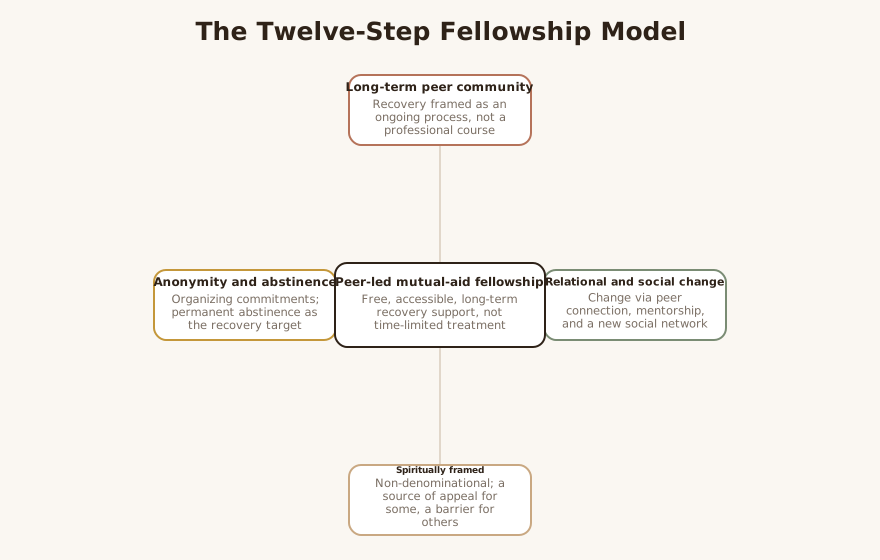
Several principles define the fellowship model and distinguish it from clinician-delivered therapy LLM. First, recovery is framed as a long-term process supported by a free, accessible, peer-based community rather than a time-limited course of professional treatment 5. The Cochrane authors note that AA commonly outperforms other treatments at lower cost precisely because it links people to a free and easily accessible long-term recovery support option 5.
Second, the model is relational and social: change is understood to occur through peer connection, mentorship, and modification of one’s social network away from drinking contacts 2. Third, the program is spiritually framed — though deliberately non-denominational — which is both a source of its appeal for many members and a barrier for others who are uncomfortable with that language 5. Fourth, anonymity and the abstinence goal are organizing commitments, with the twelve-step orientation generally presenting permanent abstinence as the recovery target 6.
Interventions & Techniques
The clinically actionable techniques live in 12-Step Facilitation, and the most robust finding in this literature is that how a clinician refers matters enormously 6. Passive referral — merely suggesting AA and handing over a meeting list — produces near-zero engagement, whereas active, enhanced linkage produces dramatically higher attendance 6. In the Sisson and Mallams comparison, a simple suggestion yielded zero percent attendance while an enhanced approach yielded one hundred percent 6.
The enhanced techniques are concrete and reproducible LLM. They include placing an in-session telephone call to connect the client with a current twelve-step member, arranging transportation to a first meeting, making follow-up reminder calls before the meeting, and having the provider verify attendance afterward 6. 12-Step Facilitation therapists also use structured goal-setting and contracting around meeting attendance, assign twelve-step-related homework, and monitor its completion 6. The Cochrane distillation describes practical scripting such as a proactive “warm hand-off” to an existing AA member or a directive prescription — “I’d like you to attend three AA meetings this week” — rather than a passive suggestion 2.
LLM-generated illustrative example (not a guideline): A clinician treating a newly abstinent client does not end a session by saying “you might look into AA.” Instead, during the session she pulls up three meetings near the client’s home, the client texts a phone contact from the local intergroup list, and they agree the client will attend two meetings before the next appointment and report back which one felt most comfortable. LLM
Where treatment is concurrent, 12-Step Facilitation therapists are encouraged to align messaging — emphasizing parallels between cognitive behavioral skills and twelve-step techniques — so the two streams reinforce rather than contradict each other 6.
Evidence Base
The evidence base for AA and 12-Step Facilitation in alcohol use disorder is mature and, for this specific application, strong LLM. The 2020 Cochrane review synthesized 27 studies involving 10,565 participants, comparing AA/12-Step Facilitation interventions against other established treatments including cognitive behavioral therapy and motivational enhancement therapy 4. The review concluded that there is high-certainty evidence that manualized AA/12-Step Facilitation interventions are more effective than other established treatments for increasing continuous abstinence 4.
The magnitude is clinically meaningful. In Project MATCH, 24% of AA/12-Step Facilitation participants achieved continuous abstinence in the first year, compared with 15% for cognitive behavioral therapy and 14% for motivational enhancement therapy 2. Across the more rigorous randomized trials, AA/12-Step Facilitation showed reduced risk of returning to drinking with relative risk ratios in the range of 1.21 to 1.66 at follow-up points from 6 to 36 months 2. On other outcomes — drinks per drinking day, alcohol-related consequences, and addiction severity — AA/12-Step Facilitation performed about as well as comparison treatments and in no case fared worse 4.
Two honest caveats are essential. First, the advantage is most pronounced and most certain specifically for continuous abstinence with manualized AA/12-Step Facilitation; non-manualized versions performed comparably to, rather than better than, other treatments 4. Second, certainty across the full set of outcomes ranged from very low to high, and several included studies carried selection bias and moderate attrition 4. The cost-effectiveness signal is consistent: four of five economic studies showed substantial healthcare cost savings, with one finding 45% lower alcohol-related healthcare costs for AA participants despite comparable clinical severity 45.
Critically, this high-certainty evidence concerns AA and 12-Step Facilitation for alcohol use disorder LLM. Evidence for Narcotics Anonymous and other drug-focused fellowships, for behavioral-addiction fellowships, and for family programs such as Al-Anon is far thinner and is largely extrapolated rather than directly demonstrated at the same level of rigor LLM.
Populations & Indications
The Cochrane authors emphasize that the efficacy evidence for AA spans a large range of populations, and that no demographic basis exists to exclude patients from a recommendation 2. The clearest indication is an adult with alcohol use disorder, particularly one for whom sustained abstinence is the goal and who would benefit from an enduring, low-cost source of peer support after formal treatment ends 2.
By extension and clinical convention, people with other substance use disorders and people maintaining recovery are also commonly directed to corresponding fellowships, and family members of people with addiction are directed to family fellowships LLM. People with behavioral addictions are sometimes served by analogous twelve-step groups, though here the clinician should be explicit that the supporting evidence is weaker LLM. Adults across severity levels can benefit: one finding noted that AA participants with severe AUD had outcomes similar to outpatients in clinical treatment, but at 45% lower cost 5.
Problems-for-Work
Fellowship linkage maps onto several concrete problems-for-work LLM. For alcohol use disorder and substance use disorders, the fellowship provides structured abstinence support and accountability; the clinician’s task is active facilitation rather than passive referral 6. For relapse prevention, the durable, free, post-treatment community addresses the well-known erosion of gains after formal care ends — the mechanism by which 12-Step Facilitation “links people to a free and easily accessible long-term recovery support option” 5.
LLM-generated illustrative example (not a guideline): A client three months sober describes mounting cravings every Friday evening when old drinking friends text. The clinician and client identify a Friday-night meeting, arrange a phone contact the client can call before the cravings peak, and frame attendance as a planned coping response rather than an admission of weakness. LLM
For social isolation and shame, the relational structure of meetings and sponsorship offers corrective social connection and a normalizing community of people with shared experience LLM. For codependency, family-oriented fellowships provide a parallel community for family members of people with addiction LLM. For behavioral addictions, analogous groups exist, but the clinician should pair the referral with explicit honesty about the limited evidence and a willingness to revisit if it does not fit LLM.
Contraindications, Cautions & Cultural Humility
There is no medical contraindication to attending a meeting, but there are clinical cautions and a clear duty of cultural humility LLM. The spiritual framing, the higher-power language, and the disease-and-permanent-abstinence model are not universally acceptable; the Cochrane authors and the Recovery Research Institute both note that alternative mutual-help organizations such as SMART Recovery, LifeRing, and Women for Sobriety may better suit clients uncomfortable with the spiritual components 25. Offering a secular alternative is itself an evidence-aligned move, not a concession 5.
Clinicians should also guard against their own biases. The distillation pointedly observes that some clinicians are highly confident they understand what happens at AA meetings yet have never actually attended one 2. A respectful stance treats fellowship participation as one supported option among several, presents abstinence-based and harm-reduction pathways without coercion, and remains alert to whether a particular group’s culture fits a given client’s identity and language LLM. A directive referral style is supported by evidence, but directiveness about attendance should not curdle into coercion about belief LLM.
Treatment-Plan Suggestions & SMART Objectives
| Goal | SMART objective (example) | Mechanism |
|---|---|---|
| Establish fellowship linkage | Client will attend 3 in-person meetings within 2 weeks and report back at next session | Social-network modification and peer support 2 |
| Build accountability structure | Client will obtain a temporary sponsor’s contact within 30 days and have one phone contact per week | Mentorship and sponsorship relationship 2 |
| Reduce return to drinking | Client will sustain continuous abstinence for 90 days, verified by self-report and collateral | Recovery coping skills and abstinence self-efficacy 2 |
| Manage cravings | Client will identify 2 high-risk windows weekly and use a fellowship phone contact before each | Reduced craving and impulsivity 2 |
| Reduce social isolation | Client will attend 1 fellowship social event per week for 8 weeks | Peer connection and corrective community 5 |
| Strengthen long-term support | Client will maintain ≥2 meetings per week through the 6-month post-treatment period | Durable, low-cost recovery support 5 |
| Support a family member | Family member will attend 4 family-fellowship meetings within 6 weeks | Parallel peer support and reduced codependent patterns LLM |
Common Misconceptions
A first misconception is that referring to AA means simply telling a client to go — when the evidence shows that passive referral yields near-zero engagement and that active linkage is what works 6. A second is that AA is unsupported “folk” treatment; in fact, manualized AA/12-Step Facilitation has high-certainty evidence of superiority for continuous abstinence in alcohol use disorder 4.
A third misconception runs the other way — that the strong AUD findings generalize cleanly to every fellowship, drug, and family program; the rigorous evidence is concentrated in alcohol use disorder, and claims beyond it should be appropriately hedged LLM. A fourth is that AA and clinical treatment are rivals; the more accurate framing is that 12-Step Facilitation and therapy can be mutually reinforcing when their messaging is aligned 6. A fifth is that AA is more expensive or resource-intensive — the cost data point the opposite way, with multiple economic studies showing healthcare savings 45.
Training & Certification
There is no certification to participate in a fellowship; meetings are open and peer-led, and “membership” requires only a desire to stop the relevant behavior LLM. For clinicians, the trainable, manualized skill is 12-Step Facilitation, which was operationalized as a structured treatment in Project MATCH and is documented in published manuals and the facilitation literature 26. The evidence suggests brief facilitation can help, but extended contact of roughly 10 to 12 sessions produces stronger outcomes 6.
Practical “training” for a referring clinician is partly experiential: the distillation’s implicit recommendation is for providers to actually familiarize themselves with local meetings rather than rely on assumptions 2. Building a working knowledge of local meeting schedules, secular alternatives, and a few reliable peer contacts to enable warm hand-offs is the core competency 6.
Key Terms
12-Step Facilitation: Manualized, one-on-one professional counseling designed to increase a client’s participation in twelve-step fellowships 6. Sponsorship: A mentoring relationship with a more experienced fellowship member, identified in the literature as a mechanism of change 2. Warm hand-off: A proactive, in-session connection of the client to an existing fellowship member, contrasted with passive referral 26. Continuous abstinence: Uninterrupted abstinence over a defined period — the outcome on which manualized AA/12-Step Facilitation shows its clearest advantage 4. Manualized intervention: A structured, protocol-driven version of AA/12-Step Facilitation; the manualized form is what carries the high-certainty evidence 4. Mutual-aid organization: A peer-led recovery community such as AA, or secular alternatives like SMART Recovery and LifeRing 5.
Resources & Further Reading
▶ Watch — a video introduction to this concept:
- Alcoholics Anonymous and other 12-step programs for alcohol use disorder — Kelly et al., 2020 (Cochrane Library)
- AA and 12-Step Facilitation Treatments for AUD: A Distillation of a 2020 Cochrane Review for Clinicians (Alcohol and Alcoholism)
- Cochrane plain-language summary: AA and 12-step programs for alcohol use disorder
- Evidence for Alcoholics Anonymous effectiveness and cost-effectiveness — Recovery Research Institute
- Professional Interventions That Facilitate 12-Step Self-Help Group Involvement (PMC)
Reflective / Supervision Questions
- When I last referred a client to a fellowship, did I use active linkage — a warm hand-off, logistical support, attendance follow-up — or did I default to a passive suggestion that the evidence predicts will fail 6? LLM
- Have I ever attended an open meeting of the fellowship I refer clients to, or am I operating on assumptions about what happens there 2? LLM
- For a client uncomfortable with spiritual or higher-power language, do I have a ready secular alternative such as SMART Recovery to offer 5? LLM
- Am I careful to present the strong evidence as specific to AA/12-Step Facilitation in alcohol use disorder, rather than overstating it for other substances, behaviors, or family programs LLM? LLM
- How do I align my own treatment messaging with the client’s fellowship participation so the two reinforce rather than contradict each other 6? LLM
- Where does my directiveness about attendance risk tipping into coercion about belief, and how do I hold that line LLM? LLM