
Type & Discipline
SMART Recovery — an acronym for Self-Management and Recovery Training — is a secular, science-oriented mutual-support framework for addiction recovery rather than a discrete psychotherapy that a clinician delivers one-to-one 45. It is organized around free, facilitator-led peer groups in which participants apply cognitive-behavioral and motivational self-management strategies to substance use and behavioral addictions 24. The program describes itself as grounded in evidence-based practice, explicitly cognitive behavioral therapy, and positions itself as a secular alternative to disease-and-spirituality models such as Alcoholics Anonymous and Narcotics Anonymous 24.
For a practicing therapist, the most useful framing is that SMART Recovery occupies the same ecological niche as a 12-step fellowship — a recurring, low-cost, community-based support structure clients attend between sessions — but its content is drawn from the same cognitive-behavioral and motivational literature clinicians already use in the consulting room 25. This makes it a natural adjunct to formal treatment rather than a competitor to it, and a particularly good fit for clients whose worldview clashes with 12-step language 34. LLM Its maturity is best described as established as a disseminated program — it operates internationally across dozens of countries with well over a thousand weekly meetings — while the controlled-outcome evidence base remains comparatively thin 51. LLM
Creators & Lineage
SMART Recovery was established in 1994 as a nonprofit organization, with its first meeting held in the United States and headquarters originally in Mentor, Ohio 5. The provided sources name no individual founders, so this article does not attribute the program to specific people; what the record does establish is the program’s institutional founding and its deliberate design as a secular, research-based system intended to “evolve as scientific knowledge evolves” 5.
The program’s intellectual lineage is explicitly cognitive-behavioral and motivational. SMART Recovery draws on cognitive behavioral therapy, Rational Emotive Behavior Therapy (REBT) — Albert Ellis’s approach — and motivational enhancement therapy and motivational interviewing principles 54. Its “SMART Toolbox” is described as a collection of MET, CBT, and REBT methods rather than an original theoretical creation 5. The relapse-prevention tradition associated with Marlatt sits comfortably within this same cognitive-behavioral family, and clinicians familiar with that literature will recognize SMART’s emphasis on identifying triggers, planning for high-risk situations, and reframing lapses as learning rather than moral failure 2. LLM The throughline across all of these influences is a view of addiction as learned, maladaptive behavior that can be unlearned, in deliberate contrast to the disease-as-incurable framing of 12-step models 4.
Core Principles
The first principle is self-empowerment. SMART Recovery centers the individual’s capacity to change rather than reliance on a higher power or an admission of powerlessness; participants are treated as agents who can learn and apply skills 4. Addiction is conceptualized as a maladaptive behavior that can be unlearned, not as a permanent disease state 4. This is the program’s defining philosophical break from the 12-step tradition and shapes everything downstream — the language, the tools, and the stance toward relapse 42.
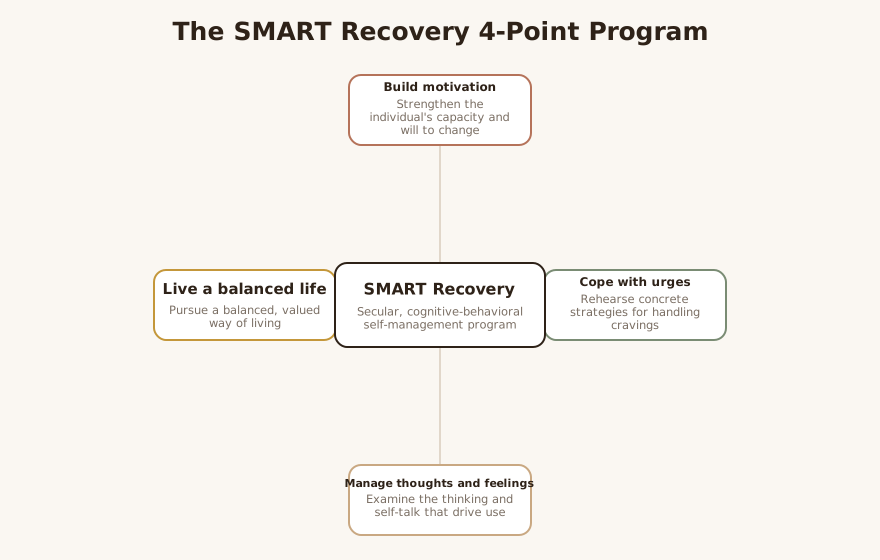
The second principle is that the work is skills-based and present-focused. Rather than a moral inventory or spiritual surrender, the program asks participants to build motivation, examine the thinking that drives use, and rehearse concrete coping strategies 2. Because the toolbox is drawn from CBT, REBT, and motivational methods, the underlying logic is that beliefs and self-talk mediate emotional and behavioral responses, and that changing those mediating cognitions changes outcomes 5. LLM
The third principle is flexibility about goals. While abstinence is encouraged, it is not a requirement of participation, which makes the program compatible with harm-reduction and moderation goals and distinguishes it from strictly abstinence-only fellowships 4. The fourth is secularity and openness to evidence: the program is explicitly non-spiritual and frames itself as research-based and revisable as the science develops 52. Finally, meetings are led by trained facilitators who are not required to be in recovery themselves, which changes the group dynamic — facilitators can redirect monologues and keep the group on task in a way peer-led formats sometimes cannot 3.
Interventions & Techniques
The program is organized around its 4-Point Program, four overlapping areas of work rather than sequential steps 2. Point 1 is building and maintaining motivation to change; Point 2 is coping with urges and cravings; Point 3 is managing thoughts, feelings, and behaviors effectively without the addictive behavior; and Point 4 is living a balanced, positive, and healthy life 24. Because the points are not a linear ladder, participants can re-enter any point as circumstances shift, which suits the nonlinear reality of recovery 2. LLM
These points are operationalized through the SMART Toolbox, a set of MET, CBT, and REBT methods 5. Among the tools the sources explicitly name are cost/benefit analysis — a structured decisional-balance exercise weighing the advantages and disadvantages of continuing versus changing the behavior — and the Change Plan Worksheet, used to translate a decision to change into concrete steps 5. More broadly, the toolbox imports the standard machinery of cognitive-behavioral and rational-emotive work: examining the beliefs and self-talk that precede use, disputing irrational or catastrophic thinking, and rehearsing alternative responses, all consistent with the REBT and CBT lineage the program claims 54. LLM Motivation work follows the motivational-interviewing tradition of building discrepancy and resolving ambivalence rather than confronting denial 5. LLM
Meetings themselves are the primary delivery vehicle, and they are free, facilitator-led, and available both in person and online across many countries 245. The combination of a structured toolbox with a recurring group container is what gives the program its clinical texture — clients leave with worksheets and a plan, not only with fellowship 2. LLM
LLM-generated illustrative example (not a guideline): A client who gambles online is ambivalent about quitting. In a SMART meeting she completes a cost/benefit analysis: on the “continue” side she lists the rush and an escape from boredom; on the “change” side, restored savings, sleep, and her partner’s trust. Seeing the columns side by side sharpens her own argument for change, and she leaves with a Change Plan Worksheet naming one concrete first step — deleting the apps and enabling a banking block before the weekend LLM.
Evidence Base
Honesty about maturity matters here. As a disseminated program, SMART Recovery is well established and widely available, but the controlled-outcome evidence is still developing rather than definitive 15. The most rigorous appraisal in the provided sources is a 2017 systematic review, which identified only twelve studies — including just three effectiveness evaluations — and concluded that “although positive effects were found, the modest sample and diversity of methods prevent us from making conclusive remarks about efficacy” 1.
The same review highlights specific gaps clinicians should keep in mind. Alcohol-related outcomes dominated the research; standardized assessment of non-alcohol substance use was infrequent; behavioral-addiction data were limited to prevalence information; functional outcomes were rarely documented; and mental-health assessment quality was characterized as poor 1. The review also noted that no economic analyses had been conducted, and that attendance emerged as a “potential candidate” process variable influencing outcomes, though the mechanisms remain poorly understood 1. Critically, the authors observe that methodologically rigorous evaluations exist for “the predominant 12-step approach,” whereas a “similarly rigorous exploration of SMART Recovery has yet to be undertaken” 1.
The program publishes participant-reported figures — for example, recent participant data citing high proportions reporting reduced or abstinent alcohol use and improvements in mental health, physical health, and social connection — but these are self-reported, organization-collected outcomes rather than controlled-trial results, and should be read as encouraging signals rather than efficacy evidence 4. LLM The practical bottom line: SMART Recovery is a reasonable, evidence-informed support option whose mechanisms (CBT, REBT, MI) are themselves well validated, even though the program-level outcome literature has not yet matured to the density seen for 12-step facilitation 15. LLM
Populations & Indications
SMART Recovery is indicated across both substance-based and behavioral addictions. The sources describe its use for alcohol, marijuana, and opioid use, and for behavioral addictions including gambling, sex addiction, and disordered eating 4. The 4-Point Program’s framing of addiction as a managed behavior makes it conceptually portable across these targets 24. LLM
It is particularly well suited to adults seeking a secular path who reject the disease model or higher-power language of 12-step fellowships 43. Demographically, one source notes that SMART tends to attract people with less severe alcohol problems, higher education, stable employment, and greater financial resources, and who are less likely to have had prior treatment or criminal-justice involvement 3. That self-selection is clinically relevant: it suggests SMART may map most naturally onto clients earlier in severity or with more intact functioning, while clients with severe, long-standing dependence may need more intensive or combined supports 3. LLM Family members of people with addiction are also served, reflecting the program’s extension beyond the individual in recovery 4. People in early recovery can use the program’s structure for motivation and urge-coping, though clinicians should pair it with appropriate medical and psychiatric care where indicated 2. LLM
Problems-for-Work
- Alcohol and substance use disorders. The core indication; participants apply motivation-building and urge-coping tools to reduce or abstain from use, and meetings provide between-session structure 24. For a client with alcohol use disorder, SMART supplies a recurring container to rehearse coping skills and review a change plan 2. LLM
- Behavioral addictions (gambling, gaming, sex, eating). The program explicitly addresses non-substance addictions, treating them as the same class of learned, modifiable behavior 4. For a client with compulsive gaming, the toolbox’s cost/benefit analysis and lifestyle-balance work target both the behavior and the void it fills 4. LLM
- Cravings and urges. Point 2 is dedicated to coping with urges; participants learn to anticipate, tolerate, and ride out cravings rather than act on them 2. LLM
- Ambivalence about change. The motivational-interviewing lineage equips facilitators to work with, rather than against, ambivalence, helping the client build their own case for change 5. A client on the fence about quitting can use decisional-balance tools to surface and resolve competing motivations 54. LLM
- Relapse prevention and maladaptive coping. Consistent with the relapse-prevention tradition, the program emphasizes identifying triggers, planning for high-risk situations, and reframing lapses as learning rather than failure 2. LLM
- Co-occurring depression and anxiety. The CBT/REBT toolbox addresses the maladaptive thinking that often links mood symptoms to use, though the review flags that mental-health outcomes have been poorly measured, so this should be supported by dedicated clinical care 15. LLM
LLM-generated illustrative example (not a guideline): A client in early alcohol recovery names Friday evenings as his highest-risk window. In session the therapist helps him build a “managing urges” plan he will also bring to his SMART meeting: a list of his most persuasive self-talk traps, two alternative actions, and a phone contact to call before pouring a drink. The group reinforces and rehearses the plan, addressing cravings and relapse risk together LLM.
Contraindications, Cautions & Cultural Humility
SMART Recovery is a support program, not a substitute for medical detoxification, pharmacotherapy, or treatment of acute psychiatric illness; clinicians should ensure clients with severe dependence receive appropriate medical care alongside any mutual-support attendance 4. LLM One source explicitly cautions that people with severe alcohol use disorder may need more than one program simultaneously, underscoring that SMART is often best deployed as one component of a broader plan rather than a standalone solution 3.
Access is a real-world caution. SMART meetings are far less numerous than 12-step meetings in most regions — one source contrasts roughly thirty SMART meetings with eighteen hundred AA meetings weekly in a single metropolitan area — so geographic availability, supplemented by online meetings, will shape what is realistic for a given client 35. The absence of formal sponsorship is another structural difference: SMART encourages peer contact between meetings but does not provide the sponsor role that one source describes as a key recovery factor in AA 3. LLM
Cultural humility cuts in both directions. SMART’s secular, self-empowerment stance is liberating for clients alienated by spiritual framings, but the same secular emphasis on individual agency may not resonate with clients whose recovery is anchored in faith or community-spiritual traditions 43. The clinician’s task is to present mutual-support options as a genuine menu — SMART, 12-step fellowships, and others — matched to the client’s worldview, severity, and access, rather than defaulting to a single path 3. LLM The evidence asymmetry should also be disclosed honestly: SMART’s mechanisms are well supported even though its program-level outcome research is less mature than that for 12-step facilitation 1. LLM
Treatment-Plan Suggestions & SMART Objectives
| Goal | SMART objective (example) | Mechanism |
|---|---|---|
| Reduce or abstain from substance use | Client will reduce drinking to zero days of heavy use over an 8-week period, tracked in a daily log reviewed each session | 4-Point structure plus CBT/REBT urge and thinking work 24 |
| Resolve ambivalence about change | Client will complete a cost/benefit analysis of continued use versus change and identify their top three reasons to change within 2 weeks | Decisional-balance and motivational methods 54 |
| Establish consistent mutual-support attendance | Client will attend at least 1 SMART Recovery meeting (in person or online) per week for 8 weeks and document attendance | Attendance as a candidate process variable for better outcomes 1 |
| Build an urge-coping repertoire | Client will identify two high-risk triggers and rehearse two coping responses, using them during at least three urge episodes over 4 weeks | Point 2 urge-coping skills 2 |
| Restructure addiction-related thinking | Client will record and dispute one instance of permission-giving self-talk per day for 3 weeks | REBT/CBT examination of beliefs and self-talk 5 |
| Operationalize change into concrete steps | Client will complete a Change Plan Worksheet specifying three actionable steps within 1 week | Structured planning tool from the SMART Toolbox 5 |
| Improve lifestyle balance | Client will add two valued non-using activities to a weekly schedule and rate satisfaction over 6 weeks | Point 4 lifestyle-balance work 2 |
| Support co-occurring mood symptoms | Client will pair SMART skills with dedicated depression/anxiety treatment and report symptom ratings biweekly | CBT/REBT cognitive work alongside formal mental-health care 51 |
Common Misconceptions
- “SMART Recovery is anti-AA or competes with 12-step programs.” SMART is commonly listed as an alternative to AA, but its own handbook frames it as something that can also serve as a supplement to 12-step programs; the two can coexist in one plan 53.
- “It’s just AA without God.” The difference is substantive, not cosmetic: SMART conceptualizes addiction as learned, modifiable behavior and centers self-empowerment and CBT/REBT tools rather than powerlessness and surrender 42.
- “SMART requires abstinence.” Abstinence is encouraged but not required, which makes the program compatible with harm-reduction and moderation goals 4.
- “There’s strong outcome evidence it beats other programs.” The most rigorous review found only a handful of studies and could draw no conclusive efficacy claims; rigorous comparison to 12-step approaches has not yet been done 1.
- “Meetings are led by people in recovery, like a sponsor model.” SMART meetings are led by trained facilitators who are not required to be in recovery, and the program does not use formal sponsorship 3.
Training & Certification
Within the scope of the provided sources, the most relevant detail for clinicians is structural rather than credential-specific: SMART Recovery meetings are run by trained volunteer facilitators, and those facilitators are not required to be in recovery themselves 23. This facilitator model is part of what gives SMART meetings their distinctive, more directed group process 3. LLM
The program’s content is built from established, separately credentialed clinical methods — CBT, REBT, and motivational interviewing — so a clinician’s own training in those modalities transfers directly to understanding and reinforcing what clients encounter at SMART 54. LLM For practitioners, the practical path is less about obtaining a SMART-specific certification and more about familiarizing themselves with the 4-Point Program and Toolbox so they can warm-hand-off clients, reinforce the tools in session, and review worksheets clients bring back 2. LLM Detailed facilitator-training requirements beyond this are not specified in the provided sources, and clinicians should consult the program directly for current credentialing pathways. LLM
Key Terms
- 4-Point Program: SMART Recovery’s core framework — building motivation, coping with urges, managing thoughts/feelings/behaviors, and living a balanced life 2.
- Self-empowerment: The program’s central stance that the individual has the capacity to change, in contrast to a powerlessness model 4.
- SMART Toolbox: The collection of MET, CBT, and REBT methods participants use to work the four points 5.
- Cost/benefit analysis: A structured decisional-balance exercise weighing reasons to continue versus change a behavior 5.
- Change Plan Worksheet: A tool for translating the decision to change into concrete, actionable steps 5.
- Secular / research-based: The program’s non-spiritual orientation and its stated intent to evolve with scientific evidence 52.
- Behavioral addiction: Non-substance compulsive behaviors (e.g., gambling, gaming, sex, eating) that SMART explicitly addresses 4.
- Facilitator: A trained meeting leader, not required to be in recovery, who guides the group and redirects discussion 3.
Resources & Further Reading
▶ Watch — a video introduction to this concept:
- Systematic review of SMART Recovery: Outcomes, process variables, and implications for research (Beck et al., 2017)
- SMART Recovery Programs — the official 4-Point Program
- Want to stop harmful drinking? AA versus SMART Recovery (Harvard Health)
- SMART Recovery for Substance Abuse Treatment (American Addiction Centers)
- SMART Recovery (Wikipedia)
Reflective / Supervision Questions
- For this client, does a secular, self-empowerment framework fit their worldview better than a spiritual or higher-power model — and am I offering mutual-support options as a genuine menu rather than a default? 43 LLM
- Given this client’s severity, am I treating SMART Recovery as a complete plan or as one component alongside medical, pharmacological, and psychiatric care where indicated? 34 LLM
- How am I representing the evidence to this client honestly — distinguishing well-validated mechanisms (CBT, REBT, MI) from the still-developing program-level outcome literature? 1 LLM
- Am I reinforcing the SMART Toolbox in session — reviewing the client’s cost/benefit analysis and Change Plan Worksheet — so the group work and our work compound rather than run in parallel? 52 LLM
- Is meeting access (geographic scarcity, online availability, no sponsor role) a practical barrier for this client, and how am I helping them build between-session support? 35 LLM
- When abstinence is encouraged but not required, have the client and I explicitly agreed on the recovery goal — abstinence versus moderation — and does the plan reflect it? 4 LLM