
Type & Discipline
The Sanctuary Model is not a discrete clinical intervention but a whole-organization, trauma-informed operating system for human-service delivery systems 6. It sits within organizational psychiatry and residential care rather than within an individual psychotherapy tradition, and it is best understood as the cultural and structural scaffolding around treatment rather than the treatment itself 6. Its developers describe it as an evidence-supported, theory-based, whole-organizational approach that provides a clear and structured methodology for creating trauma-informed systems of care 6. The Center for Health Care Strategies characterizes it as a theory-based approach to changing and sustaining a trauma-informed organizational culture, organized around four pillars: shared knowledge, shared values, shared language, and shared practice 1. For practicing therapists, the relevant frame is that Sanctuary operates one level up from the therapy hour, shaping the milieu, the team, the policies, and the leadership inside which any clinical work happens LLM.
Creators & Lineage
Sandra L. Bloom, MD, is generally recognized as the founder of the Sanctuary Model, which she and colleagues developed in an acute-care, community-hospital-based inpatient psychiatric unit between 1985 and 1991 6. From 1991 until the program’s closure in 2001, the unit was designed to treat the complex problems of adults who had been maltreated as children 6. The name itself carries clinical meaning: it derives from early writing on the inpatient treatment of trauma survivors, including a program for Vietnam veterans who expected a welcoming, healing environment and instead encountered further harm — what Bloom termed “sanctuary trauma” 6. The first ten years of the work were captured in her 1997 book Creating Sanctuary, which explored the idea that “hurt people, hurt people” 6. Bloom and Brian Farragher later co-authored Destroying Sanctuary, describing the organizational stress that produces trauma-organized systems, and Restoring Sanctuary, which frames the model as a new operating system for trauma-informed systems of care 36. The lineage reaches back further to Maxwell Jones’s mid-twentieth-century concept of the therapeutic “living-learning environment,” which Bloom explicitly invokes as the kind of setting Sanctuary aims to create 2.
Core Principles
The Sanctuary Model rests on a philosophy grounded in the biopsychosocial and existential adaptations that individuals and groups make to cope with overwhelming, repetitive stress 6. Its central organizing idea is that systems are alive — organizations are living systems subject to conscious and unconscious dynamics similar to those of the individuals who work in and are served by them 6. From this follows the concept of parallel process: the notion that trauma-organized systems develop in ways that mirror the symptoms of traumatized individuals, and that the same framework used to help people recover can help systems recover 6. Bloom argues that organizations under unrelenting financial, regulatory, and political stress can become reactive, change-resistant, hierarchical, coercive, and punitive — beginning to exhibit symptoms of collective trauma and creating what she calls a “trauma-organized culture” 2.
Safety in the model is deliberately broad, encompassing physical, psychological, social, and moral safety 6. The clinical reframe Sanctuary insists on is the shift from asking “what’s wrong with you?” to “what happened to you?” — and, more broadly, a move away from viewing people as either “sick” or “bad” toward viewing problematic behavior as the result of injuries to body, mind, relationships, conscience, and meaning 62. Being trauma-informed, in this account, means staying sensitive to the reality of traumatic experience not only for clients but for staff, families, and entire systems 2.
Interventions & Techniques
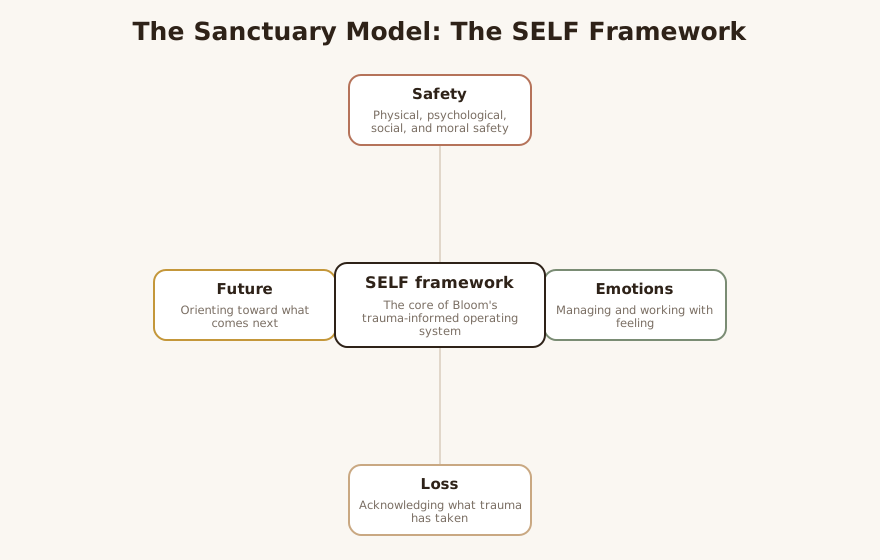
Two structures carry the model in day-to-day practice: the SELF framework and the Sanctuary Toolkit 6. SELF is an acronym — Safety, Emotional management, Loss, and Future — used as a compass for four interdependent domains of healing rather than as a staged protocol 62. It originated as an earlier tool called S.A.G.E. (Safety, Affect management, Grieving, Emancipation) before being renamed 2. Crucially, SELF is explicitly non-linear: any presenting problem can be categorized within one of the four domains, and naming and categorizing a problem is treated as the first step toward making it manageable 2. The four domains map onto the predictable disruptions of trauma — difficulty staying safe, difficulty managing emotion, unresolved loss, and difficulty envisioning a future 2.
The Sanctuary Toolkit operationalizes the philosophy into repeatable practices 6. A safety plan is a list of simple, self-soothing activities a person can choose when overwhelmed, as an alternative to unsafe or out-of-control behavior 6. Community meetings are deliberate, repetitive transition rituals that move people psychologically from one activity into a shared group space, preparing the way for collective thought and action 6. SELF psychoeducational groups help clients and staff reframe what happened to them and the role they must play in their own recovery 62. Red flag meetings give a team a structured way to respond to any critical incident or escalating concern as a group 6. SELF team meetings are focused staff meetings where every member contributes and generates ideas, and SELF treatment planning offers a non-hierarchical, shared-language approach to measuring client progress and naming obstacles 6.
Evidence Base
Honesty about maturity matters here. Sanctuary is best described as established as an implemented framework — widely adopted, manualized, and supported by a formal certification process — rather than as a deeply RCT-validated clinical treatment 6LLM. Early research was both qualitative and quantitative and demonstrated that the model could reduce violence and coercive intervention in adult psychiatric settings 6. As applied to residential child care, the model is considered evidence-supported on the basis of a controlled study by Jeanne Rivard and colleagues funded through the National Institute of Mental Health 6. Subsequent work by Wendy McSparren and Darlene Motley demonstrated significant differences in organizational culture within organizations using the model 6. The expected, measurable outcomes the developers articulate include less violence of all kinds, better staff morale, lower staff turnover, fewer injuries to staff and clients, reduction or elimination of coercive intervention, and better client outcomes 2. Clinicians should weigh this as a coherent, replicated organizational-change framework with promising but limited controlled-outcome data, not as a body of definitive efficacy trials LLM.
Populations & Indications
The model was developed for adults maltreated as children but has since been applied across a range of human-service organizations, including residential treatment centers, public and private schools, domestic violence shelters, and drug and alcohol treatment centers 62. Bloom lists residential treatment settings for children and adults, acute-care inpatient units, substance-abuse programs, domestic violence shelters, homeless shelters, group homes, day hospitals, and intensive outpatient programs among the settings that have used it 2. Because the SELF domains are framed as human universals — unbound by gender, age, race, religion, or ethnicity — the developers report that children as young as four can use the SELF language appropriately in residential programs 2. Sanctuary is indicated wherever an organization serving traumatized populations wants to align its culture, policies, and staff practices with trauma theory rather than leaving trauma-informed care to individual clinicians alone LLM.
Problems-for-Work
The model targets problems at both the client and system level. At the client level, the SELF domains organize work on affect dysregulation, self-harm and crisis behavior, unresolved loss, and the foreclosed sense of future common in complex trauma 2.
- For a youth in residential care whose escalations end in restraint, a red flag meeting reframes the incident as a system response rather than an individual failure, addressing reliance on coercion 6LLM.
- For a woman in substance-use treatment, an individual safety plan and grieving rituals give structure to affect management and unresolved loss 2LLM.
At the system level, Sanctuary explicitly targets re-traumatization within the milieu, reliance on coercion, restraint, and seclusion, and staff burnout and turnover, treating these as symptoms of a trauma-organized culture to be worked on collectively 26.
Contraindications, Cautions & Cultural Humility
The clearest caution is mismatch of scope: Sanctuary is an organizational operating system, not a stand-alone clinical technique, so a single therapist cannot “implement” it alone — partial adoption without leadership commitment risks performative change 2LLM. The developers are candid that the process is demanding; one implementing site described it as “not for the faint of heart,” requiring leveling of hierarchy, intensive staff training, and complete redesign of programming over an extended period 2. Cultural humility is built into the model’s premise that being trauma-informed means sensitivity to how trauma has affected entire groups — Bloom names Native American, African American, and LGBTQ communities specifically — though clinicians should treat this as a starting orientation rather than a substitute for population-specific competence 2LLM. Reviewing policies and procedures to ensure they do not create unintended secondary trauma is itself part of the work, as one site found when its discharge criteria were punishing clients for their symptoms 2.
Treatment-Plan Suggestions & SMART Objectives
| Goal | SMART objective (example) | Mechanism |
|---|---|---|
| Improve physical and emotional safety | Client will complete a personalized written safety plan listing 5 self-soothing activities within 3 sessions | Safety plan as a structured alternative to unsafe behavior under stress 6 |
| Strengthen affect management | Client will use a 1-10 check-in to name daily feeling state and a plan to stay safe on 5 of 7 mornings over 4 weeks | SELF “Emotional management” domain; morning check-in ritual 2 |
| Process unresolved loss | Client will participate in a structured grieving ritual addressing one significant loss within 6 weeks | SELF “Loss” domain; grieving rituals 2 |
| Rebuild a sense of future | Client will identify 2 concrete future-oriented goals and one first step within 4 sessions | SELF “Future” domain; envisioning a better future 6 |
| Reduce reactive crisis cycles | Treatment team will convene a red flag meeting within 24 hours of any critical incident, for 8 weeks | Red flag meeting structure for group response to escalation 6 |
| Increase shared understanding of trauma | Client will attend 6 of 8 SELF psychoeducational group sessions over 8 weeks | SELF psychoeducation reframing “what happened to you” 62 |
| Build collaborative treatment planning | Client and clinician will co-author a SELF-organized treatment plan naming goals and obstacles by session 4 | Non-hierarchical SELF treatment-planning structure 6 |
Common Misconceptions
A frequent misconception is that Sanctuary is a therapy modality a clinician delivers to a client; in fact it is a full-system approach focused on organizational culture, not a specific intervention 2. A second is that SELF is a sequential, staged treatment — the developers are explicit that it is circular and non-linear, a compass rather than a staircase 26. A third is that the seven “commitments” and the seven “cultures” are two different lists; they are the same seven principles described in two registers, where, for example, the Commitment to Democracy corresponds to the Culture of Shared Governance 62. Finally, some assume trauma-informed work concerns only clients, when the model insists that staff members are frequently trauma survivors too and that systems themselves can become traumatized 2.
Training & Certification
Implementation is structured and time-bounded. A core multidisciplinary team — required to include representatives from every level of the organization so that every voice is heard — activates the change process, with active involvement from all key organizational leaders 6. A range of curricula and manuals supports implementation, alongside ongoing consultation and technical assistance from Sanctuary faculty, across a process that extends over three years and leads to Sanctuary certification 6. A defining early step is participation in the five-day Sanctuary Leadership Development Institute, an intensive workshop in which key organizational questions help leaders reclaim a culture of hopefulness and innovation 2. Staff then engage in prolonged dialogue to surface the organization’s strengths, vulnerabilities, and conflicts, often discussing “undiscussables” that have never been examined openly 26.
Key Terms
- SELF — Safety, Emotional management, Loss, Future; a non-linear compass for four domains of recovery, originally called S.A.G.E. 62
- Sanctuary Commitments — the seven guiding principles (Nonviolence, Emotional Intelligence, Social Learning, Open Communication, Democracy, Social Responsibility, Growth and Change), each tied to a trauma-recovery goal 6
- Parallel process — the idea that trauma-organized systems mirror the symptoms of traumatized individuals 6
- Trauma-organized culture — a stressed organization that becomes reactive, hierarchical, coercive, and punitive 2
- Sanctuary trauma — further harm experienced in a setting expected to be safe and healing 6
- Red flag meeting — a structured team response to a critical incident or escalating concern 6
- Living-learning environment — Maxwell Jones’s therapeutic-community concept that Sanctuary seeks to recreate 2
Resources & Further Reading
▶ Watch — a video introduction to this concept:
- The Sanctuary Model — Trauma-Informed Care Implementation Resource Center (CHCS)
- Bloom (2007), The Sanctuary Model of Trauma-Informed Organizational Change — The Source (PDF)
- Bloom (2012), Sanctuary Model — Figley Encyclopedia of Trauma entry (PDF)
- Bloom & Farragher, Restoring Sanctuary: A New Operating System for Trauma-Informed Systems of Care (Oxford University Press)
- The Sanctuary Model — The Sanctuary Institute
- Trauma Conference | Sanctuary Model — Dr. Sandra Bloom (YouTube)
Reflective / Supervision Questions
- Where in your own setting do you see evidence of a “trauma-organized culture” — reactivity, coercion, or punitive responses to client symptoms — and how might parallel process be operating between staff stress and client behavior? 26LLM
- When a client escalates, does your team respond as individuals or convene something like a red flag meeting; what would change if incidents were treated as a system concern rather than an individual failure? 6LLM
- How would you describe a current client’s presenting problems in the four SELF domains, and which domain is most foreclosed for them right now? 2LLM
- Which of your program’s policies might be inadvertently re-traumatizing clients or staff, and who has the authority to revise them? 2LLM
- Given that the controlled-outcome base is still limited, how would you communicate the model’s evidence status honestly to a client, family, or referring agency? 6LLM