
Type & Discipline
Trauma-Focused Cognitive Behavioral Therapy (TF-CBT) is a structured, short-term, components- and phase-based treatment model for children and adolescents who have experienced trauma, delivered jointly with their parents or caregivers 12. It sits within the family of targeted cognitive-behavioral protocols in clinical and child psychology, and it is designed to be completed in roughly 8-25 sessions with the child/adolescent and caregiver 1. Unlike open-ended trauma counseling, TF-CBT specifies a defined set of skill-building and trauma-processing components delivered in a sequenced arc, while preserving flexibility for clinical judgment and developmental fit 24. It is among the most extensively studied psychotherapies for pediatric posttraumatic stress, and it is widely disseminated through a national certification program and trauma-treatment networks 12.
Creators & Lineage
TF-CBT was developed by Drs. Judith Cohen, Anthony Mannarino, and Esther Deblinger, who built the model and conducted much of its foundational randomized-trial research 1. The treatment was originally designed for children who had experienced sexual abuse and has since been extended to a broad range of trauma exposures 1. Its intellectual lineage is explicitly hybrid: it integrates the cognitive and behavioral techniques of cognitive behavioral therapy with structured exposure principles, and it embeds these within an attachment- and family-informed frame by treating the caregiver as a central agent of the child’s recovery LLM. The model’s persistent emphasis on caregiver skill-building and conjoint child-parent work reflects this family-systems and attachment sensibility, situated inside an otherwise CBT-driven protocol 24.
Core Principles
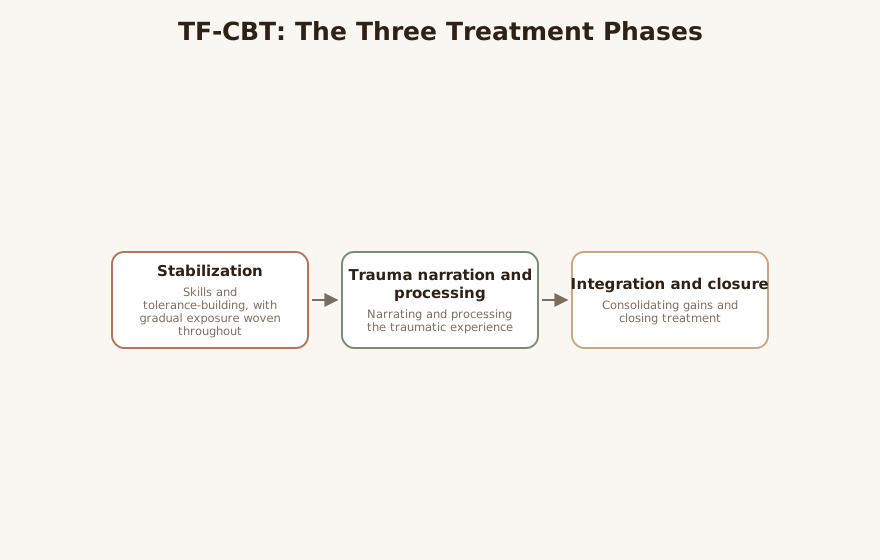
The treatment is organized around two interlocking ideas: that trauma symptoms in youth are maintained by avoidance and by distorted, trauma-related beliefs, and that recovery is accelerated when a supportive caregiver is equipped to help the child process the experience 12. Several principles follow from this. First, treatment is phase-based, moving across three broad phases — stabilization, trauma narration and processing, and integration and closure 4. Second, gradual exposure is woven throughout the entire course of treatment rather than confined to a single phase, so that the child’s tolerance for trauma-related material is titrated upward step by step 4. Third, caregiver involvement and caregiver skill-building also occur throughout treatment, regardless of whether the youth presents with a straightforward or a complex trauma history 4. Fourth, the model is proportional and adjustable: for standard presentations the three phases are divided into roughly equal thirds, whereas for complex trauma the clinician allocates about one-half of treatment to stabilization, one-quarter to trauma narration and processing, and one-quarter to integration and closure 4.
The components are commonly summarized with the mnemonic PRACTICE: Psychoeducation and Parenting skills, Relaxation, Affective expression and modulation, Cognitive coping, Trauma narrative and processing, In vivo mastery of trauma reminders, Conjoint child-parent sessions, and Enhancing safety and future development LLM. These map onto the three phases, with the skills components front-loading the stabilization phase, the trauma narrative anchoring the middle phase, and conjoint sessions plus safety planning consolidating the final phase 4LLM.
Interventions & Techniques
Stabilization phase. Early sessions build psychoeducation about trauma and common reactions, normalize the child’s symptoms, and teach concrete coping skills — relaxation and physiological down-regulation, affective expression and modulation, and cognitive coping (identifying and reframing inaccurate or unhelpful thoughts) 4LLM. In parallel, the caregiver receives psychoeducation and parenting-skills work so they can support the child and manage trauma-related behavior at home 24.
Trauma narration and processing phase. The child gradually develops a trauma narrative — a detailed account of the traumatic experience(s) created across multiple sessions — and the clinician helps process the cognitive and affective content, correcting distortions such as self-blame and challenging maladaptive beliefs 4LLM. For complex trauma, a single-event narrative may be replaced by a timeline or life narrative, and the clinician works at the level of underlying themes (for example, “I am damaged”) rather than a single discrete memory 4.
Integration and closure phase. The final phase emphasizes conjoint child-parent sessions in which the child shares the narrative with the caregiver in a prepared, supported way, alongside in vivo mastery of avoided but objectively safe trauma reminders, and enhancing safety and future development 24LLM. Notably, for youth with complex trauma the ordering is adapted clinically: safety planning may be implemented first even though it appears last in the standard protocol, and relaxation and coping strategies may precede formal psychoeducation 4.
LLM-generated illustrative example (not a guideline): A 9-year-old who witnessed domestic violence shows hypervigilance and nightmares. In stabilization, the clinician teaches belly-breathing and a feelings thermometer while coaching the mother on praise and predictable routines. Over several sessions the child dictates a narrative of “the night the police came,” and the clinician helps reframe “I should have stopped it” into “I was a kid; keeping safe was the grown-ups’ job.” A conjoint session lets the child read the story to a calm, prepared parent. LLM
Evidence Base
The evidence base for TF-CBT is established, not preliminary. The developers report that the model has been tested in roughly 25 randomized controlled trials conducted in the United States, Europe, and Africa, with consistent superiority over comparison conditions 1. NCTSN similarly describes strong evidence for improving children’s PTSD and related difficulties, drawn from those RCTs plus many additional effectiveness studies worldwide 2. TF-CBT is listed in federal and professional evidence registries, including SAMHSA’s resources and the American Psychological Association Division 12 (Society of Clinical Psychology) treatment archive 37. A dedicated evidence appraisal published in Psychiatric Services reviewed the controlled literature specifically to assess the strength of support for the model 6.
Honest caveats are warranted. The most relevant Cochrane systematic review of psychological therapies for PTSD in children and adolescents (14 RCTs, 758 participants) concluded that CBT-based approaches have the best evidence of effectiveness, with large reductions in PTSD symptoms at one month and meaningful effects on depression 5. However, the same review judged the overall evidence as fair, citing the small number and small size of trials, unclear risk of selection/detection/attrition bias, and unexplained heterogeneity; it cautioned that more evidence is needed for effectiveness beyond one month post-treatment, where effect sizes attenuated 5. That review also did not always distinguish TF-CBT from general CBT 5. Clinicians should therefore hold a stance of confident-but-calibrated: the model is well supported for short-term symptom reduction, with durability and complex-presentation outcomes less definitively settled 5LLM.
Populations & Indications
TF-CBT is indicated for youth roughly ages 3-18, with developmentally tailored delivery across young children (3-6), school-age children (7-12), and adolescents (13-18), always paired with a participating parent or caregiver 2. Although it originated as a treatment for childhood sexual abuse, it now addresses any type of trauma and has particular relevance for intimate partner / domestic violence exposure, sexual abuse, and childhood traumatic grief 12. Beyond core PTSD symptoms, the model improves affective problems (depression, anxiety), cognitive problems, and behavioral problems, and it reduces participating caregivers’ personal distress while strengthening parenting skills 1. It is appropriate when there is an identifiable trauma history, trauma-related symptoms, and a caregiver (or caregiving figure) able to participate 2LLM.
Problems-for-Work
- Posttraumatic stress disorder — the primary target; gradual exposure plus the trauma narrative directly address re-experiencing and avoidance 24.
- Childhood trauma and sexual abuse sequelae — the original indication; cognitive processing targets self-blame and the belief “it was my fault” 14LLM.
- Childhood traumatic grief — bereaved children where trauma symptoms intrude on mourning are an explicit population 12.
- Depression and anxiety — affective modulation and cognitive coping reduce comorbid mood and anxiety symptoms 1.
- Behavioral problems — parenting-skills components and caregiver coaching reduce trauma-driven dysregulated behavior 12.
- Trauma-related shame and cognitive distortions — processing addresses themes such as “I am damaged” or “the world is entirely unsafe” 4LLM.
- Affect dysregulation — relaxation and affective-expression skills build down-regulation capacity before exposure work begins 4LLM.
Contraindications, Cautions & Cultural Humility
TF-CBT presumes a caregiver who can participate constructively; where no safe, willing caregiver is available, the clinician must adapt (for example, working with a kinship or surrogate caregiver) and recognize that the conjoint components cannot be delivered as designed 2LLM. Active safety threats take precedence: in complex or high-risk presentations, safety planning is moved to the front of treatment rather than left to the closure phase 4. The trauma-narrative phase should not be rushed when stabilization skills are not yet in place, and for complex trauma a larger share of the course is deliberately devoted to stabilization for this reason 4. Gradual exposure must remain gradual and should target objectively safe reminders, not genuinely dangerous situations 4LLM.
On cultural humility: the model has been studied and applied across diverse cultures and countries, including trials in Africa and Europe, which supports — but does not guarantee — cross-cultural transportability 1. Clinicians should adapt psychoeducation, the meaning of the trauma, family roles, and grief practices to the family’s cultural and spiritual frame, treating the caregiver as the expert on the child’s world 2LLM. Caution is also warranted when generalizing efficacy findings: the controlled evidence is strongest for short-term outcomes, so claims of durable cure should be made carefully 5LLM.
Treatment-Plan Suggestions & SMART Objectives
| Goal | SMART objective (example) | Mechanism |
|---|---|---|
| Reduce PTSD symptom severity | Within 12 sessions, reduce child-report PTSD scale score by 50% from baseline | Gradual exposure + trauma narration and processing 24 |
| Build affect-regulation skills | Within 4 weeks, child independently uses a named relaxation/coping skill in 3 of 5 distressing situations | Relaxation + affective modulation components 4 |
| Correct trauma-related cognitions | By session 10, child verbalizes 2 reframed, accurate beliefs replacing self-blame statements | Cognitive coping + processing of distortions 4LLM |
| Increase caregiver support capacity | Within 6 weeks, caregiver demonstrates 3 taught parenting/support skills in session role-play | Parenting-skills + caregiver psychoeducation 12 |
| Complete a coherent trauma narrative | Over the narration phase, child constructs and shares a full narrative across ≥4 sessions | Trauma narrative development 4 |
| Reduce trauma-related avoidance | Within 8 weeks, child re-engages 2 previously avoided safe reminders without panic | In vivo mastery of trauma reminders LLM |
| Improve mood / reduce depression | Within treatment course, reduce depression screen score to subclinical range | Affective + cognitive components addressing comorbidity 1 |
| Establish a safety plan | By session 3 (complex cases), child and caregiver state and rehearse a written safety plan | Enhancing safety component, front-loaded as indicated 4 |
Common Misconceptions
- “The trauma narrative is the whole treatment.” The narrative is one phase; stabilization skills precede it and conjoint/safety work follows, with gradual exposure running throughout 4LLM.
- “Exposure happens only in one block.” Gradual exposure is integrated across the entire course, not confined to the narration phase 4.
- “It’s only for sexual abuse.” Although that was the original indication, TF-CBT now addresses any type of trauma, including domestic violence and traumatic grief 12.
- “Caregivers are optional.” Caregiver skill-building and conjoint work are core, not adjunctive, and occur throughout regardless of trauma complexity 4.
- “More sessions is always better.” The model is short-term (8-25 sessions), with longer courses reserved for complex trauma rather than being the default 14.
- “The evidence is unlimited.” Support is strong but not absolute — durability beyond one month and complex-case outcomes are less firmly established 5LLM.
Training & Certification
TF-CBT is supported by a formal national therapist certification program associated with the model’s developers, reflecting structured pathways for learning and credentialing the protocol 1. The treatment is also catalogued in major dissemination and evidence resources — the National Child Traumatic Stress Network, SAMHSA’s evidence-based-practice resources, and the APA Division 12 treatment archive — which clinicians can use to verify the model’s status and locate implementation supports 237. Faithful delivery typically involves training, consultation, and adherence to the phase-and-component structure rather than improvised trauma work 2LLM.
Key Terms
- PRACTICE — the components mnemonic: Psychoeducation/Parenting, Relaxation, Affective modulation, Cognitive coping, Trauma narrative, In vivo mastery, Conjoint sessions, Enhancing safety LLM.
- Gradual exposure — the titrated, throughout-treatment approach to trauma reminders that distinguishes TF-CBT from one-time confrontation 4.
- Trauma narrative — the detailed, multi-session account the child constructs and later processes for cognitive distortions 4LLM.
- Phase-based treatment — the three-phase arc of stabilization, narration/processing, and integration/closure 4.
- Conjoint child-parent session — a prepared joint session where the child shares the narrative with a supported caregiver 24.
- Childhood traumatic grief — bereavement in which trauma symptoms interfere with normal mourning, an explicit TF-CBT population 12.
Resources & Further Reading
▶ Watch — a video introduction to this concept:
- About TF-CBT — TF-CBT National Therapist Certification Program (official)
- Trauma-Focused Cognitive Behavioral Therapy — The National Child Traumatic Stress Network (NCTSN)
- Trauma-Focused Cognitive Behavioral Therapy (TF-CBT) — SAMHSA
- Clinician’s Corner: TF-CBT — ISTSS (Mannarino & Cohen)
- Psychological therapies for PTSD in children and adolescents — Cochrane
- TF-CBT for Children and Adolescents: Assessing the Evidence — Psychiatric Services
- Society of Clinical Psychology (APA Division 12) — Psychological Treatments archive
Reflective / Supervision Questions
- Have I confirmed that the youth has adequate stabilization skills before beginning the trauma narrative, and how am I gauging readiness? 4LLM
- Is the caregiver positioned as an active agent in this child’s recovery, and what specifically am I doing to build their support and parenting skills? 24LLM
- For a complex-trauma presentation, have I reallocated more of the course to stabilization and considered front-loading safety planning? 4
- Am I keeping exposure genuinely gradual and targeting objectively safe reminders rather than real danger? 4LLM
- How am I adapting psychoeducation and meaning-making to this family’s cultural, spiritual, and grief context? 2LLM
- Given that durable, long-term effects are less firmly established, how am I measuring maintenance of gains beyond the end of treatment? 5LLM