
Type & Discipline
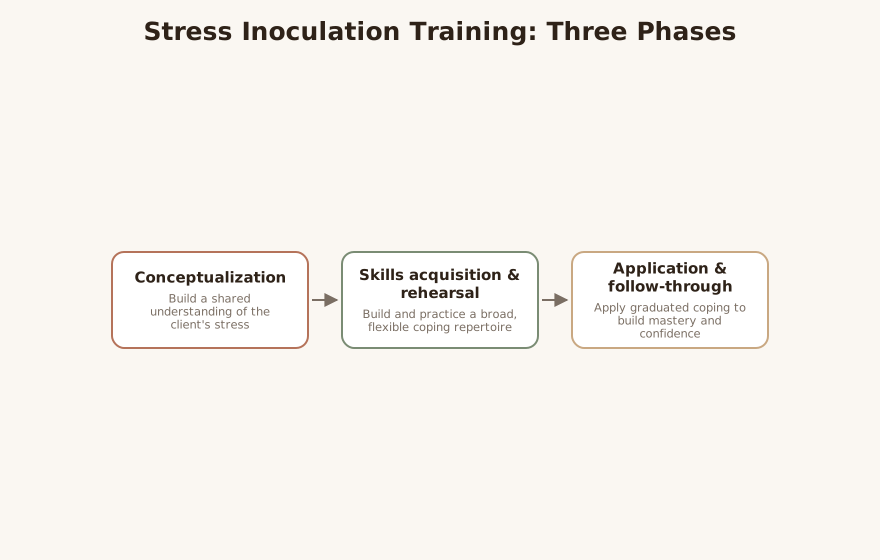
Stress Inoculation Training (SIT) is a structured cognitive-behavioral modality within clinical psychology, belonging to the family of cognitive-behavioral therapies LLM. It is best understood not as a single fixed protocol but as a flexible, individually tailored, multifaceted form of cognitive-behavioral therapy that supplies a set of general principles and clinical guidelines rather than a canned treatment formula 2. SIT is explicitly a coping-skills and stress-management framework: a non-trauma-focused cognitive-behavioral approach that teaches techniques to manage stress and anxiety 3. Its defining architecture is three interlocking, overlapping phases — conceptualization, skills acquisition and rehearsal, and application and follow-through 12. Because it is delivered through the same change mechanisms as CBT (psychoeducation, Socratic dialogue, skills training, behavioral rehearsal, graded exposure, relapse prevention), it is most accurately classified as a CBT protocol rather than a free-standing school of therapy LLM.
Creators & Lineage
SIT was developed by Donald Meichenbaum, who described roughly three decades of clinical and research work under the SIT label beginning in the mid-1970s 2. It grew directly out of Meichenbaum’s earlier work on cognitive-behavior modification and self-instructional training, in which clients learn to alter their internal dialogue and develop internal mediators to self-regulate behavior 2. The 1988 Counseling Psychologist article co-authored with Jerry L. Deffenbacher became a canonical statement of the three-phase model 1. Jerry Deffenbacher and Raymond Novaco are central figures in extending SIT to anger control and aggression, including applications with law enforcement and probation officers 2.
Theoretically, SIT rests on the transactional model of stress and coping of Lazarus and Folkman, in which stress arises whenever the perceived demands of a situation tax or exceed the system’s perceived coping resources 2. Meichenbaum also draws on a constructive narrative perspective: clients are viewed as story-telling beings, and the narratives they construct about themselves, others, and the future shape their coping 2. Lineage connections therefore run to cognitive behavioral therapy broadly, to Meichenbaum’s cognitive-behavioral modification and self-instructional training, and to the relaxation- and coping-skills training traditions that supply many of SIT’s component techniques LLM.
Core Principles
The organizing metaphor is medical inoculation: just as exposure to a weakened form of a pathogen builds immunity, controlled exposure to manageable doses of stress can build psychological “antibodies” — coping responses and confidence in using them 2. Meichenbaum traces this to Jenner’s cowpox observation, to the biology of hormesis (small doses of a stressor stimulating protective repair mechanisms), and to McGuire’s social-psychological work showing that prior exposure to weak counter-arguments can inoculate against later persuasion 2. In each case, resistance is enhanced by a stimulus strong enough to arouse coping processes without overwhelming the person 2.
Several principles follow from this LLM. First, the goal is preparedness and a sense of mastery, not the elimination of arousal 2. Second, there is no single “correct” way to cope; SIT cultivates a broad, flexible repertoire and matches problem-focused coping to changeable stressors and emotion-focused or acceptance-based coping to unchangeable ones 2. Third, the work is relentlessly collaborative — the therapeutic alliance is described as the “glue” that allows clients to confront stressors and practice skills both in session and in vivo 2. Fourth, education in SIT is Socratic and discovery-oriented rather than didactic, and it continues throughout treatment 2. Finally, SIT often extends beyond the individual client, adopting a “dual-track” strategy of also working with significant others and community agents (hospital staff, coaches, parents) who may inadvertently maintain stress 2.
Interventions & Techniques
Phase 1 — Conceptualization. The clinician establishes a collaborative alliance, elicits the client’s “story,” and helps translate global stress complaints into behaviorally specific problems 2. Techniques include Socratic discovery-based interviewing, self-monitoring, imagery-based reconstruction of a prototypic stressful incident, psychological testing with strengths-oriented feedback, bibliotherapy, and exposure to coping-modeling films 2. Clients learn to disaggregate large stressors into short-, intermediate-, and long-term goals and to distinguish changeable from unchangeable aspects of a situation 2. The phase culminates in a shared reconceptualization that reframes distress as a normal, understandable reaction and frames the client as resourceful rather than defective — Meichenbaum notes the plausibility of this reconceptualization matters more than its scientific precision 2.
Phase 2 — Skills acquisition and rehearsal. Clients acquire and consolidate coping skills tailored to their needs, which can include relaxation training (e.g., applied, cue-controlled relaxation), cognitive restructuring, problem-solving training, self-instructional training, positive coping self-statements, assertion and communication skills, anger control, and use of social supports 23. Emotion-focused palliative skills — perspective taking, attention diversion, reframing, humor, acceptance, and spiritual practices — are trained for uncontrollable stressors 2. Skills are first rehearsed in session through behavioral and imagery rehearsal and coping modeling, then practiced in vivo, with explicit attention to building generalization rather than “training and hoping” 2.
Phase 3 — Application and follow-through. Clients apply skills across graded, increasingly demanding stressors — the actual “inoculation trials” — using coping imagery, role play, behavioral rehearsal, and graded in vivo exposure 2. This phase incorporates relapse prevention (identifying high-risk situations, reframing lapses as learning opportunities), attribution retraining so clients “take credit” for their gains, and follow-through via booster sessions and involvement of significant others 2.
Evidence Base
SIT is an established intervention, but its evidentiary maturity is uneven across problems, and the honest picture for PTSD is notably weaker than its reputation as a “classic” CBT LLM. As a broad stress-, anxiety-, anger-, and performance-management framework it has a long track record across hundreds of case studies, demonstration projects, and outcome studies reviewed over decades 2. For anger and aggression specifically, Meichenbaum cites meta-analytic work on cognitive-behavioral anger treatments (DiGuiseppe & Tafrate) reporting average effect sizes ranging from .67 to .99 with a mean near .70, and a Beck and Fernandez meta-analysis of 50 SIT and CBT interventions across 1,640 subjects — findings that apply to anger/CBT interventions broadly as reported in his chapter, not to SIT as a generic effect size 2. Programs using standardized manuals and fidelity checks were the most effective 2.
For PTSD, the guideline verdict is restrained. The 2017 VA/DoD Clinical Practice Guideline gives SIT a “Weak For” strength of recommendation, suggesting it as an individual, manualized, non-trauma-focused option when trauma-focused therapies are unavailable or the patient declines them 3. A 2018 AHRQ systematic review found insufficient evidence to determine SIT’s efficacy for PTSD, and the 2013 Cochrane review folded SIT into the broader category of non-trauma-focused CBT without examining it on its own 3. A 2019 literature search identified no randomized controlled trials of SIT for PTSD published since the 2017 guideline search 3.
Two caveats keep this honest in both directions LLM. In Foa and colleagues’ comparative trials, SIT outperformed supportive counseling and waitlist, but there was a trend for prolonged exposure (PE) clients to reach higher overall functioning, and combining treatments did not improve — sometimes slightly worsened — outcomes 2. Meichenbaum argues these trials handicapped SIT by stripping out its third (application/exposure) phase to avoid overlap with the PE condition, so the comparison tested only the first two phases 2. Notably, SIT (but not PE) produced a greater decrease in anger in assault survivors, suggesting SIT is particularly well-suited where anger is prominent 2.
Populations & Indications
SIT has been applied, on both treatment and preventive bases, across a strikingly wide range of populations 2. Medical and procedural populations include surgical and dental patients, burn patients, those with chronic and acute pain, hypertension, rheumatoid arthritis, and the caretakers of medically ill children and adults 2. Psychiatric applications include patients with panic and severe anxiety, PTSD (especially following sexual assault), and anger-control and aggression problems 2. SIT has also targeted performance and evaluative anxiety (public speaking, test, math, dating, and athletic competition), circumscribed fears such as animal phobias and fear of flying, and life-transition stress such as unemployment, military entry, and relocation 2. High-stress occupational groups — military personnel, nurses, teachers, probation officers, and disaster and safety workers — are a recurring preventive target 2. This maps directly onto the populations of interest to clinicians: veterans, first responders, trauma survivors, athletes, adults broadly, people with chronic illness, and patients facing medical procedures LLM.
Problems-for-Work
SIT lends itself to problems where appraisal, arousal, and coping behavior are the levers of change LLM. For performance anxiety, an athlete might be taught cue-controlled relaxation and “anti-stress” self-statements, then rehearse them under trainer-induced high arousal before competition — packaged as “mental toughness” self-control training rather than therapy 2. For anger, an assault survivor or a high-anger first responder can use the conceptualization phase to map the trigger-emotion-thought-behavior “vicious cycle,” then rehearse coping responses for high-risk provocations 2. For chronic pain and chronic illness, emotion-focused and attention-diversion skills are emphasized for the unchangeable components, alongside problem-solving for what can be altered 2. For acute medical procedures, brief SIT (sometimes as short as 20 minutes pre-surgery) reduced pre-operative anxiety, analgesic requests, and length of stay in early studies 2. For PTSD, acute stress disorder, and adjustment difficulties, SIT is appropriate as a non-trauma-focused coping framework, with the clinically important constraint that for PTSD it is second-line to trauma-focused therapies 3.
LLM-generated illustrative example (not a guideline): A paramedic with escalating irritability and intrusive arousal after a series of pediatric calls works through conceptualization (mapping how a dispatch tone triggers a surge of “I can’t do this again,” then snapping at colleagues), acquires paced breathing and a reappraisal script in phase two, and in phase three rehearses these against graded imagined call scenarios before applying them on shift, reviewing successes to “take credit” for regained control LLM.
Contraindications, Cautions & Cultural Humility
The provided sources do not enumerate formal contraindications, and clinicians should not infer rigid exclusion criteria that the literature does not support LLM. The most explicit caution comes from Meichenbaum himself: SIT is “not a panacea” and is often best used as a supplemental tool alongside other interventions — for example, with Prolonged Exposure for traumatized patients, or with environmental and community supports for chronic stressors 2. The evidence-based caution for PTSD is concrete: because SIT carries only a “Weak For” recommendation, offering it as a stand-alone PTSD treatment when an effective trauma-focused therapy is available and acceptable to the patient is hard to justify 3. Treatment decisions should weigh clinical judgment, patient history, and preferences that affect engagement and retention 3.
On cultural humility, SIT’s flexibility is also where its risk lies LLM. Meichenbaum frames SIT as needing to be delivered in a culturally sensitive fashion, and his account of consulting to a dislocated Inuit community in Nunavut illustrates how individual coping work is inadequate without attention to chronic structural stressors — poverty, dislocation, racism, and collective trauma 2. The principle that “the plausibility of the reconceptualization is more important than its scientific validity” places real responsibility on the clinician to ground reframes in the client’s own worldview rather than impose the therapist’s 2. Skill: an over-individualized “just cope better” message can be invalidating where the stressor is environmental and unjust, which is why SIT’s dual-track work with significant others and systems matters LLM.
Treatment-Plan Suggestions & SMART Objectives
| Goal | SMART objective (example) | Mechanism |
|---|---|---|
| Build a usable coping repertoire | Within 4 sessions, client demonstrates at least 3 coping skills (e.g., cue-controlled relaxation, a reappraisal script, paced breathing) and self-rates confidence using them at >=6/10 | Skills acquisition and rehearsal phase 2 |
| Increase awareness of the stress cycle | Within 2 weeks, client completes daily self-monitoring logs linking triggers, appraisals, emotions, and behaviors on >=5 of 7 days | Conceptualization / Socratic self-monitoring 2 |
| Reduce performance/evaluative anxiety | By session 8, client rehearses coping skills under graded imagined stressors and reports a 30% drop in peak subjective anxiety during a target performance | Application phase “inoculation trials” 2 |
| Improve anger control | Over 6 weeks, client uses a rehearsed coping response in >=3 real provocations and logs reduced escalation, verified by self-report and collateral | Trigger-cycle mapping plus rehearsal 2 |
| Prepare for a medical procedure | Before the scheduled procedure, client practices relaxation, coping self-talk, and coping imagery and reports readiness >=7/10 | Brief procedural SIT 2 |
| Match coping to controllability | Within 3 sessions, client correctly classifies 4 current stressors as changeable vs. unchangeable and selects a fitting coping strategy for each | Problem- vs. emotion-focused coping 2 |
| Consolidate gains and prevent relapse | In the final 2 sessions, client identifies 3 high-risk situations, rehearses responses, and reframes a recent lapse as a learning opportunity | Relapse prevention / attribution retraining 2 |
Common Misconceptions
A frequent misconception is that SIT is just a grab-bag of relaxation and coping techniques LLM. Meichenbaum is emphatic that SIT is “more than” a collection of coping techniques — without the inoculation trials, application opportunities, and collaborative narrative work, the skills components are “unlikely to prove effective, nor sufficient” 2. A second misconception is that SIT aims to eliminate stress or arousal; in the athletic adaptation, the explicit goal is greater control over emotional responses, not their removal 2. A third is that SIT is a robustly evidence-based stand-alone PTSD treatment — in fact it is a non-trauma-focused option with only a “Weak For” recommendation and insufficient stand-alone PTSD efficacy data 3. A fourth is that the comparative trials proved SIT inferior to exposure; Meichenbaum notes those trials removed SIT’s exposure-bearing third phase, complicating any clean head-to-head conclusion 2.
Training & Certification
There is no single proprietary certification required to practice SIT; it is an open cognitive-behavioral framework documented in Meichenbaum’s manuals and treatment texts, and the provided sources do not describe a formal credentialing body LLM. Competent delivery presumes general CBT training — alliance-building, Socratic method, cognitive restructuring, relaxation and skills training, graded exposure, and relapse prevention — applied through SIT’s three-phase structure 2. The sources note that programs using standardized manuals and treatment-fidelity checks were the most effective, which argues for manual-guided implementation and supervision rather than informal improvisation 2. Clinicians should also note SIT’s emphasis that treatment length be performance-based (tied to demonstrated mastery and self-efficacy) rather than a fixed session count, while recognizing most clinical applications run roughly 8 to 15 sessions plus boosters 2.
Key Terms
- Inoculation trial: A graded exposure to a manageable dose of stress in which the client practices coping responses, building confidence and “psychological antibodies” 2.
- Conceptualization phase: The first phase, establishing alliance, eliciting the client’s narrative, and reframing distress in collaborative, normalizing terms 2.
- Transactional model of stress: Lazarus and Folkman’s view that stress arises when perceived demands exceed perceived coping resources 2.
- Constructive narrative perspective: The view that clients’ self-stories shape coping, and that therapy helps clients move from “victim” to “survivor” to “thriver” 2.
- Problem-focused vs. emotion-focused coping: Strategies matched to changeable versus unchangeable stressors, respectively 2.
- Non-trauma-focused CBT: The category SIT occupies for PTSD, focused on managing anxiety rather than processing the trauma memory 3.
- Generalization technology: Deliberate procedures built into treatment so skills transfer beyond the clinic rather than relying on “train and hope” 2.
Resources & Further Reading
▶ Watch — a video introduction to this concept:
- Meichenbaum, D., & Deffenbacher, J. L. (1988). Stress Inoculation Training. The Counseling Psychologist (SAGE)
- Meichenbaum, D. Stress Inoculation Training: A Preventative and Treatment Approach (Melissa Institute PDF)
- Stress Inoculation Training for PTSD — PHCoE / Defense Health Agency Evidence Brief
- Stress inoculation training (Springer Nature chapter)
- A Vaccine for Stress? How Stress Inoculation Training Can Help — PsychCentral
Reflective / Supervision Questions
- For a given client, am I delivering all three phases, or have I drifted into teaching coping skills without the conceptualization and application/inoculation work that the model treats as essential 2?
- If my client has PTSD, have I clearly considered and discussed trauma-focused therapies first, and can I justify SIT as a deliberate second-line or supplemental choice rather than a default 3?
- Whose reconceptualization am I offering — one that fits the client’s culture and worldview, or one I find scientifically tidy 2?
- For this client’s primary stressors, am I correctly matching problem-focused coping to what is changeable and emotion-focused/acceptance coping to what is not 2?
- Where structural or systemic stressors dominate, am I also engaging the “dual track” — significant others and systems — rather than placing the full burden of change on the individual 2?
- Is my treatment length anchored to demonstrated mastery and self-efficacy, or am I defaulting to an arbitrary session count 2?