
Type & Discipline
Cognitive Behavior Modification (CBM) is a modality within clinical psychology that sits in the cognitive-behavioral family of treatments 1. It is an integrative framework: it joins the rigor of behavior modification and operant conditioning with an explicit focus on the client’s covert speech — the running internal dialogue that precedes, accompanies, and follows behavior 1. Its best-known clinical method is Self-Instructional Training (SIT), a structured procedure for replacing maladaptive self-talk with adaptive, task-guiding self-statements 2. Throughout this article CBM refers to the broader approach and Self-Instructional Training to its core technique 3.
CBM is best understood as a “second-wave” cognitive-behavioral approach that emerged in the 1970s, when behaviorism was incorporating private cognitive events as legitimate, modifiable targets 1. Rather than treating thoughts as epiphenomena, CBM treats inner speech as behavior that can be shaped through modeling, rehearsal, and reinforcement 3. This positions it alongside, and historically just ahead of, the cognitive therapies of Beck and Ellis, with which it later largely merged LLM.
Creators & Lineage
The approach was developed by Donald Meichenbaum, a Canadian clinical psychologist whose 1977 book Cognitive-Behavior Modification: An Integrative Approach formalized the framework 1. Meichenbaum is widely regarded as one of the founders of cognitive-behavioral therapy, and his publication record documents the evolution of self-instructional methods and stress inoculation across several decades 5.
The intellectual lineage of CBM is unusually explicit about its developmental-psychology roots 3. Meichenbaum drew on the Soviet psychologists Lev Vygotsky and Alexander Luria, who described how children’s self-regulation develops as overt external speech (an adult’s instructions) is gradually internalized into the child’s own private, self-directing speech 3. Self-Instructional Training deliberately recapitulates this developmental sequence in the consulting room or classroom, moving the client from being guided by another’s words to guiding themselves 2.
CBM’s second parent is behavior modification and operant conditioning, which supplied its emphasis on modeling, graded practice, shaping, and reinforcement 1. A third major branch grew directly out of CBM: stress inoculation training, Meichenbaum’s structured method for building coping skills against anticipated stressors, which applies the same logic of rehearsed self-statements to physiological and emotional arousal 4. Downstream, the self-instructional and coping-skills emphases of CBM were absorbed into mainstream cognitive-behavioral therapy, where they survive as standard techniques even when the CBM label is no longer used LLM.
Core Principles
The organizing premise of CBM is that what people say to themselves matters 1. Maladaptive behavior is sustained in part by maladaptive internal dialogue — self-statements that are catastrophic, self-critical, distracting, impulsive, or simply absent when guidance is needed — and changing that dialogue changes behavior and affect 6. Treatment therefore targets the content, timing, and function of self-talk rather than treating it as a private byproduct 3.
A second principle is that adaptive self-guidance can be taught, not merely encouraged 2. CBM does not ask clients to “think positively”; it teaches a concrete repertoire of self-statements that orient attention, define the task, plan steps, cope with errors, and deliver self-reinforcement 6. These categories of self-talk — problem definition, focusing of attention, self-guiding instruction, coping and error-correction, and self-reward — recur across most CBM protocols 6.
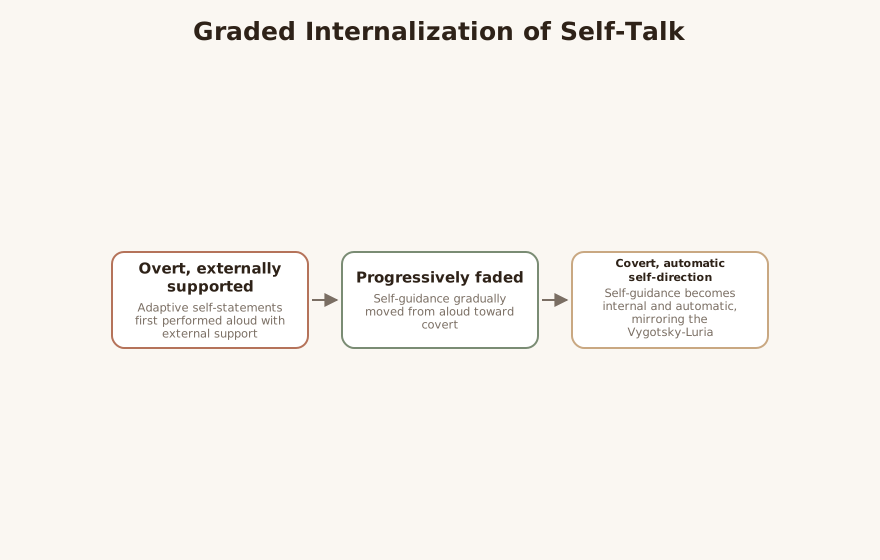
A third principle is graded internalization 3. Skills are first performed aloud and externally supported, then progressively faded to covert, automatic self-direction, mirroring the Vygotsky-Luria account of how regulation normally develops 3. A fourth is collaborative empiricism and a non-pathologizing stance: the client is recast as an active problem-solver who is acquiring coping skills, and behavioral assignments test new self-statements in vivo 4. Finally, CBM assumes that cognition, affect, physiology, and behavior are reciprocally linked, so a change in inner speech is expected to propagate to arousal and action 1.
Interventions & Techniques
The flagship intervention is the five-step Self-Instructional Training sequence 2. First, cognitive modeling: the therapist performs the target task while speaking the relevant self-instructions aloud 2. Second, overt external guidance: the client performs the task while the therapist speaks the instructions 3. Third, overt self-guidance: the client performs the task while instructing themselves aloud 3. Fourth, faded (whispered) self-guidance: the client instructs themselves in a whisper or with lip movements 2. Fifth, covert self-instruction: the client performs the task while guiding themselves through silent, internal speech 3. The fading from therapist-spoken to silently self-spoken instruction is the heart of the method 6.
The self-statements rehearsed at each step are typically grouped into functional classes — defining the problem (“What do I have to do here?”), focusing attention and planning (“Go slowly, take it one step at a time”), coping with difficulty and error (“That’s a mistake; I can slow down and try again”), and self-reinforcement (“Good, I did it”) 6. Therapists model errors and recovery on purpose, so that clients learn coping self-talk rather than perfectionistic performance 4.
Stress inoculation training extends these methods into a three-phase coping framework 4. The first phase, conceptualization (education), helps the client understand the nature of stress and reframe threats as solvable problems 4. The second, skills acquisition and rehearsal, builds and practices coping responses — relaxation, cognitive restructuring, adaptive self-statements, and problem-solving 4. The third, application and follow-through, exposes the client to graded, manageable stressors so the new skills are rehearsed under realistic load before real-world demands 4. The “inoculation” metaphor is deliberate: controlled exposure to lower doses of stress builds psychological resistance to larger ones 4.
LLM-generated illustrative example (not a guideline): A clinician working with an impulsive third-grader first solves a maze worksheet aloud — “Okay, where do I start? Go slow, no rush. Oops, dead end — that’s fine, I’ll back up and try the other way. Nice, I found it.” The child then completes the next maze while the clinician coaches aloud, then while talking to themselves, then in a whisper, and finally silently. LLM.
Evidence Base
Honesty about maturity matters here. CBM and Self-Instructional Training are an established but largely foundational approach: their strongest evidence is decades old, and much of their content has been absorbed into mainstream cognitive-behavioral therapy rather than studied under the CBM banner in recent trials LLM. The framework’s historical importance is well documented in Meichenbaum’s own integrative text and publication record 15.
Self-Instructional Training accumulated its best support with children, particularly for impulsivity, hyperactivity, and self-control deficits, where teaching verbal mediation improved performance on attentional and problem-solving tasks 3. The reference and encyclopedia literature treats self-instruction as an established behavioral-cognitive technique with a recognized procedural base 2. At the same time, effects in some later and more controlled trials — especially for generalization and durability of gains, and for translating laboratory improvements into classroom or real-world behavior — have been modest or mixed LLM.
Stress inoculation training has the more robust independent evidence stream within this lineage, with applications documented across stress, anxiety, and coping with anticipated stressors, and it is presented by Meichenbaum as both preventive and treatment-oriented 4. Clinicians should therefore weight the self-instructional and stress-inoculation components by their specific evidence rather than assume uniform support across the whole framework LLM. The practical implication: use these methods as skill-building tools nested within a broader, better-evidenced CBT case formulation, not as a standalone cure LLM.
Populations & Indications
CBM was developed and validated first with children, and self-instructional methods remain most strongly associated with pediatric and school populations 3. Indicated groups include children with impulsivity and hyperactivity, people with attention-deficit/hyperactivity disorder, and students with learning and behavioral problems who benefit from explicit verbal self-guidance 2. The developmental logic — externalize the guiding speech, then fade it — maps naturally onto children who have not yet internalized self-regulatory language 3.
Self-instructional and coping-skills methods also extend to impulsive individuals more broadly, adults with anxiety, and people with developmental and intellectual disabilities, for whom concrete, rehearsable self-statements scaffold task completion and emotion regulation 2. Through stress inoculation, the indications widen further to test anxiety, performance anxiety, and preparation for anticipated stressors in otherwise non-clinical populations 4. The method’s structure — modeling, rehearsal, fading — makes it adaptable across cognitive levels, which is part of its appeal for developmental-disability and child contexts LLM.
Problems-for-Work
CBM and Self-Instructional Training are well matched to problems where the missing ingredient is adaptive, well-timed internal guidance LLM.
- Impulsivity and self-control deficits. The five-step fading sequence teaches a “stop and talk it through” routine that interrupts impulsive responding; a clinician might rehearse “Go slowly, one step at a time” with a child before timed tasks 2.
- Attention-deficit/hyperactivity disorder and hyperactivity. Verbal self-guidance supports sustained attention and planning, used adjunctively alongside behavioral and medical management 3.
- Maladaptive self-talk. Catastrophic or self-critical inner speech is directly targeted by substituting coping and self-reinforcing statements 6.
- Anxiety disorders and test anxiety. Coping self-statements and graded rehearsal reduce avoidance; a student practices “I can handle this one question at a time” before mock exams 4.
- Aggression and conduct problems. Self-instruction inserts a verbal pause between provocation and action, supporting alternative responses LLM.
- Stress. Stress inoculation builds a rehearsed coping repertoire applied to anticipated stressors across the three phases 4.
LLM-generated illustrative example (not a guideline): An adult with test anxiety rehearses a coping script — “My heart racing means I’m activated, not in danger; define the task, take one item at a time, and praise myself for finishing each section” — first aloud with the clinician, then silently during a timed practice exam. LLM.
Contraindications, Cautions & Cultural Humility
There are no hard contraindications to teaching adaptive self-talk, but several cautions apply LLM. Self-Instructional Training presupposes a level of verbal and metacognitive capacity; with very young children, acute psychosis, severe cognitive impairment, or active intoxication, the method may need heavy simplification or may be inappropriate until stabilization LLM. Mechanically drilling self-statements without a shared case formulation risks producing rote, hollow scripts that do not generalize — a known limitation when gains stay tied to the training task LLM.
Generalization and maintenance require explicit planning: practice across settings, fading supports gradually, and recruiting parents or teachers to prompt the new self-talk in vivo 4. With clients whose self-talk reflects genuine, ongoing adversity — discrimination, unsafe environments, real threat — reframing inner speech as “maladaptive” can be invalidating and miss the systemic problem; the clinician’s job is to distinguish distorted cognition from accurate appraisal of a hostile context LLM. Cultural humility also applies to the content of self-statements: the “adaptive” script should be co-constructed in the client’s own idiom, values, and language rather than imposed from a manual, and bilingual clients may self-regulate more effectively in their first language LLM.
Treatment-Plan Suggestions & SMART Objectives
| Goal | SMART objective (example) | Mechanism |
|---|---|---|
| Reduce impulsive responding | Within 8 weeks, client will complete the five-step self-instruction sequence on a structured task in 4 of 5 sessions without therapist prompting | Graded fading of overt to covert self-guidance 2 |
| Build coping self-talk for anxiety | Within 6 weeks, client will generate and use 3 coping self-statements during a graded stressor with self-rated distress reduced by 2 points | Self-instruction plus graded rehearsal 4 |
| Improve on-task attention | Within 10 weeks, client will use whispered then silent self-guidance to complete a 15-minute academic task on 4 of 5 school days | Internalization of verbal self-regulation 3 |
| Replace self-critical inner speech | Within 8 weeks, client will identify a maladaptive self-statement and substitute a coping statement in 5 logged situations per week | Restructuring of self-talk content 6 |
| Inoculate against an anticipated stressor | Across 3 phases over 8 weeks, client will progress from conceptualization through rehearsal to applying coping skills under graded stress exposure | Stress inoculation three-phase model 4 |
| Strengthen error recovery | Within 6 weeks, client will verbalize a coping-with-error statement after mistakes in 4 of 5 practice trials rather than abandoning the task | Modeled coping self-talk 6 |
| Generalize skills to daily life | Within 12 weeks, client will apply self-guidance in 2 untrained real-world settings, confirmed by collateral report | Programmed generalization and in-vivo practice 4 |
Common Misconceptions
A frequent misconception is that CBM is the same as “positive thinking” or affirmations LLM. It is not: the method teaches functional, task-specific self-instructions — problem definition, attention focusing, coping, self-reward — rehearsed and faded through a structured sequence, not generic optimism 6. A second misconception is that Self-Instructional Training is only for children 3. While its strongest evidence is pediatric, the same logic underlies adult applications and the stress inoculation framework 4.
A third error is treating CBM as obsolete because the label is rarely used today LLM. Its techniques are very much alive — they were folded into mainstream cognitive-behavioral therapy, so clinicians often use self-instructional and coping-skills methods without naming the tradition LLM. A fourth is assuming the self-statements come from a fixed script; in practice the content should be individualized and co-authored with the client 6. Finally, some assume gains automatically generalize; the evidence is clear that generalization must be deliberately programmed 4.
Training & Certification
There is no formal credential or licensing body specific to Cognitive Behavior Modification or Self-Instructional Training; competence is acquired within general cognitive-behavioral therapy training and supervision LLM. The primary canonical resource is Meichenbaum’s 1977 integrative text, which remains the foundational description of the framework 1. His official publications list collects subsequent work on self-instruction, stress inoculation, and related coping-skills methods and is a useful map of the literature 5.
Practically, clinicians develop competence by studying the procedural steps, observing or role-playing the modeling-and-fading sequence, and practicing under supervision with the relevant population 2. Because the techniques are now embedded in standard CBT, structured CBT training programs, supervised practice, and the encyclopedia and reference literature on self-instruction provide an accessible on-ramp 2. For stress inoculation specifically, Meichenbaum’s accessible overview of the three-phase model is a good starting point for clinicians adapting the method to stress and anxiety work 4.
Key Terms
- Cognitive Behavior Modification (CBM): Meichenbaum’s integrative framework joining behavior modification with the modification of internal dialogue 1.
- Self-Instructional Training: The core CBM procedure that teaches adaptive self-statements through a modeling-to-covert fading sequence 2.
- Self-statements / self-talk: The covert verbal instructions a person gives themselves before, during, and after a task 6.
- Cognitive modeling: Therapist performs a task while voicing the relevant self-instructions for the client to observe 2.
- Fading: Gradual reduction of external and overt supports until self-guidance becomes silent and automatic 3.
- Verbal self-regulation: The Vygotsky-Luria process by which external speech is internalized into self-directing private speech 3.
- Stress inoculation training: A three-phase CBM-derived method (conceptualization, skills acquisition, application) for building coping resistance to stress 4.
Resources & Further Reading
▶ Watch — a video introduction to this concept:
- Meichenbaum, D. (1977). Cognitive-Behavior Modification: An Integrative Approach (Springer)
- Self-Instruction Training — Encyclopedia of Behavior Modification and CBT (SAGE)
- Self-Instruction — overview (ScienceDirect Topics)
- Stress Inoculation Training: A Preventative and Treatment Approach (Meichenbaum, Melissa Institute PDF)
- Publications — Donald Meichenbaum (official site)
- Self-Instructional Technique in Cognitive Behaviour Modification — Psychology Town
Reflective / Supervision Questions
- When I target a client’s self-talk, am I distinguishing genuinely distorted cognition from an accurate appraisal of real adversity? LLM
- Are the self-statements I rehearse co-authored in the client’s own language and values, or imported from a manual? LLM
- How am I deliberately programming generalization, rather than assuming gains will transfer from the training task? LLM
- For pediatric clients, am I matching the fading pace to the child’s developmental and verbal capacity? LLM
- Where does Self-Instructional Training fit within my broader, better-evidenced case formulation, and am I overselling it as a standalone solution? LLM
- With stress inoculation, am I genuinely grading the exposure, or skipping to application before skills are consolidated? 4