
Type & Discipline
The genogram is a clinical technique: a structured, multigenerational family diagram that maps genealogical structure alongside emotional relationships, health and mental-health events, roles, and patterns across at least three generations 1. It sits primarily within family therapy and is most closely associated with Bowen family systems theory, though in practice it has migrated far beyond its origins into nursing, social work, medicine, and clinical training 2. Unlike a genealogical family tree, which records who is related to whom, a genogram is built to surface psychological and relational information — recurring conflicts, cutoffs, alliances, and patterns that repeat across generations 1.
It is important to be precise about its category. The genogram is not a self-contained treatment model; it is an assessment and engagement tool used within a treatment framework LLM. A clinician can construct a genogram inside Bowen family systems therapy, but also within emotionally focused, structural, narrative, or integrative work — the diagram is a method of organizing family information, not a theory of change in itself LLM. This distinction matters for documentation, for evidence interpretation, and for how you frame the work to clients LLM.
Creators & Lineage
The genogram’s intellectual roots lie with psychiatrist Murray Bowen, who developed the “family diagram” during his research at the National Institute of Mental Health beginning in 1954, conceptualizing families as unified emotional systems rather than collections of individuals 5. Bowen established a set of standardized symbols in 1966 — squares for males, circles for females, with lines representing relationships — creating a visual language still recognizable today 5. Bowen himself preferred the plain term “family diagram”; the word genogram was coined by Philip J. Guerin, who trained under Bowen, and first appeared in the published literature in 1972, defined as “a schematic diagram of the three-generational family relationship system” 5.
The figure most clinicians now associate with the tool is Monica McGoldrick. With Randy Gerson, she published Genograms in Family Assessment in 1985, the first comprehensive clinical guide and what became the de facto standard for genogram construction across clinical settings 1. Betty Carter and McGoldrick had earlier popularized family-systems thinking through The Family Life Cycle (1980), and the McGoldrick–Gerson lineage continued through later editions, with the work remaining a standard reference into its fourth edition (2020) 2. McGoldrick’s distinctive contribution went beyond notation: she integrated cultural, ethnic, racial, gender, and life-cycle perspectives, reframing the genogram as a tool that explicitly acknowledges how culture shapes family functioning 5.
The conceptual scaffolding behind genogram interpretation comes from Bowen’s eight family-systems concepts: differentiation of self, triangles, nuclear family emotional process, family projection process, multigenerational transmission process, sibling position, emotional cutoff, and societal emotional process 5. These constructs are what let a clinician read a diagram as more than a chart — they convert lines and symbols into hypotheses about how anxiety and patterns move through a system LLM. Attachment theory and object-relations thinking are natural companions here, since both describe how early relational templates are carried forward, though the genogram itself is theory-agnostic enough to host any of these lenses LLM.
Core Principles
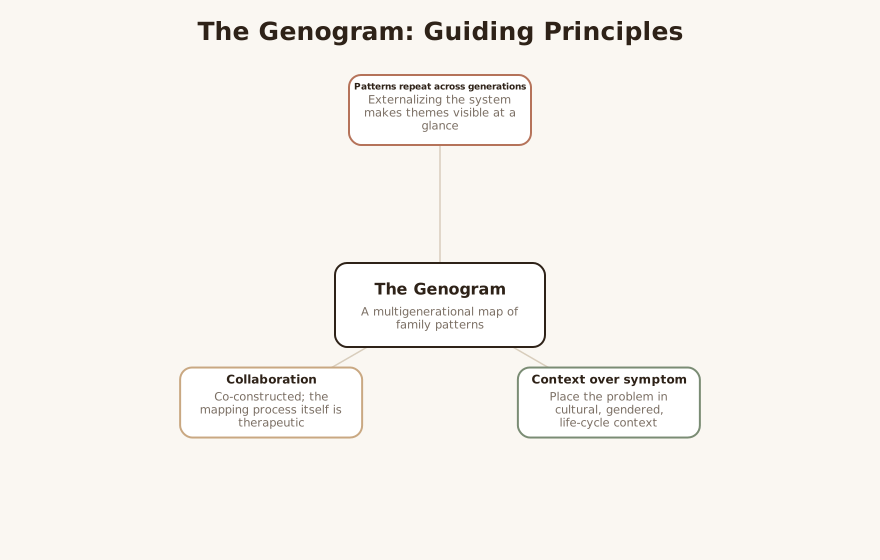
The foundational premise is that families operate as emotional systems, and that patterns — both adaptive and maladaptive — repeat across generations 4. A genogram externalizes that system onto paper so that themes which are difficult to perceive in conversation become visible at a glance 4. The act of seeing addiction, trauma, codependency, mental illness, or estrangement recur across three generations often produces insight that talking alone does not 4.
A second principle is context over symptom. McGoldrick’s approach deliberately shifts attention away from an isolated individual symptom toward the racial, cultural, gendered, and life-cycle issues that can keep clients in chronic distress 3. The presenting problem is placed in historical and relational context rather than treated as a property of one person 3. This is a reframe with clinical consequences: a client who arrives describing themselves as “the anxious one” may leave a genogram session understanding that role as a position in a multigenerational pattern rather than a personal defect LLM.
A third principle is collaboration. The genogram is co-constructed; the mapping process itself is therapeutic because it invites clients and family members to share histories and memories, which builds dialogue, empathy, and a sense of agency in changing patterns 4. The diagram is rarely the endpoint — the conversation it provokes is the intervention LLM.
Interventions & Techniques
Construction follows a standardized notation. Males are drawn as squares and females as circles; horizontal lines connect partners, with conventions distinguishing marriage from divorce; vertical lines connect parents to children; and additional symbols denote twins, adoptions, pregnancies, miscarriages, and deceased individuals 1. Each symbol is annotated with names, ages, birth and death dates, and significant facts such as illnesses, occupations, or major events 2. Relationship quality is layered on top using differentiated line types — close, distant, conflicted, enmeshed, or cutoff — so the emotional texture of the system is encoded alongside its structure 4.
The genogram interview is itself the core technique. In McGoldrick’s demonstrations, the clinician moves through a step-by-step process of gathering historical information, drawing the diagram, and contextualizing the presenting problem, often beginning in the very first session 3. The interview deliberately widens the frame from the individual to the family across racial, cultural, and life-cycle dimensions 3.
Several specialized adaptations have developed: cultural genograms, spiritual genograms, and trauma-resilience genograms each foreground a particular domain 5. Bowenian technique also brings interpretive moves into the work — most notably the mapping of triangles and the practice of detriangling, helping a client step out of a stabilizing-but-stuck three-person emotional configuration 3.
LLM-generated illustrative example (not a guideline): A clinician working with a 34-year-old client who describes constant friction with her mother draws a three-generation genogram and notices a repeating cutoff pattern: the client’s mother was also estranged from her mother in her thirties. Naming this pattern aloud — “this distance has happened before in your family, around this same age” — shifts the client from blaming herself to becoming curious about an inherited script, which becomes the focus of subsequent sessions. LLM
Software has standardized and accelerated this work. GenoPro, launched in 1998, pioneered dedicated genogram software, and general diagramming platforms now offer templates of varying clinical sophistication; newer web-based tools have continued this trajectory 25.
Evidence Base
Honesty about the evidence is essential here, because the genogram’s status as “established” is easy to misread. It is established by adoption and standardization — the McGoldrick–Gerson notation became the definitive clinical standard, and the tool is in routine use across mental health, medicine, nursing, social work, and clinical education 12. That adoption is broad and durable, spanning four decades and four editions of the standard text 2.
What is far thinner is direct outcome evidence. The clinically oriented sources describe the genogram’s purposes and benefits — insight generation, communication, empowerment — but do not present controlled efficacy data, and reference materials describing the tool do not provide empirical evidence of effectiveness 14. In practical terms: there is strong consensus and face validity supporting the genogram as an assessment and engagement method, but a clinician should not claim that the genogram, as an isolated procedure, has been shown in rigorous trials to improve symptom outcomes LLM. Its value is best framed as helping the clinician and client understand and organize a family system — a clinical reasoning and alliance tool — rather than as a stand-alone, empirically validated treatment LLM. This is the appropriate level of confidence to communicate to clients and to record in clinical reasoning LLM.
Populations & Indications
The genogram is unusually portable across populations. It is used with whole families, with couples, and with individual adults, and McGoldrick’s own demonstrations include work with individuals, six-session couples therapy, and multi-session family therapy 3. It is well suited to adolescents and to immigrant families, where life-cycle and cultural transitions are salient and where the historical frame helps situate a young person’s struggle within a larger system 3.
It is particularly indicated where intergenerational patterns are plausibly driving the presentation: families carrying trauma across generations, systems marked by recurring addiction or mental illness, and clients facing chronic or hereditary illness, where a medical genogram can also map genetic risk and health history 14. Mental health professionals use genograms to assess support networks, identify detrimental relationships, recognize behavioral patterns, and detect substance-use triggers 1. As a general rule, the genogram earns its place whenever the question “where did this pattern come from?” is clinically live LLM.
Problems-for-Work
The genogram maps cleanly onto a range of problems-for-work, with the common thread that each becomes more legible when placed in a multigenerational frame LLM.
- Family conflict and relationship conflict. Differentiated line types make alliances, conflicts, and enmeshment visible, allowing repetitive conflict cycles to be named and located in the wider system rather than pinned on one member 4.
- Intergenerational trauma. Mapping trauma, loss, and their sequelae across generations helps clients see how patterns of fear, silence, or rupture were transmitted, opening space for a different response 45.
- Substance use and family patterns. Charting addiction across generations surfaces inherited patterns and helps identify triggers embedded in the family system 14.
- Estrangement and emotional cutoff. Cutoffs are explicitly represented, and recognizing a cutoff as a recurring family solution (rather than a one-off) can reframe a client’s own distancing 5.
- Grief, loss, and role strain. Annotating deaths, dates, and roles reveals how unresolved losses and assigned roles shape current functioning and life-cycle transitions 23.
- Identity confusion and attachment difficulties. Situating a client within cultural, gendered, and relational history can clarify questions of identity and the relational templates that underlie attachment struggles 3.
LLM-generated illustrative example (not a guideline): A couple in conflict over parenting builds a joint genogram and discovers that each partner is reenacting opposite roles from their families of origin — one the over-functioning caretaker, the other the peripheral parent. Seeing the symmetry defuses blame and lets them treat the conflict as a meeting of two inherited systems rather than a fight about who is right. LLM
Contraindications, Cautions & Cultural Humility
The genogram is low-risk but not risk-free. Constructing one surfaces painful material — abuse, loss, addiction, estrangement — and can be activating, so pacing and stabilization should govern how quickly and how deeply the history is explored LLM. With clients who have limited contact with their family of origin, or fragmented or unknown histories (adoption, foster care, displacement), large blank regions of the diagram can themselves be distressing, and the clinician should hold that absence with care rather than pressing to fill it LLM. The genogram is a working hypothesis, not a verdict; patterns it suggests are starting points for curiosity, not conclusions to impose on a client LLM.
Cultural humility is structurally central to the modern tool rather than an add-on. McGoldrick’s signal contribution was to integrate cultural, ethnic, racial, and gender perspectives, and her approach explicitly foregrounds how race, culture, gender, and life-cycle position shape family functioning 53. In practice this means resisting a single normative template of “the family”: definitions of kinship, caregiving roles, household composition, and acceptable closeness vary across cultures, and the clinician’s job is to map the client’s family on the client’s terms LLM. Standard notation built around binary symbols and conventional marriage also requires flexible, respectful adaptation for diverse family forms and gender identities LLM.
Treatment-Plan Suggestions & SMART Objectives
| Goal | SMART objective (example) | Mechanism |
|---|---|---|
| Build a shared map of the family system | Co-construct a three-generation genogram across the first two sessions, annotated with names, ages, and major events | Externalizes the system so patterns become visible 1 |
| Identify a recurring intergenerational pattern | Name at least one repeating pattern (e.g., cutoff, addiction, role) by session 4 and link it to the presenting problem | Multigenerational transmission made explicit 5 |
| Reduce reactivity in a key triangle | Map one stabilizing triangle and practice one detriangling move within 6 sessions | Detriangling lowers reactivity in stuck configurations 3 |
| Reframe self-blame as a systemic role | Client describes their “role” as a family position rather than a personal flaw by session 5 | Context-over-symptom reframe 3 |
| Process an intergenerational loss or trauma | Chart relevant losses/trauma and complete two sessions of focused processing within 8 weeks | Visual mapping supports recognition and meaning-making 4 |
| Strengthen family dialogue | Client and a family member share one previously unspoken family story during a joint mapping session | Co-construction catalyzes communication and empathy 4 |
| Situate identity in cultural/relational history | Add cultural, racial, and gender dimensions to the genogram across two sessions | McGoldrick’s cultural lens clarifies identity in context 3 |
Common Misconceptions
“A genogram is just a family tree.” It is not; a family tree records lineage, while a genogram adds psychological, relational, and emotional information designed to reveal patterns that repeat across generations 12. “Bowen invented the term genogram.” Bowen created the family diagram and its symbols, but he preferred the term “family diagram”; it was Philip Guerin, a Bowen trainee, who coined “genogram,” appearing in print in 1972 5. “The genogram is a stand-alone, evidence-based treatment.” It is a standardized and widely adopted assessment and engagement technique, but the available sources describe its purposes and benefits without presenting controlled outcome evidence, so it is best understood as a tool used within a treatment, not a validated treatment by itself 14. “The diagram is the deliverable.” The lasting value lies in the collaborative conversation the mapping provokes, not the finished chart 4.
Training & Certification
There is no single licensing credential specific to genogram use; competence is developed through family-systems training and supervised practice LLM. The canonical written reference is McGoldrick and Gerson’s Genograms in Family Assessment and its successors, which remain the standard guides to notation and interpretation 12. For demonstrated technique, McGoldrick’s video instruction offers roughly 8.5 hours of recorded clinical work — genogram construction with individuals, six-session couples therapy, and multi-session family therapy, with commentary and debriefing, plus material on triangles and detriangling 3. Continuing-education providers for mental health professionals also offer focused genogram instruction 4. Genograms additionally appear in clinical training as a vehicle for therapist self-awareness, with trainees often mapping their own families to develop reflective capacity 2.
Key Terms
Genogram — a multigenerational family diagram mapping structure plus emotional and relational information 1. Family diagram — Bowen’s original term for the tool he developed and standardized 5. Differentiation of self, triangles, multigenerational transmission process, emotional cutoff, sibling position — core Bowen concepts used to interpret a genogram 5. Detriangling — a Bowenian technique for stepping out of a stabilizing three-person emotional configuration 3. Cultural / spiritual / trauma-resilience genograms — specialized adaptations foregrounding a particular domain 5. Medical genogram — a variant emphasizing health history and genetic/hereditary risk 1.
Resources & Further Reading
▶ Watch — a video introduction to this concept:
- Genogram — EBSCO Research Starters
- Genogram — Wikipedia
- Genograms in Psychotherapy (video) — Monica McGoldrick, Psychotherapy.net
- Genograms in Therapy — SWEET Institute
- A Brief History of Genograms: From Bowen to McGoldrick — Psychology Smart Tools
Reflective / Supervision Questions
- When I construct a genogram, am I co-creating it with the client or imposing my own pattern hypotheses onto their history? LLM
- Whose definition of “family” is shaping the diagram — the client’s, or a default normative template I carry? LLM
- How do I hold the genogram as a working hypothesis rather than a verdict, especially when a pattern seems obvious to me? LLM
- What is my own genogram, and how might my family-of-origin patterns shape what I notice or avoid in a client’s? LLM
- Am I pacing the history-gathering to the client’s stability, particularly when trauma, loss, or estrangement surfaces? LLM
- When I describe the genogram’s value in documentation and to clients, am I claiming more empirical certainty than the evidence supports? LLM