
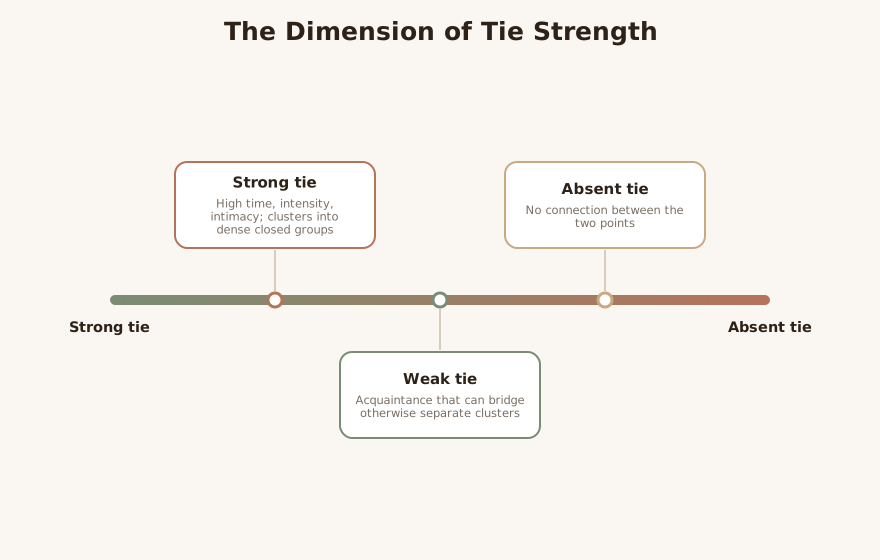
The strength-of-weak-ties theory is one of the most cited ideas in modern sociology, and its central claim is deliberately counterintuitive: the acquaintances at the edge of your social world, not your closest friends, are often the ones who connect you to new information and new opportunities 4. The argument is structural, not sentimental: it says nothing about which relationships matter most emotionally, only about which positions in a social network carry novelty across otherwise separate clusters 1. For clinicians, the theory is not a therapy but a lens LLM. A great deal of clinical work touches isolation, withdrawal, unemployment distress, and the thinness of a client’s support network, and this theory reframes the goal of “expanding someone’s circle” in a precise and sometimes surprising way: the close, intense bonds clients prize are not the ties most likely to deliver a job lead, a new community, or a fresh perspective 1LLM.
Type & Discipline
The strength-of-weak-ties theory is a descriptive sociological theory within social network analysis, concerned with how the strength of the ties between individuals shapes the structure and behavior of the larger networks and communities they form 1. Mark Granovetter defined the strength of a tie as “a (probably linear) combination of the amount of time, the emotional intensity, the intimacy (mutual confiding), and the reciprocal services which characterize the tie” 12. His project was explicitly to bridge “micro” and “macro” levels of sociological analysis, showing how a property of a two-person relationship scales up to patterns of diffusion, social mobility, political organization, and community cohesion 1.
The discipline shapes how a clinician should hold the theory. It originated as basic social science about how networks are structured, not as a model of psychotherapy or psychopathology, and its evidence base sits in sociology, network science, and labor economics rather than in clinical trials 13. Its relevance to the consulting room is therefore inferential and adjunctive: it explains why a client with a few close relationships can still feel cut off from opportunity, and how loose connections function differently from intimate ones, which can inform formulation and treatment planning without itself constituting a treatment LLM.
Creators & Lineage
The theory was introduced by Mark Granovetter in his 1973 paper “The Strength of Weak Ties,” published in the American Journal of Sociology 13. The paper is among the most influential and most cited in the social sciences, and Granovetter, a sociologist long associated with Stanford University, became a central figure in the development of economic sociology and social network analysis 3. The article’s now-famous origin includes the fact that it was rejected by the American Sociological Review before being published in the American Journal of Sociology, a detail Granovetter himself has noted 3.
Granovetter built the empirical case partly from a study of how people find jobs, finding that those who landed work through a personal contact most often heard about it not through a close friend but through an acquaintance, someone they saw only occasionally 4. He later expanded this work into the book Getting a Job, and the broader research program connected the strength-of-weak-ties idea to questions of social mobility and labor markets 3LLM. The lineage runs forward into social capital theory, which treats networks as resources, and into Ronald Burt’s structural holes theory, which formalizes the advantage of spanning gaps between otherwise disconnected groups; it sits within the wider tradition of social network theory and is frequently read alongside social support theory in clinical contexts 5LLM.
Core Principles
The first principle is the definition of tie strength itself, combining time, emotional intensity, intimacy, and reciprocal services into a single (roughly linear) dimension running from strong to weak to absent 12. This lets ties be ranked without reducing them to a single attribute, and it makes “weak” a structural label rather than a value judgment about importance 1.
The second principle is the forbidden triad, the structural engine of the whole theory. Granovetter argued that if person A has strong ties to both B and C, then B and C are very likely to have at least a weak tie to each other; a configuration in which A is strongly tied to both B and C while B and C have no tie at all is, in his terms, the “forbidden triad” and is empirically rare 12. Because our strongest contacts tend to know one another, strong ties cluster into dense, closed groups whose members largely share the same information 1.
The third principle is the concept of a bridge. A bridge is a tie that provides the only path between two points in a network, the single line of connection along which information can flow from one cluster to another 12. From the forbidden-triad logic Granovetter derived a striking corollary: “no strong tie is a bridge,” meaning that all bridges are necessarily weak ties 12. In large, realistic networks he relaxed this to the more practical notion of a “local bridge,” but the upshot holds: the connections that link separate social worlds are overwhelmingly weak ones 1.
The fourth principle is the consequence for information flow. Because strong ties bind people into clusters that recycle the same knowledge, “whatever is to be diffused can reach a larger number of people, and traverse a greater social distance, when passed through weak ties rather than strong” 12. Weak ties are the conduits of novelty, carrying information that is non-redundant precisely because it originates in a part of the network the recipient is not otherwise connected to 14. This is the heart of the paradoxical title: ties that are weak in intensity are strong in their structural function 4.
The fifth principle extends the argument to the community and macro level. Granovetter reasoned that individuals with few weak ties are deprived of information from distant parts of the social system and are confined to the provincial news and views of their close friends, which can leave them disadvantaged in the labor market and harder to mobilize 1. At the level of whole communities, a network rich in weak ties between clusters is better able to organize collectively, while one fragmented into cliques connected by no bridges struggles to mount coordinated action 1.
Interventions & Techniques
The strength-of-weak-ties theory does not supply a treatment protocol, but its principles map onto recognizable clinical and case-management moves LLM. The most direct is a shift in how the clinician helps a client think about network expansion. Rather than treating the goal as deepening a small number of intense relationships, the work can deliberately cultivate a wider band of low-intensity, intermittent contacts, on the theory’s premise that these are the ties most likely to carry new opportunities and information 14LLM.
A second technique is network mapping with an eye to redundancy. Because strong ties cluster and recycle the same information, a clinician can help a client notice that an emotionally rich but closed circle may nonetheless be informationally “provincial,” leaving the client cut off from leads and possibilities that only a bridge could supply 1LLM. Naming this can relieve the self-blame of a client who “has people” yet still feels stuck LLM.
A third works through bridge-building and recategorization of activities. Encouraging participation in settings that generate acquaintances across different clusters, classes, interest groups, volunteer roles, recovery meetings, can be framed not as superficial “getting out more” but as constructing the weak ties that, structurally, are the ones likely to change a client’s circumstances 14LLM. These techniques are delivered inside established modalities such as behavioral activation rather than as a standalone therapy LLM.
LLM-generated illustrative example (not a guideline): A client in recovery says her only contacts are three close family members who all share her pessimism about finding work. The clinician maps the network and points out that these strong ties, however loving, circulate the same discouraging information among themselves. Together they reframe her weekly recovery meeting and a volunteer shift not as obligations but as deliberate sources of weak ties, the acquaintances most likely to bridge her to a job lead her tight family circle could not supply LLM.
Evidence Base
The strength-of-weak-ties theory is established. Granovetter’s original paper is one of the most cited articles in the social sciences, and its core constructs, tie strength, the forbidden triad, bridges, and the diffusion advantage of weak ties, are foundational to social network analysis 13. The job-finding evidence that anchored the theory, that people more often hear of jobs through acquaintances than through close friends, has been widely discussed and was later developed in Granovetter’s book Getting a Job 34.
The honest caveats are important for clinicians. First, “established theory” is not “established therapy”; the evidence concerns the behavior of social networks and labor markets, not randomized trials of any “weak-ties intervention,” which does not exist as a discrete modality LLM. Second, the theory’s reach into causal claims about individual outcomes has been refined over decades of subsequent network research, including large-scale studies that have qualified and added nuance to the simple “weaker is better” reading 4LLM. Recent large-scale work, summarized in coverage of the theory’s fiftieth anniversary, has examined the relationship between tie strength and job mobility and found the picture more complex than a strict linear rule, with the optimal tie strength for landing a job depending on the industry and context rather than being uniformly weak 4. Third, the theory is descriptive and structural; it tells a clinician how networks tend to behave, not that any given client’s wellbeing will improve from a particular change to their network, which remains an empirical and individual question LLM.
Populations & Indications
The framework applies wherever a person’s circumstances are shaped by their access (or lack of access) to information and opportunity through their network LLM. Job seekers are the canonical case, since the theory was substantially built on how people find work and predicts that acquaintances are disproportionately the source of useful leads 14. Emerging adults / young adults are indicated because the transition into work, education, and adult social roles depends heavily on building a wide base of weak ties beyond family and a few close friends LLM. Socially isolated individuals are a central group: the theory specifies that a person with few weak ties is confined to “the provincial news and views of their close friends” and is structurally cut off from the wider social system, which gives isolation a concrete informational dimension beyond the emotional one 1LLM.
Immigrants are strongly indicated, since establishing weak ties that bridge into the institutions and opportunities of a new society is a recognized pathway to settlement and mobility 1LLM. People in recovery often need to build new networks deliberately, and the theory clarifies why a few intense bonds may be insufficient to supply the breadth of new contacts a changed life requires LLM. Marginalized communities are addressed at the macro level: Granovetter argued that the absence of bridging weak ties between clusters leaves a community fragmented and harder to mobilize, which connects individual isolation to collective disadvantage 1LLM.
Problems-for-Work
The strength-of-weak-ties theory gives clinicians a precise vocabulary for a cluster of presenting problems that are usually framed only emotionally LLM.
- Social isolation and loneliness. The theory distinguishes the emotional poverty of isolation from its structural form: a client may have intense bonds yet lack the bridging weak ties that connect them to the wider world, which is a different and separately addressable deficit 1LLM.
- Unemployment-related distress. Where a client’s job search is stalled, the theory points to a thin layer of acquaintances rather than a lack of close friends as the relevant network gap, since leads most often travel along weak ties 14.
- Limited social support. A network of only strong, clustered ties recycles the same resources and information; widening the band of weak ties can introduce the novelty a closed circle cannot provide 1LLM.
- Social withdrawal. The theory reframes re-engagement: even low-intensity, intermittent contact has structural value, which can lower the bar for a withdrawn client who finds intimate connection daunting 1LLM.
- Adjustment difficulties (e.g., relocation, immigration, role transition). Bridging into the clusters of a new setting is exactly the function weak ties perform, making their deliberate cultivation a natural treatment target 1LLM.
- Help-seeking barriers. A client embedded only in a dense, provincial cluster may never encounter the information that help, services, or alternatives exist; weak ties are the conduits by which such novel information arrives 1LLM.
LLM-generated illustrative example (not a guideline): A recently relocated client reports she “knows no one” and feels stuck. The clinician maps her ties and finds she does have several loose acquaintances from a parents’ group and a gym, contacts she had dismissed as not “real” friendships. The work reframes these weak ties as her most promising bridges into the new community’s information and opportunities, rather than treating the problem as a simple absence of close friends LLM.
Contraindications, Cautions & Cultural Humility
The first caution is against reading the theory as a claim that weak ties are better than strong ties, full stop. Granovetter’s argument is about a specific function, the diffusion of novel information and access to opportunity, not about emotional value, safety, or wellbeing, all of which strong ties typically supply 1LLM. A clinician who hears “weak ties are strong” and nudges a vulnerable client toward a scatter of acquaintances at the expense of their few sustaining close bonds has misapplied the theory and may erode exactly the support that buffers distress LLM.
A second caution concerns clients for whom widening the network is not neutral. For people with social anxiety, trauma histories, or attachment difficulties, “go make acquaintances” can be experienced as unsafe or invalidating, and the structural logic of the theory does not address the affective capacity to form ties; that capacity is the clinical work, and the network goal must be paced to it LLM. Mobilizing new ties is also inappropriate where a client’s available networks are sources of harm, exploitation, or coercion LLM.
Cultural humility is essential because the value, accessibility, and meaning of weak ties are culturally patterned. In strongly collectivist or kin-centered contexts, dense networks of obligated strong ties are normative and protective, and a Western clinician should be wary of pathologizing them as “provincial” or pushing an individualistic model of loose, opportunistic acquaintance as the healthy default 1LLM. The theory’s own macro-level claim, that bridging ties between clusters help communities organize, should also sharpen rather than blunt attention to structural inequity: marginalized communities are not short of bridges through individual deficiency but because of the social arrangements that segregate clusters in the first place 1LLM.
Treatment-Plan Suggestions & SMART Objectives
| Goal | SMART objective (example) | Mechanism |
|---|---|---|
| Map the network and distinguish strong from weak ties | Within 2 sessions, client will complete a network map labeling each contact as a close (strong) or acquaintance (weak) tie | Operationalizes tie strength as time, intimacy, and reciprocity 1 |
| Identify informational redundancy in a closed circle | By week 3, client will name one piece of information their close circle all shares and one they lack access to | Strong-tie clusters recycle redundant information 1 |
| Reactivate dormant weak ties | Over 6 weeks, client will reconnect with 3 prior acquaintances and note any new information each provides | Weak ties carry non-redundant, novel information 1 |
| Build bridging ties in a new setting | Within 8 weeks, client will attend a group bridging an unfamiliar cluster (volunteer, class, meeting) at least twice monthly | Bridges link otherwise separate clusters 1 |
| Use weak ties for a stalled job search | By week 6, client will inform 5 acquaintances they are job-seeking and log any leads received | Job leads travel disproportionately along weak ties 14 |
| Lower the threshold for social re-engagement | Over 4 weeks, client will initiate one low-intensity contact (brief message or chat) twice weekly | Intermittent weak contact has structural value with low affective cost 1 |
| Reduce isolation’s informational dimension | Within 10 weeks, client will add 2 contacts who connect them to a different social cluster than their current circle | Counters confinement to “provincial” close-friend information 1 |
| Pace network-building to affective capacity | Each session, clinician and client will review whether the pace of new contact feels safe and adjust accordingly | Protects against overwhelm in anxious or trauma-affected clients LLM |
Common Misconceptions
The most common misconception is that the theory says weak ties are more valuable than strong ties. It does not; it says weak ties are structurally more likely to perform one specific function, bridging separate clusters and carrying novel information, while saying nothing to diminish the emotional and supportive role of strong ties 1LLM. A second misconception is that “weak tie” means an unimportant or low-quality relationship; in Granovetter’s framework “weak” is a measure of intensity (time, intimacy, reciprocity), and a structurally weak tie can be enormously consequential precisely because of its bridging position 14. A third is that the forbidden triad claims close friends can never be strangers to one another; the claim is probabilistic, that the fully open triad is rare, not impossible 1. A fourth is that “no strong tie is a bridge” is an absolute law in every network; Granovetter himself moved to the more realistic notion of local bridges in large networks, preserving the insight while relaxing the strict form 1. A final, more recent misconception is that weaker is always better for finding a job; large-scale follow-up research has shown the relationship is more nuanced, with the most useful tie strength varying by context and industry 4.
Training & Certification
There is no certification in the strength-of-weak-ties theory, and none would be appropriate, because it is a sociological model rather than a credentialed treatment LLM. Clinicians typically encounter it within coursework in sociology, social psychology, social work, and community psychology, and within case-management and community-mental-health training, where its constructs are absorbed into how a practitioner assesses and builds a client’s social network 3LLM. Competence comes from supervised practice in network assessment and social-connection interventions, and from familiarity with the broader social network and social capital literature, rather than from a standalone course LLM.
Key Terms
- Tie strength: “a (probably linear) combination of the amount of time, the emotional intensity, the intimacy (mutual confiding), and the reciprocal services” that characterize a relationship 12.
- Strong tie: a high-intensity, intimate, time-consuming, reciprocal relationship, e.g., a close friend or family member 1.
- Weak tie: a low-intensity, intermittent relationship, e.g., an acquaintance, which is more likely to bridge separate clusters 14.
- Forbidden triad: the empirically rare configuration in which one person is strongly tied to two others who have no tie at all to each other 12.
- Bridge: a tie that forms the only path between two points in a network; “no strong tie is a bridge” 12.
- Local bridge: the more realistic large-network version of a bridge, a tie providing a shortest or near-shortest path between clusters 1.
- Diffusion advantage: the principle that information travels farther and reaches more people through weak ties than through strong ones 12.
- Provincialism (of strong-tie clusters): the confinement of a person with few weak ties to the redundant news and views of their close friends 1.
Resources & Further Reading
▶ Watch — a video introduction to this concept:
- The Strength of Weak Ties (Granovetter, 1973) — American Journal of Sociology
- The Strength of Weak Ties (Granovetter, 1973) — full-text PDF (Stanford SNAP)
- Mark Granovetter — Wikipedia
- The strength of weak ties — Stanford Report
- Granovetter’s Strength of Weak Ties in Social Networks — GeeksforGeeks
- Mark Granovetter - The Strength of Weak Ties (summary) — YouTube
Reflective / Supervision Questions
- When I encourage this isolated client to “expand their circle,” am I distinguishing the structural deficit (too few bridging weak ties) from the emotional one (too few close bonds), and does my plan match the deficit I actually found? 1LLM
- For a client whose job search is stalled, have I considered that their thin layer of acquaintances, not their lack of close friends, may be the relevant gap? 14
- Am I at risk of devaluing a client’s sustaining strong ties by over-applying “weak ties are strong,” when the theory speaks only to information and opportunity, not to support and safety? 1LLM
- For an anxious or trauma-affected client, is the pace of building new weak ties matched to their capacity to form connection safely, or am I prescribing breadth without addressing that capacity? LLM
- How might this client’s cultural context shape the value and accessibility of weak versus strong ties, and am I reading a dense, kin-centered network as “provincial” when it may be normative and protective? 1LLM
- At the community level, am I locating a marginalized client’s lack of bridging ties in the structural segregation of clusters rather than in any individual deficiency? 1LLM