
The sick role is one of the oldest and most consequential ideas in medical sociology, and most clinicians have absorbed its logic without ever naming it. When you expect a patient to “want to get better,” when a disability evaluator probes whether someone is genuinely trying, when a team grows uneasy about a patient who seems too comfortable being ill, all of these reflexes trace back to a single mid-century theory about what society asks of sick people in return for excusing them LLM. Understanding it explicitly turns a moralizing reflex into a clinical formulation LLM.
Type & Discipline
The sick role is a sociological theory, not a treatment, technique, or clinical modality 1. It belongs to medical sociology and was articulated within the broader framework of structural functionalism, the school of thought that analyzes society as a system of interlocking roles and norms that keep the whole functioning 1. Its central claim is that illness is not merely a biological state but a social role, governed by shared expectations, just like the roles of parent, employee, or student 1. From this angle, becoming sick means temporarily entering a recognized social position with its own rights and duties, rather than simply having something wrong with one’s body 4.
The theory treats illness as a form of social deviance that must be managed, because a person who cannot perform their normal obligations represents a potential disturbance to the social order 15. Society’s solution is to channel that deviance into a sanctioned, temporary, and supervised role 1. For the practicing therapist the value of this is interpretive: the sick role is a lens for understanding the behavior, expectations, and conflicts that surround being a patient, not something one performs in session LLM. Everything that follows translates a descriptive social theory into questions a clinician can actually use, and that translation is clinical reasoning rather than a direct prescription from the source literature LLM.
Creators & Lineage
The concept is the work of the American sociologist Talcott Parsons, who introduced it in his 1951 book The Social System 1. Parsons was the leading figure of structural functionalism in mid-twentieth-century American sociology, and the sick role was his application of that framework to medicine and health 2. He was among the first social theorists to take medicine seriously as a social institution rather than a purely technical one, treating the doctor-patient relationship as a structured social system with its own normative expectations 2.
Parsons’s analysis grew out of his interest in how societies manage deviance and maintain stability 1. He understood sickness as a state that, left unregulated, could let people opt out of their responsibilities, so the role exists to legitimize illness while simultaneously containing it and motivating a return to health 15. His account was also shaped by a broadly Freudian and Weberian intellectual background, and he saw the physician as an agent of social control whose legitimating authority kept illness from becoming a route of escape 2.
The idea was foundational and immediately influential, but it did not stand still 1. Critics, most prominently Eliot Freidson, argued that Parsons’s model assumed a level of medical consensus and patient deference that did not hold across all conditions 1. A particularly important line of revision concerns chronic illness: Matthias Varul has revisited Parsons’s theory and argued that, while the original model fits acute illness well, it requires substantial rethinking to accommodate conditions that never resolve 3. The sick role thus sits at the head of a long lineage in the sociology of health and illness, connected to later work on illness behavior, labeling and stigma, and the biopsychosocial reframing of medicine LLM.
Core Principles
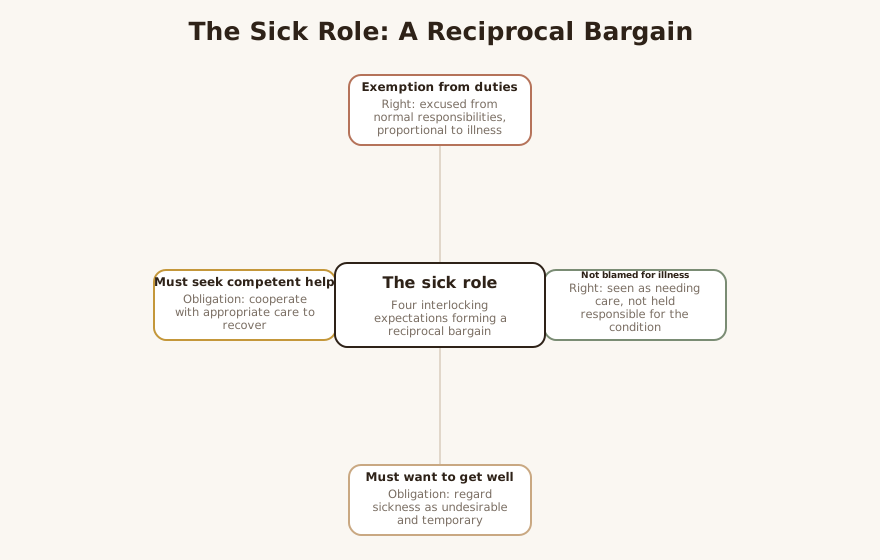
Parsons defined the sick role through four interlocking expectations, conventionally divided into two rights (exemptions) and two obligations 1. The two rights describe what society grants the sick person, and the two obligations describe what it asks in return; the role is a reciprocal bargain, not a free pass 4.
The first right is exemption from normal social responsibilities, proportional to the nature and severity of the illness 1. A genuinely sick person is excused from work, family duties, and other obligations, and this exemption must be legitimated by others, typically a physician 15. The second right is that the sick person is not held responsible for their condition; they are seen as being in a state beyond their control, not as someone who could simply will themselves well, and they are therefore regarded as needing care rather than blame 14.
These rights are conditional on two obligations 1. The first obligation is that the sick person must regard being sick as undesirable and must want to get well; sickness is meant to be a temporary state the person is motivated to leave 15. The second obligation is that the person must seek technically competent help, usually a physician, and cooperate with that help in the project of recovery 1. Crucially, the rights are contingent on the obligations: society extends exemption and absolution only so long as the person visibly wants to recover and cooperates with treatment 4. The person who appears not to want to get better, or who refuses competent help, forfeits the legitimacy of the role LLM.
A further principle concerns the physician’s side of the bargain 2. The doctor is not merely a technician but a gatekeeper and agent of social control who legitimizes entry into the sick role and certifies the person’s effort to leave it 2. The doctor-patient relationship is thus an asymmetric, role-governed system in which the patient is expected to defer to professional competence 2.
Interventions & Techniques
The sick role prescribes no protocol, but its logic supports several ways of thinking that clinicians can put to direct use LLM. The most basic is role formulation: mapping a patient’s presentation onto the four expectations to see which are being met, which are contested, and where the friction lies LLM. A patient locked in conflict with a medical team can often be understood as someone whose claim to the rights of the sick role is being questioned because one of the obligations appears unmet LLM.
A second use is negotiating the recovery obligation explicitly rather than assuming it LLM. Because the role requires the patient to “want to get well,” a clinician can name the ambivalence that chronic or frightening illness produces, treating reluctance not as bad faith but as a predictable feature of a difficult role 3LLM. A third is examining the secondary gains and losses of the role: the legitimate relief from intolerable obligations that the sick role provides, alongside the dependency, stigma, and identity costs it imposes 1LLM. A fourth is clarifying the gatekeeping relationship, helping a patient understand that adherence and engagement are partly what sustains their legitimacy in the eyes of clinicians, evaluators, and family 2LLM. These are framing moves delivered inside whatever modality the clinician is already using; the sick role supplies the formulation, not the therapy LLM.
LLM-generated illustrative example (not a guideline): A patient recovering from a cardiac event is described by the team as “not motivated.” Reframed through the sick role, the question becomes which obligation is in doubt: does the patient not want to recover, or are they so frightened of relapse that they cling to the exemption from work and exertion? Naming the bind, “the role that protected you now feels like a trap,” reopens collaboration rather than judgment LLM.
Evidence Base
The sick role is an established theory, in the specific sense that it is a foundational, canonical, and durably influential concept in medical sociology, not in the sense that it is an outcome-validated treatment 1. Its standing rests on its theoretical reach and its central place in the field for more than half a century, and it remains a standard starting point for teaching the sociology of health and illness 12. It is descriptive and analytic; it makes no claim to improve clinical outcomes and should never be cited as evidence for a particular intervention LLM.
The honest caveat is that the theory has been heavily and productively criticized 1. The most important limitation is its poor fit for chronic illness and disability: Parsons built the model around acute, curable conditions where recovery is the expected endpoint, and it strains badly when applied to conditions that never resolve, where “getting well” is not on offer and the obligation to recover becomes incoherent 13. Varul’s reassessment argues precisely that chronic illness forces a reworking of the role, because the chronically ill cannot discharge the recovery obligation yet are still held to its spirit 3. Further critiques note that the model assumes patient compliance and medical consensus that often do not exist, neglects the patient’s own agency and the contested nature of many diagnoses, and reflects a culturally specific, mid-century, Western, and arguably class-bound view of medicine 15. It also handles stigmatized conditions poorly, since some illnesses bring blame rather than absolution 1. Clinicians should therefore treat it as a powerful heuristic with known boundaries, not a literal description of every patient LLM.
Populations & Indications
The framework is most illuminating wherever the social meaning of being ill is contested or costly LLM. It is especially relevant to patients in medical settings, where entry into and exit from the sick role is constantly being negotiated with clinicians who serve as gatekeepers 2. It is highly apt for people with chronic illness and chronic pain, precisely because their situation exposes the model’s central tension: they occupy a role built for temporary states 3. It speaks to people with disability, for whom the expectation of recovery may be inappropriate or even oppressive, and to people with somatic symptom disorders and functional conditions, where the legitimacy of the sick role is frequently questioned by others 1LLM.
The model also illuminates the family system LLM. Caregivers and families participate in legitimating or contesting a member’s sick role, granting or withdrawing exemptions and judging whether the person is “really trying,” and these dynamics often drive the conflict that brings a family to treatment LLM. The clearest single indication for invoking the lens is any clinical situation organized around the question of whether someone’s illness behavior is legitimate, deserved, or being managed in good faith LLM.
Problems-for-Work
The sick role gives clinicians a precise vocabulary for a cluster of difficult presenting problems LLM.
- Illness behavior and secondary gain. The role makes explicit that illness carries real, legitimate benefits, exemption from intolerable duties and freedom from blame, which reframes “secondary gain” as a structural feature of being sick rather than a moral accusation 1LLM. For example, a worker whose only sanctioned escape from an unbearable job is illness can be understood without assuming deception LLM.
- Treatment non-adherence. Non-adherence can be read as a breach of the obligation to seek and cooperate with competent help, which is exactly why teams react to it with such moral charge; naming this dynamic depersonalizes the conflict 1LLM.
- Adjustment to chronic illness and disability. The mismatch between a role demanding recovery and a body that will not recover is a recognized engine of distress, and it is the precise point at which the classic model breaks down 3. A newly disabled client grieving a self that “should” get better is wrestling with a role that no longer fits LLM.
- Dependency. The exemptions of the sick role can become a stable identity, and the difficulty of relinquishing them maps onto the broader problem of role exit 1LLM.
- Somatic symptom disorder, functional neurological disorder, and health anxiety. These are arenas where the patient’s claim to the sick role is most often contested by others, generating the invalidation and conflict that frequently dominate the clinical picture 1LLM.
- Depression secondary to chronic illness. The loss of valued roles, combined with confinement in a role that demands an impossible recovery, contributes to demoralization 3LLM.
- Malingering, factitious disorder, and illness deception. The theory clarifies why these are treated as such serious violations: they exploit the rights of the sick role while counterfeiting the obligations, threatening the trust the whole arrangement depends on 1LLM.
LLM-generated illustrative example (not a guideline): A client with persistent functional symptoms reports that every clinician eventually implies she is “making it up.” Through the sick-role lens, she is a person whose claim to the role’s two rights is repeatedly denied because observers doubt the underlying state. The clinical task is not to adjudicate her legitimacy but to address the demoralization of perpetually having to prove it LLM.
Contraindications, Cautions & Cultural Humility
The chief danger is using the sick role as a covert moral judgment LLM. Because the model frames illness as deviance to be managed and ties the patient’s rights to their visible motivation, it can be weaponized to accuse patients of not “really” wanting to recover, which is both clinically destructive and frequently wrong, especially for chronic, invisible, or contested conditions 13LLM. The lens should generate curiosity about a patient’s situation, never a verdict on their character LLM.
The model carries cultural and historical baggage that demands humility 5. It encodes a specific, mid-twentieth-century, Western view of medicine, of the deferential patient, and of the physician’s authority, and it assumes a level of access to “technically competent help” that many people do not have 15. Expectations about how illness should be expressed, who legitimizes it, and how much dependency is acceptable vary widely across cultures, families, and communities, so what one observer reads as failing the recovery obligation may be a culturally normative way of being ill LLM. The model’s poor handling of disability is itself an ethical caution: applying an expectation of recovery to a permanent condition can replicate ableist pressure 3LLM. The theory is best held as a frame for understanding social expectations, including the clinician’s own, rather than as a standard the patient must meet LLM.
Treatment-Plan Suggestions & SMART Objectives
| Goal | SMART objective (example) | Mechanism |
|---|---|---|
| Reduce demoralization tied to a non-recovering illness role | Within 8 sessions, client will articulate two valued roles available despite illness and act on one weekly, logged | Loosens the recovery obligation that the classic sick role makes impossible in chronic illness 3 |
| Reframe “secondary gain” without moral blame | By week 6, client will name three legitimate relief functions their illness serves and one alternative route to each, in session | Treats exemption from duties as a structural right of the role rather than deception 1 |
| Improve engagement with care | Over 6 sessions, client will identify and address one specific barrier to cooperating with treatment per session, tracked | Targets the help-seeking obligation underlying perceived non-adherence 1 |
| Renegotiate family expectations around the sick role | Within 10 weeks, client and a family member will hold two structured conversations clarifying realistic duties and exemptions | Addresses the family’s role in granting or contesting the sick role LLM |
| Reduce distress from contested legitimacy | By week 8, client will use a coping plan for invalidation in 3 logged encounters without escalation | Lowers the harm of having the role’s two rights repeatedly denied 1 |
| Support adjustment to disability identity | Within 12 sessions, client will draft a revised self-narrative that does not hinge on future “recovery,” reviewed in session | Replaces the temporary-role frame with a durable identity 3 |
| Build tolerance for relinquishing the role | Over 8 sessions, client will resume one previously avoided responsibility per fortnight as capacity allows | Addresses dependency and the difficulty of role exit 1 |
Common Misconceptions
A frequent error is reading the sick role as a cynical claim that sick people are fakers or simply seeking benefits; Parsons’s point was the opposite, that legitimate illness earns exemption and absolution, and the obligations exist to keep the role from being abused, not to imply that most patients abuse it 14. A second misconception is that the model describes how patients actually behave; it describes a set of normative social expectations, an ideal type, and real illness routinely departs from it 5. A third is treating the theory as universal and timeless, when it is in fact a culturally and historically specific account that fits acute, curable, Western, twentieth-century medicine far better than chronic illness or contemporary contested conditions 13. A fourth is assuming the patient is the only actor: the physician’s gatekeeping role and the family’s legitimating function are equally part of the system, and clinicians enact the model whether or not they notice 2LLM. Finally, the sick role is sometimes mistaken for a therapeutic technique; it is a descriptive lens, and its clinical use is interpretive LLM.
Training & Certification
There is no certification in the sick role, and none would make sense; it is a sociological theory, not a credentialed therapy LLM. Clinicians typically meet it in coursework on medical sociology, the sociology of health and illness, or the social foundations of medicine, where it is taught as a foundational concept 12. Competence in using it clinically comes not from a course but from supervised practice in medical, rehabilitation, and chronic-illness settings, paired with familiarity with the major critiques, especially the chronic-illness reappraisal, so the lens is applied with its limits in view 3LLM.
Key Terms
- Sick role: the socially sanctioned, temporary role a person occupies when legitimately ill, carrying defined rights and obligations 1.
- Structural functionalism: the sociological framework, central to Parsons, that analyzes society as interlocking roles and norms maintaining stability 1.
- Exemption from normal duties: the sick person’s right to be released from usual responsibilities, proportional to the illness 1.
- Absolution from blame: the right to be seen as not responsible for the condition and therefore deserving care rather than blame 14.
- Obligation to recover: the duty to regard sickness as undesirable and to want to get well 1.
- Obligation to seek competent help: the duty to obtain and cooperate with technically competent care 1.
- Gatekeeper / agent of social control: the physician’s function in legitimizing entry into and certifying exit from the sick role 2.
- Illness as deviance: the framing of sickness as a disturbance to social functioning that the role exists to regulate 15.
Resources & Further Reading
▶ Watch — a video introduction to this concept:
- Sick role — Wikipedia
- Talcott Parsons and the Theory of the ‘Sick Role’ (Milton) — Kent Academic Repository
- Talcott Parsons, the Sick Role and Chronic Illness (Varul, 2010) — Body & Society
- Sick role (medical sociology) — EBSCO Research Starters
- Sick Role Theory | Definition, Rights & Criticisms — Study.com
Reflective / Supervision Questions
- When I describe a patient as “unmotivated” or “not really trying,” which obligation of the sick role am I implicitly accusing them of breaching, and is that judgment warranted? 1LLM
- For a client with a chronic or permanent condition, am I imposing an obligation to recover that the situation cannot support, and what would it mean to release them from it? 3
- How is this patient’s family granting, contesting, or withdrawing the rights of the sick role, and how does that shape the presenting problem? LLM
- In what ways am I acting as a gatekeeper for this patient’s legitimacy, and how does that role affect our alliance? 2
- Whose cultural template for “how to be sick” am I using as the baseline, and how might this client’s expectations differ from it? 5LLM