
Type & Discipline
Illness–disease–sickness is a conceptual framework rather than a treatment modality, drawn from medical anthropology and closely allied with medical sociology and the phenomenology of the body LLM. It is not a therapy you deliver but a lens you think with, a way of separating three things that ordinary clinical language collapses into one word LLM. The framework’s enduring clinical value comes from a single insight formalized by Kleinman, Eisenberg, and Good: there is a fundamental distinction between disease and illness, and attending to it changes how care is delivered 1. For psychotherapists, the framework sits naturally inside the biopsychosocial model, supplying the conceptual vocabulary for the “psycho” and “social” dimensions that biomedicine alone underdescribes LLM.
Creators & Lineage
The distinction was articulated for a clinical audience in the 1978 Annals of Internal Medicine paper by Arthur Kleinman, Leon Eisenberg, and Byron Good, who argued that anthropologic and cross-cultural research could be translated into practical clinical strategy 1. They framed the problem in terms familiar to any modern clinician: patient dissatisfaction, inequity of access, and spiraling costs, and proposed that a “clinical social science” could translate concepts from cultural anthropology into clinical language 2. Their notion of the “cultural construction of clinical reality” placed the patient’s meaning-making at the center of care rather than treating it as noise around the real biomedical signal 2.
The third term, sickness, was elaborated in later philosophical and sociological work. Bjørn Hofmann’s 2002 analysis treats disease, illness, and sickness as three different perspectives on human ailment, each carrying distinct epistemic and normative dimensions, and argues the triad is analytically useful even without a unifying general theory of health 3. The lineage thus runs from medical anthropology through medical sociology and phenomenology into the biopsychosocial model that frames contemporary integrated care LLM.
Core Principles
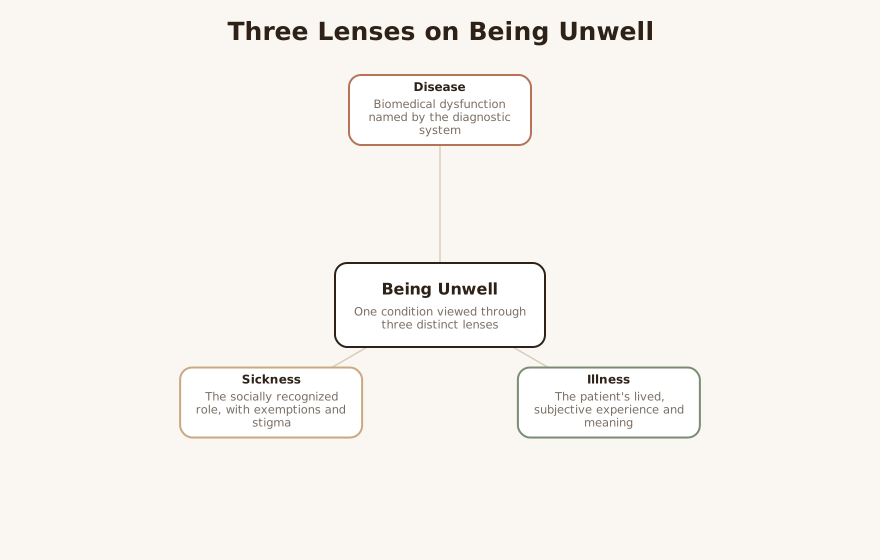
The framework rests on three definitions LLM:
Disease is the biomedical reality, the dysfunction in biological structure or function as named and classified by the clinician’s diagnostic system LLM. It is the practitioner’s object: a lesion, a deranged lab value, a diagnostic code LLM. A person can have disease (an early tumor, controlled hypertension) without yet feeling unwell LLM.
Illness is the lived, subjective experience of being unwell, the patient’s perception, meaning, and response to symptoms LLM. Kleinman and colleagues treated this experience as the proper object of clinical attention, not a distortion to be corrected 1. Illness includes the personal and social meaning a person attaches to their disorder, their expectations of what will happen and what the provider will do, and their own therapeutic goals 4. Conversely, a person can have profound illness with no detectable disease, the situation that defines functional and medically unexplained presentations LLM.
Sickness is the socially recognized status, the role a person occupies once others treat them as unwell, with its attendant exemptions, obligations, stigma, and entitlements LLM. Sickness is the perspective that captures the social and normative consequences of ailment, distinct from both the biology and the inner experience 3. Disability accommodations, the legitimacy granted by a diagnosis, and the suspicion withheld from “real” versus “imagined” complaints are all phenomena of sickness, not disease LLM.
The clinical payoff is that these three can dissociate, and most difficult cases are precisely the points of dissociation: disease without illness, illness without disease, or illness and sickness that outrun the disease LLM.
Interventions & Techniques
The framework’s signature clinical operationalization is the explanatory model (EM): the set of beliefs a patient holds about their condition’s nature, cause, course, and appropriate treatment 4. Eliciting the patient’s EM, and noticing where it diverges from the clinician’s, is the core technique LLM.
Kleinman developed a set of eight questions a provider can ask to learn a patient’s explanatory model, meant to be asked in order 4:
- What do you call your problem? What name does it have? 4
- What do you think caused your problem? 4
- Why do you think it started when it did? 4
- What does your sickness do to you? How does it work? 4
- How severe is it? Will it have a short or long course? 4
- What do you fear most about your disorder? 4
- What are the chief problems that your sickness has caused for you? 4
- What kind of treatment do you think you should receive? What are the most important results you hope to receive from treatment? 4
In practice these are folded into the clinical interview rather than read off a card, and the comparison of the patient’s EM with the clinician’s becomes a negotiation rather than a correction LLM. The technique pairs well with reflective listening, validation, and motivational-interviewing stance, because its premise is that the patient’s account is data, not error LLM.
LLM-generated illustrative example (not a guideline): A client with treated rheumatoid arthritis says, “The disease is under control, but I’m still sick, my family expects me to push through and I feel like a fraud asking for help.” Here the clinician hears disease (controlled), illness (continued suffering and self-doubt), and sickness (a contested social role) pulling apart, and can name each separately rather than reassuring her that “the numbers look good.” LLM
Evidence Base
The maturity label for this framework is established, but that word needs an honest gloss LLM. “Established” here means conceptually foundational and broadly adopted in medical and behavioral-health education and practice, not that it is a randomized-trial-validated treatment LLM. The framework is an anthropological and philosophical lens with wide pedagogical uptake; the 1978 paper is among the most cited works in cultural psychiatry and primary-care education, and the eight questions are disseminated by U.S. federal cultural-competence resources 14. Hofmann’s work supplies the conceptual rigor showing the triad is analytically defensible 3. What the framework does not have, and does not claim to have, is an outcome literature treating “illness–disease–sickness” as an intervention with measured effect sizes; it is a way of organizing attention, and its value is realized through the modalities it informs LLM.
Populations & Indications
The framework earns its keep wherever the gap between biology and experience is wide LLM. It is most useful with people who have chronic illness, where disease management and the lived experience of a long course diverge over years; with people who have medically unexplained symptoms and functional somatic syndromes, where illness is severe but disease is undetectable; and with people in chronic pain, where the social legitimacy of the complaint (sickness) is often contested LLM. It is foundational in primary care, the setting Kleinman and colleagues originally addressed 1. It is also clarifying for people with disability, whose central struggles are frequently in the domain of sickness and social role rather than disease, and for caregivers, whose own illness experience and role strain are routinely invisible to the disease-focused encounter LLM.
Problems-for-Work
- Somatic symptom disorder and illness anxiety disorder. The framework reframes the clinical task from arbitrating whether symptoms are “real” to taking the illness experience seriously while gently widening the explanatory model. Application: with a client convinced of an undiagnosed disease, the EM questions surface the feared meaning (“What do you fear most?”) rather than re-litigating test results LLM.
- Functional somatic syndromes and chronic pain. Separating disease from illness lets the clinician validate suffering without requiring a confirmatory lesion, reducing the adversarial “it’s all in your head” dynamic LLM.
- People with chronic illness adjustment and adjustment disorder. Mapping where disease, illness, and sickness diverge organizes the grief, identity disruption, and role renegotiation that adjustment work targets LLM.
- Stigma and help-seeking barriers. These are sickness-level phenomena; naming them as social rather than personal can be destigmatizing and can open the door to care LLM.
- Treatment nonadherence. Nonadherence frequently reflects a mismatch between the patient’s and clinician’s explanatory models; eliciting the patient’s expectations and goals (questions 1, 2, and 8) often reveals the actual obstacle 4.
Contraindications, Cautions & Cultural Humility
This is a conceptual lens, so it has no contraindications in the pharmacologic sense, but it has misuse modes LLM. The framework must never be used to dismiss disease: validating illness experience does not license skipping appropriate medical workup, and a psychotherapist hearing a somatic complaint should support, not replace, medical evaluation within scope of practice LLM. The EM questions can feel interrogational if delivered as a checklist; they require warmth and timing LLM. There is also a risk of stereotyping, assuming a patient’s explanatory model from their demographic group rather than asking LLM. The corrective is cultural humility: the model’s whole point is that meaning is individual and must be elicited, not presumed, and the clinician treats the patient as the authority on their own illness 4. Finally, clinicians should resist romanticizing the patient’s EM; the goal is negotiation between models, not abandoning clinical judgment LLM.
Treatment-Plan Suggestions & SMART Objectives
The framework is not itself a billable standalone therapy; the objectives below are realized through recognized modalities and documented accordingly LLM. The following table offers example goals, SMART objectives, and the proposed mechanism of change LLM:
| Goal | SMART objective (example) | Mechanism |
|---|---|---|
| Articulate the patient’s explanatory model | Within 2 sessions, client will describe their understanding of the cause, course, and feared outcome of their condition using the eight elicitation prompts | Externalizes implicit beliefs so they can be examined |
| Reduce disease/illness conflict in somatic presentations | Over 6 sessions, client will report a 30% drop on a distress measure while maintaining engagement with medical follow-up | Validation of illness lowers threat without abandoning disease care |
| Renegotiate the sick role with family | Within 8 weeks, client will hold one structured conversation with a family member about role expectations and report the outcome | Targets sickness-level role strain directly |
| Improve treatment adherence via EM alignment | By session 4, client and clinician will jointly state a treatment rationale the client endorses in their own words | Closes the patient–clinician explanatory-model gap |
| Reduce internalized stigma | Over 10 sessions, client will reframe two self-stigmatizing beliefs as social (sickness) rather than personal failings | Relocates shame from self to social context |
| Support chronic-illness adjustment | Within 6 sessions, client will identify three losses tied to illness and one preserved value or role | Structures grief and identity work |
| Strengthen caregiver self-recognition | Within 4 sessions, caregiver will name their own illness experience and one self-care commitment | Makes the caregiver’s invisible role visible |
Common Misconceptions
- “Illness just means disease.” The framework’s founding move is precisely that they differ: disease is the biological dysfunction, illness is the lived experience, and the two routinely come apart 1.
- “If there’s no disease, there’s no real problem.” Severe illness can exist with no detectable disease; this is the defining feature of functional presentations, not evidence of malingering LLM.
- “Sickness is just a synonym for being ill.” Sickness is the social dimension, the recognized role and its normative consequences, analytically distinct from both biology and inner experience 3.
- “The eight questions are a script.” They are an ordered set of prompts to elicit meaning, intended to be woven into a relationship, not recited 4.
- “This replaces medical evaluation.” It reframes how you attend to the patient; it does not substitute for appropriate diagnostic care LLM.
Training & Certification
There is no certification in “illness–disease–sickness”; it is taught as part of broader curricula rather than credentialed on its own LLM. Clinicians typically encounter it within cultural psychiatry, medical anthropology, biopsychosocial-model training, and cultural-competence and cultural-humility coursework LLM. The most direct practical entry point is the explanatory-model interview, disseminated through accessible federal and educational resources, which can be self-taught and rehearsed in supervision 4. Deeper grounding comes from reading the primary 1978 paper and Kleinman’s later writing on illness narratives 1.
Key Terms
- Disease — biomedical dysfunction of structure or function as defined by the clinician’s diagnostic framework LLM.
- Illness — the patient’s subjective, lived experience of being unwell, including its personal and social meaning 4.
- Sickness — the socially recognized role and normative consequences of being unwell 3.
- Explanatory model (EM) — a person’s beliefs about the cause, course, mechanism, and appropriate treatment of their condition 4.
- Cultural construction of clinical reality — Kleinman, Eisenberg, and Good’s term for how meaning shapes the clinical encounter rather than merely surrounding it 2.
- Clinical social science — their proposed translation of anthropologic concepts into practical clinical language 2.
Resources & Further Reading
▶ Watch — a video introduction to this concept:
- Kleinman, Eisenberg & Good (1978), Culture, Illness, and Care — Annals of Internal Medicine
- Culture, illness, and care (1978) — PubMed record (PMID 626456)
- Hofmann (2002), On the triad disease, illness and sickness — PubMed (PMID 12607162)
- Arthur Kleinman’s Eight Questions — Think Cultural Health (HHS Office of Minority Health)
- The Explanatory Model — Palliative Care Network of Wisconsin Fast Fact
- Sickness as Cultural Semantics — Springer chapter
Reflective / Supervision Questions
- For a recent difficult case, where did disease, illness, and sickness diverge, and which one was I actually treating? LLM
- When did my explanatory model and the client’s last differ, and how did I handle the gap, negotiation or correction? LLM
- Whose suffering in the family system is going unrecognized because it does not map onto a disease? LLM
- Where might I be inferring a client’s beliefs from their background instead of asking? LLM
- How do I document the social, sickness-level work in a way that respects both its clinical reality and the limits of my scope? LLM