
Type & Discipline
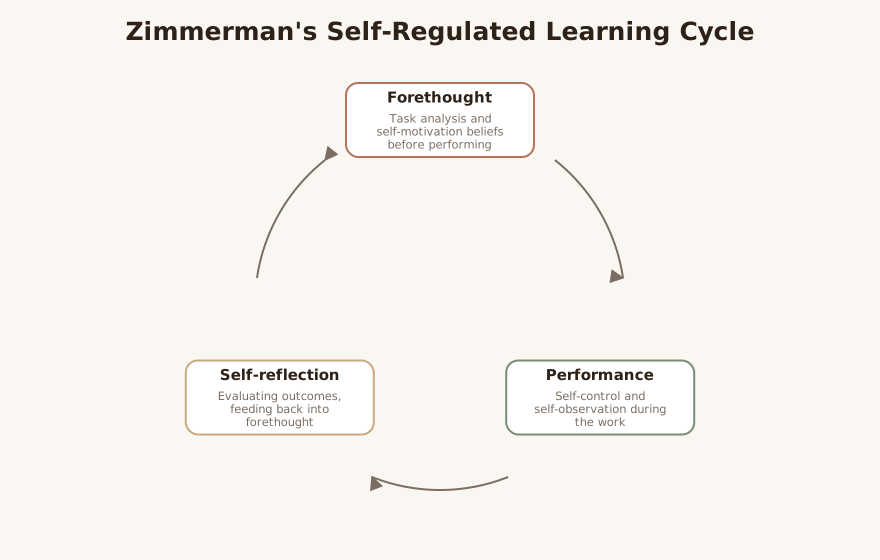
Self-Regulated Learning (SRL) is a framework from educational psychology, not a freestanding psychotherapy 4. It describes learning that is guided by metacognition, by strategic action such as planning, monitoring, and evaluating one’s progress against a standard, and by the motivation to learn 4. At its center is Barry Zimmerman’s cyclical model, in which a learner moves through three recurring phases: forethought before a task, performance control during it, and self-reflection afterward, with each phase feeding the next 1. The framework sits within social-cognitive theory and treats self-direction as a set of learnable skills rather than a fixed trait 5. For clinicians, SRL functions as a metacognitive scaffold embedded inside an existing modality, such as a skills or psychoeducation module within cognitive behavioral therapy, rather than as a therapy billed in its own right LLM. Understanding its phases, its mechanisms, and its limits keeps clinical use precise and modest LLM.
Creators & Lineage
The cyclical three-phase model of self-regulated learning was developed by Barry Zimmerman, whose 2002 overview, “Becoming a Self-Regulated Learner,” remains the canonical statement of the framework 1. Zimmerman’s account grew directly out of social-cognitive theory, which examines the reciprocal, triadic interaction between the person, their behavior, and their environment, so that beliefs about success, engagement in a task, and feedback from the environment continuously shape one another 4. Albert Bandura supplied the deeper foundation, establishing self-efficacy, the person’s belief in their capability, as a core mechanism that the SRL model later places inside its forethought phase 5.
SRL is best understood as a family of related models rather than a single theory 3. A widely cited review by Panadero compared six major SRL frameworks, including Zimmerman’s cyclical model, Boekaerts’s dual-pathway model with its emphasis on emotion, Winne and Hadwin’s metacognition-centered architecture, Pintrich’s integration of motivation and affect across cognition, motivation, behavior, and context, Efklides’s metacognitive analysis, and the Hadwin, Järvelä, and Miller model that extends regulation into co-regulation and socially shared regulation 3. Paul Pintrich’s contribution is notable for foregrounding motivational and affective components alongside cognition 5. The framework’s lineage therefore runs through social-cognitive theory and self-efficacy theory into a broader literature on metacognition and self-regulation 3.
Core Principles
The organizing principle is that self-regulation is cyclical, not linear: forethought shapes performance, performance generates the experience that self-reflection evaluates, and that reflection shapes the forethought of the next attempt 1. The first phase, forethought, is the preparatory work a learner does before performing, and it has two components: task analysis, which includes goal-setting and strategic planning, and self-motivation beliefs, which include self-efficacy, outcome expectations, intrinsic interest in or value placed on the task, and goal orientation 5. These beliefs energize the whole cycle, because a learner who expects to fail or sees no value in the task is unlikely to plan or persist 5.
The second phase, performance, also called volitional control, occurs during the learning itself and draws on the learner’s attention and willpower 4. It comprises self-control, which includes methods such as self-instruction, imagery, attention focusing, and task strategies, and self-observation, the monitoring and self-recording of one’s own activity 4. Self-observation, the tracking of one’s own performance, is described as the most important of these performance processes, because a learner cannot adjust what they are not watching 4.
The third phase, self-reflection, follows performance and is where the learner reviews the result against the goal 4. It comprises self-judgment, which includes self-evaluation against a standard and causal attribution of the outcome, and self-reaction, the learner’s affective and motivational response, which can be adaptive or defensive 3. The attributions a learner makes here, whether they explain an outcome by effort and strategy or by fixed ability, feed directly back into the self-efficacy and motivation of the next forethought phase 3. What distinguishes strong self-regulators from poor ones is precisely this looping use of strategy, monitoring, and reflection, paired with a high sense of self-efficacy 4.
Interventions & Techniques
Because SRL is a framework rather than a therapy, “interventions” here means concrete ways to embed its phases inside recognized clinical and educational activities LLM. The practical strategies the literature names map onto the cycle: goal-setting, self-monitoring, self-evaluation, time management, and help-seeking 4. Goal-setting and strategic planning operationalize the forethought phase, where vague intentions are converted into a specific plan with a defined standard 5. Breaking material into manageable sections and maintaining goal-oriented focus are forethought and performance techniques the explainer literature highlights 5.
Self-monitoring techniques operationalize the performance phase 4. A clinician can have a client self-record behavior, mood, or strategy use as it happens, making covert process visible so it can be adjusted, and can teach self-instruction and attention-focusing as in-the-moment self-control methods 4. Self-testing during study is a concrete example of monitoring progress against a standard while still in the work 5.
Self-evaluation and attribution work operationalize the self-reflection phase 3. Here the clinician helps the client compare the outcome to the goal, examine how they explained the result, and notice whether their self-reaction was adaptive, leading back into the task, or defensive, leading to avoidance 3. Across all three phases, the instructional task is to create structured opportunities for the client to set clear goals, track progress, and reflect on achievements, and then to fade that external structure as the cycle becomes self-sustaining 5.
LLM-generated illustrative example (not a guideline): A clinician working with a procrastinating graduate student walks one assignment through the full cycle: together they set a specific, time-bound subgoal and rate the client’s confidence (forethought); the client logs start time, distractions, and the strategy used during a single work block (performance and self-observation); and at the next session they compare what happened to the plan, examine the client’s explanation for the result, and notice whether the self-reaction pulled them back toward the work or away from it (self-reflection), then carry that learning into the next plan LLM.
Evidence Base
SRL is best described as an established and widely adopted educational framework, but “established” refers to broad acceptance and pedagogical utility, not to validation as a standalone clinical treatment 1. Zimmerman’s cyclical model is one of the most influential accounts in the field, and the broader SRL literature is mature enough that reviews now compare and integrate multiple competing models rather than arguing for a single one 3. Panadero’s review concludes that these models collectively form an integrative and coherent framework while also showing differential effects across developmental stages, which is a measured rather than triumphal claim 3.
The available outcome evidence is educational. Some studies report that self-regulated learning can support accelerated learning while maintaining long-term retention compared with instructor-led environments 4. Honesty requires two qualifications LLM. First, the models differ in what they emphasize, with metacognition foregrounded in some and motivation or emotion foregrounded in others, so SRL is a coordinated family of theories rather than one settled construct, and measurement of self-regulation remains an active area of debate 3. Second, SRL has not been validated as a clinical intervention with symptom-level outcome data, because it is a learning framework rather than a treatment; its clinical warrant comes from its educational track record and from the evidence base of the modalities it is embedded in, such as cognitive behavioral therapy LLM. Clinicians should therefore present SRL as a structured way to build self-direction, not as an evidence-based therapy on its own LLM.
Populations & Indications
SRL was developed with students, and students of all ages remain its primary population 5. It extends naturally to adolescents and to college students, where the demand for independent planning, monitoring, and time management is high and where the gap between strong and weak self-regulators becomes consequential 4. Research has examined population differences directly, for example finding that first-generation college students report significantly lower levels of self-regulation for online learning than their peers, which points to where targeted support may matter most 4.
In clinical settings the framework is well suited to clients in skills training and psychoeducation, where any new coping or behavioral skill must be planned, practiced, monitored, and refined over repeated attempts LLM. It is especially relevant for children and adults with attention-deficit/hyperactivity disorder or executive-function difficulties, because the forethought and self-observation components target precisely the planning and self-monitoring functions that are most impaired LLM. The benefits the framework is associated with, including autonomy, resilience, and durable, lifelong learning habits, describe the kind of self-direction many clinical goals ultimately aim at 5. Across these groups the indication is consistent: SRL applies wherever the therapeutic task is to help a client govern their own behavior across the plan-do-reflect cycle rather than relying on external prompting alone LLM.
Problems-for-Work
Several presenting problems map cleanly onto the SRL cycle LLM. For procrastination, the work targets the forethought phase, replacing avoidance with a specific, time-bound subgoal and a confidence rating, then using self-monitoring to start and sustain the task and self-reflection to revise the plan rather than abandon it 5. For attention-deficit/hyperactivity disorder and executive-function deficits, the self-observation component is central, because externalizing planning and self-recording compensates for impaired internal monitoring 4.
For academic underachievement, the cycle distinguishes a client who never plans from one who plans but does not monitor, and from one who monitors but reacts defensively to setbacks, each of which points to a different intervention point 3. For low motivation, the self-motivation beliefs of the forethought phase, self-efficacy, outcome expectations, interest, and goal orientation, become the explicit focus, because these beliefs energize or deflate the entire cycle 5. For poor self-monitoring, teaching deliberate self-observation and self-recording is the direct remedy, since the framework identifies monitoring as the pivotal performance process 4. For goal-setting difficulties, the task-analysis component supplies the concrete skill of converting an intention into a specific, attainable standard 5.
LLM-generated illustrative example (not a guideline): A 16-year-old with attention-deficit/hyperactivity disorder consistently underestimates how long homework takes and gives up after the first stuck point. The clinician scaffolds forethought by having the teen predict the time and rate confidence, scaffolds performance with a simple distraction log kept during one short block, and scaffolds reflection by comparing predicted to actual time and reframing the cause from “I’m lazy” to “the plan needed smaller steps,” which is then built into the next forethought cycle LLM.
Contraindications, Cautions & Cultural Humility
SRL has no contraindications in the pharmacological sense, but several cautions matter LLM. The most common failure is treating self-regulation as a fixed trait or a verdict on the client, when the framework’s premise is that these are learnable, cyclical skills that develop with practice and support 5. Labeling a client a “poor self-regulator” as if it were a stable deficit both misreads the model and risks lowering the self-efficacy the model depends on 4. A second caution concerns capacity and state: expecting full independent planning, monitoring, and reflection from a client in acute distress, in crisis, or with significant cognitive impairment can set them up to fail, so the degree of external scaffolding must be calibrated to current functioning and faded only as capacity returns LLM.
A third caution is over-reliance on self-report: because self-observation and self-judgment are internal, a client may believe they are monitoring and evaluating accurately when they are not, so the clinician should corroborate self-reports with concrete logs and observable outcomes rather than assume the cycle is intact 4. Cultural humility is relevant because SRL emerged within a social-cognitive, individualistic, and formal-schooling tradition that prizes autonomous goal-setting and independent self-direction 5. The value placed on individual versus relational goals, the acceptability of help-seeking, and the meaning of “autonomy” itself vary across cultures and families, and the framework’s own extension into co-regulation and socially shared regulation underscores that regulation is often a shared rather than solo achievement 3. The clinician should adapt the emphasis on independent versus interdependent goals, and the place of help-seeking, to the client’s cultural context rather than treating solo self-direction as a universal endpoint LLM.
Treatment-Plan Suggestions & SMART Objectives
The plan-do-reflect cycle makes SRL a practical engine for writing measurable self-direction objectives within a broader treatment plan LLM. The examples below are illustrative templates to adapt, not prescriptions LLM.
| Goal | SMART objective (example) | Mechanism |
|---|---|---|
| Strengthen forethought and planning | Within 3 sessions, client will convert one recurring task into a written subgoal with a defined standard and a confidence rating before starting | Task analysis and self-motivation beliefs in the forethought phase 5 |
| Build in-task self-monitoring | Over 4 weeks, client will self-record start time, strategy used, and one distraction during two work blocks per week | Self-observation, the pivotal performance process 4 |
| Improve self-control during work | Within 6 sessions, client will apply one named attention-focusing or self-instruction method during an in-session task and log its effect | Self-control methods within the performance phase 4 |
| Develop accurate self-evaluation | Over 4 weeks, client will compare predicted to actual outcomes on logged tasks and rate the gap weekly | Self-judgment and self-evaluation in the self-reflection phase 3 |
| Shift causal attributions | Within 8 sessions, client will reframe two failure explanations from fixed ability to effort or strategy in session | Causal attribution feeding self-efficacy in the next cycle 3 |
| Raise task-specific self-efficacy | Across 6 sessions, client will log one supported success per week and rate confidence before each attempt | Self-motivation beliefs energizing the forethought phase 5 |
| Reduce procrastination through cycling | Over 4 weeks, client will complete one full plan-do-reflect cycle on a previously avoided task and record the next-cycle adjustment | Cyclical feedback from reflection into the next forethought 1 |
Common Misconceptions
A frequent misconception is that self-regulation is a stable personality trait, when the framework treats it as a set of cyclical, teachable skills that develop with practice and appropriate support 5. A second is that the three phases run as a one-time, linear sequence; in fact the model is cyclical, and the reflection at the end of one attempt directly shapes the planning of the next 1. People also assume SRL is mainly about cognition, overlooking that motivation and affect, through self-efficacy, outcome expectations, interest, and self-reactions, are built into the model and often determine whether the cognitive strategies are ever deployed 5.
Another error is reducing SRL to time management or study tips, when those are only the surface techniques of a deeper plan-monitor-reflect architecture 4. Some treat SRL as a single settled theory, when the literature is a family of competing and complementary models that weight metacognition, motivation, and emotion differently 3. Finally, a clinically important misconception is that SRL is an evidence-based therapy in its own right; it is an educational framework whose clinical value is organizational and whose outcome warrant comes from the modalities it is embedded inside LLM.
Training & Certification
There is no certification in self-regulated learning and no credential is required to use it, because it is a public, widely disseminated educational framework rather than a proprietary clinical method LLM. Clinicians typically encounter it through graduate coursework in educational, developmental, or clinical psychology, and through the foundational literature on self-efficacy and social-cognitive theory that underpins it 5. The primary entry point is Zimmerman’s 2002 overview, which lays out the cyclical model and its phases in accessible form, and is available in full text 12. For a map of how Zimmerman’s model relates to the other major SRL frameworks, Panadero’s review is the standard reference 3. Open explainer texts and reference summaries provide practical descriptions of the phases and strategies suitable for clinical adaptation 45. No formal training is needed to apply SRL ethically within one’s existing scope of practice, provided it is used inside a modality the clinician is already competent to deliver LLM.
Key Terms
Self-regulated learning – learning guided by metacognition, strategic action, and motivation, in which the learner plans, monitors, and evaluates their own progress against a standard 4. Forethought phase – the preparatory phase before a task, comprising task analysis (goal-setting and strategic planning) and self-motivation beliefs 5. Performance phase – the volitional-control phase during the task, comprising self-control methods and self-observation 4. Self-reflection phase – the phase after the task, comprising self-judgment and self-reaction 3. Self-efficacy – the learner’s belief in their capability to succeed, a self-motivation belief that energizes the cycle 5. Self-observation – the monitoring and self-recording of one’s own activity, identified as the most important performance process 4. Causal attribution – the explanation a learner gives for an outcome, which feeds back into self-efficacy and motivation for the next cycle 3. Co-regulation and socially shared regulation – extensions of SRL in which regulation is shared between people rather than performed alone 3.
Resources & Further Reading
▶ Watch — a video introduction to this concept:
- Becoming a Self-Regulated Learner: An Overview (Zimmerman, 2002, Theory Into Practice)
- Becoming a Self-Regulated Learner: An Overview (full-text PDF, University of Bath mirror)
- A Review of Self-regulated Learning: Six Models and Four Directions for Research (Panadero, 2017, Frontiers in Psychology)
- Self-regulated learning (Wikipedia)
- Self-Regulated Learning Theory (Design in Progress, Pressbooks open text)
Reflective / Supervision Questions
- For a client stuck on a goal, can you locate which phase is breaking down: do they never plan (forethought), fail to track what they do (performance), or react defensively to setbacks (self-reflection)? LLM
- When a client reports they are “monitoring” their behavior, how do you corroborate that self-report with concrete logs or observable outcomes rather than taking the internal process on faith? LLM
- How deliberately do you work with the self-motivation beliefs, self-efficacy, value, and goal orientation, that energize the cycle, rather than only the cognitive strategies? LLM
- When a client explains a setback by fixed ability, how do you help them re-attribute it to effort or strategy so the next planning cycle is not poisoned by lowered self-efficacy? LLM
- Where might your emphasis on independent, solo self-direction need to give way to co-regulation and the client’s own cultural and relational context? LLM