
Type & Discipline
Bloom’s Taxonomy is a classification framework, not a treatment, drawn from educational psychology and instructional design 1. It organizes learning objectives into ordered levels of cognitive complexity, with parallel affective and psychomotor domains 2. For clinicians, it functions as a scaffolding heuristic rather than a standalone therapy, and any clinical use sits inside an existing modality such as psychoeducation within psychotherapy or structured clinical supervision LLM. Understanding its origins and limits keeps its application appropriately modest LLM.
Creators & Lineage
The original taxonomy was developed in 1956 by a committee of educators led by Benjamin Bloom, who sought a common language for classifying educational goals across institutions 2. The cognitive domain was the most fully elaborated, with six original categories: Knowledge, Comprehension, Application, Analysis, Synthesis, and Evaluation 5. In 2001, a team led by Lorin Anderson, a former student of Bloom, and David Krathwohl, a co-author of the original framework, published a substantial revision 1. The revision changed the category labels from nouns to verbs to emphasize that learning objectives describe what learners do, and it reordered the top two levels so that Create sits at the apex 6. The framework’s intellectual lineage runs through cognitive learning theory, constructivism, and instructional design, where it remains a foundational reference for curriculum and assessment design LLM.
Core Principles
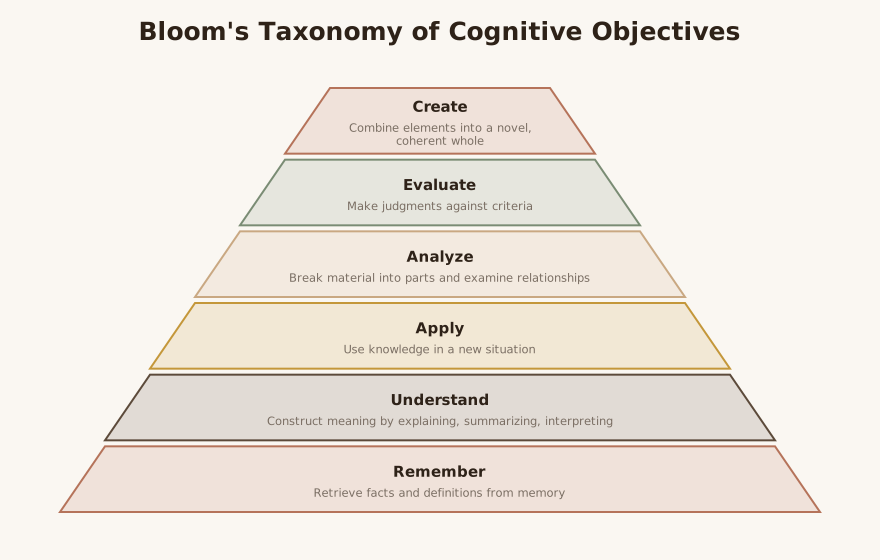
The revised cognitive taxonomy contains six levels arranged from lower-order to higher-order thinking: Remember, Understand, Apply, Analyze, Evaluate, and Create 6. Remember involves retrieving facts and definitions from memory, and Understand involves constructing meaning by explaining, summarizing, or interpreting 4. Apply means using knowledge in a new situation, Analyze means breaking material into parts and examining relationships, and Evaluate means making judgments against criteria 4. Create, the highest level, means combining elements into a novel, coherent whole 6. The 2001 revision also added a second dimension, the knowledge dimension, distinguishing factual, conceptual, procedural, and metacognitive knowledge, so any objective can be located on a grid of cognitive process by knowledge type 1.
A central principle is that the levels were intended as a rough cumulative progression, with mastery at higher levels assumed to depend on competence at lower ones 5. The action-verb framing is practically important: each level is associated with characteristic verbs, such as “define” and “list” for Remember, “explain” and “classify” for Understand, “demonstrate” and “use” for Apply, “differentiate” and “compare” for Analyze, “critique” and “justify” for Evaluate, and “design” and “construct” for Create 3. These verbs are what make the taxonomy directly useful for writing measurable objectives LLM. The affective domain, addressing attitudes and values, and the psychomotor domain, addressing physical skills, were developed separately and are less commonly used clinically 2.
Interventions & Techniques
Because Bloom’s Taxonomy is a framework rather than a therapy, “interventions” here means structured ways to embed it within recognized clinical and training activities LLM. The first application is sequencing psychoeducation so a client moves through cognitive levels rather than receiving information all at once LLM. A clinician introducing emotion regulation might first ensure the client can name and recognize a skill (Remember), then explain when it applies in their own words (Understand), then rehearse it in session (Apply), before expecting independent generalization LLM.
A second technique is using the action verbs to convert vague goals into observable behaviors during collaborative goal-setting LLM. Rather than “the client will understand their triggers,” a clinician writes “the client will identify three situational triggers and describe the physiological cue that precedes each,” which specifies the cognitive level and the evidence of attainment LLM.
A third application is the deliberate scaffolding of clinical supervision, where supervisees are moved from recalling diagnostic criteria toward applying interventions, analyzing session process, evaluating their own clinical decisions, and ultimately creating case formulations LLM. The taxonomy gives supervisors a shared vocabulary for naming where a trainee is stuck and what the next developmental step looks like LLM.
LLM-generated illustrative example (not a guideline): A supervisor notices a trainee can accurately list the criteria for PTSD (Remember) and explain the rationale for exposure (Understand) but freezes when planning a session. The supervisor reframes the gap as a jump from Understand to Apply and assigns a structured role-play, then a graded live attempt, before asking the trainee to evaluate the session recording against fidelity criteria LLM.
Evidence Base
Bloom’s Taxonomy is best described as an established and widely adopted framework, but “established” refers to adoption and utility, not to validation as an empirical theory of cognition or as a clinical intervention 1. It is one of the most cited and used frameworks in education for curriculum, assessment, and objective writing 5. However, the strict cumulative hierarchy, the assumption that each level strictly requires mastery of all lower levels, has limited empirical support, and the 2001 revision itself softened this by acknowledging that the categories overlap and that the hierarchy is approximate rather than rigid 6.
For clinical use, there is no outcome evidence that applying Bloom’s Taxonomy improves symptoms, because it is not a treatment and has not been studied as one LLM. Its value in clinical settings is pragmatic and structural: it helps clinicians and supervisors design clearer, more measurable learning and skill-acquisition goals, a function supported by its long track record in education rather than by clinical trials LLM. Clinicians should present it to clients and trainees as an organizing tool, not as an evidence-based therapy in its own right LLM.
Populations & Indications
The framework was designed for students and educators, and those remain its primary populations 5. In clinical and training contexts, its most natural fit is with trainees and clinical supervisees, where it structures competency development across a graded sequence LLM. It also applies to children and adolescents in educational settings, where treatment planning frequently intersects with academic objectives and individualized education goals LLM.
With adult clients, Bloom’s is indicated whenever the therapeutic task involves deliberate learning or skill acquisition, including psychoeducation about a diagnosis, learning a coping or regulation skill, or building a concrete competency LLM. It can be adapted for people with learning difficulties by deliberately pacing movement through the levels and not assuming a client has reached Apply or Analyze simply because they can verbalize a concept LLM. The framework is indication-neutral with respect to diagnosis; it shapes how learning content is delivered rather than which condition is treated LLM.
Problems-for-Work
Several presenting and training problems map cleanly onto the taxonomy LLM. For learning difficulties and academic difficulties, the clinician can locate where comprehension breaks down, distinguishing a client who cannot recall material from one who recalls but cannot apply it, which points to different remediation LLM.
For skill acquisition deficits and cognitive skill development, the levels function as a checklist of whether a skill has truly generalized LLM. A client who can name a grounding technique but cannot use it during distress is stuck between Remember and Apply, and the work targets that specific transition LLM.
For psychoeducation, the taxonomy prevents the common error of stopping at Understand; a client who can explain the cognitive model has not necessarily reached the Apply or Analyze levels needed for durable change LLM. For training and supervision needs, the framework names the developmental edge of a supervisee and sequences assignments accordingly LLM. For goal setting, the action verbs translate ambitions into observable, measurable objectives that satisfy documentation standards LLM.
LLM-generated illustrative example (not a guideline): An adolescent client states they “get” anxiety psychoeducation but continues to avoid school. The clinician recognizes the client is at Understand but not Apply, and shifts from explaining anxiety to in-session graded exposure rehearsal, then to the client analyzing which avoidance behaviors maintain the cycle LLM.
Contraindications, Cautions & Cultural Humility
Bloom’s Taxonomy has no contraindications in the pharmacological sense, but several cautions apply LLM. The first is over-rigidity: treating the hierarchy as a strict, fixed sequence can pathologize normal nonlinear learning, since real learning loops back and forth across levels rather than climbing a ladder 6. Clinicians should hold the order loosely and use it descriptively, not prescriptively LLM.
A second caution is misuse as an assessment of intelligence or worth; the taxonomy describes objectives and tasks, not the value or capability of a person, and labeling a client as operating “only at a low level” is both clinically unhelpful and stigmatizing LLM. A third caution concerns clients with cognitive impairment, intellectual disability, or active acute distress, for whom expectations to reach higher cognitive levels must be calibrated to current functioning rather than imposed as a standard LLM.
Cultural humility matters because the taxonomy was developed within a Western, formal-schooling tradition that privileges abstract analysis and individual creation LLM. What counts as “higher-order” thinking, and which forms of knowledge are valued, vary across cultures, and collaborative or relational ways of knowing may not map neatly onto a single creator-at-the-apex model LLM. Clinicians should adapt objectives to the client’s own learning history, language, and cultural context rather than treating the taxonomy as a universal standard LLM.
Treatment-Plan Suggestions & SMART Objectives
The action verbs make Bloom’s Taxonomy a practical engine for writing measurable objectives within a broader treatment or training plan LLM. The examples below are illustrative templates to adapt, not prescriptions LLM.
| Goal | SMART objective (example) | Mechanism |
|---|---|---|
| Build recall of a coping skill | Within 2 sessions, the client will name and describe the steps of one grounding technique without prompting | Remember: retrieval from memory establishes the foundation for use 4 |
| Demonstrate understanding of a diagnosis | Within 3 sessions, the client will explain their anxiety cycle in their own words using a written diagram | Understand: constructing meaning supports buy-in and self-monitoring 4 |
| Apply a skill under distress | Over 4 weeks, the client will use a regulation skill in two logged real-world distress episodes per week | Apply: transfer to new situations is the threshold for functional change 6 |
| Analyze maintaining factors | Within 6 sessions, the client will identify three avoidance behaviors and describe how each maintains the problem | Analyze: examining relationships exposes targets for intervention 4 |
| Evaluate progress against criteria | Monthly, the client will rate which strategies worked using an agreed effectiveness scale and justify the rating | Evaluate: judgment against criteria builds self-directed adjustment 6 |
| Create a personalized plan | By session 12, the client will design a written relapse-prevention plan integrating their most effective strategies | Create: synthesis into a novel whole supports durable, generalized gains 6 |
| Advance a supervisee’s competency | Within one quarter, the supervisee will move from applying a manualized intervention to formulating two independent case conceptualizations | Spans Apply to Create across the supervision arc LLM |
Common Misconceptions
A frequent misconception is that the levels form a strict staircase in which no work at a higher level can occur until a lower level is fully mastered; the revised framework explicitly treats the order as approximate and overlapping 6. Another is that “higher” levels are always better or more important, when in practice the appropriate target level depends on the goal, and solid recall and understanding are often exactly what a client needs LLM.
People often assume the original 1956 ordering still stands, but the 2001 revision reordered the top levels and renamed the categories as verbs, so Create, not Evaluation, now sits at the top 6. A further misconception is that Bloom’s is an evidence-based clinical intervention; it is an instructional framework with no clinical outcome trials, and its clinical value is organizational rather than therapeutic LLM. Finally, some treat the taxonomy as measuring a learner’s fixed ability, when it classifies tasks and objectives, not persons LLM.
Training & Certification
There is no certification in Bloom’s Taxonomy and no credential required to use it, because it is a public, widely disseminated educational framework rather than a proprietary clinical method LLM. Clinicians typically encounter it through graduate coursework in education or supervision, through teaching-center resources at universities, and through the primary texts 1. Authoritative free summaries are maintained by university teaching centers, including Vanderbilt University, the University of Waterloo, and the University of Illinois Chicago, which provide verb lists and worked examples suitable for clinical adaptation 235. The most thorough source for the revised framework is the Anderson and Krathwohl 2001 volume, with Krathwohl’s 2002 overview offering a concise summary 16. No formal training is needed to apply it ethically within one’s existing scope of practice LLM.
Key Terms
Cognitive domain refers to the branch of the taxonomy concerned with knowledge and intellectual skills, the part most used clinically 2. The six revised cognitive levels are Remember, Understand, Apply, Analyze, Evaluate, and Create, ordered from lower-order to higher-order thinking 6. The knowledge dimension, added in 2001, classifies content as factual, conceptual, procedural, or metacognitive 1. Action verbs are the level-specific verbs, such as “list,” “explain,” “apply,” “analyze,” “critique,” and “design,” used to write observable objectives 3. The affective domain addresses attitudes, values, and emotional engagement, and the psychomotor domain addresses physical and motor skills, both developed as parallel taxonomies 2. Scaffolding, a related instructional concept, refers to structured support that is gradually withdrawn as competence grows LLM.
Resources & Further Reading
▶ Watch — a video introduction to this concept:
- A Taxonomy for Learning, Teaching, and Assessing: A Revision of Bloom’s Taxonomy (Anderson & Krathwohl, 2001)
- Bloom’s Taxonomy — Vanderbilt University Center for Teaching (Armstrong)
- Bloom’s Taxonomy — University of Waterloo Centre for Teaching Excellence
- Anderson and Krathwohl — Revised Bloom’s Taxonomy (PDF, Quincy College)
- Bloom’s Taxonomy of Educational Objectives — University of Illinois Chicago
- A revision of Bloom’s taxonomy: An overview (Krathwohl, 2002)
Reflective / Supervision Questions
- When you last delivered psychoeducation, did you confirm the client reached Apply, or did you stop at Understand and assume the rest would follow? LLM
- For a current supervisee, can you name the specific cognitive level where they are stuck, and the next developmental step that would move them forward? LLM
- Are your written treatment objectives anchored to observable action verbs, or do they rely on unmeasurable words like “understand” and “improve”? LLM
- Where might a rigid reading of the hierarchy be causing you to underestimate a client whose learning is simply nonlinear? LLM
- How does your use of the taxonomy account for the client’s cultural and educational background rather than imposing a single standard of “higher-order” thinking? LLM