
Type & Discipline
Metacognition is a construct — a theoretical entity inferred from behavior rather than a treatment in its own right — originating in cognitive and educational psychology 4. At its simplest it is “thinking about thinking”: awareness of one’s own thought processes and an understanding of the patterns behind them 4. The construct sits within the family of self-regulated learning, where it describes how learners plan, track, and assess their own understanding and performance 3.
For practicing therapists the relevance is direct even though the lineage is educational. The same architecture that lets a student notice “I don’t actually understand this chapter” also lets a client notice “I am caught in worry again” — and it is that second-order awareness, or its absence, that several contemporary therapies deliberately target 4. Understanding metacognition as a construct, rather than as a single technique, clarifies why it surfaces under many names across modalities LLM.
Creators & Lineage
The developmental psychologist John H. Flavell coined the term in 1979, defining metacognition as knowledge about cognition and control of cognition 4. Flavell’s original concern was developmental: he observed that young children have limited knowledge about cognitive phenomena and do relatively little monitoring of their own memory and comprehension, and he proposed a model of what adult-like metacognitive knowledge and behavior might look like 1. The construct grew out of information-processing theory and the broader cognitive-developmental tradition 1.
From education and cognitive psychology, the idea migrated into clinical work. The most prominent translation is Adrian Wells’ Metacognitive Therapy, which reframes emotional disorders as problems of how people relate to their thoughts rather than the content of those thoughts 4. This article treats Flavell’s construct as the trunk and the clinical applications as branches — a distinction worth holding onto, because the evidence for the two differs in maturity LLM.
Core Principles
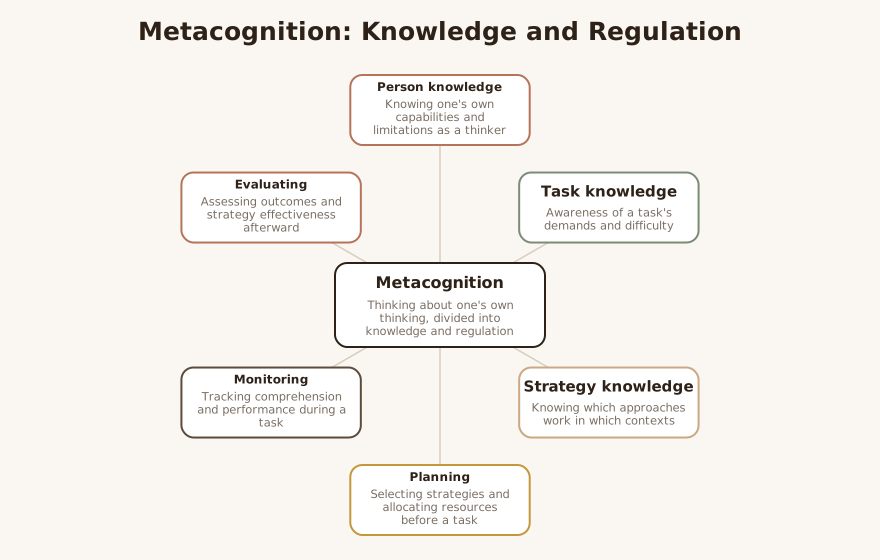
Metacognition is conventionally divided into two components 45.
Metacognitive knowledge is what a person knows about thinking and learning, organized around three variables 45:
- Person knowledge — understanding one’s own capabilities and limitations as a thinker; self-assessments here are not always accurate 3.
- Task knowledge — awareness of a task’s demands and difficulty relative to one’s abilities 4.
- Strategy knowledge — recognition of which approaches work in which contexts, and the capacity to adapt them 3.
This knowledge is sometimes parsed as declarative (“knowing what”), procedural (“knowing how”), and conditional (“knowing when and why”) 5.
Metacognitive regulation is the active control of cognition through three processes 45:
- Planning — selecting strategies and allocating resources before a task 4.
- Monitoring — tracking comprehension and performance during a task 4.
- Evaluating — assessing outcomes and strategy effectiveness afterward 4.
Flavell also distinguished metacognitive experiences — the in-the-moment feelings and realizations through which this knowledge accrues, such as the confidence built by a run of high test scores 3. A further principle, easy to miss, is that metacognition is domain-general: the skills transfer across subjects and contexts rather than belonging to any one 4. In clinical translation, Wells frames a related distinction between object mode, in which thoughts are treated as truth, and metacognitive mode, in which thoughts are evaluated as cues requiring assessment 4.
Interventions & Techniques
Metacognition is not itself an intervention; it is a target and a mechanism that interventions recruit LLM. Several recognizable techniques work by strengthening metacognitive knowledge or regulation.
In Metacognitive Therapy, the central model is the Cognitive-Attentional Syndrome (CAS) — a pattern of excessive, threat-focused attention expressed as worry, rumination, and unhelpful monitoring 4. Two techniques follow from it. The Attention Training Technique (ATT) builds cognitive control and flexible attention to reduce worry 4. Detached mindfulness and the shift into metacognitive mode help clients hold thoughts as passing events rather than facts demanding engagement 4.
Cognitive-behavioral therapy “often involves metacognitive components,” and metacognitive therapy specifically targets the beliefs and processes underlying disorders 5. Decentering and defusion are close cousins of metacognitive mode — both ask the client to step back and observe thinking LLM.
In educational and self-regulated-learning settings, the techniques are more pedestrian but well validated: pretesting, self-evaluation, study planning, and comprehension monitoring while reading 4. Students taught these skills perform measurably better on examinations 4. Therapists working with attention and executive difficulties can borrow the same scaffolds — planning prompts, in-task self-checks, post-task review — as concrete regulation training LLM.
LLM-generated illustrative example (not a guideline): A clinician asks a ruminating client to name, each time they catch themselves replaying a conversation, “Is this a thought I’m watching, or a problem I’m solving?” The question is a monitoring prompt that nudges the client from object mode toward metacognitive mode. LLM
Evidence Base
Honesty here requires splitting the construct from its clinical applications LLM.
As a construct, metacognition is established. It has been a defined area of inquiry since Flavell’s 1979 paper and remains an active research field with a substantial measurement literature 12. Decades of educational research link strong metacognitive skills to academic achievement, and metacognitive training reliably improves examination performance 45.
That maturity coexists with genuine debate. A recent review argues that the pursuit of measurement rigor — quantifying confidence judgments trial-by-trial with metrics such as meta-d′ and the M-ratio — may be narrowing the construct, turning it into “a science of the task or metric, rather than of the construct” itself 2. Self-report questionnaires are criticized for circularity, presupposing the very awareness they aim to measure 2. Whether metacognitive ability is domain-general or domain-specific remains unresolved 2.
The clinical translation is a separate and younger evidence base LLM. Metacognitive Therapy and related metacognitive training have been applied to generalized anxiety, obsessive-compulsive presentations, and psychosis, and the underlying models (CAS, ATT, object vs. metacognitive mode) are well articulated 4. But the construct’s established status in cognitive psychology should not be read as settling the magnitude of clinical benefit; therapists should look to the specific therapy’s own trial literature rather than assume the construct’s pedigree transfers LLM. This article cites no efficacy statistics because the provided sources support none LLM.
Populations & Indications
Metacognition is relevant across a wide span of presentations 4. In students and people with learning difficulties, it is a lever for comprehension, study strategy, and self-regulated learning 43. In adults and adolescents, the same regulatory skills support deliberate problem-solving and emotional self-management 5.
The clearest clinical indications cluster around anxiety disorders: the CAS model identifies the threat-focused attention that maintains worry and rumination, making metacognitively informed work a natural fit for generalized anxiety 4. For people with ADHD and others with executive or attentional difficulties, the planning–monitoring–evaluating cycle maps onto exactly the regulatory functions that are taxed, suggesting metacognitive scaffolding as adjunctive support LLM. Across all of these, the unifying indication is impaired or unhelpful self-monitoring — whether of comprehension, attention, or thought LLM.
Problems-for-Work
- Worry and generalized anxiety disorder — the CAS frames worry as a maintained attentional habit; work targets the metacognitive beliefs (“worrying keeps me safe”) and the attention they drive 4.
- Rumination — shifting from object mode to metacognitive mode lets a client observe ruminative thoughts as events rather than facts to be resolved 4.
- Attention difficulties — attention training and in-task monitoring prompts rebuild flexible cognitive control 4.
- Poor self-monitoring — comprehension monitoring and self-evaluation exercises, drawn from the learning literature, externalize the checking process until it becomes habitual 45.
- Executive dysfunction — explicit planning and post-task evaluation scaffolds stand in for under-functioning regulation LLM.
- Learning difficulties — teaching strategy knowledge (which approach, when, and why) improves transfer across tasks 3.
- Cognitive distortions — metacognitive mode and decentering loosen the grip of distorted thoughts by changing the client’s relationship to them rather than litigating content 4.
Contraindications, Cautions & Cultural Humility
There are no formal contraindications to a construct, but several cautions apply to its clinical use LLM. Person knowledge — a client’s self-assessment of their own abilities — can be inaccurate, so therapists should not treat clients’ metacognitive self-reports as ground truth 3. Self-report measures of metacognition carry the same circularity that troubles the research literature, and should be triangulated with observed behavior 2. Motivation is a precondition: unmotivated clients struggle to engage in self-reflection, so metacognitive work presupposes a baseline of engagement that may itself need to be built first 3.
Culturally, “thinking about thinking” is not value-neutral. What counts as adaptive self-monitoring, appropriate confidence, or healthy detachment from thought is shaped by cultural norms around emotion, deference, and the self LLM. The construct itself notes that reasonable people may defer to others in how concepts are used and judged, a reminder that metacognitive standards are partly socially set rather than purely individual 6. Clinicians should hold their own metacognitive ideals lightly and collaborate on what regulation looks like for a given client LLM.
Treatment-Plan Suggestions & SMART Objectives
| Goal | SMART objective (example) | Mechanism |
|---|---|---|
| Reduce worry duration | Client will use the Attention Training Technique daily and report a 30% reduction in self-rated worry time within 6 weeks | Builds cognitive control over threat-focused attention (CAS) 4 |
| Disrupt rumination | Client will identify and label 3 ruminative episodes per day, shifting to metacognitive mode, for 4 weeks | Object-to-metacognitive mode shift 4 |
| Improve self-monitoring | Client will complete a brief comprehension/attention self-check after 5 daily tasks for 3 weeks | Monitoring component of regulation 45 |
| Strengthen planning | Client will write a 3-step plan before each study or work block, 5 days/week, for 4 weeks | Planning component of regulation 4 |
| Loosen cognitive distortions | Client will practice decentering from 2 distressing thoughts per day, rating belief before/after, for 4 weeks | Metacognitive mode / decentering 4 |
| Build strategy knowledge | Client will name which coping strategy fits which trigger across 4 logged situations weekly | Conditional (“when/why”) knowledge 5 |
| Increase post-task evaluation | Client will complete a 2-minute “what worked / what I’d change” review after weekly goals for 6 weeks | Evaluating component of regulation 4 |
Common Misconceptions
“Metacognition is the same as introspection or general self-awareness.” It is more specific: knowledge about cognition plus the regulation of cognition, organized around person, task, and strategy 45. “It’s a therapy technique.” It is a construct and a target; techniques such as ATT or detached mindfulness recruit it LLM. “Flavell described the full modern framework.” Flavell originated the term and a developmental model; the now-standard person/task/strategy and planning/monitoring/evaluating breakdowns were elaborated by later work 14. “More confidence means better metacognition.” Metacognitive accuracy — the calibration between confidence and performance — matters more than confidence itself, and measuring it is genuinely hard 2. “It’s a fixed trait.” Metacognitive skills are teachable and improve with training 4.
Training & Certification
No certification governs the metacognition construct itself; it belongs to the shared vocabulary of cognitive and educational psychology LLM. Therapists wishing to apply it clinically should pursue training in the specific modality that operationalizes it — most directly Metacognitive Therapy, with its defined CAS model and attention-training methods, or the metacognitive elements embedded within cognitive-behavioral therapy 45. Familiarity with the measurement debates — the limits of self-report and the meaning of metacognitive accuracy — is useful for reading the literature critically 2.
Key Terms
- Metacognitive knowledge — what one knows about cognition, across person, task, and strategy variables 45.
- Metacognitive regulation — planning, monitoring, and evaluating cognition 4.
- Metacognitive experience — momentary feelings/realizations about one’s cognition 3.
- Cognitive-Attentional Syndrome (CAS) — the threat-focused attentional pattern maintaining worry and rumination 4.
- Object vs. metacognitive mode — treating thoughts as truth vs. as cues to be evaluated 4.
- Metacognitive accuracy — calibration of confidence to actual performance; central to measurement 2.
- Deference judgment — judging that one should defer to others in how a concept is used 6.
Resources & Further Reading
▶ Watch — a video introduction to this concept:
- Flavell, J. H. (1979). Metacognition and cognitive monitoring
- Katyal & Fleming — The future of metacognition research (PMC)
- Metacognition (Flavell) — Learning-Theories.com
- Metacognition — Wikipedia
- Metacognition: Thinking About Thinking — PsychologyNotesHQ
- Shea, N. (2018) — Metacognition and abstract concepts (PubMed)
Reflective / Supervision Questions
- For a given client, am I targeting the content of thoughts or their relationship to thoughts — and which does this presentation call for? LLM
- How accurate is this client’s self-assessment of their own abilities, and how would I know if it were miscalibrated? 3
- Where does my own metacognitive ideal (detachment, “rational” appraisal) reflect cultural assumptions the client may not share? LLM
- Am I treating metacognition as an established construct while keeping appropriate humility about the magnitude of clinical benefit? 2
- Which regulation process — planning, monitoring, or evaluating — is most impaired here, and is my intervention matched to it? 4