
Type & Discipline
Dissipative structures are a concept from non-equilibrium thermodynamics and physical chemistry, not from clinical psychology 2. The term names a class of ordered systems that arise and persist only when an open system continuously exchanges energy and matter with its environment, dissipating energy in the process 6. Ilya Prigogine coined the name to stress that such structures exist only in conjunction with their surroundings—remove the throughput of energy and the order collapses 2. In psychotherapy the idea travels as a metaphor and an organizing lens for thinking about change, never as an evidence-based treatment in its own right LLM. This article treats it as a conceptual import: rigorous and well-validated in its home discipline, but borrowed for its explanatory shape when we reason about how people and the systems they live in reorganize LLM.
Creators & Lineage
Ilya Prigogine (1917–2003) was a Belgian physical chemist, born in Moscow, who built the “Brussels School” of non-equilibrium thermodynamics and completed his doctorate under Théophile de Donder 7. He received the 1977 Nobel Prize in Chemistry “for his contributions to non-equilibrium thermodynamics, particularly the theory of dissipative structures” 2. His Nobel lecture, titled “Time, Structure and Fluctuations,” laid out how irreversible processes and fluctuation can generate order rather than merely degrade it 1. With the philosopher Isabelle Stengers he later wrote Order Out of Chaos, popularizing the ideas for a broader audience 7. The work sits at the headwaters of complexity and chaos theory, general systems theory, and self-organization theory—the same currents that flowed into nonlinear-dynamics thinking in psychotherapy LLM. Clinicians inherit the concept secondhand, through that systems-and-complexity tradition rather than from Prigogine directly LLM.
Core Principles
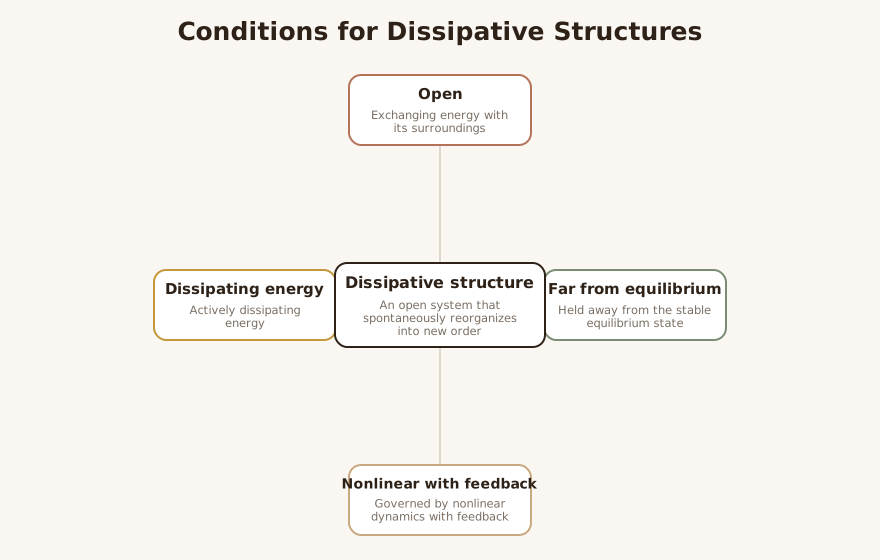
Classical equilibrium thermodynamics predicts decay toward disorder, yet Prigogine showed that order can emerge under the right conditions 2. The press release for his prize put the paradox plainly: the probability of order arising from disorder is infinitesimal by chance, yet dissipative systems demonstrate that order from disorder is possible 2. Four conditions are required: the system must be open (exchanging energy with its surroundings), held far from equilibrium, governed by nonlinear dynamics with feedback, and actively dissipating energy 5. Near equilibrium, perturbations damp out and the system returns to its old state; pushed far from equilibrium, the same system can become unstable, and a fluctuation that would normally fade is instead amplified 1. At a critical threshold—a bifurcation point—the system jumps to a qualitatively new organized state 4. Prigogine summarized this as “order through fluctuations”: small fluctuations, at the right moment, select the system’s next structure 1.
For a clinician, the load-bearing translation is this: stability is not the only attractor, and instability is not only pathology LLM. A person, couple, family, or organization is an open system that takes in experience and expends effort; under enough pressure, its old equilibrium can give way to a reorganization rather than a mere return to baseline LLM. Order, in this view, is something a living system does, continuously, not a static trait it has LLM.
Interventions & Techniques
There is no “dissipative-structures therapy” and no proprietary technique catalog—the construct informs how a clinician thinks, not a manualized protocol LLM. Used as a lens, it shapes existing interventions across modalities LLM. In family and couples work it reframes a stuck homeostatic pattern as a system clinging near its old equilibrium, suggesting that the clinician may need to increase meaningful difference—heightening affect, introducing novelty, blocking habitual moves—rather than soothe the system back to baseline LLM. In experiential and emotion-focused work, the deliberate intensification of avoided affect can be read as pushing the client far enough from equilibrium that a new emotional organization can crystallize LLM. The lens also counsels timing: change-amplifying interventions land differently at a bifurcation point (a crisis, a transition) than during a stable phase, so the clinician watches for windows when the system is poised to reorganize LLM. Crucially, the metaphor argues for tolerating transient disorganization as part of the work rather than reflexively closing it down LLM.
LLM-generated illustrative example (not a guideline): A clinician working with a couple notices that every session de-escalates to a polite truce that resolves nothing. Reading the truce as a low-energy equilibrium, the clinician slows down and amplifies one partner’s unspoken hurt rather than smoothing it over—holding the heightened affect long enough for a new, more honest pattern of contact to form. LLM
Evidence Base
Honesty requires a sharp line here. As physics, the theory is mature and Nobel-validated, with rigorous mathematical foundations and decades of confirmation across chemistry and biology 2. In biological systems, dissipative-structure dynamics are documented as bistability, sustained oscillations such as circadian rhythms and the cell cycle, Turing-type spatial patterns, and propagating waves like those in somite formation and neural firing 5. The framework has been actively reviewed and celebrated in the physical-science literature on its anniversaries, confirming its continued standing within thermodynamics 34. None of this constitutes clinical evidence LLM. There are no randomized trials, no outcome studies, and no measurement instruments for “dissipative-structures-informed therapy,” because it is not a therapy LLM. Its maturity in psychotherapy is metaphorical: it offers a vivid, internally coherent way to describe change processes, but borrowing a validated physics result does not transfer that validation to clinical claims LLM. Treat any assertion that the metaphor predicts a clinical outcome as a hypothesis at best, and present it to clients and supervisees as a frame, not a finding LLM.
Populations & Indications
As a way of thinking, the lens is most useful to therapists and theorists reflecting on how change happens, and to researchers studying change processes in nonlinear terms LLM. It is naturally suited to family systems and couples, where homeostasis, feedback, and reorganization are already core constructs LLM. It scales to organizations and complex social systems—teams, agencies, communities—facing pressure to transform rather than merely adjust LLM. At the individual level it speaks most to clients in transition: people at developmental thresholds, in acute crisis, or between an old identity and an emerging one LLM. The indication is conceptual rather than diagnostic; the lens helps when a clinician needs language for why a system is stuck or how it might leap, not when a specific symptom calls for a specific protocol LLM.
Problems-for-Work
Therapeutic change processes. The metaphor frames first-order versus second-order change: returning to the old equilibrium versus crossing a bifurcation into a new structure LLM.
LLM-generated illustrative example (not a guideline): A client who repeatedly “gets back on track” after each relapse may be re-equilibrating rather than reorganizing; the clinician names this and works toward a structural shift in identity, not another return to baseline. LLM
Resistance to change and maladaptive homeostasis. Resistance is reframed not as opposition but as a system defending a costly-but-stable equilibrium LLM.
LLM-generated illustrative example (not a guideline): A family whose conflict always routes through the identified-patient child is holding a homeostasis that spares the parental dyad; the clinician gently raises the system’s “temperature” by addressing the spousal rift directly. LLM
Stuckness/stagnation and crisis as transformation opportunity. Crisis is recast as proximity to a bifurcation point—maximum instability, maximum possibility LLM.
LLM-generated illustrative example (not a guideline): A client in the acute disorganization following a divorce is helped to see the chaos as the precondition for a reorganized life, not only as damage to be repaired. LLM
Contraindications, Cautions & Cultural Humility
The central caution is category error: dissipative structures are a physical theory, and dressing clinical claims in its authority can lend false scientific weight to what is really intuition LLM. “Order through fluctuations” must never become a rationale for manufacturing crisis, withholding stabilization, or pushing a client toward distress in the hope that reorganization follows—destabilization can harm, not heal LLM. For clients who are acutely unsafe, traumatized, or dysregulated, the clinical priority is stabilization and safety, and the metaphor should recede entirely LLM. The framing also imports a Western, individualist optimism that crisis is opportunity; many clients live in systems where instability has meant material loss, displacement, or violence, and reframing their chaos as growth can feel dismissive LLM. Cultural humility means checking whose interests a “needed” disruption serves, and holding the metaphor lightly, as one lens among many LLM.
Treatment-Plan Suggestions & SMART Objectives
| Goal | SMART objective (example) | Mechanism |
|---|---|---|
| Reduce reliance on a maladaptive homeostatic pattern | Within 8 sessions, client identifies 3 recurring interactions that keep an old pattern stable and names the cost of each | Surfacing the equilibrium the system is defending LLM |
| Increase tolerance for transitional disorganization | Over 6 weeks, client reports staying with uncomfortable uncertainty for one full session per week without premature resolution | Allowing far-from-equilibrium states long enough to reorganize LLM |
| Convert crisis into structured reorganization | Within 10 sessions, client articulates one concrete new role or identity emerging from the current transition | Selecting a new structure at a bifurcation point LLM |
| Shift a couple from low-energy truce to genuine contact | Within 12 sessions, partners complete 4 conversations that surface, rather than suppress, a core unmet need | Amplifying meaningful difference instead of damping it LLM |
| Map the feedback loops maintaining stuckness | Within 4 sessions, client and clinician co-create a written loop diagram of the maintaining cycle | Making nonlinear feedback explicit and changeable LLM |
| Build capacity to self-regulate during destabilization | Over 8 weeks, client demonstrates 2 grounding skills used during periods of heightened affect | Providing stabilizing structure so disorganization stays workable LLM |
| Strengthen support inputs to the open system | Within 6 weeks, client adds 2 sustaining relational or behavioral “energy inputs” to weekly life | Maintaining the throughput an open system needs to hold new order LLM |
Common Misconceptions
“It’s proven in therapy because Prigogine won a Nobel Prize.” The prize validated the physics; clinical application is metaphor and carries no transferred evidence LLM. “Far from equilibrium means more chaos is always better.” The theory requires bounded instability plus continued energy throughput and nonlinear structure—not unbounded disorder, which simply degrades the system 5. “Dissipative means wasteful or destructive.” Dissipation here is the energy flow that sustains order; remove it and the structure dies 6. “Any change is reorganization.” Returning to the prior equilibrium (first-order change) is precisely what the metaphor distinguishes from crossing a bifurcation into new structure 4. “The clinician engineers the new structure.” Order arises through fluctuation and self-selection; the clinician shapes conditions, not the specific outcome 1.
Training & Certification
There is no certification, credential, or accredited training program in “dissipative-structures therapy,” because it is a conceptual lens rather than a treatment modality LLM. Clinicians typically encounter the idea indirectly, through training in family-systems theory, complexity and chaos approaches to psychotherapy, or general systems thinking LLM. The most direct way to deepen understanding is to read Prigogine’s own work and the systems-theory literature, then notice where the metaphor genuinely sharpens case formulation versus where it merely decorates it LLM. Any clinician using the frame should ground their actual interventions in an evidence-based modality for which appropriate training and supervision exist LLM.
Key Terms
- Dissipative structure — an ordered pattern that an open system maintains by continuously dissipating energy; it exists only with its environment 26.
- Far from equilibrium — a regime where a system is driven well away from its resting balance, making new organization possible 1.
- Order through fluctuations — Prigogine’s principle that amplified fluctuations select a system’s new structure at instability 1.
- Bifurcation point — a threshold at which a system becomes unstable and can jump to a qualitatively new state 4.
- Open system — one that exchanges energy and matter with its surroundings, a precondition for dissipative order 5.
- Homeostasis (clinical use) — a self-maintaining equilibrium a person or system defends, sometimes at significant cost LLM.
- Self-organization — emergence of structure from internal dynamics rather than external imposition 3.
Resources & Further Reading
▶ Watch — a video introduction to this concept:
- Prigogine, I. (1977). “Time, Structure and Fluctuations” — Nobel Lecture (PDF)
- The Nobel Prize in Chemistry 1977 — Press Release
- Dissipative structures and irreversibility in nature: Celebrating Prigogine’s 100th anniversary (Chaos / AIP, 2017)
- The rehabilitation of irreversible processes and dissipative structures’ 50th anniversary (Phil. Trans. Royal Society A)
- Dissipative structures in biological systems: bistability, oscillations, spatial patterns and waves (PMC)
- Dissipative system (Wikipedia)
- Ilya Prigogine (Wikipedia)
Reflective / Supervision Questions
- When my client is “resisting,” what equilibrium might the system be defending, and at what cost? LLM
- Am I reflexively stabilizing a client back to baseline when the moment actually calls for tolerating disorganization? LLM
- Where in this case am I using the dissipative-structures metaphor to clarify the work, and where am I using it to sound rigorous? LLM
- For this client, has instability historically meant growth or loss—and does my framing of “crisis as opportunity” honor their reality? LLM
- What concrete “energy inputs” sustain this client’s capacity to hold a new pattern once it forms? LLM
- How would I explain to a supervisor why I chose to amplify difference rather than soothe it in this session? LLM