
Type & Discipline
Persuasive Systems Design (PSD) and Just-in-Time Adaptive Interventions (JITAIs) are not psychotherapies. They are design frameworks from human-computer interaction and digital health that specify how a technology carries and times behavior-change content. LLM PSD answers the question, “what software features make a digital tool influential on attitudes and behavior?” while a JITAI answers, “when and in what amount should support be delivered to fit a person’s changing state?” 31 For a clinician, the practical relevance is that these frameworks describe the scaffolding around the digital tools your clients increasingly use between sessions, from a smoking-cessation app to a sensor-driven activity coach. LLM
Both frameworks are content-agnostic. LLM A JITAI is best understood as “a special type of adaptive intervention where, thanks to mobile technology like activity sensors and smartphones, an intervention can be delivered in everyday life, when and where it is needed.” 5 The therapeutic content it delivers, such as a cognitive reframe or a behavioral-activation prompt, is drawn from established modalities; the JITAI governs only the timing and adaptation of that delivery. LLM
Creators & Lineage
The PSD framework was articulated by Harri Oinas-Kukkonen and Marja Harjumaa, who set out a systematic way to design and evaluate persuasive systems and to organize persuasive software features into coherent categories. 3 The JITAI framework was synthesized for behavioral medicine by Inbal Nahum-Shani and colleagues, including Susan A. Murphy, in a 2018 paper in Annals of Behavioral Medicine that defined the components and design principles for ongoing health-behavior support. 12
The intellectual lineage runs through behavioral science rather than software engineering alone. LLM JITAIs draw on the logic of adaptive interventions, defined as “a sequence of decision rules that specify how the intensity or type of treatment should change depending on the patient’s needs.” 5 The content these frameworks deliver typically originates in cognitive behavioral therapy and behavioral activation, the readiness logic echoes the transtheoretical model’s emphasis on matching support to a person’s stage, and the real-time assessment of internal and contextual state is rooted in ecological momentary assessment. LLM The methodological engine for optimizing a JITAI’s decision rules is the micro-randomized trial, an experimental design for building better just-in-time interventions. 5
Core Principles
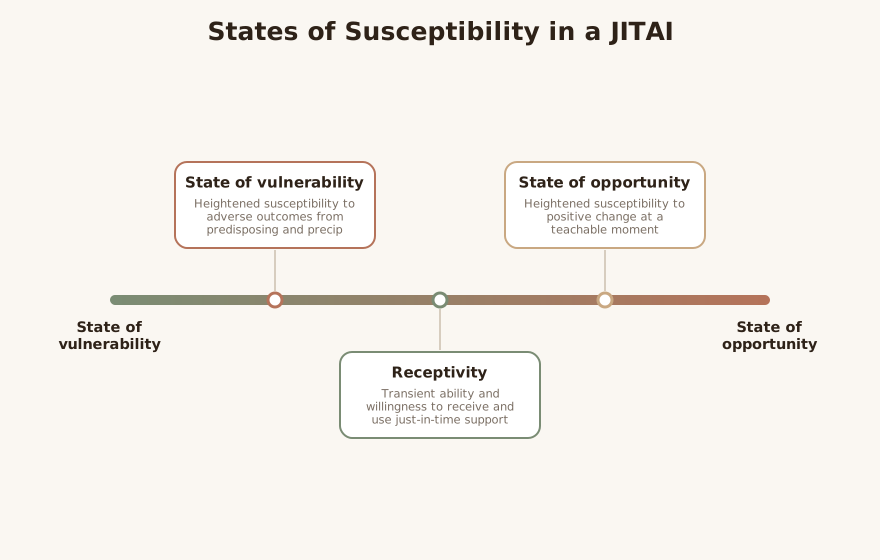
The JITAI rests on two clinical constructs. LLM A state of vulnerability is a period of heightened susceptibility to adverse outcomes, arising from the interaction of stable predisposing factors, such as personality or environment, with transient precipitating influences, such as current mood or immediate context. 1 A state of opportunity is a period of heightened susceptibility to positive change, when an intervention can capitalize on a teachable moment or natural readiness. 1 The aim is to deliver “the right type/amount of support, at the right time, by adapting to an individual’s changing internal and contextual state.” 1
Crucially, timing is gated by receptivity, defined as “the individual’s transient ability and/or willingness to receive, process, and utilize just-in-time support,” itself a function of internal factors like mood and contextual factors like location. 1 A JITAI is built from four formal components: decision points (moments when an intervention decision is made), intervention options (the array of possible actions available at a decision point), tailoring variables (the information used to decide what to offer and when), and decision rules (the logic linking variables to options). 1
PSD organizes its persuasive features into four categories: primary task support, dialogue support, system credibility support, and social support, together comprising 28 principles intended to shape user attitudes and behavior. 34 A foundational premise is that persuasion is approached as a voluntary, non-coercive process of reinforcing or changing behavior, with the design problem broken into analyzing the persuasion context and then selecting appropriate software features. LLM
Interventions & Techniques
In practice, a JITAI continuously evaluates tailoring variables, which may be actively assessed through brief self-report (higher burden) or passively assessed through sensors and usage data (lower burden), and applies decision rules at each decision point to choose an intervention option. 1 A vital and easily overlooked option is the “provide nothing” choice: the system must be able to stay silent when the person is unreceptive, because pushing support at the wrong moment wastes the opportunity and can erode engagement. 1 Newer implementations move beyond static rules toward learning systems; one expandable design uses reinforcement learning with separate models to optimize intervention type and frequency on one hand and delivery timing on the other, adapting “in terms of intervention type, timing, and frequency… in compliance with people’s action plans, changing physical/psychological contexts, as well as their changing preferences over time.” 6
PSD techniques map onto familiar clinical scaffolding. LLM In chronic-disease mobile health, the most frequently implemented features are self-monitoring (primary task support, present in roughly 80% of reviewed studies), reminders (dialogue support, the highest-implemented principle at about 90%, often for medication adherence), and reduction, which simplifies a complex task into easier steps. 4 Other commonly used principles include suggestions, praise, tunneling (guiding the user through a predetermined sequence), rewards, social role, tailoring, and authority. 4
LLM-generated illustrative example (not a guideline): A client in remission from alcohol use disorder carries a phone app that passively detects when they enter a location previously logged as high-risk (a tailoring variable signaling a state of vulnerability). At that decision point, the decision rule offers a brief grounding exercise and a one-tap message to a support contact. On an ordinary evening at home, the same app stays silent (the “provide nothing” option), conserving the client’s attention for moments that matter. LLM
Evidence Base
The honest summary is that these frameworks are conceptually mature but empirically emerging, and clinicians should hold claims of efficacy lightly. LLM The JITAI framework itself was developed to close “a significant disconnect between technological capabilities and evidence-based development practices,” and its authors explicitly call for more sophisticated theory and better understanding of how timely support affects adherence and retention. 1
Several specific findings illustrate where the evidence actually stands. LLM The expandable reinforcement-learning JITAI described in JAMIA was validated only in simulation, with a randomized controlled trial in 280 diabetes patients still pending at publication, and it acknowledged the “cold-start” problem of poor performance when the system encounters states it has not yet learned. 6 The micro-randomized trial methodology used to optimize decision rules is itself still an area of active methodological development. 5 A 2025 review of PSD in chronic-disease mobile health found a “pronounced imbalance,” with heavy use of instrumental features but markedly underused social support (all such principles applied in no more than about 15% of studies) and credibility elements, a gap the authors argue may limit long-term efficacy and engagement. 4 In short, the frameworks tell us how to build and deliver, but rigorous outcome data tying specific design choices to clinical endpoints remain thin. LLM
Populations & Indications
These frameworks have been studied across a broad range of adults using digital health interventions. 4 JITAI applications have targeted prevention and treatment for substance use and conditions such as HIV/AIDS and mental illness, where states of vulnerability can arise rapidly and unpredictably in daily life. 5 PSD-informed mobile health has concentrated on people with chronic illness, with reviewed studies clustering in metabolic disorders such as obesity and diabetes, mental health conditions including depression and anxiety, and cardiovascular disease. 4
Indications are best framed by mechanism rather than diagnosis. LLM A JITAI is well suited to problems where the moment of risk or readiness is fleeting and context-dependent, and where between-session support could plausibly change a proximal behavior. 1 Adolescents and young adults, as heavy users of mobile technology, are a frequently considered population, though the cautions below apply with particular force given engagement and burden concerns. LLM
Problems-for-Work
These frameworks are most useful as adjuncts to ongoing therapy, supporting work on concrete, behaviorally specified problems between sessions. LLM
- Medication adherence and treatment nonadherence: reminders, the most heavily used dialogue-support feature, are commonly deployed to prompt medication-taking at the right moment. 4
- Relapse prevention in substance use disorders: a JITAI can detect a state of vulnerability and deliver brief support at a high-risk moment, an explicit target domain for these interventions. 5
- Physical inactivity and obesity / weight management: passive activity sensing supports timely prompts toward movement, with self-monitoring as the dominant supporting feature. 41
- Smoking cessation and other health-behavior change: decision rules can target craving peaks and contextual cues identified as tailoring variables. 1
- Major depressive disorder and generalized anxiety disorder: mental-health apps in the reviewed literature lean on self-monitoring and reminders, typically carrying cognitive behavioral or behavioral-activation content. 4
LLM-generated illustrative example (not a guideline): A client working on physical inactivity wears an activity tracker that, after detecting two hours of inactivity during a window the client identified as a good time to move (a state of opportunity), delivers a 30-second behavioral-activation prompt tied to a valued activity. The clinician reviews the week’s prompt-response data in session to refine the decision rule collaboratively. LLM
Contraindications, Cautions & Cultural Humility
The central caution is burden. LLM JITAIs introduce a unique adherence challenge: frequent support across many states can overwhelm users, and the “law of attrition” in mobile health shows that people quickly abandon even valued applications, partly from cognitive overload and intervention fatigue. 1 Active self-report tailoring variables add to this load, so design must balance the value of knowing the user’s state against the cost of repeatedly asking. 1 A poorly timed prompt is not neutral; it can be counterproductive, which is why the “provide nothing” option is a clinical safeguard rather than a missing feature. 1
Cultural humility matters because the reviewed evidence skews toward instrumental, individual-focused features and underuses social and credibility principles, meaning many tools may not fit clients whose change is embedded in family or community context. 4 Surface credibility and visual-interface persuasive elements were found to be systematically neglected, which can undermine trust unevenly across populations. 4 Clinicians should treat any commercial app’s decision rules as opaque unless documented, attend to data-privacy and surveillance concerns inherent in passive sensing, and confirm that the content delivered is appropriate for clients in acute risk, for whom an app prompt is never a substitute for direct clinical contact. LLM
Treatment-Plan Suggestions & SMART Objectives
| Goal | SMART objective (example) | Mechanism |
|---|---|---|
| Improve medication adherence | Client will take prescribed medication on schedule on at least 6 of 7 days per week for 4 consecutive weeks, supported by app reminders | Dialogue-support reminders timed to decision points 4 |
| Increase physical activity | Client will respond to at least 3 activity prompts per week and accumulate 90 minutes of moderate activity weekly by week 6 | Passively sensed inactivity as tailoring variable triggering prompts 14 |
| Reduce substance-use relapse risk | Client will use a one-tap grounding or contact option at high-risk moments at least 80% of detected episodes over 8 weeks | Detection of vulnerability states with just-in-time support option 51 |
| Build daily self-monitoring | Client will log mood and one target behavior daily for 5 of 7 days across 4 weeks | Self-monitoring as primary task support 4 |
| Strengthen between-session behavioral activation | Client will complete 2 prompted valued activities per week for 6 weeks | Opportunity-state prompts carrying behavioral-activation content 1 |
| Reduce prompt fatigue / improve fit | Client and clinician will review prompt-response data and revise decision rules at 2 review sessions over 6 weeks | “Provide nothing” option and receptivity-gated timing 1 |
| Support smoking cessation | Client will use a coping strategy at craving peaks on at least 70% of logged cravings for 4 weeks | Tailoring variables capturing craving and context 1 |
Common Misconceptions
“A JITAI is a type of therapy you can deliver.” It is not; it is a delivery and adaptation framework that carries content from established modalities such as cognitive behavioral therapy and behavioral activation. 5LLM
“More prompts mean more help.” The opposite risk dominates: over-prompting drives attrition and fatigue, and the ability to deliver nothing is a core design principle. 1
“Persuasive design means manipulating users.” In the PSD framing, persuasion is treated as a voluntary, non-coercive process of reinforcing or changing behavior, not coercion. LLM
“These tools are evidence-based and ready to substitute for treatment.” Much of the strongest work remains simulation-based or has trials still pending, and outcome evidence linking design features to clinical endpoints is still emerging. 61
Training & Certification
There is no clinical certification in PSD or JITAIs; they are research and design frameworks rather than credentialed therapies. LLM Familiarity is built by reading the primary methodological literature, notably the Nahum-Shani et al. component-and-principles paper for JITAIs and the Oinas-Kukkonen and Harjumaa framework for PSD. 13 Clinicians collaborating on tool development will encounter adjacent methods such as the micro-randomized trial, which is the experimental design used to optimize decision rules and is itself an evolving area. 5
Key Terms
- Decision point: a moment when the intervention decides whether and what to deliver. 1
- Tailoring variable: the internal or contextual information used to drive that decision, assessed actively or passively. 1
- Decision rule: the logic linking tailoring variables to a specific intervention option. 1
- State of vulnerability / state of opportunity: transient periods of heightened risk or heightened readiness for change. 1
- Receptivity: the person’s momentary ability and willingness to receive and use support. 1
- Distal vs. proximal outcomes: the ultimate clinical goal versus the short-term behavior measured soon after a prompt. 1
- PSD categories: primary task support, dialogue support, system credibility support, and social support. 34
Resources & Further Reading
▶ Watch — a video introduction to this concept:
- Nahum-Shani et al. (2018), JITAIs in Mobile Health: Key Components and Design Principles (Annals of Behavioral Medicine)
- Nahum-Shani et al. (2018) JITAIs — PubMed record
- Oinas-Kukkonen & Harjumaa, A Systematic Framework for Designing and Evaluating Persuasive Systems
- Application of persuasive system design in mobile health interventions for chronic disease management: a mini review (Frontiers in Public Health)
- Just-in-Time Adaptive Interventions and Adaptive Interventions (Susan Murphy lab, Harvard)
- An expandable approach for design and personalization of digital, just-in-time adaptive interventions (JAMIA)
Reflective / Supervision Questions
- For a given client, what concrete state of vulnerability or opportunity would a digital tool need to detect, and is that state actually observable without excessive burden? LLM
- When a between-session app is part of care, how do I review its prompts and the client’s responses in session so that the decision rules stay collaborative rather than imposed? LLM
- Am I confident the content a tool delivers matches the modality the client and I are working in, or am I assuming the framework guarantees clinical quality? LLM
- How do I weigh the engagement and privacy costs of passive sensing against the clinical value of timely support for this particular client? LLM
- Given that much of this evidence is emerging, how will I communicate realistic expectations to a client about what an app can and cannot do? LLM