
Type & Discipline
The therapeutic community (TC) is a residential, social-psychiatric treatment modality in which the whole community — staff, residents, and the structure of daily life — functions as the primary instrument of change rather than a single expert clinician 2. It sits within the family of milieu and population-level interventions, and TC practice is explicitly built on milieu-therapy principles, integrating group psychotherapy and practical communal activity into a comprehensive, governed environment 1. The defining phrase, “the community as doctor,” captures the philosophy that the therapeutic environment itself — collective responsibility and full participation in daily community life — drives healing 1.
It is important from the outset to recognize that “therapeutic community” names two related but distinct lineages with different governance philosophies, target populations, and intervention styles 13. Conflating them leads to clinical and referral errors, so this article distinguishes the British democratic TC from the American concept-based (hierarchical) TC throughout 3.
Creators & Lineage
The TC concept grew out of eighteenth- and nineteenth-century moral-treatment reforms in psychiatry associated with figures such as Philippe Pinel and William Tuke, and of post-war experiments in shared responsibility and collective decision-making 1. The term “therapeutic community” was coined by Thomas Main in 1946 1. Maxwell Jones became the movement’s most influential figure, developing at the Henderson Hospital the model that would crystallize as the democratic therapeutic community, and his book The Therapeutic Community: A New Treatment Method in Psychiatry framed the unit itself as a deliberate treatment method 16.
The American lineage diverged into “concept houses” — hierarchically structured residential programs that emerged primarily to treat addiction, often in correctional settings, drawing on transactional analysis, twelve-step practices, and graded responsibility 1. George De Leon is the figure most associated with articulating and operationalizing this addiction-TC model and its central organizing idea of “community as method” 27. The shared intellectual heritage spans social psychiatry, milieu therapy, group analysis, and both democratic and concept-based community models 13.
Core Principles
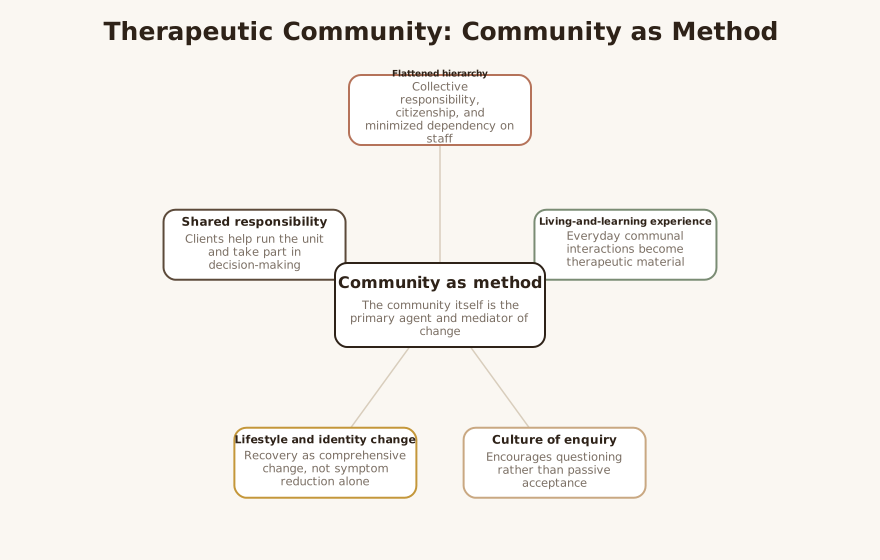
The central principle of the addiction TC is “community as method”: the purposive use of the community to teach individuals to use the community to change themselves, so that the community is simultaneously the context for and the mediator of personal transformation 2. The model views the person through degrees of psychological and social dysfunction — poor impulse control, problems with authority, low frustration tolerance, and social-skill deficits — rather than primarily through pattern of drug use 2. Recovery is framed as comprehensive lifestyle and identity change addressing psychological, social, behavioral, and spiritual dimensions, not symptom reduction alone 2.
The democratic TC organizes itself around a recognizable set of structural features 3:
- Flattened hierarchy emphasizing collective responsibility, citizenship, and empowerment, with residents involved in decision-making and minimized dependency on staff 13.
- The living-and-learning experience, in which everyday communal interactions become therapeutic material rather than incidental to “real” treatment delivered in sessions 13.
- A culture of enquiry that encourages questioning, reflection, and feedback at every level of the community 13.
- Regular community meetings that promote open communication and explicitly work to prevent destructive staff–patient splitting 3.
- Clear boundaries of place, time, and role that contain the intensity of communal living 1.
Both models converge on social learning, peer support, mutual self-help, and the development of prosocial values such as honesty, accountability, and a work ethic 2. LLM
Interventions & Techniques
In the concept-based addiction TC, daily life is highly structured: community meetings, groups, seminars, work assignments, and a hierarchy of job functions through which residents rotate to gain varied roles and learning experiences 27. Peers actively confront negative behavior within an overall supportive frame, and graded responsibility — earning more demanding roles as one progresses — is itself a core intervention 7. De Leon describes four basic stages: admission/evaluation (preprogram), induction (orientation), primary treatment, and reentry into the wider community, with clients advancing as they master each stage’s objectives rather than on a fixed clock 7.
In the democratic TC, the techniques are less behavioral and more group-analytic: the community meeting, peer feedback, shared governance (including resident input on admissions and discharges), and the deliberate analysis of the community’s own dynamics as they arise 13. Contemporary TCs of both kinds increasingly integrate additional evidence-based interventions — cognitive-behavioral therapy, motivational interviewing, relapse prevention, and family services — layered onto, rather than replacing, the core community methodology 2.
LLM-generated illustrative example (not a guideline): A resident who repeatedly arrives late to the morning community meeting is not simply written up by a staff member; the lateness is raised in the meeting itself, peers describe its effect on the group, and the resident is asked to reflect on what authority and accountability evoke for him — turning a logistical lapse into therapeutic material 2. LLM
Evidence Base
The maturity of the evidence base is best described as established, particularly for the addiction TC 2. Research spanning roughly four decades shows a consistent correlation between treatment retention in TCs and positive post-treatment outcomes, and multiple longitudinal follow-up studies tracking thousands of individuals indicate TC programs are cost-effective for severe substance-use cases with comorbid psychological and social problems 2. Clinical trials support both residential and day-treatment TC formats as viable, with day-TC outcomes reported as comparable to residential TC 7. TC practices also align with recognized behavioral mechanisms — peer tutoring, alliance-building, motivational enhancement, behavior modification, and goal-attainment frameworks — giving the model theoretical as well as empirical support 2.
For the democratic TC in personality disorder, a systematic review found a substantial positive effect in controlled studies, and cost-offset research (for example at Henderson Hospital and Francis Dixon Lodge) documented reductions in overall service use within two years of treatment 3. Two honest caveats temper this: much of the retention-outcome literature is observational rather than randomized, so retention may partly index motivation as well as treatment effect; and the heterogeneity of “TC” across sites complicates pooled estimates 23. LLM
Populations & Indications
The addiction TC was developed for, and works most clearly with, individuals who have long histories of substance dependence and antisocial behavior, including those involved with the criminal justice system 7. Modified TC models now serve a much broader range of populations: homeless individuals, people with co-occurring mental illness and substance use (“mentally ill chemical abusers”), adolescents, and incarcerated populations, often with shortened residential stays of three, six, or twelve months and outpatient or day-treatment adaptations 27.
For the democratic TC, the primary NHS indication is severe emotionally unstable (borderline) personality disorder, typically in people with histories of abuse, attachment failure, and heavy, fragmented use of multiple services 3. The 24-hour structured environment with peer support is suited to those whose central difficulty is managing distress and relationships constructively 3. Other populations served include offenders (with HMP Grendon cited as demonstrating effectiveness), children with severe behavioral problems, and — in modified form — some patients with psychosis 3.
Problems-for-Work
TCs are organized around interpersonal and lifestyle problems more than discrete symptoms 2. Typical problems-for-work, with brief application:
- Substance use disorders and relapse prevention — the community structure rebuilds daily routine, accountability, and a drug-free peer network that supports sustained abstinence 27.
- Antisocial behavior and problems with authority — graded responsibility and peer confrontation give repeated, real-time practice in tolerating limits and exercising authority prosocially 27.
- Emotional dysregulation and self-destructive behavior — for personality disorder, the containing 24-hour milieu plus peer feedback offers in-vivo practice in managing distress without self-harm or service escalation 3.
- Interpersonal dysfunction — communal living surfaces the resident’s relational patterns where they can be observed and addressed, rather than only described in a weekly session 13.
- Social and occupational impairment — work assignments and rotating roles rebuild functional skills and a work ethic as explicit treatment targets 2.
Contraindications, Cautions & Cultural Humility
Admission to a democratic TC requires meaningful consent, secured through thorough assessment, written information, and sometimes pre-admission trial attendance; residents need the eventual capacity to engage in dialogue and tolerate therapeutic intensity 3. The intensity is genuinely risky for some: suicide clusters have been observed in TC populations, requiring careful monitoring; some patients deteriorate in institutional settings through “malignant regression”; institutional dynamics can become powerfully destructive; and endings can be particularly problematic, indeed often catastrophic, demanding deliberate planning 3.
A specific caution concerns the confrontational, hierarchical concept-based model: SAMHSA guidance states that TC approaches should be modified for women, adolescents, and people with co-occurring mental disorders, because the confrontational structure can be ineffective or harmful for these groups 7. Clinically, this is also a cultural-humility issue — peer confrontation, hierarchy, and demands for public self-disclosure land differently across gender, trauma history, culture, and neurodevelopmental profile, and a model designed largely on and for men with antisocial features should not be applied uncritically 7. LLM
Treatment-Plan Suggestions & SMART Objectives
| Goal | SMART objective (example) | Mechanism |
|---|---|---|
| Sustain abstinence | Remain substance-free with verified screens for 90 consecutive days while completing each program phase | Drug-free peer milieu, daily structure, graded reentry 27 |
| Improve accountability | Hold an assigned community work role for 4 weeks with documented peer feedback reviewed weekly | Graded responsibility, rotating job functions 27 |
| Reduce self-harm (PD) | Decrease self-harm episodes from baseline to zero over 8 weeks, using community meeting to process urges | Containing milieu, peer feedback, culture of enquiry 3 |
| Build prosocial values | Demonstrate 3 documented instances/week of honesty or repair in community life over 6 weeks | Social learning, mutual self-help 2 |
| Strengthen distress tolerance | Use a non-harmful coping plan in 8 of 10 logged distress episodes over 6 weeks | Living-and-learning experience, in-vivo practice 13 |
| Improve authority relationships | Resolve 2 staff/peer conflicts via the community meeting rather than rule-breaking within one phase | Flattened hierarchy, anti-splitting structure 13 |
| Plan a stable reentry | Complete reentry-phase housing, work, and aftercare plan before discharge | Stage-based progression, relapse prevention 7 |
Common Misconceptions
- “It’s just supportive group living.” The community is a deliberate clinical method — community as method — not incidental cohabitation; daily life is engineered as the change agent 2. LLM
- “All TCs are confrontational.” Confrontation characterizes the American concept-based addiction model; the British democratic TC is group-analytic and collaborative, and even concept-based confrontation is meant to sit inside a supportive frame 137.
- “It’s a low-intensity, low-risk setting.” The opposite can be true: intensity can precipitate regression, suicide clustering, and catastrophic endings, requiring active risk management 3.
- “Retention proves it works.” Retention correlates strongly with outcome but is largely observational, so it partly reflects who stays as well as what staying does 2. LLM
- “It’s an outdated 1950s relic.” Modified TCs are in active use across prisons, hospitals, and community residences for diverse contemporary populations 27.
Training & Certification
Because the TC is a whole-program model, quality is assured at the program level rather than solely through individual practitioner certification 5. In the UK, the Royal College of Psychiatrists operates the Community of Communities quality network within its College Centre for Quality Improvement, providing standards-based peer review and accreditation for therapeutic communities 5. Clinicians entering TC work are typically trained on the job within the community’s own learning culture, supplemented by the recognized modalities (group, individual, motivational, and CBT-based work) that staff deliver inside the milieu 25. LLM
Key Terms
- Community as method — the purposive use of the whole community to teach individuals to use the community to change themselves 2.
- The community as doctor — the philosophy that the environment, not an individual expert, is the agent of healing 1.
- Living-and-learning experience — everyday communal interactions treated as therapeutic material 13.
- Culture of enquiry — a norm of questioning, reflection, and feedback at all levels 13.
- Democratic TC — flattened-hierarchy, group-analytic model, primarily for personality disorder 13.
- Concept-based (hierarchical) TC — structured, graded-responsibility model, primarily for addiction 17.
- Malignant regression — clinical deterioration some patients undergo within intensive institutional settings 3.
Resources & Further Reading
▶ Watch — a video introduction to this concept:
- Therapeutic community — Wikipedia
- De Leon & Unterrainer — The Therapeutic Community (PMC7424041)
- Pearce & Haigh — Therapeutic communities (Advances in Psychiatric Treatment)
- NIDA Research Report Series — Therapeutic Communities
- Community of Communities Process Document — Royal College of Psychiatrists
- Maxwell Jones — The Therapeutic Community (book review)
- SAMHSA/CSAT TIP Chapter 8 — Intensive Outpatient Treatment Approaches
Reflective / Supervision Questions
- For a given referral, am I clear whether the democratic or concept-based model is indicated, and does the program’s actual style match what this client can tolerate? LLM
- How do I distinguish productive peer confrontation from re-traumatizing pressure, especially for women, adolescents, and clients with co-occurring disorders? 7 LLM
- What is my plan for the ending? Given that TC endings can be catastrophic, how am I preparing this client and the community weeks in advance? 3 LLM
- Am I monitoring for regression and contagion of risk (including suicide clustering) at the community level, not just the individual level? 3 LLM
- When I cite “retention predicts outcome” to a client or referrer, am I being honest that this is largely correlational? 2 LLM
- How does the community’s culture of enquiry apply to the staff team itself — are we examining our own splitting and dynamics? 13 LLM